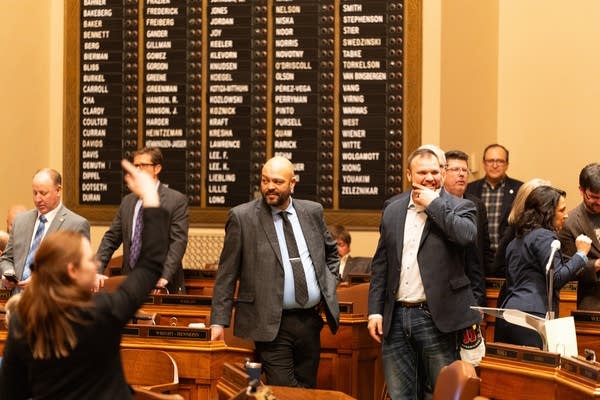
The president previewed the logic earlier this week in five words that deserve to be remembered: “We’re fighting wars. We can’t take care of day care.”
That sentence is not a gaffe. It is a confession. It describes, with unintended precision, a structural trap that consumes nations from the inside: militarized security generates the conditions that demand more militarized security, while systematically defunding the systems that would make societies actually safe.
Call it the Iron Law of Misplaced Defense. It works like this. Resources flow toward what is already protected — military budgets expand while public health, ecological restoration, and civic infrastructure struggle. What is protected gains political influence — defense contractors, fossil fuel interests, and concentrated wealth shape policy to preserve their position. Influence reinforces protection — lobbying ensures outdated priorities continue to receive disproportionate resources. And real vulnerabilities deepen, genuine risks go unaddressed until crisis forces a reactive, catastrophically expensive response.
The president said it plainly: We’re fighting wars. We can’t take care of day care. He meant it as a justification. It is, in fact, a diagnosis.
This is not conspiracy. It is structural inertia, the gravitational pull of legacy systems, legacy thinking, and legacy power. And the FY2027 budget is the most naked expression of that inertia in modern American history.
The arithmetic of the Trap
Consider what is being traded. The $500 billion annual increase in Pentagon spending would be enough, on its own, to make meaningful progress on nearly every domestic crisis the country faces. Instead, the budget eliminates the $4 billion Low Income Home Energy Assistance Program that keeps vulnerable Americans warm in winter and cool in summer. It cancels $15.2 billion in renewable energy infrastructure investments. It slashes the National Institutes of Health by $18 billion and the CDC by $3.6 billion — in a world where the last pandemic cost tens of trillions and the next one is a matter of when, not if. It cuts the Environmental Protection Agency by 52%, the National Science Foundation by 55%, the Small Business Administration by 67%. It eliminates environmental justice programs, community development block grants, and climate research — the very infrastructure of prevention.

When essential systems are built around extractive chokepoints, conflict travels outward as inflation, scarcity, and instability.
Meanwhile, $175 billion goes to “Golden Dome,” a hemispheric missile defense shield. Sixty-six billion goes to new warships — “Trump’s Golden Fleet.” And a separate $200 billion emergency request is pending to fund the ongoing war with Iran, a sum that, on its own, dwarfs the entire budget of the Department of Health and Human Services.
This is the trap in its purest form: a government that can find $1.5 trillion for weapons systems but declares itself unable to afford day care. A nation that builds missile shields while dismantling the health, education, and ecological systems that determine whether its citizens can live with dignity.
The Trap Abroad
The war with Iran, now in its fifth week, is both the justification for this budget and its most damning indictment.
The conflict has effectively closed the Strait of Hormuz, through which 20% of the world’s oil supply flows. Gas prices have surged 30%. Diesel costs have spiked, rippling into grocery prices, freight costs, and fertilizer markets — up to 50% for urea, a critical input for food production worldwide. The International Energy Agency has called it the largest supply disruption in the history of the global oil market. Oxford Economics warns that a prolonged conflict could tip the world economy into recession, with global growth falling to 1.4% and inflation hitting 7.7%. Nations across Southeast Asia are rationing fuel. European gas storage is at historic lows. Food insecurity is rising from Brazil to the Gulf states.
Iranian strikes have hit commercial data centers in the UAE — the first military targeting of cloud infrastructure in history — exposing the fragility of concentrating the digital economy’s backbone in one of the world’s most volatile regions. The war has spread to involve Houthi attacks in the Red Sea, disruption across Central Asian trade routes, and over $16 billion in emergency arms sales to Jordan, Kuwait, and the UAE, approved without the normal congressional review.
This is what overinvestment in militarized security produces: not stability, but cascading fragility. The very infrastructure of globalized extraction — chokepoint-dependent energy systems, concentrated supply chains, fossil-fuel-powered economies — becomes the vector through which military conflict transmits economic pain to billions of people who had no say in starting it.
The Trap at Home
And then there is Minneapolis.
In January, the Department of Homeland Security deployed 2,000 federal agents to the Twin Cities in what it called the largest immigration enforcement operation in American history. Operation Metro Surge resulted in over 3,000 arrests, the detention of U.S. citizens, raids on homeless encampments, and the fatal shooting of two American civilians: Renée Good, a 37-year-old mother of three, and Alex Pretti, a 37-year-old ICU nurse killed while filming a protest. The UN has warned that the shootings may constitute extrajudicial killings. A federal judge found ICE violated at least 96 court orders in Minnesota in January alone. The operation cost Minneapolis over $200 million in a single month, shuttered schools, disrupted businesses, and prompted over 60 Minnesota-based CEOs to call for immediate de-escalation.
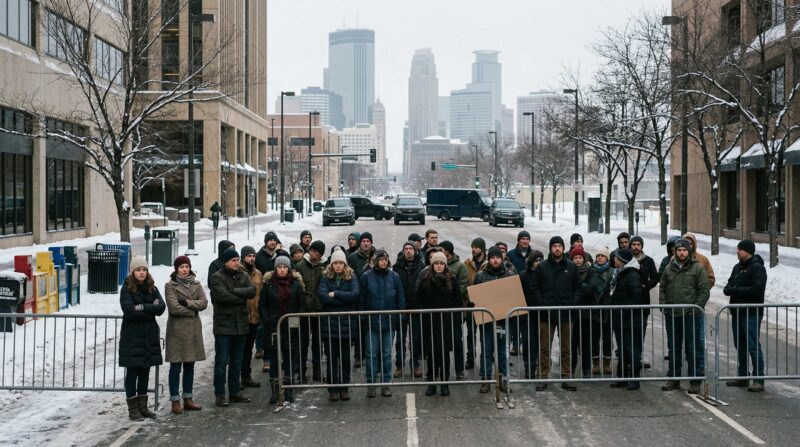
When enforcement becomes the default language of governance, the damage radiates beyond those targeted and into the civic life of the whole city.
This is the Iron Law operating domestically — the same structural logic, turned inward. Resources flow to enforcement. Enforcement generates resistance and disruption. Disruption is cited to justify more enforcement. The communities that bear the cost — immigrant neighborhoods, but also the broader civic fabric of a major American city — are precisely the communities whose stability constitutes actual security. And the systems that would address root causes — mental health services, economic opportunity, community development, education — are the ones being cut in the same budget that funds the agents.
The Counter-Budget Nobody Wrote
The war itself is making the case for the alternative, if anyone is willing to read the evidence.
Global fertilizer prices are up 50% because a third of the world’s urea transits the Strait of Hormuz. But farmers operating regenerative systems — building soil fertility through cover cropping, composting, and integrated nutrient cycling — are not checking Hormuz shipping reports this week. Their inputs are local, biological, and free from petrochemical dependency. The $15.2 billion in renewable energy investments this budget cancels would have accelerated precisely the distributed infrastructure that cannot be blockaded, cannot be bombed, and cannot be held hostage by a 39-kilometer strait on the other side of the world. Communities with solar cooperatives and local wind grids are experiencing this energy crisis differently than those still tethered to global petroleum markets — and the budget just defunded the transition that would extend that resilience to everyone else.
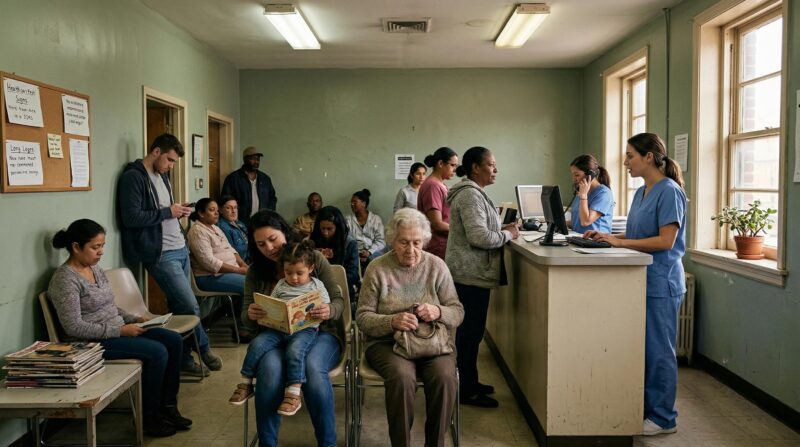
Real security is often quiet and local — the clinic, program, or public service that prevents crisis before it cascades.
Iranian drone strikes hit commercial data centers in the UAE, the first military targeting of cloud infrastructure in history. The lesson is not that we need a bigger missile shield over server farms. It is that concentrating critical digital infrastructure in a geopolitical flashpoint was a design failure — one that distributed, community-governed systems would not have made.
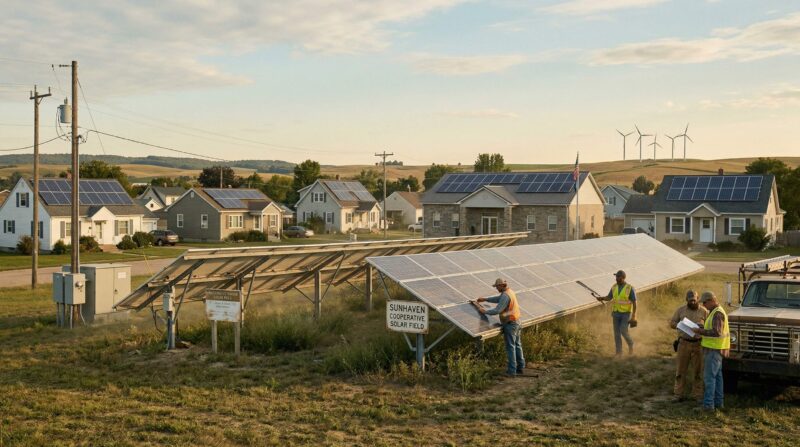
Distributed energy does more than decarbonize — it reduces the power of distant shocks to dictate local survival.
Now run the counter-budget. The $18 billion in NIH cuts could have funded the pandemic preparedness infrastructure that the WHO estimates returns $5–$10 for every dollar invested, in a world where the last pandemic cost the global economy tens of trillions. The $4 billion LIHEAP cut, the program that keeps low-income Americans from freezing, is roughly what a single day of the Iran conflict costs the Pentagon. The $3.6 billion slashed from the CDC would fund community health worker networks across every underserved county in America. The cancelled community development block grants and environmental justice programs are the connective tissue of civic life in the communities most vulnerable to the economic shocks this war is now producing.
In every case, the pattern holds: what is being cut is what actually works. Conflict prevention returns $16 for every dollar invested, according to UN analyses. Ecosystem restoration prevents disaster damage at a fraction of the cost of emergency response. Community health infrastructure catches problems before they cascade. These are not aspirational values, they are operational systems with proven returns. And they are being dismantled to fund a Pentagon that has not passed an audit in eight years.
Breaking the Cycle
The $1.5 trillion budget is not inevitable. It is a choice — and it is the wrong one.
In every case, the pattern holds: what is being cut is what actually works.
The trap works because it is self-reinforcing. But self-reinforcing cycles can also be broken. Every dollar redirected from reactive defense toward preventive infrastructure weakens the loop. Every enterprise that builds genuine resilience rather than profiting from fragility shifts the balance. Every investor who directs capital toward the systems that actually keep communities safe, rather than the ones that merely perform security, is building the exit ramp.
The president said it plainly: We’re fighting wars. We can’t take care of day care. He meant it as a justification. It is, in fact, a diagnosis — of a nation caught in a trap of its own making, spending its future on yesterday’s paradigm while the foundations of genuine security erode beneath its feet.
The question is not whether we can afford to invest in the systems that actually protect us. It is whether we can afford not to — and for how much longer we will pretend that the fortress is keeping us safe while everything it was meant to protect crumbles inside its walls.
—
Laurie Lane-Zucker is Founder and CEO of Impact Entrepreneur, PBC. His forthcoming book, The Impact Entrepreneur Breakthrough: A Field Manual for the Regenerative Economy (Berrett-Koehler Publishers, September 2026), examines the structural misallocation of defense and the architecture of genuine security.