
A shift appears to be underway in how the federal government does immigration enforcement – away from the high-profile show of force seen during the Immigration and Customs Enforcement operation in Minnesota and toward a less visible approach, relying more on local police.
"Partnership is vitally important," Markwayne Mullin, the new secretary for the Department of Homeland Security, told Congress at his confirmation hearing last month. "I would love to see ICE become a transport more than the front line. If we can get back into just simply working with law enforcement, we're going to them, we're picking up these criminals from their jail."
In a statement to NPR this week, a DHS spokesperson echoed Mullin's line of thinking: "ICE has supercharged efforts with state and local law enforcement to assist federal immigration officers in our efforts to make America safe again."
Here's what to know about how that shift is taking place – and what it might look like in communities around the country.
Why is this shift happening?
The enforcement operation in Minnesota was aggressive and highly visible: federal immigration officers slammed protesters to the ground, deployed tear gas in neighborhoods and outside schools, dragged people from their cars, and ultimately killed two U.S. citizens.
These tactics were also very politically unpopular. In February, an NPR/PBS News/Marist poll found that two thirds of Americans said ICE had gone too far.
How do ICE officers work with local and state police?
Mullin's comments point to increased emphasis on the federal 287(g) program, which allows state and local law enforcement officers to take on some of the duties of ICE officers.
Though the program has existed for decades, the number of police and sheriff's departments signing up for the program during President Donald Trump's second term has grown exponentially. During his first term in 2019, there were only 45 agreements. In 2025 alone, there were more than 1,100 agreements, a previous NPR analysis showed. Now, there are more than 1,600 agreements across 39 states, according to ICE.
About a third of the entire U.S. population now lives in a county where a local law enforcement agency has signed a 287(g) agreement, according to an ACLU report released in February.
The most intensive version of the program, called the Task Force Model, deputizes local police to enforce immigration law, including arresting people on ICE's behalf during regular law enforcement work, like traffic stops. On its website, ICE refers to this model as a "force multiplier."
That model, discontinued during the Obama administration, was revived when Trump took office again, and now makes up the majority of 287(g) agreements. More than 13,000 police officers around the country are taking part in that model, according to an analysis released earlier this year from FWD.us, an organization that advocates for immigration and criminal justice reform.
How does it affect communities when local police work with ICE?
It's not uncommon for U.S. law enforcement to work with federal immigration authorities, even without a signed agreement. What has changed in recent years are mandates in states like Florida and Texas, where state officials required some or all law enforcement agencies to join a 287(g) program. In those two states alone, the ACLU report estimates that more than 40 million people live in a place where their local law enforcement signed one of these agreements.
Florida has among the most 287(g) agreements in the nation, along with Texas, according to the latest ICE data.
Coinciding with new enthusiasm from ICE for local partners, Gov. Ron DeSantis' administration ramped up pressure on all Florida law enforcement agencies to sign up, despite only sheriffs being required. There were carrots in the form of bonuses for officers that received 287(g) training, and sticks in the form of threats to remove elected officials from office who didn't sign on.
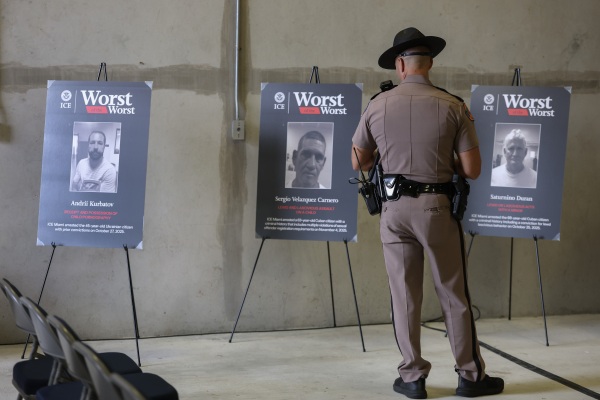
The campaign was successful. Agencies from the Florida Highway Patrol, to the Florida Fish and Wildlife Conservation Commission, to university campus police departments have all signed up to work with ICE.
On the ground, the seemingly ubiquitous partnerships have created a sea change in local policing.
At least 1,800 state troopers on Florida highways are trained to enforce immigration law alongside their regular police duties. That has created situations where traffic stops for minor offenses — like tinted windows or failing to use a turn signal — turn into inquiries into a person's immigration status, an occurrence happening in Texas as well.
Arrests have risen sharply, with the Florida State Board of Immigration Enforcement reporting at least 10,000 immigration arrests by local agencies alone, not ICE, since last August. The majority of those arrests are made by Florida Highway Patrol troopers.
One county particularly affected is Palm Beach County and the majority-Hispanic city of Lake Worth Beach, where advocates with the Guatemalan-Maya Center have said Florida state troopers are profiling residents.
" They've been the most aggressive in our cities," Mariana Blanco, director of operations for the center, said at an event earlier this year. "They're the ones that are targeting, racially profiling our people."
Additionally, when local police work with ICE, it makes it harder for the community to be aware of immigration enforcement happening near them, says Kristin Etter, director of policy and legal services at the Texas Immigration Law Council.
She says that's been the case in Texas for years, where local police cooperation with federal authorities represents a much quieter approach than the tactics seen in Minnesota – where observers would track ICE and use whistles to alert neighbors to their presence.
"Your whistle doesn't work in Texas. You're not going to need a whistle in Texas because you're never going to have that Minneapolis moment. They're going to try to keep this hidden as much as possible," Etter says.
The fear, she says, is this more hidden form of enforcement will ramp up elsewhere in the country.
How do state and local police feel about working with ICE?
Some agencies that sign up for 287(g) agreements have been offered incentives from the federal government, including reimbursements for salaries, benefits and overtime pay for each officer trained for the Task Force Model, as well as thousands of dollars for new equipment and vehicles.
But beyond the monetary benefits, some sheriffs are also staunch ideological supporters of the Trump administration's immigration approach.
"They came here to the United States illegally. A crime was committed every minute, every day and every year that that person is still here, they're still committing the crime. They did not come here the right way," Sheriff Billy Woods, of Marion County, Fla., said of undocumented immigrants.
Some police leaders across the country have expressed concerns that cooperating with federal immigration authorities erodes community trust – and could make undocumented immigrants and others afraid to call 911 when they are victims of a crime or to participate as witnesses in criminal investigations. Some states, like Maryland, have banned 287(g) agreements.
In Florida, the large number of people arrested by local police has also made some of DeSantis' most fervent supporters uncomfortable.
"There are those here that are working hard. They have their kids in college or in school. They're going to church on Sunday. They're not violating the law. They are living the American dream," Sheriff Grady Judd, of Polk County, Fla., said at a state immigration board meeting last month.
Judd stressed that he still felt strongly about detaining those who have committed crimes, but said "maybe there needs to be a path" for immigrants who are law-abiding and add to society, though it's unclear what the sheriff meant specifically.
It's also unclear if the recent pushback in Florida from several conservative sheriffs will change how immigration enforcement is conducted in the state. So far, immigrant advocates say not much has changed.
Copyright 2026, NPR