
Outcome-based software development is a delivery model where the client pays for a defined business result, not open-ended hours. The result is scoped before build begins, measured with explicit acceptance criteria, and delivered through milestone-based execution. For CTOs and founders, the value is simple: clearer accountability, tighter scope control, and better alignment between spend and business progress.
Why Teams Are Rethinking Hourly Billing
The case against hourly delivery is not philosophical. It is operational. Long-standing research on technology projects shows how quickly misalignment can become financial risk. McKinsey found that large IT projects run 45% over budget, 7% over time, and deliver 56% less value than predicted.Research published by Harvard Business Review and Oxford found average cost overruns of 27% across IT projects and a much more dangerous fat tail: one in six became black swans, with average cost overruns of 200% and schedule overruns of almost 70%.[2] PMI has also reported that inaccurate requirements gathering remained a primary cause of project failure.[3]
Those numbers explain why many founders and CTOs no longer trust vague statements like “we’ll move fast” or “we’ll stay agile.” They want to know what they are buying, what done looks like, what evidence proves delivery, and what happens when reality changes.
That is where outcome-based software development becomes useful. It does not eliminate uncertainty. It replaces hidden ambiguity with explicit structure.
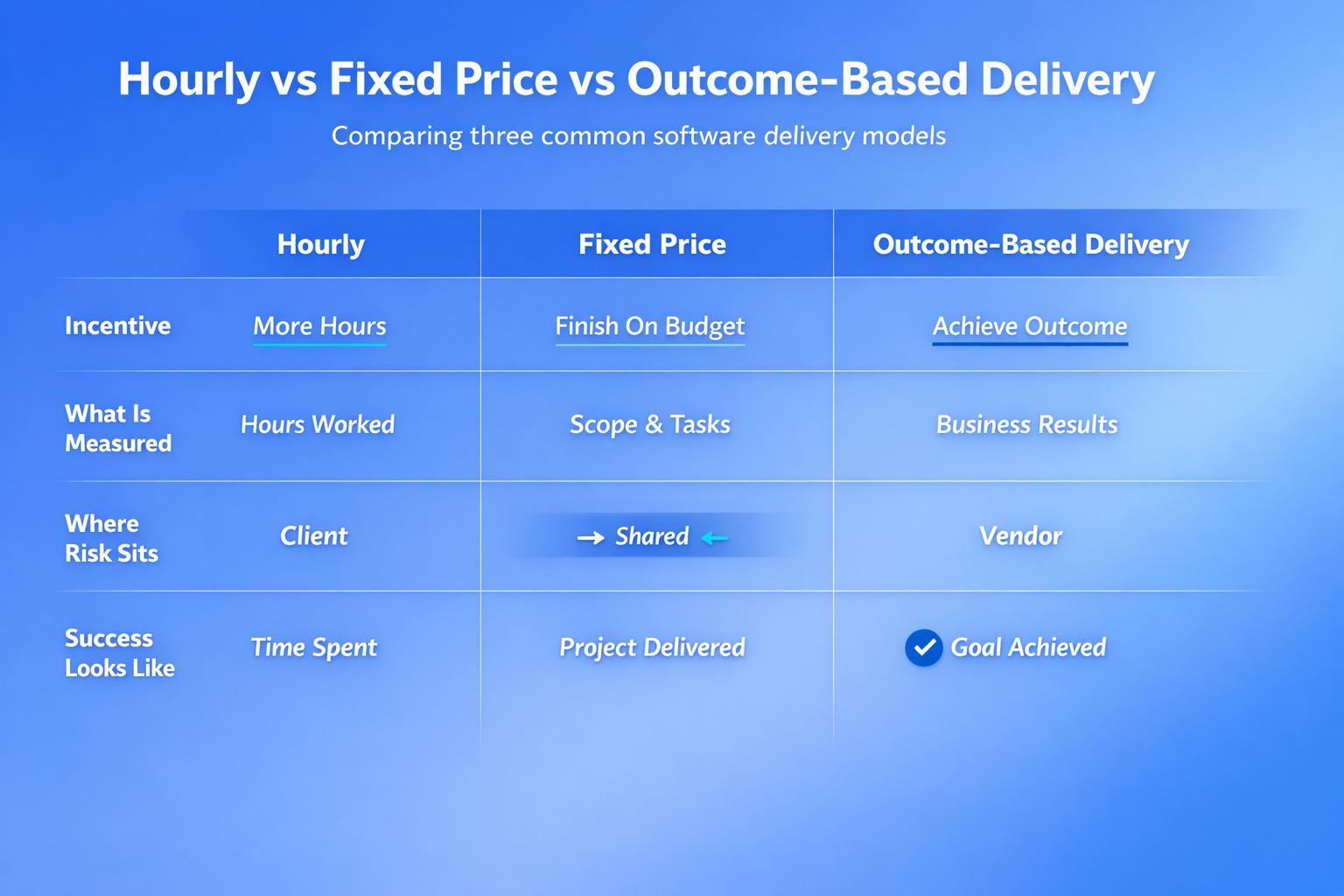
It also helps to separate three delivery models that often get blurred together:
| Model | Paid for | What success looks like | Common risk |
| Hourly / time-and-materials | Effort and capacity | Team stays active and responsive | Accountability stays diffuse; cost grows with time |
| Fixed price | Predefined scope | Scope is completed within budget | Weak assumptions turn change control into conflict |
| Outcome-based | Defined business result | Result is delivered with proof and checkpoints | Fails if the outcome is vague or governance is weak |
For technical buyers, that distinction matters. You are not buying developer time. You are buying progress toward a measurable business objective.

What Outcome-Based Software Development Actually Means
A good outcome is not a feature list. It is a business result with a technical boundary around it.
For example, build an AI assistant is not an outcome. Launch a customer support AI assistant for a defined use case, with approval flows, role-based access, audit logging, and production monitoring is much closer. In the same way, modernize our legacy product is too broad. Rebuild one revenue-critical workflow without disrupting production operations and with agreed release-readiness criteria is deliverable.
In practice, every credible outcome should answer four questions:
- What business result are we trying to create?
- Which user journey, workflow, or system boundary is included?
- How will we verify that the work is complete?
- What cadence of checkpoints will keep risk visible while the work is underway?
This is the part many vendors skip. They jump from problem statement to sprint planning without building a real definition of success. That shortcut feels fast in week one and expensive by week six.
At Ailoitte, the cleanest way to think about this is as an outcome stack.
Book a scoping call to define your outcome in the first 30 minutes.
The Ailoitte Outcome Definition Stack
Layer 1: Business result
Start with the business objective, not the feature backlog. Do you need a beta-ready MVP for fundraising? Faster onboarding completion? A lower operational workload? A production-safe AI workflow in a regulated environment? The commercial reason for the project shapes every delivery decision that follows.
Layer 2: Delivery boundary
Once the result is clear, define the scope boundary. Which workflow is included? Which integrations matter? Which assumptions are being made? Which dependencies are client-owned and which are pod-owned? Scope becomes safer when it is explicit enough to exclude things as well as include them.
Layer 3: Acceptance proof
This is where outcome-based software development becomes measurable. Acceptance proof can include release readiness, completion of a defined user flow, passed QA criteria, performance thresholds, security checks, stakeholder sign-off, and production deployment requirements. If the team cannot show proof, the outcome is not yet delivered.
Layer 4: Operating rhythm
The final layer is cadence. Delivery is broken into milestone checkpoints with demos, scorecards, and review moments. This prevents the common agency pattern where a team goes quiet for weeks and returns with a surprise.
This framework matters because it gives both sides something better than optimism. It creates a shared operating contract.

How AI Velocity Pods Execute Outcome-Based Delivery
A delivery model only works when the operating system behind it is mature. That is why outcome-based software development is not just a pricing decision. It is an execution decision.
Ailoitte’s AI Velocity Pods are designed as small, senior-led units that scope, build, validate, and ship toward a defined result. The model is explained at a high level on the AI Velocity Pods page and in more operational detail through The Engine Room, which outlines how governed workflows, senior ownership, and automated QA fit together.
From first call to scoped outcome
The first conversation should not sound like a staffing discussion. It should sound like a delivery definition exercise. The business objective comes first. The desired user or workflow comes second. Then come constraints: timeline, dependencies, technical risk, compliance needs, and release expectations.
Documentation before code
Before anyone writes production code, the scope needs working artifacts. That usually includes a scoping brief, milestone map, architecture notes, assumptions and exclusions, acceptance criteria, demo plan, risk log, and release checklist. These documents are not bureaucracy. They are what make the model auditable. They reduce future arguments because they turn unspoken expectations into visible decisions.
Milestone checkpoints instead of status theatre
A strong outcome model is milestone-led. A typical engagement may move through four checkpoints: scope confirmation, core workflow build, QA and hardening, and release readiness with handoff. Each checkpoint should answer the same question: what did we agree would be true by this point, and is it now true?
Human-led governance, AI-accelerated execution
The fastest way to break trust is to confuse speed with a lack of control. AI can compress execution time, but it does not remove the need for architecture judgment, security review, release discipline, or quality assurance.
This is also where adjacent Ailoitte pages become useful for context. Early-stage teams can map to Startup MVP Velocity. Modernization programs can map to Legacy AI Modernization. Release confidence becomes stronger when validation is continuous through the Agentic QA Pipeline. And for sensitive workflows, Security & Compliance shows how zero-retention handling, OWASP-minded engineering, and controlled delivery fit into the pod model.
If a reader needs the category framing first, Ailoitte’s explainer on what an AI Velocity Pod is can work as a supporting internal link from the introduction or conclusion.

When Outcome-Based Delivery Works Best
This model is not ideal for every situation. It works best when the buyer can define a meaningful result, assign decision-makers, and stay disciplined about boundaries.
It is especially effective in four scenarios.
1. MVPs where speed matters more than feature breadth
Founders rarely need everything. They need enough product to validate, demo, learn, and unlock the next decision. Outcome-based delivery works well here because it keeps the team focused on launch readiness instead of endless backlog expansion.
2. Legacy modernization where risk must be contained
A broad modernization mandate can sprawl for months. A better pattern is to define one critical workflow, one business risk, or one release objective at a time. That is why this model maps well to legacy modernization work.
3. AI product features where governance matters
Many companies want to ship an AI feature quickly, but the real problem is not model access. It is scope discipline, guardrails, feedback loops, and production readiness. Outcome-based delivery forces those concerns into the definition of done.
4. Regulated or operations-heavy environments
Where compliance, auditability, or workflow continuity matters, vague delivery models become dangerous. This is why a healthcare workflow such as Clinical AI Documentation, or a retail workflow such as Autonomous Commerce, benefits from a more explicit approach to scope, proof, and validation.
Explore how we scope MVPs, modernization, and AI builds around defined outcomes.
What Good Looks Like in Practice
A model becomes real when buyers can see outcome patterns, not just theory.
Ailoitte’s case-study hub highlights several examples that fit this structure. In fintech modernization, the site describes an AI-augmented pod engagement that moved an MVP timeline from 12 weeks to 5 while cutting cost by 40%. In healthcare, the company describes a Voice-to-EMR bridge for a regional hospital network that delivered 99.2% medical accuracy and reclaimed more than 12 hours per clinician per week.In logistics hiring, Ailoitte describes a multilingual WhatsApp AI recruiter that reduced time-to-hire from 14 days to 48 hours with an 85% automation rate.
The point is not that every project should promise those exact numbers. The point is that outcome-based delivery works best when the result is framed in business language that can be measured after launch: weeks to MVP, hours reclaimed, time-to-hire reduced, release confidence improved, or operational cost lowered.
| Readiness question | Why it matters |
| Can we name one business result in a single sentence? | If the outcome is fuzzy, the project will drift into activity without proof. |
| Is one workflow or user journey clearly in scope? | Boundaries reduce the risk of silent scope expansion. |
| Do we have a decision-maker who can unblock trade-offs quickly? | Outcome-based delivery slows down when approvals are fragmented. |
| Can we define acceptance criteria before build starts? | Proof must exist before execution, not after spend is committed. |
| Are key dependencies and integrations known? | Known dependencies make milestone planning realistic. |
| Are security, privacy, or compliance constraints visible early? | Hidden constraints create late-stage surprises and release risk. |
| Can the team review progress at fixed checkpoints? | Milestones only work when stakeholders actually inspect and decide. |
| Are both sides willing to rescope openly if the outcome changes? | Transparent change handling protects trust and budget discipline. |
Where This Model Usually Fails
- It fails when the buyer wants unlimited flexibility with fixed accountability.
- It fails when stakeholders do not agree on the business objective.
- It fails when the delivery partner has weak scoping discipline and hides behind process language.
- It fails when acceptance proof is vague.
- It fails when change control is treated as politics instead of operations.
- In other words, outcome-based software development is not easier than hourly billing. It is stricter. That is exactly why it can produce better alignment when both sides are serious.
Final Thoughts
For founders and CTOs, the appeal of outcome-based software development is not just commercial. It is managerial. It gives you a better way to buy software delivery: define the result, bound the work, agree the proof, and review progress at visible checkpoints.
That is the core logic behind AI Velocity Pods. A small senior-led team, clear milestones, continuous QA, human-led governance, and explicit rules for scope and proof create a delivery model that is easier to inspect and harder to hide inside.
If your current agency model rewards motion more than completion, that is the real problem to solve.
The first useful question is not how many developers do we need? It is what is the outcome we need next?
Book a velocity call and leave with a clearer definition of success, scope, and delivery risk.
FAQs
What is outcome-based software development?
Outcome-based software development is a delivery model where the engagement is scoped and priced around a measurable result instead of open-ended engineering hours. The result is defined before execution begins and validated through agreed acceptance criteria such as launch readiness, workflow completion, quality thresholds, and stakeholder sign-off. The goal is tighter accountability between commercial spend and real business progress.
How is outcome-based software development different from fixed-price delivery?
Fixed-price delivery usually focuses on a predefined scope and budget. Outcome-based software development goes further by anchoring the work to a business result, explicit proof of completion, and milestone-led execution. A fixed-price project can still be vague about success, while an outcome-based model requires the team to define what will be true when the engagement is complete and how that will be verified.
When is outcome-based delivery a good fit?
It is a good fit when the buyer can define a meaningful result, assign fast decision-makers, and stay disciplined about scope boundaries. It works particularly well for MVP launches, legacy modernization, AI feature rollouts, and regulated workflows where proof, security, and operational continuity matter. If the desired result is still fuzzy, a discovery phase is often needed before outcome-based execution begins.
What should be included in the outcome definition?
A strong outcome definition should include the business objective, the workflow or system boundary being addressed, the timeline, key dependencies, measurable acceptance criteria, and the operating cadence used to review progress. It should also state assumptions and exclusions clearly. If the definition cannot explain what is in scope, what proof is required, and what could change the plan, it is not ready.
What happens if scope changes during the project?
If the desired result changes, the delivery plan should change too. That usually means structured rescoping: reviewing the new requirement, assessing impact on timeline and complexity, and deciding whether to protect the original outcome or redefine it. Outcome-based delivery is not about freezing reality. It is about making change visible early so it can be handled deliberately instead of becoming hidden overrun.
How do AI Velocity Pods support this model?
AI Velocity Pods support the model by combining senior technical ownership, milestone-based delivery, AI-accelerated execution, and continuous QA. The structure is designed to reduce ambiguity between business intent and technical implementation. Instead of scaling with large teams and loosely tracked hours, the pod model focuses on shipping a defined result with visible checkpoints, governed workflows, and clearer accountability for release readiness.
How do you measure whether the outcome was achieved?
Measurement depends on the type of project, but common proof includes a production-ready release, completion of agreed user journeys, passed QA criteria, performance benchmarks, security validation, compliance checks, adoption signals, or operational improvements such as reduced time-to-hire or hours reclaimed. The key principle is that measurement is agreed before build begins, not improvised after the budget has already been spent.
Can outcome-based delivery work in regulated industries?
Yes, and in many cases it is more useful there because regulated environments need explicit controls. Healthcare, finance, insurance, and enterprise operations often require stronger documentation, auditability, validation, and risk handling. Outcome-based delivery fits when those controls are included in the definition of done. In regulated contexts, a vague scope is not just inefficient; it can create compliance and release risk.

Discover how Ailoitte AI keeps you ahead of risk

Sunil Kumar
Sunil Kumar is CEO of Ailoitte, an AI-native engineering company building intelligent applications for startups and enterprises. He created the AI Velocity Pods model, delivering production-ready AI products 5× faster than traditional teams. Sunil writes about agentic AI, GenAI strategy, and outcome-based engineering. Connect on
LinkedIn

Stephan is the sports journalist for the Maple Grove Report.