The Ȟaȟá Wakpádaŋ, or Bassett Creek, flows from Medicine Lake in Plymouth to the Mississippi River in Minneapolis across from Boom Island. Ȟaȟá Wakpádaŋ is the Dakota name for the creek.
A group of water walkers traveled about 13 miles on foot from Medicine Lake to the Mississippi River on Wednesday, approximating the creek’s path. Participants of the ceremonial water walk, or nibi walk in the Ojibwe language, honored and prayed for the water while on their journey.
Sharon Day is a member of the Bois Forte Band of Chippewa and has led the water walks for many years. The walks began over two decades ago in response to water pollution.
“Nothing can live without water,” Day said.
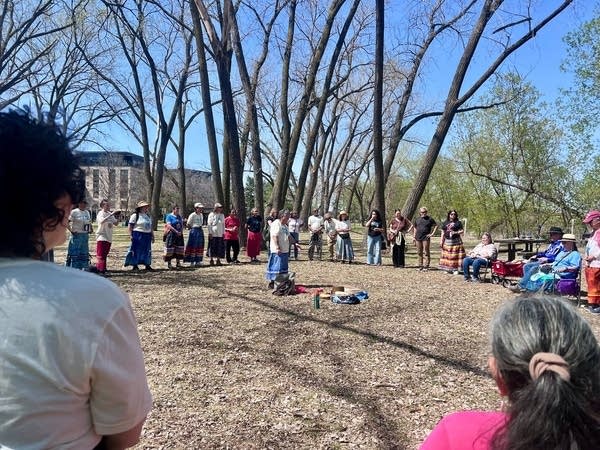
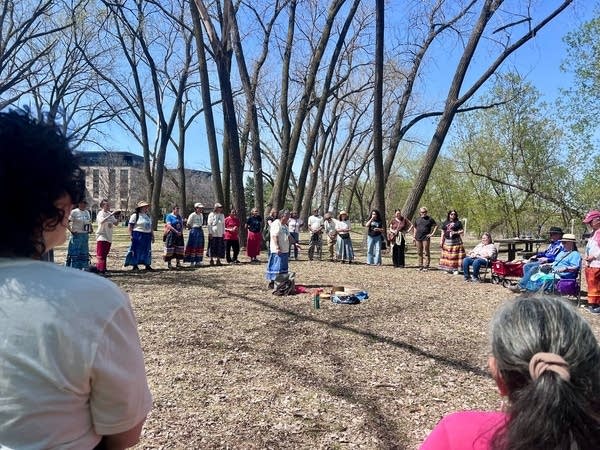
Nearly 40 walkers arrived at the riverbank, and one woman carried a copper bucket filled with water from Medicine Lake. During the ceremony, the carrier poured the water from the bucket into the creek where it meets the Mississippi.
Roxanne Biidaabinokwe Gould is a retired educator and is Odawa and Ojibwe. She had waited in the crowd for the walkers to arrive. Gould says the watershed was heavily polluted when the city was being settled in the 1800s.
“The creek was used as a dumping ground for sewage. So, it was greatly neglected and abused,” Gould said.
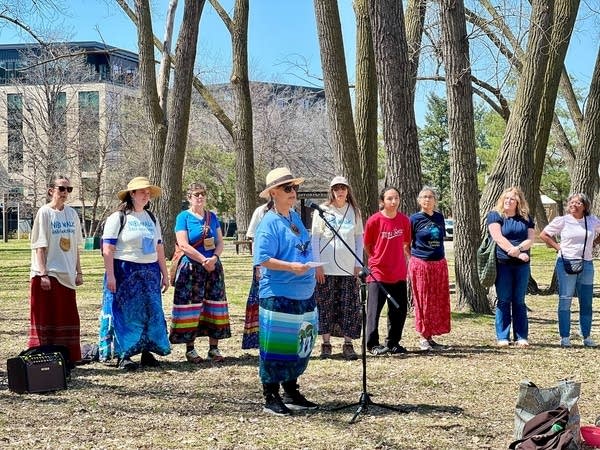
Day planned the Ȟaȟá Wakpádaŋ water walk for Earth Day as a chance for community members to reflect on the water as a “life giver.”
“[Ȟaȟá Wakpádaŋ] was so polluted. Hearing all the stories about what happened, and [I] just wanted to walk this river on Earth Day,” said Day.
Day says participants of varying ages took part in the water walk, and that everyone can take care of the earth’s waterways.
Retired educator Jim Rock, a member of the Sisseton Dakota Oyate, was also in the crowd when walkers arrived at Bassett Creek. He says every day is “Mother Earth” Day.
“That water is her blood," he said, comparing the earth to a body, which cares for those who inhabit it. "Not just our selfish, two-legged human way, but [for] all these relatives.”
Gould shared that Bassett Creek had been a source of “food and medicine” for Dakota people before pollution and city development.
“The creek was a path that the Dakota people used for thousands of years. They would walk along the high part of the creek from Medicine Lake to the Mississippi River,” Gould said. “It was, I think, popular because there was so much abundance.”
By doing the water walk on Earth Day, participants hope to encourage efforts to restore Ȟaȟá Wakpádaŋ to its original abundance.
Chandra Colvin covers Native American communities in Minnesota for MPR News via Report for America, a national service program that places journalists into local newsrooms to report on undercovered issues and communities.