Minnesota Senate to vote on firearm restrictions, school safety funding


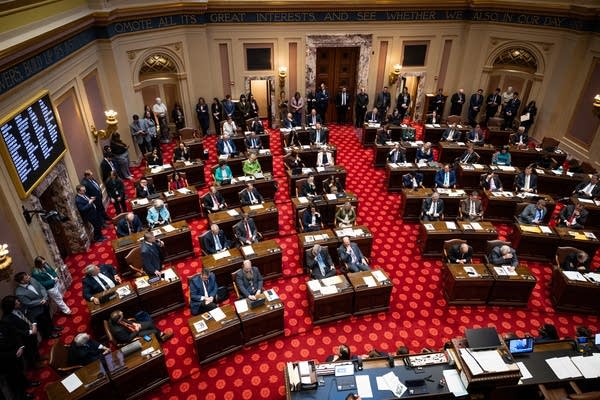
The Minnesota Senate chambers

The Minnesota Senate planned to debate a proposal Monday to restrict assault-style weapons and high capacity magazines.

The proposal also deals with school safety efforts and it comes months after a fatal shooting at Annunciation Catholic Church and School in Minneapolis. Lawmakers in the divided Legislature have said school safety is a top priority this session but have disagreed about the best path forward.

Democrats hold a one-vote edge in the Senate and would need all 34 members to advance it, barring unexpected GOP support. DFLers in the Senate have already taken votes on gun laws — background checks, revocation orders and trigger devices — since their last election so some in competitive districts will face campaign pushback regardless of how they vote on these.

This vote won’t be the final word for the measures because the House, which is tied, has not advanced companion bills. Families affected by gun violence, physicians who treat patients with gun-related injuries and advocates for more restrictions on firearms spoke in support of the proposal Monday morning.

“This legislation is comprehensive and doesn't compromise on our values. Students and parents do not want us to choose between banning weapons of war and investing in schools. This isn't either or. We need both,” said Sen. Zaynab Mohamed, DFL-Minneapolis, who sponsored the bill.
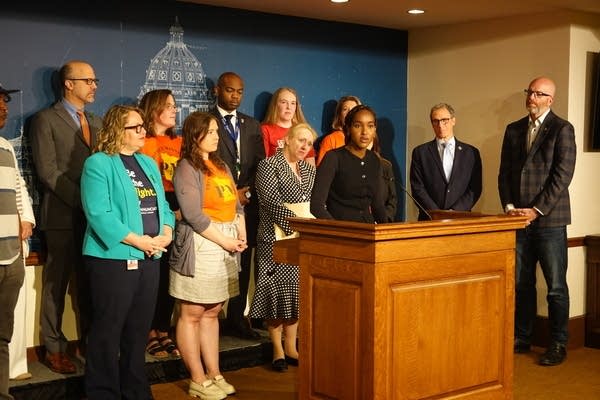
A group of people stand behind a podium to speak to reporters.
State Sen. Zaynab Mohamed, DFL-Minneapolis, speaks to Capitol reporters on Monday about a proposal to restrict assault style weapons and high-capacity magazines. The bill is set to come up for a vote Monday.
Dana Ferguson | MPR News

The proposal would prohibit firearms dealers from selling assault-style weapons and large-capacity magazines, though non dealers could continue selling them as long as they follow existing firearm sale and transfer laws. Owners would have to certify the assault-style weapons and large-capacity magazines they already have with the state. The bill would also make it a felony to sell or transfer ghost guns, those without a serial number.

Dr. Rachel Weigert is a pediatric emergency room physician at Children’s Minnesota who treated children injured during the shooting at Annunciation. She said the changes are needed.

“As a doctor, I'm supposed to train and prepare for the worst, not kids, not educators and not parents,” Weigert said. “Since that day, a chorus of kids, educators, parents and medical professionals have been begging the legislature to take a vote on policy changes like the Senate will do today. I'm glad we're finally here, and yet there is still so much to do.”

It includes provisions dealing with school safety provisions including more funding for mental health services and school safety grants, and to anonymous threat reporting systems. The House has deadlocked over provisions of a school safety proposal. Republicans have said they won’t support firearm restrictions as part of a compromise bill.

Democrats said if Republicans block the measure from advancing this year, it will be a key focus on the campaign trail. All 201 legislative seats are on the ballot in November.

“People are wondering where people stand. So I hope that that pressure works, and if the pressure does not work under the dome in the next two weeks, it certainly will be there as we all face our voters and they ask us what we've done on this issue,” Rep. Emma Greenman, DFL-Minneapolis said.

This is a developing story. Please check back for updates.


Source link

Leave a Reply

Subscribe to Our Newsletter

Get our latest articles delivered straight to your inbox. No spam, we promise.

Recent Reviews


Speaker of the House Mike Johnson, R-La., takes questions at a news conference at the U.S. Capitol on April 21, 2026.

Speaker of the House Mike Johnson, R-La., takes questions at a news conference at the U.S. Capitol on April 21, 2026.
Speaker of the House Mike Johnson, R-La., takes questions at a news conference at the U.S. Capitol on April 21.
J. Scott Applewhite | AP

The House of Representatives voted Thursday to reopen most of the Department of Homeland Security, ending the longest agency shutdown in U.S. history.

The House passed a bill funding DHS, minus dollars for Immigration and Customs Enforcement and Customs and Border Protection. The measure passed by voice vote on what was the 76th day of the shutdown.

Democrats refused to back funding for many of the agency's immigration functions in an unsuccessful effort to secure reforms including body-worn cameras and broad restrictions on face coverings after federal law enforcement killed two American citizens in Minnesota earlier this year.

The Senate, led by Republican Majority Leader John Thune, R-S.D., unanimously advanced this funding legislation in March. At the time, Speaker Mike Johnson, R-La., referred to the proposal as "a joke" and refused to bring it up for a vote. Many members of the House Republican conference refused to fund the agency in a piecemeal fashion and did not want to negotiate over reforms to immigration enforcement operations.

On April 1, Johnson reversed course. He announced the funding bill would be voted on "in the coming days." More than four weeks later, he finally made good on that commitment.

In an effort to appease his hardline members, Johnson waited to bring the Senate's proposal to a vote until that chamber's Republicans started the arcane procedural process, known as reconciliation, to fund all of DHS — including Immigration and Customs Enforcement (ICE) and Customs and Border Protection (CBP) — for the remainder of Trump's term without any backing from Democrats.

The funding bill comes as Secretary of Homeland Security Markwayne Mullin warned the agency was close to running out of funds to pay staff.

"We have reached all the emergency funds we can reach into," Mullin told Fox News on Friday. "I am completely out of the slush fund, I have no place to move at the end of the month."

Mullin said the agency was relying on appropriated funds from last year's One Big Beautiful Bill, which allocated more than $150 billion to DHS on top of its regular annual appropriations funding.

President Donald Trump signed a memo this month authorizing DHS to use some of the money from that legislation to fund the department's operations — potentially infringing on the powers granted to Congress by the Constitution to direct how taxpayer money is spent.

Copyright 2026, NPR


Source link