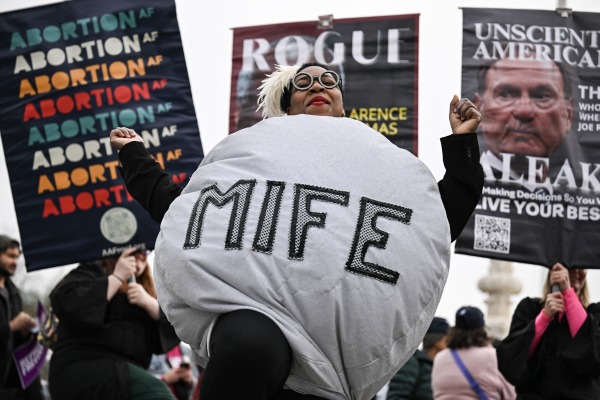

Supreme Court Justice Samuel Alito on Monday put a one-week hold on major changes to how the abortion pill mifepristone can be prescribed. The ruling temporarily restores nationwide access to a drug used for most medication abortions in the U.S.
On Friday, an appeals court had said the Food and Drug Administration needed to revert to rules that the pills, part of a two-drug regimen for medication abortion, must be prescribed only in-person. The change was effective immediately for the whole country.
The appeals court order meant that mifepristone could not be prescribed via telehealth or sent through the mail. Alito's order restores that telehealth access for one week.
A challenge from Louisiana
The one-week hold comes as part of a case filed by the state of Louisiana against the FDA. The state's argument centered around the FDA's decision several years ago to remove an in-person requirement for patients to receive mifepristone. Louisiana argued that telemedicine access to mifepristone undermines the state's almost complete ban on abortions.
In the almost four years since the Supreme Court overturned Roe v. Wade, telemedicine abortion has grown. In fact, it's a big part of the reason why — despite state bans — the overall number of abortions has actually gone up nationally since 2020, the last year before the end of Roe for which comprehensive national estimates are available.
In 2020, there were about 620,000 abortions reported to the federal government. There were about 1.1 million abortions that involved a clinician in 2025, according to estimates from the Guttmacher Institute, a research organization which supports abortion rights.
By 2022, medication abortions accounted for nearly two-thirds of all abortions in the U.S., according to Guttmacher. Roughly 1 in 4 abortions were provided via telehealth by the end of 2024, according to KFF, a nonpartisan health policy research organization.
7 million patients
The FDA has found mifepristone to be safe, and the medication has been used by more than 7 million patients in the U.S. since it was first approved in 2000. In combination with misoprostol, a medication that's also used to treat ulcers, hemorrhage and for the insertion of IUDs, mifepristone is approved in the U.S. to end pregnancies up to 10 weeks of gestation.
On Friday, the 5th Circuit Court of Appeals, based in New Orleans, issued a 19-page order in the Louisiana case. It was written by Judge Stuart Kyle Duncan, who was appointed by President Trump.
Duncan wrote that telemedicine access to mifepristone "injures Louisiana by undermining its laws protecting unborn human life and also by causing it to spend Medicaid funds on emergency care for women harmed by mifepristone. Both injuries are irreparable."
Duncan ruled that the FDA needed to impose rules that were in place in 2022 that required mifepristone to be prescribed and given in person. With no parameters limiting that change to Louisiana or setting a time for it to be implemented, it was immediately in effect for all states.
The two companies that make mifepristone, Danco Laboratories and GenBioPro, quickly appealed directly to the Supreme Court for "emergency relief." Alito, who responds to such requests for the 5th Circuit, granted that relief on Monday morning.
Alito blocked the appeals court's decision from going into effect until next Monday, May 11, at 5 p.m. Alito also asked all the parties in the ongoing lawsuit brought by the state of Louisiana to file briefs by Thursday, May 7, at 5 pm.
Diane Webber contributed to this report.
Copyright 2026, NPR