

Minnesota hunters donating more venison to food banks


Deer Disease Drawings

It's easy to mistake the La Crescent food shelf in Houston, Minn., for a small market.

Nestled between an elementary school and sunny suburbia, the food shelf blends in to give those who need it seamless, easy access to rows of food and freezers of meat.

Inside, a freezer is partially empty. But last fall was a different story.

“When we had all that venison coming in, we just had so much venison we didn't have room for any other products. This whole area here was filled up with venison,” said Susan Oddsen, La Crescent's program manager. She said people were happy to see the meat.

Minnesota's Hunter-Harvested Venison Donation Program has been around since 2007, but it's growing more popular.

The idea is simple: Hunters donate deer to local processors, who prep it for food shelves and feeding programs. In 2025, the program saw a 50 percent jump in donations compared to the previous year, according to the Minnesota Department of Agriculture.

That’s roughly 14,000 pounds of venison in all.

La Crescent joined the program in 2024 after a local processor reached out.

“We had not been a part of that before because I didn’t see any local processor that was a part of the program,” Oddsen said.

Oddsen said the catalyst for joining the program was a call from Big Valley Meats’ Molly Frickson, who told her that she was part of the program.

Up a gravel driveway, Big Valley Meats sits inside a barn surrounded by animals awaiting their fate and cats enjoying the view.

“We just basically took the front quarter of our barn and turned it into a processing area for deer,” said Frickson.

Inside, the dirt and wood quickly turned into a sanitized table and scrubbed concrete floor.

Frickson has only been part of the program for two years. The first year, she had more than 50 deer come in for processing.

And then this year, we just skyrocketed,” Frickson said. We had a lot of deer come in, and it was pretty much skinning and deboning deer for every day for many weeks straight.

Chad Garteski, a real estate agent working in Chatfield, said he and his friends donated around 20 deer in 2025.

"Part of it was that one of my clients that I had sold several farms to over the last couple years determined that they had too many deer on their farms,Garteski said. And you know, as far as responsible conservation practices, they wanted to get a group of people together to go out there and try to reduce the deer numbers a little bit on these particular farms.”

He said the venison donation program is a win-win all around.

"If you knew how many deer you drove past today, there’s a lot of, let’s call it protein there that’s now available to people. It breaks my heart to see all the deer lying along the side of the road, you know, the ones that get hit by cars. That's just a lot of wasted, wasted meat."

You can find information about the Hunter Harvested Venison Donation Program at the Minnesota Department of Agriculture website.


Source link

Leave a Reply

Subscribe to Our Newsletter

Get our latest articles delivered straight to your inbox. No spam, we promise.

Recent Reviews


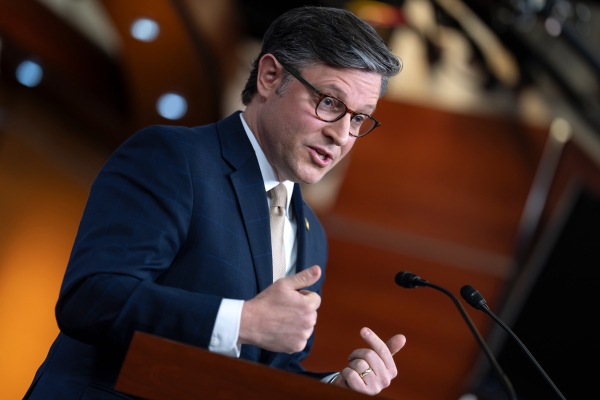
Speaker of the House Mike Johnson, R-La., takes questions at a news conference at the U.S. Capitol on April 21, 2026.

Speaker of the House Mike Johnson, R-La., takes questions at a news conference at the U.S. Capitol on April 21, 2026.
Speaker of the House Mike Johnson, R-La., takes questions at a news conference at the U.S. Capitol on April 21.
J. Scott Applewhite | AP

The House of Representatives voted Thursday to reopen most of the Department of Homeland Security, ending the longest agency shutdown in U.S. history.

The House passed a bill funding DHS, minus dollars for Immigration and Customs Enforcement and Customs and Border Protection. The measure passed by voice vote on what was the 76th day of the shutdown.

Democrats refused to back funding for many of the agency's immigration functions in an unsuccessful effort to secure reforms including body-worn cameras and broad restrictions on face coverings after federal law enforcement killed two American citizens in Minnesota earlier this year.

The Senate, led by Republican Majority Leader John Thune, R-S.D., unanimously advanced this funding legislation in March. At the time, Speaker Mike Johnson, R-La., referred to the proposal as "a joke" and refused to bring it up for a vote. Many members of the House Republican conference refused to fund the agency in a piecemeal fashion and did not want to negotiate over reforms to immigration enforcement operations.

On April 1, Johnson reversed course. He announced the funding bill would be voted on "in the coming days." More than four weeks later, he finally made good on that commitment.

In an effort to appease his hardline members, Johnson waited to bring the Senate's proposal to a vote until that chamber's Republicans started the arcane procedural process, known as reconciliation, to fund all of DHS — including Immigration and Customs Enforcement (ICE) and Customs and Border Protection (CBP) — for the remainder of Trump's term without any backing from Democrats.

The funding bill comes as Secretary of Homeland Security Markwayne Mullin warned the agency was close to running out of funds to pay staff.

"We have reached all the emergency funds we can reach into," Mullin told Fox News on Friday. "I am completely out of the slush fund, I have no place to move at the end of the month."

Mullin said the agency was relying on appropriated funds from last year's One Big Beautiful Bill, which allocated more than $150 billion to DHS on top of its regular annual appropriations funding.

President Donald Trump signed a memo this month authorizing DHS to use some of the money from that legislation to fund the department's operations — potentially infringing on the powers granted to Congress by the Constitution to direct how taxpayer money is spent.

Copyright 2026, NPR


Source link