

Minneapolis poised to pass assault weapons ban


Annunciation Community Run

The Minneapolis City Council is expected to ban assault weapons in the city during its Thursday meeting.

The bill is part of an effort by 17 Minnesota cities that pledged to adopt gun violence ordinances following the mass shooting at Annunciation Catholic Church and School, in which a gunman killed two children and injured 28 others.

The bill approved by the council would ban certain semi-automatic weapons defined in state law that are commonly known as assault weapons. It includes AK- and AR- variants.

The bill would also ban large capacity magazines, binary triggers and ghost guns.

Cheers erupted during the council’s Tuesday meeting as they unanimously voted to move the bill on to a final vote. Supporters in attendance included Annunciation parents and community members.

“My son is always on alert, scanning for danger,” said Nicole Farrell, whose seventh-grader was attending Mass when a gunman shot through the stained glass windows of the church. “Unexpected noises, as simple as opening a can of crescent rolls for dinner, can send him spiraling.”

A spokesperson said Minneapolis Mayor Jacob Frey supports the bill.

Despite the unanimous support from the city council and Frey, the bill would largely be symbolic. According to Everytown for Gun Safety, Minnesota is one of 42 states that have preemption laws, which prevent city governments from regulating firearms.

The gun safety nonprofit says the laws became commonplace in the 1980s after backlash to an Illinois city’s decision to ban handguns.

Mayors of several Minnesota cities have urged the state to drop its preemption laws. In November, St. Paul passed a similar assault weapons ban that would not take effect until state preemption laws are lifted.

“It’s something that has touched all our wards and all of our constituents,” said Council Member Aurin Chowdhury at the bill hearing Tuesday. “We are just extremely united as a city to do everything we can to reduce the harm of gun violence.”

Earlier this week, Minnesota Senate Democrats voted to pass new restrictions on assault-style weapons and high capacity magazines. The bill’s fate in the House, which is tied 67-67, remains uncertain.


Source link

Leave a Reply

Subscribe to Our Newsletter

Get our latest articles delivered straight to your inbox. No spam, we promise.

Recent Reviews


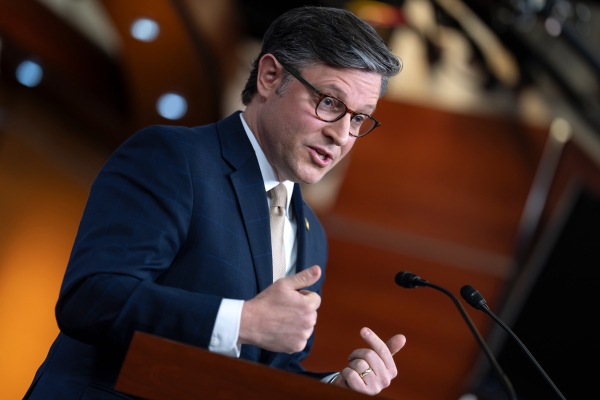
Speaker of the House Mike Johnson, R-La., takes questions at a news conference at the U.S. Capitol on April 21, 2026.

Speaker of the House Mike Johnson, R-La., takes questions at a news conference at the U.S. Capitol on April 21, 2026.
Speaker of the House Mike Johnson, R-La., takes questions at a news conference at the U.S. Capitol on April 21.
J. Scott Applewhite | AP

The House of Representatives voted Thursday to reopen most of the Department of Homeland Security, ending the longest agency shutdown in U.S. history.

The House passed a bill funding DHS, minus dollars for Immigration and Customs Enforcement and Customs and Border Protection. The measure passed by voice vote on what was the 76th day of the shutdown.

Democrats refused to back funding for many of the agency's immigration functions in an unsuccessful effort to secure reforms including body-worn cameras and broad restrictions on face coverings after federal law enforcement killed two American citizens in Minnesota earlier this year.

The Senate, led by Republican Majority Leader John Thune, R-S.D., unanimously advanced this funding legislation in March. At the time, Speaker Mike Johnson, R-La., referred to the proposal as "a joke" and refused to bring it up for a vote. Many members of the House Republican conference refused to fund the agency in a piecemeal fashion and did not want to negotiate over reforms to immigration enforcement operations.

On April 1, Johnson reversed course. He announced the funding bill would be voted on "in the coming days." More than four weeks later, he finally made good on that commitment.

In an effort to appease his hardline members, Johnson waited to bring the Senate's proposal to a vote until that chamber's Republicans started the arcane procedural process, known as reconciliation, to fund all of DHS — including Immigration and Customs Enforcement (ICE) and Customs and Border Protection (CBP) — for the remainder of Trump's term without any backing from Democrats.

The funding bill comes as Secretary of Homeland Security Markwayne Mullin warned the agency was close to running out of funds to pay staff.

"We have reached all the emergency funds we can reach into," Mullin told Fox News on Friday. "I am completely out of the slush fund, I have no place to move at the end of the month."

Mullin said the agency was relying on appropriated funds from last year's One Big Beautiful Bill, which allocated more than $150 billion to DHS on top of its regular annual appropriations funding.

President Donald Trump signed a memo this month authorizing DHS to use some of the money from that legislation to fund the department's operations — potentially infringing on the powers granted to Congress by the Constitution to direct how taxpayer money is spent.

Copyright 2026, NPR


Source link