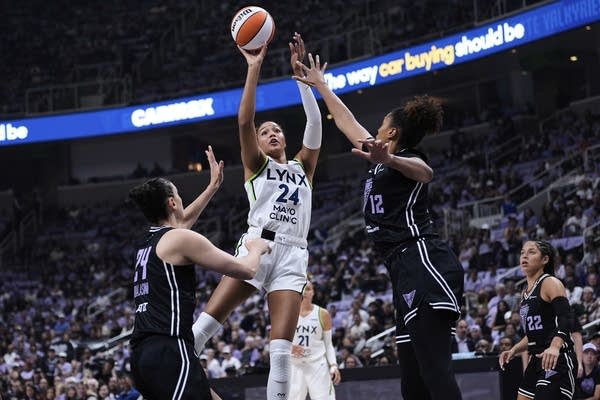
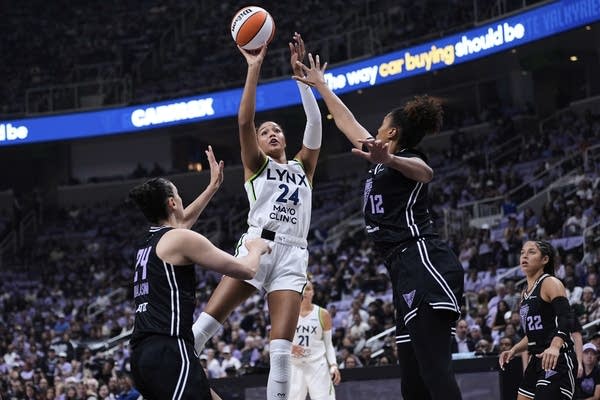
The women's pro basketball season begins May 8 without Napheesa Collier, who's recovering from surgery. Yet the Minnesota Lynx star's fingerprints are visible across the league.
Collier played a notable role in negotiating a new contract that increased the players' share of WNBA revenues, just as those revenues have soared. The contract multiplied every player's salary to the point where the lowest-paid players in 2026 will be paid more than the highest-paid in 2025.
Collier is the vice president of the players' union, the Women's National Basketball Players Association, and last year made a relentless public critique of league management. She said her statement was necessary in the run-up to the contract negotiations. Her off-court advocacy, as much as her on-court play, has made Collier the subject of fascination to fans. Some fit the WNBA negotiations into a proud history of women advocating for equality in sports, stretching back to Billie Jean King and beyond.
In an NPR video interview, filmed at the Lynx practice center in Minneapolis, Minn., Collier talked about the new WNBA contract, the upcoming season and her future in basketball.
You can watch Collier above. Below are highlights from our conversation.
We were in one place where men’s sports and women’s sports are equal
Collier spoke with us at The Courts at Mayo Clinic Square in Minneapolis — the practice facility shared by the Lynx and their affiliated men's team, the Minnesota Timberwolves. We were in a room overlooking the practice courts — one for the men's team, one for the women's team, side-by-side and equal in every respect. The only difference was the logos.
"We really want for nothing here," Collier said, from "chefs" to "massage therapists."
She says her attack on WNBA leadership was ‘a little dramatic’
At a season-ending press conference last year, Collier read a prepared statement denouncing the league and its commissioner, Kathy Engelbert. She said players were grossly underpaid. She criticized the refs. She called the game too physical and unsafe. She was talking after suffering injuries to both ankles that required surgery in the offseason. Collier will not be able to resume play until June, and spoke with us while wearing a medical boot on one foot.
Reminded that she had called Engelbert "the worst leadership in the world," Collier stepped back slightly. "Thinking about the state of the world right now, I think that's a little dramatic," Collier said.
But she added, "I think it was something that needed to happen and it was something that furthered our CBA [collective bargaining agreement] negotiations." Other players rallied to her side, and the statement added to public pressure on the league. Collier said she's only had brief conversations with the commissioner since then, and they never discussed her denunciation.
She helped to get every player a big raise – but hers is only for one season
The new agreement allows players to be paid with 20% of team revenues, rather than 8 percent — a bigger slice of much bigger pie, as women's basketball has exploded. Collier herself was able to sign a "supermax" contract — the largest allowed — for $1.4 million. The one-year contract is more than five times Collier's salary the previous year.
Some WNBA stars have signed multi-year contracts, but Collier opted for a single season. In our interview, she didn't explicitly say she would be looking for a new team.
"I'm so focused on the now," Collier said, though she acknowledged that "there's new opportunities every year" that a player's contract ends.
Even after the raise, she says players make more in her own league
Collier talked about Unrivaled, a three-on-three league that she co-founded, and that plays during the WNBA offseason. She described it in business terms: It's a way for pro players, who make millions from endorsements and other off-court deals, to remain visible year-round.
She said the WNBA raises do not make her own league any less necessary. "Most people are still making more in Unrivaled than they are in the WNBA," she said with evident pride.
Collier said she's learning more about the business of sports, though she's determined to play "until the wheels fall off." Asked how many more years she intends to keep playing, the 29-year-old said, "I think 10 would be a good number."
An explosion of sports betting has come with an explosion of threats
The growing popularity of women's basketball has attracted the interest of sports gamblers — who bet not only on the outcome of a game but a myriad of statistics and even individual shots. Collier mostly welcomes the attention, but talked about a side effect of growing sports betting — death threats from disappointed bettors.
Mostly it's just words, she said. "It worries you, though, at some point, something bad is going to happen because some person has lost. $30,000 because you didn't hit a three pointer or something," Collier said.
We asked about the possibility of a player shaping a game to win a bet. She cast doubt on it. "I think most people, one, want to uphold that integrity and, two, you don't want to risk it," Collier said. "Like this is the first time that a lot of us are making real money. And do you want to risk that for something like gambling?"
Copyright 2026, NPR