Judge: No immediate end to ICE near Minnesota schools


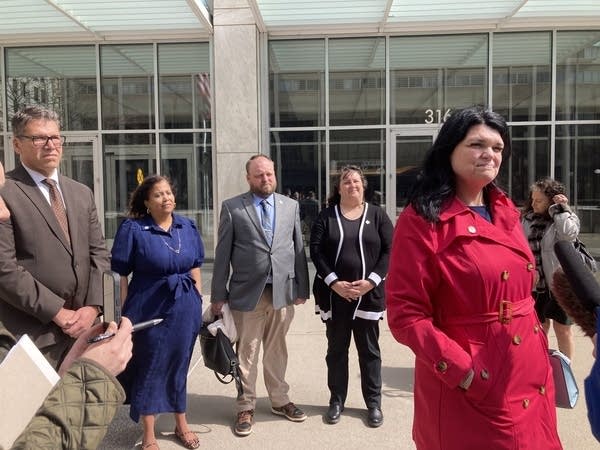
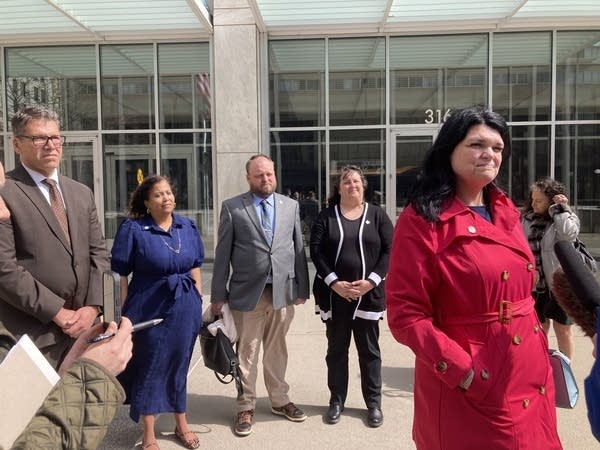
woman speaking to reporters outside of a building

A federal judge on Wednesday denied a request for a preliminary injunction that would have immediately stopped U.S. Immigration and Enforcement agents from operating near or on school grounds.

Two Minnesota school districts along with the state teachers union had filed a lawsuit asking courts to require the Department of Homeland Security to treat schools as protected areas, free of immigration enforcement.

While the request for an immediate end was denied, the case continues.

The districts, Fridley and Duluth, brought their lawsuit earlier this year as ICE agents flooded the Twin Cities in February.

School leaders argued immigration enforcement conducted near schools had damaged student attendance and enrollment. During “Operation Metro Surge,” Minnesota districts with widespread federal activity saw as many as 20 to 40 percent of students staying home from school.

Since the 1990s, the U.S. government has declared schools, hospitals and churches as safe zones, off-limits to immigration enforcement. The Trump administration rescinded that policy last year.

Lawyers for the Fridley and Duluth school systems argued the decision violated the federal Administrative Procedures Act and asked a federal court to put a temporary stay on the policy change while deciding on the merits of the case.

In her ruling, Judge Laura Provinzino, a Biden appointee, found that the plaintiffs didn’t meet the requirements necessary for the court to issue a temporary stay ahead of the final court decision.

The Fridley and Duluth school districts — along with Education Minnesota, the teachers union — said their case would continue despite losing on the immediate injunction. “This is not the end of our fight,” they said in a statement.



Source link

Leave a Reply

Subscribe to Our Newsletter

Get our latest articles delivered straight to your inbox. No spam, we promise.

Recent Reviews


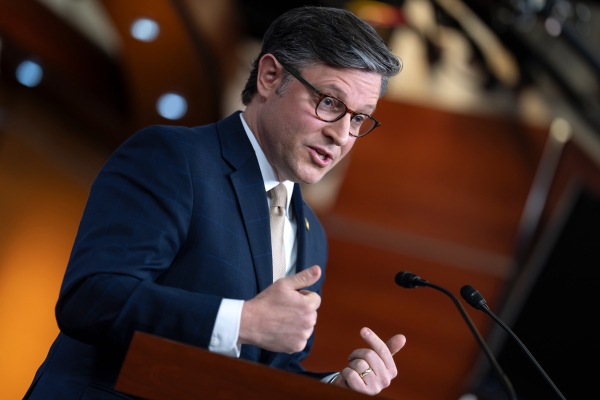
Speaker of the House Mike Johnson, R-La., takes questions at a news conference at the U.S. Capitol on April 21, 2026.

Speaker of the House Mike Johnson, R-La., takes questions at a news conference at the U.S. Capitol on April 21, 2026.
Speaker of the House Mike Johnson, R-La., takes questions at a news conference at the U.S. Capitol on April 21.
J. Scott Applewhite | AP

The House of Representatives voted Thursday to reopen most of the Department of Homeland Security, ending the longest agency shutdown in U.S. history.

The House passed a bill funding DHS, minus dollars for Immigration and Customs Enforcement and Customs and Border Protection. The measure passed by voice vote on what was the 76th day of the shutdown.

Democrats refused to back funding for many of the agency's immigration functions in an unsuccessful effort to secure reforms including body-worn cameras and broad restrictions on face coverings after federal law enforcement killed two American citizens in Minnesota earlier this year.

The Senate, led by Republican Majority Leader John Thune, R-S.D., unanimously advanced this funding legislation in March. At the time, Speaker Mike Johnson, R-La., referred to the proposal as "a joke" and refused to bring it up for a vote. Many members of the House Republican conference refused to fund the agency in a piecemeal fashion and did not want to negotiate over reforms to immigration enforcement operations.

On April 1, Johnson reversed course. He announced the funding bill would be voted on "in the coming days." More than four weeks later, he finally made good on that commitment.

In an effort to appease his hardline members, Johnson waited to bring the Senate's proposal to a vote until that chamber's Republicans started the arcane procedural process, known as reconciliation, to fund all of DHS — including Immigration and Customs Enforcement (ICE) and Customs and Border Protection (CBP) — for the remainder of Trump's term without any backing from Democrats.

The funding bill comes as Secretary of Homeland Security Markwayne Mullin warned the agency was close to running out of funds to pay staff.

"We have reached all the emergency funds we can reach into," Mullin told Fox News on Friday. "I am completely out of the slush fund, I have no place to move at the end of the month."

Mullin said the agency was relying on appropriated funds from last year's One Big Beautiful Bill, which allocated more than $150 billion to DHS on top of its regular annual appropriations funding.

President Donald Trump signed a memo this month authorizing DHS to use some of the money from that legislation to fund the department's operations — potentially infringing on the powers granted to Congress by the Constitution to direct how taxpayer money is spent.

Copyright 2026, NPR


Source link