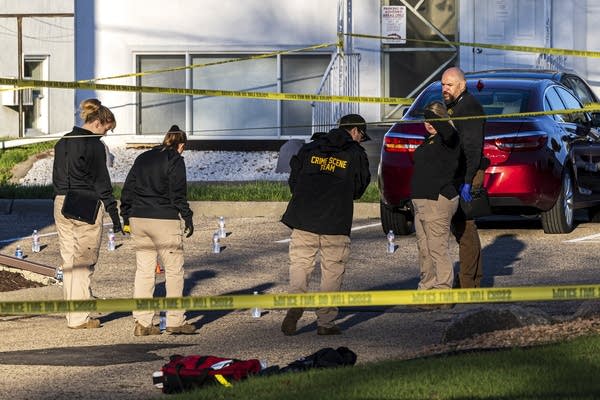
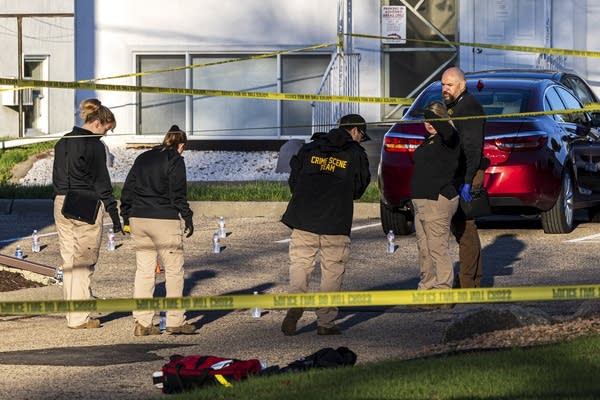
The family of Desaver Hollis, a Black man shot and killed by Richfield police last month, are questioning the police’s narrative after viewing the body-worn camera footage.
Richfield police officers shot and killed Hollis, 27, on April 29 after identifying him as a suspect in a reported theft from a vehicle. Video released Monday showed Hollis shoot Sgt. Mario Leon in the hand before Leon and Sgt. Kristian Schultz returned fire at least 20 times, including while Hollis was on the ground.
The family has retained an attorney from Burris Nisenbaum Curry and Lacy, a national law firm focused on civil rights and police misconduct. Nicole Holliday, the family’s legal liaison, said in a Monday statement the family is limiting their comments while the investigation is ongoing.
“Out of respect for the integrity of the ongoing investigation and legal process, the family is not in a position to publicly express opinions, conclusions or perceptions regarding the case,” Holliday said.

The family on Monday met with the Richfield Police Department and the Minnesota Bureau of Criminal Apprehension, the agency investigating the killing, to view the body-worn camera footage of the shooting before it was released to the public.
The video, which consists of footage from two officers, includes a timeline crafted by Richfield police as well as enhanced clips the department said highlight “pertinent moments from each perspective.” At times, the footage is obscured.
Sgt. Leon’s footage shows him chasing Hollis into an apartment lot and attempting to tackle him.
One of the officers yells, “He’s got a gun.” A frame of the footage highlighted by Richfield police appears to show Hollis pointing a gun at Leon.
The sound of a gunshot is heard and Leon is seen falling to the ground, screaming that he’s been shot. A frame highlighted by Richfield police appears to show Hollis firing the gun. Leon’s right hand can be seen with a gunshot wound as multiple gunshots are fired.
The gunfire exchange is not visible from Leon’s camera, instead pointing toward the sky. After the shooting subsides, he escapes to the side of a building before asking for a tourniquet.
Footage from Sgt. Schultz’s body-worn camera shows Schultz running to the apartment parking lot with his taser in hand. Leon tackles Hollis to the ground.
While Leon is standing over Hollis, Schultz yells that Hollis has a gun and tosses his taser. The BCA said in a release its preliminary investigation found Schultz tried using the taser.
A gunshot goes off and Leon screams before falling to the ground. Schultz fires multiple shots at Hollis over the next six seconds, including while Hollis is on the ground with his back turned to Schultz.
Hollis screams for around three seconds before Sgt. Schultz’s footage shows Sgt. Leon fire multiple shots at Hollis with his left hand while on his back. The footage is partially obscured by Schultz reloading and covering his camera while operating a radio.
Schultz joins Leon at the side of the building and tells another officer who had just arrived to “hold” Hollis. The third officer stands over Hollis with his gun pointing at him while Schultz provides aid to Leon.
The BCA said in its preliminary investigation officers tried to provide aid to Hollis. The video released Monday does not include footage of officers rendering aid.
Police did not respond to a request for comment seeking clarification about the shooting.
In a statement, the family said the footage was “redacted and heavily edited.”
“What we do know is 20 shots were fired,” Holliday said. “Question is, at what point is it excessive force? We have another Black man dead after interaction with police.”
The Minnesota Bureau of Criminal Apprehension is conducting a use-of-force investigation and will forward its findings to the Hennepin County Attorney’s Office for review. In a statement, the city of Richfield said both officers were placed on critical incident leave.
In 2023, a judge found Hollis incompetent to stand trial in an assault case and had him civilly committed as mentally ill. A court-appointed psychologist diagnosed Hollis with schizoaffective disorder, possible bipolar type, with manic and psychotic features.
“A mother just lost her son and is grieving without enough answers; a family is grieving the loss of their son, brother, uncle and loved one,” Holliday said. “This will not be a quick process, but it will be a thorough process.”