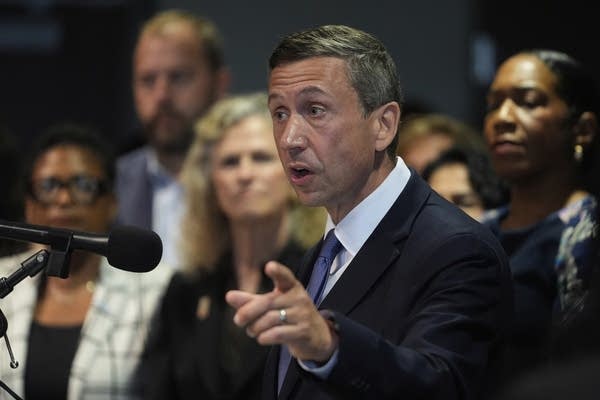
Democrats keep winning at the ballot box. And yet Ken Martin, the man leading the Democratic National Committee, is facing a crisis of confidence among party officials who are increasingly concerned about the health of their political machine barely a year into his term.
Major donors aren’t giving. Liberal influencers are publicly questioning Martin's refusal to release an internal report on the party's failures. And Democratic operatives have begun informal discussions about recruiting a new chair, even as most believe that Martin's job isn't in serious jeopardy ahead of the midterm elections.
Amanda Litman, who leads the Democratic-allied organization Run For Something, said she's been approached by senior strategists in recent days gauging her interest in replacing Martin. She declined but said many in the party have lost faith in the DNC leader.
“I think it’s a really hard job, and also Ken is not doing it very well,” Litman told The Associated Press. “I honestly think he’s going to have a hard time rebuilding trust.”
Part of the challenge for those Democrats frustrated with Martin, she said, “is that there’s not really an alternative.”
The criticism has gotten to Martin, said two people who insisted on anonymity to describe private conversations. They said he's become increasingly paranoid, even inside party headquarters in Washington, where he did not install his own team after taking over last year.
Martin tries to press forward
The handwringing comes in spite of the Democratic Party's undeniable success in the vast majority of elections under Martin's leadership, which coincides with Republican President Donald Trump's return to the White House. Democrats over the last year have dominated races for governor and special elections for state legislative and congressional seats. They've also won campaigns for state supreme court, county executive and even county sheriff.
Less than six months before the 2026 midterm elections, however, the concern over Martin's leadership is, at best, an unwanted distraction for a party desperate to break the Republican Party's grip on power in Washington. And, at worst, the conflict will make it harder for Democrats to win in November, while undermining faith in the DNC as it coordinates the party's next presidential nomination process.
Martin declined to comment for this article. He has sought to avoid media interviews over the last week, preferring to keep his head down while focusing on improving the DNC's financial health and scouting potential sites for the presidential convention in 2028.
While in Denver, for example, Martin hosted a crowded fundraising event before three private one-on-one donor meetings in between calls to more donors in other cities.
Former DNC Chair Jaime Harrison, whom Martin replaced, said he’s upset and frustrated by those in his party who are publicly challenging Martin's leadership. Harrison was especially angry with Democratic operatives from the podcast “Pod Save America,” who pressed Martin during a recent episode about why he reneged on a promise to release a post-2024 election autopsy.
Even Martin's close allies described the interview as a cringeworthy moment for the first-term chair.
“Am I happy with everything that goes on in the party? No. Am I happy with leadership that sometimes you get? No. But do you see me going out at this juncture trying to make that case? This is not the moment for that,” Harrison said. “We have to be as strong as we possibly can going into November, because we have to win. Once we win, we can fight like hell.”
Asked if he thought Martin's job was at risk, Harrison said, “I don't think so.”
Martin's gamble
Martin is leaning into a 50-state spending strategy that his supporters privately acknowledge is risky.
The DNC each month is distributing $1 million among party organizations in every state and key U.S. territories, besides allocating $5,000 more per month to nearly two dozen Republican-controlled states, to help build party infrastructure.
The investments are overwhelmingly popular with local leaders even as the DNC struggles financially.
The national party reported $22.1 million cash on hand with $18.4 million in debt at the end of March, according to its most recent federal filing. The Republican National Committee, by contrast, reported $116.8 million in the bank with zero debt.
Despite the criticism, DNC national finance co-chair Chris Lowe said the cash disparity is the result of an intentional strategy Martin outlined when running for chair and has executed since taking over the building.
“We made a conscious decision to spend money,” Lowe said. “His view, and I would agree with this view, is the best way to position ourselves for the presidential (election) in ’28 is not just to amass a bunch of money, it’s to have a history of winning elections all across the country up and down the ballot. And that’s what we’ve done.”
Lowe notes that Martin raised more money in his first year as chair than anyone else in an equivalent year when the Democrats did not have the White House. And in 2026 so far, he said, the committee has exceeded its big-dollar fundraising targets every month.
DNC member Michael Kapp, a vocal Martin ally from California, said that he'd “love to have big donors come on board” but that the committee's bank account isn't what matters most.
“Republicans can brag about having more money but they’re not spending it, and they’re not winning,” Kapp said. “At the end of the day the scoreboard matters more than the spreadsheet.”
The secret autopsy
Beyond fundraising, the furor around Martin's leadership centers on his refusal to release the DNC's internal study of the 2024 election — known inside the DNC as the “after-action report” — despite his past promises to do so on his first day as chair.
Kapp, as is the case with many of Martin's allies, said “it's certainly something that should be made public,” but he's willing to accept Martin's argument that it's too close to the November midterm elections to release the autopsy now.
“I know there are lessons to be learned from that,” he said of the report. “I trust Ken. I’ve known the man for 10 years. But at this point, when we’re six, seven months away from the midterms, we need to be focused on the midterms.”
Martin has been aggressively courting big-dollar donors, despite their demonstrated reluctance to give to the committee. He acknowledged pressure related to the autopsy in some of the conversations and indicated changes could be coming soon, according to two people with direct knowledge of the discussions but not authorized to share them.
As Martin looks ahead to 2028, when the DNC is tasked with building out the political infrastructure for the party's next presidential nominee, some presidential prospects are approaching the intraparty conflict with caution.
Kentucky Gov. Andy Beshear, who is expected to launch a presidential bid, did not answer directly when asked whether Martin should continue to lead the DNC.
“Ken and I work well together. And I say that being somebody who wasn’t originally on board,” Beshear said. “But he made an effort to reach out to me. And, listen, I want to work with whoever’s there. We need a healthy DNC. We need it to work.”