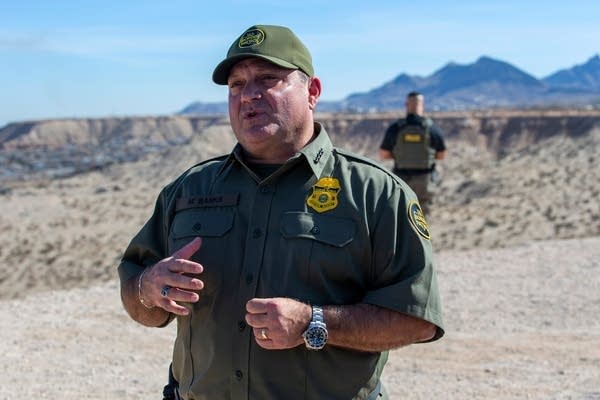
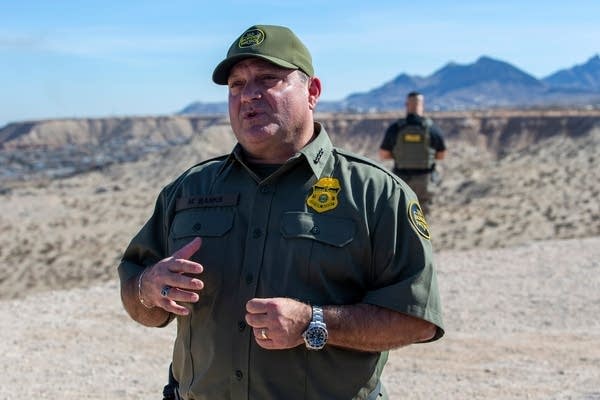
The head of U.S. Border Patrol, the agency tasked with securing the nation's frontiers and increasingly tapped by the Trump administration for immigration operations in American cities, announced his resignation Thursday.
Michael Banks' decision, announced in a Fox News interview and later confirmed by the Department of Homeland Security, is the latest leadership shake-up of officials implementing President Donald Trump's immigration crackdown and comes as the Republican administration appears to be recalibrating its approach to its centerpiece policy of mass deportations.
“It’s just time,” Banks was quoted as saying in a report on the Fox News website, which said the resignation was effective immediately. “I feel like I got the ship back on course," he said, referring to what he described as previous chaos at the southern border. Banks said it was “time to enjoy the family and life."
In a statement, the U.S. Customs and Border Protection commissioner, Rodney Scott, thanked Banks for his service “during one of the most challenging periods for border security.”
The White House did not immediately respond to a request for comment.
It was not clear who will replace Banks. He led an agency at the forefront of Trump's high-profile immigration enforcement efforts but kept a lower profile than some other officials such as Gregory Bovino, a now-retired commander who became a public face of the immigration crackdown.
Border Patrol participated in immigration enforcement operation in U.S. cities
CBP is one of the federal agencies that participated since last year in a series of immigration enforcement operations, carried out primarily in cities governed by Democrats — an effort that triggered a spike in arrests and led to the fatal shooting of two U.S. citizens in Minneapolis this year at the hands of federal immigration officers.
Banks' resignation takes place two months after Markwayne Mullin, a former Republican senator from Oklahoma, became homeland security secretary. DHS oversees CBP and U.S. Immigration and Customs Enforcement, commonly known as ICE.
Banks is stepping down at the same time that ICE is also going through a leadership transition. Todd Lyons, the acting ICE director, is leaving later this month and will be replaced by David Venturella, who worked for years for private contractors before returning to government service.
CBP was established in 2003 and handles customs, immigration, and agricultural regulations to secure U.S. borders. It has a workforce of over 20,000 agents assigned to patrol the more than 6,000 miles of land borders, and an operating budget of $1.4 billion, according to information from its website.
As head of CBP, Banks became a pivotal figure in the Trump administration’s hardline policy to reconfigure immigration law enforcement in the United States. He oversaw the expansion of prosecutions for illegal border crossings, intensified coordination between the Border Patrol and ICE, and supervised the implementation of broader internal enforcement operations within the country’s borders.
Banks had a long career at Border Patrol
Banks returned to the Border Patrol last year after a long agency career that had never landed him in its senior ranks. His star had risen as border czar to Gov. Greg Abbott, R-Texas, during a period when illegal crossings reached record highs and the state launched a multibillion-dollar enforcement surge that led to turf battles with the Biden administration.
Banks kept a relatively low public profile as arrests for illegal crossings that have plunged to their lowest levels since the mid-1960s, a trend that began toward the end of that Democratic administration.
Banks did not appear publicly at the Border Security Expo this month in Phoenix, an annual conference at which government officials update contractors on the state of the border. Scott, who was Banks’ supervisor, is a close ally of Trump border czar Tom Homan and has acted more as the agency’s public face.
Banks, who grew up in a small town in Warner Robins, about 100 miles (160 kilometers) southeast of Atlanta, Georgia, has said his first job was picking peaches at an orchard when he was 14 years old. He worked with migrant farm workers and learned “compassion and humility,” he said, in an interview published last year on the CBP website.
Banks, in the interview, said he was “honored” to have returned to the agency.
“The United States Border Patrol will be unapologetic in its enforcement of our nation’s laws,” he said.