Minnesota Senate backs anti-grooming bill


grooming bill final session days

The Minnesota Senate on Friday voted unanimously to pass a bill to make the sexual grooming of children a felony.

It would also ban teachers from being alone with students on field trips and require the Minnesota Department of Education to develop new mandatory reporter training to help school staff identify grooming.

The bill has already passed the House. Senate lawmakers on Friday added an amendment that would add additional funding. It will now go back to the House where lawmakers are expected to sign off and send to Gov. Tim Walz.

The measure gained traction following an MPR News investigation last fall that found police had concluded an Eagan High School band teacher had a “pattern of predatory grooming” in two districts for more than a decade.

Hannah LoPresto, the person at the center of that story, testified repeatedly at the Capitol this session about the need to strengthen state laws. Her concerns brought a rare bipartisan response from lawmakers, with several sharing their own stories.
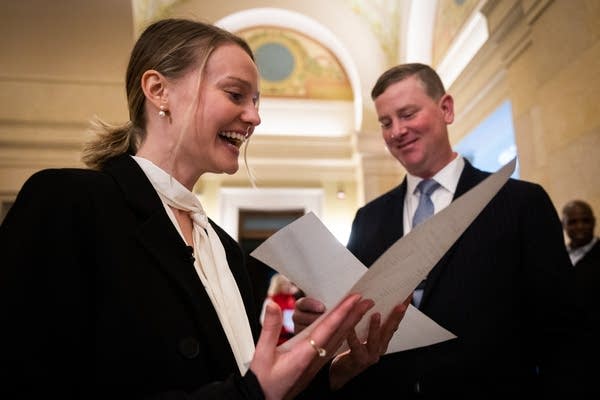
Two people hold white print outs
Hannah LoPresto and Eagan police detective Chad Clausen receive a printed copy of the 133-0 vote by the Minnesota House of Representatives that passed anti-grooming legislation at the State Capitol in St. Paul on April 27.
Ben Hovland | MPR News

“I was 9 years old the first time a grown man said something sexual about my body,” said state Sen. Erin Maye Quade, DFL- Apple Valley who sponsored the bill in the Senate.

“When I was 14 years old, my best friend was in a relationship for years with a 24 year old man. It was not uncommon for girls as young as 13 and 14 to have boyfriends who are in their 20s,” she told colleagues on the Senate floor.

“What is happening to young girls and women in this world is truly, truly awful, and our statutory construction often ignores that reality that far too many of us experience,” she added.

Emphasizing how important the measure was to her, House bill sponsor Rep. Peggy Bennett-R Albert Lea, told colleagues her story of being groomed by a band director when she was in 10th grade.

grooming bill last days of session
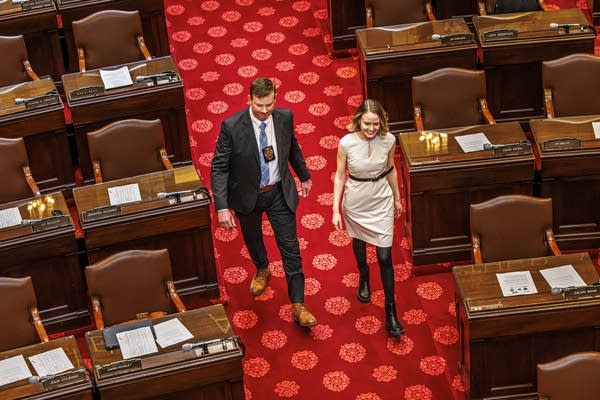
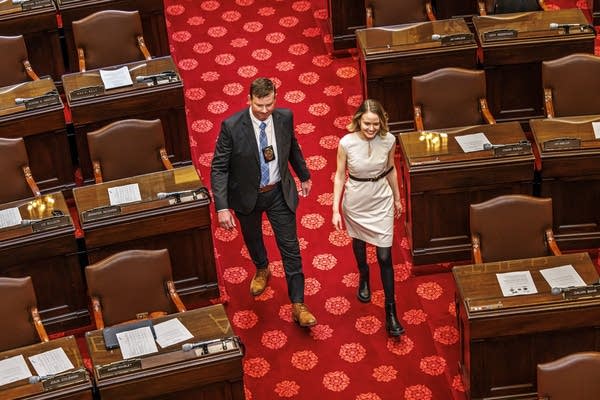
Hannah LoPresto watches as the Senate passes anti-grooming legislation on Friday. Lawmakers credited LoPresto's advocacy and her willingness to share her own story of being groomed by a teacher as key to passing the legislation.
Kerem Yücel | MPR News

Both lawmakers credited the courage of LoPresto in helping shape the bill.

“Just watching Hannah’s courage and her bravery and speaking out … I don’t know that we would have gotten to this point right now without them,” Bennett said.

Bennett believes the bill will prevent similar abuse from happening to other students and hopes that by telling her story along with Hannah, Maye Quade and others, survivors will find the courage to come forward.

“That’s where victims, I think, are empowered, when they can speak out. That’s when the shame is lifted, and you can say, ‘You know what? This wasn’t my fault. This was that perpetrator’s fault,’” she said.

“I do want this bill to be a statement to those sexual predators that go after our kids, that go into our schools … to just say we’re coming after you, and I mean that,” she added. “We’re watching. Leave our kids alone.”
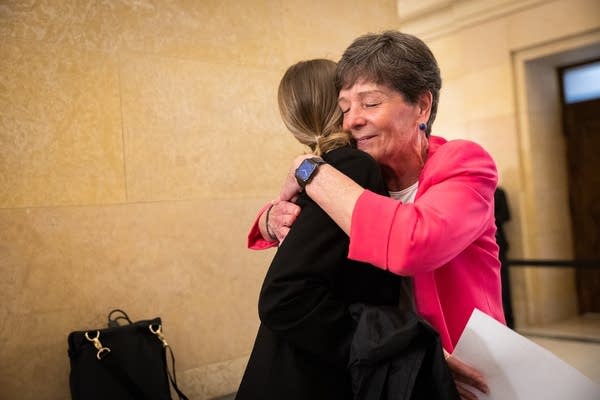
Two women embrace
Hannah LoPresto (left) embraces Rep. Peggy Bennett after the Minnesota House of Representatives voted to pass anti-grooming legislation at the State Capitol in St. Paul on April 27.
Ben Hovland | MPR News

Bennett and Maye Quade say their work on the bill has led community members and colleagues to share similar stories of abuse.

“It’s notable that so many legislators connected with (Hannah’s) story and had similar stories,” Maye Quade said. “One of the experiences of this bill is having a lot of staff in this building come up to me and say, ‘Oh, let me tell you about a thing that happened to me when I was in school, or like my classmate.’ It is long past time.”

For LoPresto, seeing the bill move forward and hearing lawmakers applaud her effort has been meaningful.

“Something that I’ve learned through this process is just how common it (grooming) is, unfortunately,” LoPresto said in April after the bill passed the House. “But actually learning that made me feel less alone. And I think it can be comforting for other people who've experienced it to know just how many other people have experienced it too.”

Maye Quade said she is working on more legislation to raise the age of consent in Minnesota to 18 and increase penalties for failures in mandatory reporting as well as removing the statute of limitations for victims to pursue civil penalties.
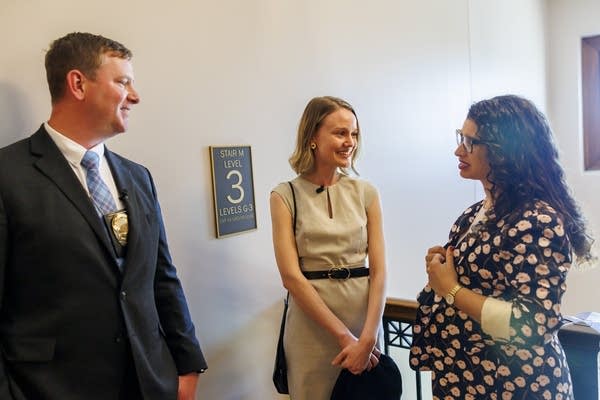
people stand and embrace
Hannah LoPresto and Sen. Erin Maye Quade talk after the Senate passes anti-grooming legislation on Friday.
Kerem Yücel | MPR News


Source link

Leave a Reply

Subscribe to Our Newsletter

Get our latest articles delivered straight to your inbox. No spam, we promise.

Recent Reviews


Speaker of the House Mike Johnson, R-La., takes questions at a news conference at the U.S. Capitol on April 21, 2026.

Speaker of the House Mike Johnson, R-La., takes questions at a news conference at the U.S. Capitol on April 21, 2026.
Speaker of the House Mike Johnson, R-La., takes questions at a news conference at the U.S. Capitol on April 21.
J. Scott Applewhite | AP

The House of Representatives voted Thursday to reopen most of the Department of Homeland Security, ending the longest agency shutdown in U.S. history.

The House passed a bill funding DHS, minus dollars for Immigration and Customs Enforcement and Customs and Border Protection. The measure passed by voice vote on what was the 76th day of the shutdown.

Democrats refused to back funding for many of the agency's immigration functions in an unsuccessful effort to secure reforms including body-worn cameras and broad restrictions on face coverings after federal law enforcement killed two American citizens in Minnesota earlier this year.

The Senate, led by Republican Majority Leader John Thune, R-S.D., unanimously advanced this funding legislation in March. At the time, Speaker Mike Johnson, R-La., referred to the proposal as "a joke" and refused to bring it up for a vote. Many members of the House Republican conference refused to fund the agency in a piecemeal fashion and did not want to negotiate over reforms to immigration enforcement operations.

On April 1, Johnson reversed course. He announced the funding bill would be voted on "in the coming days." More than four weeks later, he finally made good on that commitment.

In an effort to appease his hardline members, Johnson waited to bring the Senate's proposal to a vote until that chamber's Republicans started the arcane procedural process, known as reconciliation, to fund all of DHS — including Immigration and Customs Enforcement (ICE) and Customs and Border Protection (CBP) — for the remainder of Trump's term without any backing from Democrats.

The funding bill comes as Secretary of Homeland Security Markwayne Mullin warned the agency was close to running out of funds to pay staff.

"We have reached all the emergency funds we can reach into," Mullin told Fox News on Friday. "I am completely out of the slush fund, I have no place to move at the end of the month."

Mullin said the agency was relying on appropriated funds from last year's One Big Beautiful Bill, which allocated more than $150 billion to DHS on top of its regular annual appropriations funding.

President Donald Trump signed a memo this month authorizing DHS to use some of the money from that legislation to fund the department's operations — potentially infringing on the powers granted to Congress by the Constitution to direct how taxpayer money is spent.

Copyright 2026, NPR


Source link