

App allows NE Minnesota transit users to book rides


train window showing people

Arrowhead Transit, the largest rural transportation network in Minnesota, launched a new mobile app this month that allows users to book trips on their smart phones and track the bus in real-time to see how close it is to picking them up.

The technology is a game-changer for many of the thousands of people who rely on public transportation in the huge 10-county region that Arrowhead Transit serves. It provides bus service spanning from the Canadian border to counties just north of the Twin Cities metro area. At more than 20,000 square miles, it’s the second-largest public transit network by geography in the country.

“I actually love it,” Grand Rapids resident Krissy Starkey, 50, said of the app. She relies on Arrowhead Transit for rides to and from work and to run errands around town.

Starkey said it saves a lot of time to schedule a bus ride on her phone, rather than having to call an operator for an appointment. “Because when you call, you’re on hold for like ten minutes, maybe longer,” Starkey said.

Before the app, the only way people could schedule rides was to call Arrowhead Transit’s dispatch system. At the busiest times, wait times were “sometimes more than you would like,” conceded transit director Brandon Nurmi.
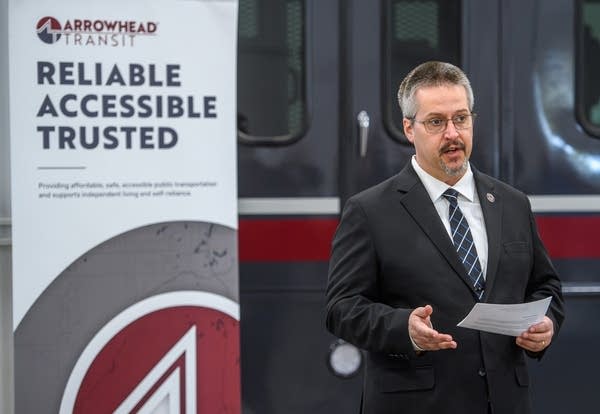
man talking in front of train
Arrowhead Transit Director Brandon Nurmi speaks at an event in Hibbing on May 4, to launch a new mobile app that allows users to book trips and receive notifications on their smart phones.
Courtesy of Arrowhead Transit

Another huge benefit — customers can now track in real-time the location of their bus, and when it’s going to arrive to pick them up. With the old system, users had to wait outside during a 10-20 minute window when their bus was expected to arrive.

Having to stand outside in the extreme cold of a northern Minnesota winter “was a real concern and problem for our customers,” Nurmi said. Now the app lets them know, “hey, it's here, and you just go out.”

Unlike transit systems in larger metro areas that are built around fixed routes and high-density corridors, many rural transit systems offer “dial-a-ride” service, where people schedule their rides over the phone, or now in Arrowhead Transit’s case, through the app.

The bus picks them up wherever they are, and drops them off where they want to go. Arrowhead Transit offers that service within 14 larger communities throughout its service area, including Virginia and Hibbing on the Iron Range, Two Harbors and Grand Marais along the North Shore, Ely, Grand Rapids, Cambridge and other cities.

Arrowhead Transit also offers commuters rides between different cities in the service territory. Buses will also deviate from established routes by up to three quarters of a mile to pick people up at their homes.

“This is about more than a new app,” Nurmi added. “It’s about improving how people access transportation in rural communities and making our system easier to use in everyday life.”

Transit officials say the new system will also give dispatchers and drivers better tools for scheduling and routing, and helps the agency collect more data on how riders use the service, which can be used to guide future planning.

“This system… helps us schedule more efficiently, and creates a better experience for the people who depend on us,” said Sandra Wheelecor, Arrowhead Transit’s operations director.




Source link

Leave a Reply

Subscribe to Our Newsletter

Get our latest articles delivered straight to your inbox. No spam, we promise.

Recent Reviews


Speaker of the House Mike Johnson, R-La., takes questions at a news conference at the U.S. Capitol on April 21, 2026.

Speaker of the House Mike Johnson, R-La., takes questions at a news conference at the U.S. Capitol on April 21, 2026.
Speaker of the House Mike Johnson, R-La., takes questions at a news conference at the U.S. Capitol on April 21.
J. Scott Applewhite | AP

The House of Representatives voted Thursday to reopen most of the Department of Homeland Security, ending the longest agency shutdown in U.S. history.

The House passed a bill funding DHS, minus dollars for Immigration and Customs Enforcement and Customs and Border Protection. The measure passed by voice vote on what was the 76th day of the shutdown.

Democrats refused to back funding for many of the agency's immigration functions in an unsuccessful effort to secure reforms including body-worn cameras and broad restrictions on face coverings after federal law enforcement killed two American citizens in Minnesota earlier this year.

The Senate, led by Republican Majority Leader John Thune, R-S.D., unanimously advanced this funding legislation in March. At the time, Speaker Mike Johnson, R-La., referred to the proposal as "a joke" and refused to bring it up for a vote. Many members of the House Republican conference refused to fund the agency in a piecemeal fashion and did not want to negotiate over reforms to immigration enforcement operations.

On April 1, Johnson reversed course. He announced the funding bill would be voted on "in the coming days." More than four weeks later, he finally made good on that commitment.

In an effort to appease his hardline members, Johnson waited to bring the Senate's proposal to a vote until that chamber's Republicans started the arcane procedural process, known as reconciliation, to fund all of DHS — including Immigration and Customs Enforcement (ICE) and Customs and Border Protection (CBP) — for the remainder of Trump's term without any backing from Democrats.

The funding bill comes as Secretary of Homeland Security Markwayne Mullin warned the agency was close to running out of funds to pay staff.

"We have reached all the emergency funds we can reach into," Mullin told Fox News on Friday. "I am completely out of the slush fund, I have no place to move at the end of the month."

Mullin said the agency was relying on appropriated funds from last year's One Big Beautiful Bill, which allocated more than $150 billion to DHS on top of its regular annual appropriations funding.

President Donald Trump signed a memo this month authorizing DHS to use some of the money from that legislation to fund the department's operations — potentially infringing on the powers granted to Congress by the Constitution to direct how taxpayer money is spent.

Copyright 2026, NPR


Source link