
97% of children in the UAE already use digital devices. As of January 2027, every platform they touch, whether social media, gaming, streaming, or e-commerce, must prove it is protecting them. Not with a checkbox. Not with a date-of-birth field. With real-time, auditable systems that regulators can inspect at any time.
If your app, platform, or digital service is accessible to UAE users, whether you are headquartered in Dubai or San Francisco, the UAE Child Digital Safety Law applies to you. And the clock has been running since 1 January 2026.
This guide covers everything your team needs: what the law requires, how it affects specific platform types, the technical systems you must build, the penalties for non-compliance, and a step-by-step checklist to assess your readiness before full enforcement in January 2027.
What Is the UAE CDS Law and Why Now?
The UAE enacted (the CDS Law) in October 2025. It came into force on 1 January 2026, giving businesses a one-year grace period. Full enforcement begins on 1 January 2027.
The law is not the product of a single incident. It reflects a years-long recognition that the rapid digitalisation of everyday life has outpaced child protection infrastructure. With 97% of children in the UAE already using digital devices and one of the world’s fastest-growing digital economies, the government made a strategic decision to act before harm compounds.
The CDS Law is part of a global convergence around child online safety. It aligns closely with the EU Digital Services Act, the UK Online Safety Act, and Australia’s Online Safety Act, all of which impose proactive duties of care on digital platforms. What makes the UAE framework notable is its comprehensiveness: age assurance, data privacy, content moderation, parental controls, and governance are addressed in a single law.
Who governs enforcement?
Two bodies share responsibility. The oversees platform and ISP compliance. The Child Digital Safety Council, chaired by the Minister of Family, coordinates national strategy, platform classification, and policy alignment across federal and local entities.
Does This Law Apply to Your Platform?
This is the question international teams most often get wrong. The CDS Law uses a dual-nexus trigger: it applies to any platform that is operating within the UAE OR targeting users in the UAE. Both conditions independently bring a platform into scope.
You do not need a UAE entity, a UAE business licence, or a UAE server. If your users include UAE residents and your platform is accessible to them, you are in scope. This is identical to the extraterritorial logic of the EU’s GDPR.
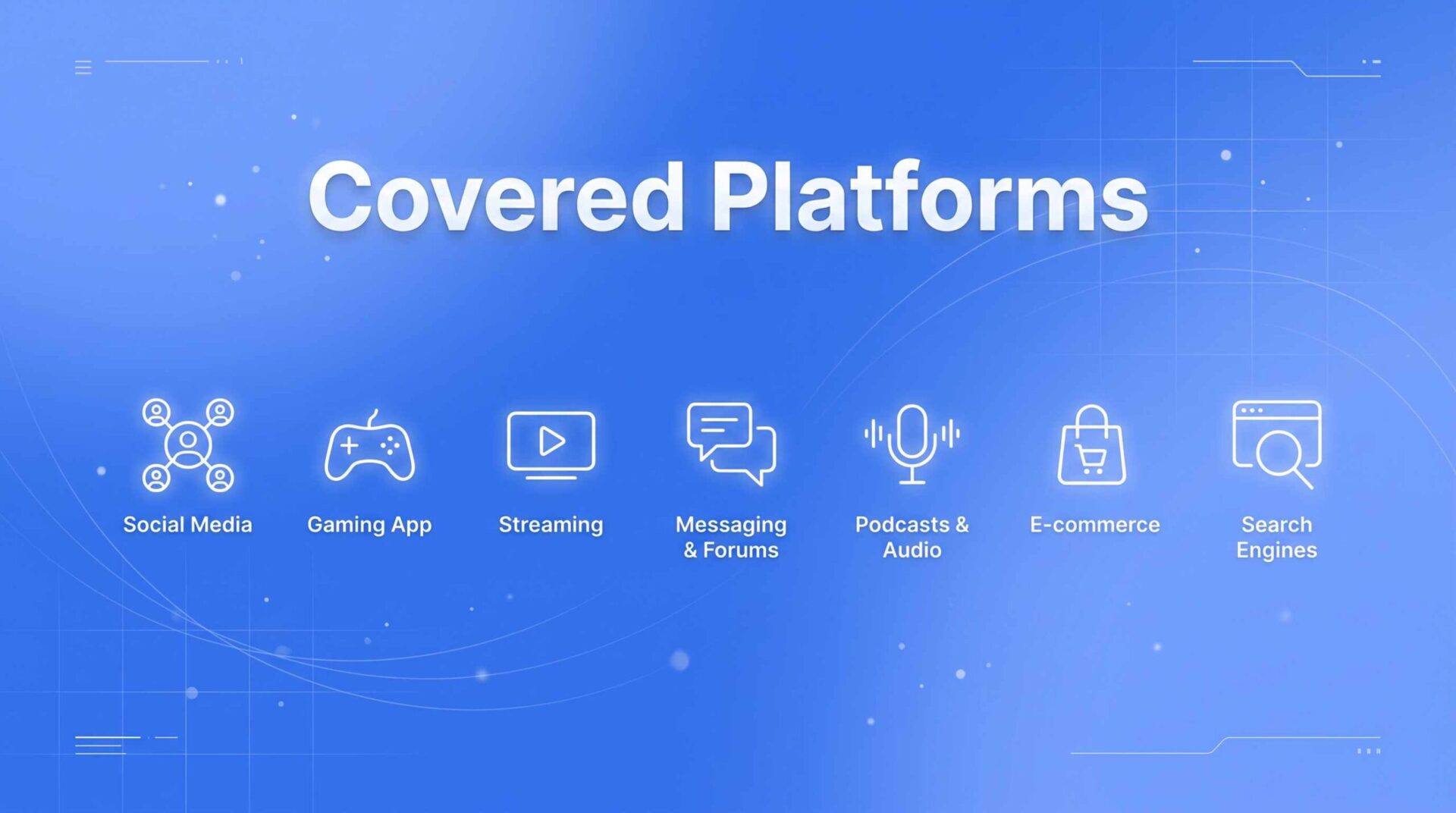
Covered platform types (non-exhaustive)
| Platform type | Examples / scope notes |
| Social media platforms | Instagram, TikTok, Snapchat equivalents and all UGC-driven networks |
| Gaming apps | Mobile, PC, console and browser games, especially those with UGC, chat, or in-app payments |
| Streaming & video on demand | Netflix-style services, YouTube alternatives, live-streaming platforms |
| Messaging & forums | WhatsApp-style apps, community forums, Discord-type platforms |
| Podcasts & audio | Spotify-style platforms and standalone podcast applications |
| E-commerce marketplaces | Amazon-style platforms, reseller apps, digital goods stores |
| Search engines | Any engine that surfaces user-generated or indexed third-party content |
| Smart applications | Any UAE App Store-distributed app with user interaction features |
Risk Tiers: How Your Platform Will Be Classified
The CDS Law introduces a risk-based classification system, to be issued via Cabinet Resolution. Platforms will be categorised by content type, scale of use, reach, and potential impact on children. Your tier determines the strictness of your obligations.

| Platform type | Likely risk tier & rationale |
| Social media with UGC | High: broad reach, user-generated content, direct child interaction |
| Gaming (with chat / loot boxes) | High: financial mechanics, addiction risk, peer communication |
| Live-streaming services | High: real-time content, unpredictable, large audience |
| Video-on-demand / SVOD | Medium-High: curated content, age-tiered libraries |
| E-commerce (child-facing) | Medium: payment data, targeted marketing exposure |
| B2B SaaS / professional tools | Low: limited child access, professional use context |
Age Verification: The Most Complex Technical Requirement
Age verification is where most platforms face their largest compliance gap: not because the tools do not exist, but because the standard the CDS Law requires is far more demanding than what most apps currently implement.
A date-of-birth field has no evidentiary value under CDS. A self-reported checkbox fails completely. The law requires verifiable proof tied to trusted identity signals within the UAE digital identity ecosystem. Every verification decision must produce a traceable, auditable record.
Platforms running , which performs only a one-time check at onboarding with no re-validation, will need to redesign their identity architecture entirely. This is not a configuration change; it is a rebuild.
Accepted verification methods in the UAE
| Method | How it works in the UAE |
| UAE Pass federation | Verification via the UAE government’s national digital identity app, the gold standard for UAE-resident identity assurance |
| Telco-backed SIM identity | Verification linked to SIM registration data from du or Etisalat (e&), reliable for UAE mobile users |
| Biometric facial estimation | AI-powered age range estimation, used as a supporting signal layer rather than a standalone method |
| Verified KYC datasets | Bank-grade KYC data from DIFC and ADGM-regulated financial institutions: the strongest signal for high-risk platforms |
The integration is increasingly the preferred path for regulated platforms. It provides government-issued identity confirmation with a single API handshake, and is already trusted by UAE users across banking, government, and healthcare applications.
Integration Architecture: Building It Into Your Stack
Age verification is a product engineering challenge, not just a legal one. The most common compliance failures come from poor integration, not missing tools. Our and teams have seen this pattern repeatedly: platforms verify age in isolation but fail to propagate that decision across the service layer. A user who passes age verification at login can still access restricted content through an unguarded API endpoint.
The four integration requirements
- API gateway enforcement: , not merely at the user interface. Every request to restricted content must pass through a verification gate, not only the login screen.
- SDK-level integration: For , verification must be embedded directly into iOS and Android SDKs. The native app layer is the primary attack surface for age circumvention.
- Shared decision layer: All services and microservices must act on the same verified identity state in real time. Siloed verification that does not propagate across services creates exploitable gaps.
- UAE-hosted audit logs: Data residency is a hard requirement. All verification events, identity records, and audit logs must be stored within UAE infrastructure and available for regulatory inspection at any time.
Ailoitte’s approach
Every CDS integration we build goes through our AI Velocity Pod delivery model with agentic QA pipelines validating the enforcement logic on every commit. Compliance-grade verification requires testing at the same standard as payment infrastructure, not a post-launch afterthought.
Child Data Privacy: What You Can and Cannot Do
The CDS Law establishes a strict privacy framework for children under 13 that operates on top of the UAE Personal Data Protection Law (Federal Decree-Law No. 45 of 2021). The child privacy obligations are immediately enforceable from January 2027.
Prohibited without verified parental consent
- Collecting, processing, publishing, or sharing personal data of children under 13
- Using children’s data for commercial purposes, including targeted advertising
- Tracking children’s behaviour beyond the explicitly authorised purpose of the service
- Sharing data with third parties without separate documented consent
What verified parental consent requires

Consent must be explicit, documented, and withdrawable at any time. It cannot be implied by account creation or buried in terms of service. The mechanism for withdrawing consent must be as simple and visible as granting it.
Platforms managing consent at scale, across thousands of child accounts, need more than a database field. A enables structured consent record management, audit-ready event logs, and automated withdrawal workflows: the operational backbone of CDS data privacy compliance. If you are evaluating whether to build this infrastructure in-house, our guide on covers the data architecture, feature set, and integration considerations that apply directly to regulated platform needs.
Privacy-by-default is the baseline: every children’s account must launch with maximum privacy settings. Users or caregivers can reduce privacy, but the default state must be the most protective option available.
Content Moderation: Proactive, Not Reactive
Platforms cannot wait for users to report harmful content before acting. They must deploy technical systems capable of detecting and removing harmful content before it reaches child users.
What platforms must implement
- AI and machine learning systems for proactive detection of harmful content, including CSAM, violence-inciting content, and content threatening children’s moral or psychological welfare
- User-facing reporting tools that are clearly visible, accessible without multiple steps, and functional on all platform surfaces
- Immediate reporting workflows to UAE authorities on CSAM detection, with defined response timelines
- Periodic transparency reports to TDRA on measures taken, content removed, and compliance status
Ailoitte’s include automated OWASP security scanning and content validation on every pull request, a pattern that translates directly to CDS-compliant content governance workflows.
The algorithm requirement
Platforms must ensure recommendation algorithms do not promote addictive behaviour or direct children toward restricted content. Commercial gambling mechanics, including loot boxes and variable-ratio reward systems accessible to under-18 users, are explicitly prohibited.
Parental Controls: Mandated Product Features
Parental controls under the CDS Law are not optional add-ons. They are baseline product requirements for every covered platform, and they must be genuinely discoverable. Buried settings pages do not satisfy the legal standard.
Required parental control features
- Daily time limits: tools that allow caregivers to set and enforce maximum daily usage durations
- Mandatory break mechanisms: automatic interruptions at defined usage thresholds
- Account supervision and monitoring: caregivers must be able to view activity summaries and content accessed
- Content blocking and filtering by age group: granular controls for caregivers by content category
- Caregiver account linkage: for ISPs, caregivers must sign terms of service for child accounts
Our team recommends designing parental control dashboards as first-class product surfaces rather than settings panels. Apps like Google Family Link and Apple Screen Time have set user expectations; the CDS Law now makes that standard a legal minimum.
Penalties: What Non-Compliance Actually Costs You
The CDS Law is unambiguous on consequences. Non-compliance does not result in a warning letter. It results in regulatory action that can permanently damage a platform’s ability to operate in the UAE market.
Enforcement powers already in the law
- Partial blocking: restricting access to specific features or services for UAE users
- Full service blocking: complete removal from UAE networks, executed at ISP level
- Suspension: temporary shutdown pending compliance remediation
- Permanent closure: in the most serious cases, withdrawal of the ability to operate in the UAE
An Administrative Penalties Regulation is being prepared by Cabinet and will define the financial penalty structure. The service blocking and closure powers, however, are already active in the law.
The publishes compliance reports on both local and international platforms. Non-compliant platforms will be publicly named, a significant reputational risk for global consumer brands, particularly as ESG and child safety records come under increasing scrutiny from investors and partners.
Beyond reputational exposure, non-compliance creates an operational problem: when the TDRA requests documentation of consent records, verification events, and caregiver interactions, platforms without a structured system face a scramble to produce evidence under pressure. Platforms already running Salesforce or HubSpot can extend their existing stack with an that auto-logs compliance interactions and caregiver communications, turning infrastructure they already own into an audit-ready compliance record system without a full rebuild. Platforms starting from scratch should consider a designed around their specific compliance data model.
Global Context: How CDS Fits the Worldwide Regulatory Picture
UAE CDS 2027 is part of a global regulatory convergence around child online safety. Understanding where it sits helps multinational teams prioritise work and avoid duplication.
| Framework | Key obligations and comparison to CDS |
| EU Digital Services Act (DSA) | Risk-based framework, algorithmic transparency, age assurance for VLOPs. Platform risk assessment methodology is closely analogous to the UAE tier classification |
| UK Online Safety Act (OSA) | Proactive duty of care, Ofcom codes, age verification for pornography. Similar continuous-verification philosophy to CDS |
| Australian Online Safety Act | Takedown obligations, Basic Online Safety Expectations, age assurance trials. Narrower scope than CDS |
| UAE CDS Law 2027 | All of the above combined: age assurance, algorithmic transparency, parental controls, data privacy, and content moderation in one framework with a single enforcement body (TDRA) |
| US COPPA | Data privacy for under-13s, narrower scope, no proactive content duty or continuous verification requirement |
For teams that have already mapped DSA or UK OSA obligations, UAE CDS compliance is not a separate silo. What differs is the specific implementation: UAE Pass as the identity standard, TDRA as the regulator, and UAE-hosted audit logs as a hard data residency requirement.
How Ailoitte Helps You Get CDS-Ready
Ailoitte is a leading AI-native product engineering partner with proven delivery experience in regulated digital products across the UAE, GCC, and 21 countries. With a team deeply embedded in the UAE technology ecosystem, Ailoitte has built compliance-grade systems for platforms in fintech, gaming, e-commerce, and healthcare: products where security and regulatory adherence are non-negotiable.
Every engagement runs through our delivery model: senior architects, governed AI workflows, and that validate compliance logic on every commit. The result is faster delivery with fewer defects, producing an audit trail regulators can inspect.
What we build for CDS 2027 compliance
| Service | What it delivers |
| Age Verification SDK | Continuous, multi-signal verification using UAE Pass integration, biometric estimation, and KYC, deployed at the SDK and API gateway layer for iOS and Android |
| Parental Control Dashboards | Full-featured caregiver interfaces built to CDS regulatory standard: time limits, content controls, activity monitoring, and account supervision |
| Audit Log Infrastructure | UAE-hosted, real-time audit logging for every identity and access decision, structured for TDRA inspection with full queryability |
| AI Content Moderation Layer | Proactive detection, automated reporting workflows, and takedown execution, built on models trained for UAE content standards |
| CDS Compliance Audit | A full technical and legal gap analysis of your current platform against CDS requirements, with a prioritised remediation plan delivered in 5 business days |
| Consent & Compliance CRM | Custom CRM system or AI automation layer on your existing Salesforce/HubSpot: structured consent record management, caregiver interaction logs, and audit-ready data for TDRA inspection |
Our include a healthcare platform serving 53M+ members with 100% compliance rate, a fintech platform distributed across 200K+ advisors, and a mobile-first job platform scaled to 50M+ users. These are the engineering benchmarks we bring to every CDS engagement. Explore our to see how the Velocity Pod system works. For platforms that need to manage compliance data, consent records, and caregiver relationships at enterprise scale, explore our and capabilities.
Conclusion
The platforms that will struggle most with UAE CDS 2027 are those that treat it as a legal compliance task, something to hand to the legal team and resolve with a policy update. The law’s requirements do not resolve at the document layer. They resolve at the code layer.
Age verification must be engineered into your API infrastructure. Parental controls must be designed into your product, not bolted on. Audit logs must be built into your data architecture. Content moderation must be trained, tested, and integrated into your content pipeline. These are product engineering deliverables, and they take time.
The UAE digital market is one of the most dynamic and opportunity-rich in the world. CDS 2027 is not a barrier to operating in it. It is the baseline expectation for every serious platform that wants to be part of it.
Ailoitte is ready to help you get there. Let’s Start with a free audit
FAQs
Does UAE CDS 2027 apply to apps and platforms based outside the UAE?
Yes. The CDS Law uses a dual-nexus rule: it applies to any platform operating within the UAE OR targeting users in the UAE. A business headquartered in Europe, India, or the US with UAE users is in scope regardless of having no UAE entity or UAE servers. This is the same extraterritorial logic used by the EU’s GDPR.
What is the deadline for UAE CDS 2027 compliance?
The CDS Law came into force on 1 January 2026 and includes a one-year grace period. Full enforcement begins on 1 January 2027. Platforms that are not compliant by that date are exposed to service blocking, suspension, and financial penalties under the forthcoming Administrative Penalties Regulation.
What age verification methods are accepted under UAE CDS 2027?
The CDS Law requires verifiable, auditable verification signals, not self-reported data. Accepted methods include federation (the UAE government’s national digital identity app), telco-backed SIM identity linked to du or Etisalat registration, biometric facial estimation, and bank-grade KYC datasets from DIFC or ADGM-regulated institutions. A date-of-birth field has no evidentiary value.
What happens if my platform is non-compliant after January 2027?
Non-compliance exposes your platform to partial or full service blocking in the UAE. UAE ISPs (du and Etisalat) can be directed to block access to your service. Additional consequences include suspension, closure, and financial penalties under the Administrative Penalties Regulation being prepared by Cabinet. The TDRA also publishes compliance reports publicly naming non-compliant platforms.
How does Ailoitte help with UAE CDS 2027 compliance?
Ailoitte’s and teams build the full technical stack for CDS compliance: age verification SDKs integrated at the API gateway layer, parental control dashboards, UAE-hosted audit log infrastructure, and AI content moderation layers. Every build runs through our to validate compliance logic before production. We offer a free CDS readiness audit as the starting point.
Is a one-time KYC check at onboarding enough for CDS 2027?
No. This is the most common compliance gap. CDS 2027 requires continuous verification: re-validation tied to session activity, content type, and risk level. A user verified once at onboarding who later accesses restricted content without re-verification does not meet the standard. Every verification event must also generate an auditable log stored in UAE-hosted infrastructure.
What parental controls must digital platforms provide under UAE CDS?
Platforms must provide daily time limits, mandatory break mechanisms, account supervision tools, content blocking by age group, and usage monitoring for caregivers. These are not optional premium features. They are baseline product requirements and must be prominently visible to caregivers rather than buried in settings menus.
How does UAE CDS 2027 compare to the EU Digital Services Act?
Both laws are risk-based, require age assurance, and impose algorithmic transparency obligations. The key differences: CDS combines content moderation, data privacy, parental controls, and age assurance in one framework (the DSA separates these); CDS uses and UAE-specific identity infrastructure; and CDS has a single enforcement body (TDRA) rather than multiple EU national regulators. For multinationals, DSA and CDS compliance work is largely compatible as the same risk assessment methodology applies.

Discover how Ailoitte AI keeps you ahead of risk

Ravi Ranjan
Ravi Ranjan is a seasoned Mobile Lead specializing in Flutter, iOS, and Android development. With 8+ years of experience, he has built and scaled high-performance mobile apps used by global audiences.

Stephan is the sports journalist for the Maple Grove Report.