
Key Takeaways
- LMS market growth: According to MarketsandMarkets, the global LMS market is set to grow from $30.07 billion in 2025 to $88.41 billion by 2032, at a CAGR of 16.6%.
- Custom = control: Custom LMS development gives your organisation complete ownership over features, data, branding, integrations, and long-term roadmap.
- Enterprise vs Traditional: Enterprise LMS supports 5,000 to 500,000+ users with multi-tenancy, SSO, BI analytics, and deep ERP/HRMS integrations. Traditional LMS serves simpler, smaller needs.
- Development cost range: LMS development costs range from $15,000 for an MVP to $300,000+ for enterprise platforms, with annual maintenance running at 15-20% of initial build cost.
- Timeline: A well-scoped MVP takes 12-16 weeks. Full-featured enterprise platforms typically take 6-12 months.
- Right partner matters: The LMS development company you choose determines not just the quality of the first release, but how well the platform scales, integrates, and evolves over time.
Why LMS Development Is the Smartest Investment You Can Make Right Now
The way people learn has fundamentally changed. Corporate training, academic education, and professional upskilling have all migrated online, and the numbers tell a compelling story. According to MarketsandMarkets, the global LMS market is projected to grow from $30.07 billion in 2025 to $88.41 billion by 2032, at a CAGR of 16.6%. For context, this is faster than cloud computing, cybersecurity, and most enterprise software categories. Businesses that fail to build scalable digital learning infrastructure today will find themselves scrambling to catch up tomorrow.
At the heart of every successful digital learning strategy sits a powerful Learning Management System. Whether you are a growing startup, a large enterprise, or an educational institution, investing in professional LMS development is no longer optional; it is a competitive necessity.
This complete guide walks you through everything you need to know: what LMS development actually involves, the features that make or break a platform, the real cost breakdown, how enterprise LMS differs from traditional platforms, and a step-by-step look at the development process. We also introduce you to Ailoitte, a leading LMS development company with a proven track record of building high-performance learning platforms for clients across industries.
What Is LMS Development?
LMS development refers to the process of designing, building, and deploying a Learning Management System, a software platform that enables organisations to create, deliver, manage, and track educational content and training programmes.
Unlike purchasing an off-the-shelf solution, custom LMS development gives your organisation full control over features, user experience, branding, integrations, and scalability. You are not locked into vendor pricing models or constrained by a platform that was built for someone else’s use case.
Types of LMS Platforms
Before diving into development, it helps to understand the different deployment models available:
▸ Cloud-Based LMS: Hosted on cloud infrastructure (AWS, Azure, GCP), accessible via browser, with no hardware requirements. Ideal for distributed teams and rapid scaling.
▸ Self-Hosted / On-Premise LMS: Deployed on the organisation’s own servers. Preferred by enterprises with strict data governance and compliance requirements.
▸ Open-Source LMS: Built on platforms like Moodle or Open edX, then customised heavily. Lower upfront cost but significant development overhead.
▸ SaaS-Based LMS: Subscription model, quick to deploy, but limited customisation. Best for small organisations with standard needs.
Industries Leading LMS Adoption
- EdTech and higher education
- Corporate HR and compliance training
- Healthcare and pharmaceutical training
- Banking, finance, and insurance
- Manufacturing and retail onboarding
- IT and software services
Key Features of a Modern LMS
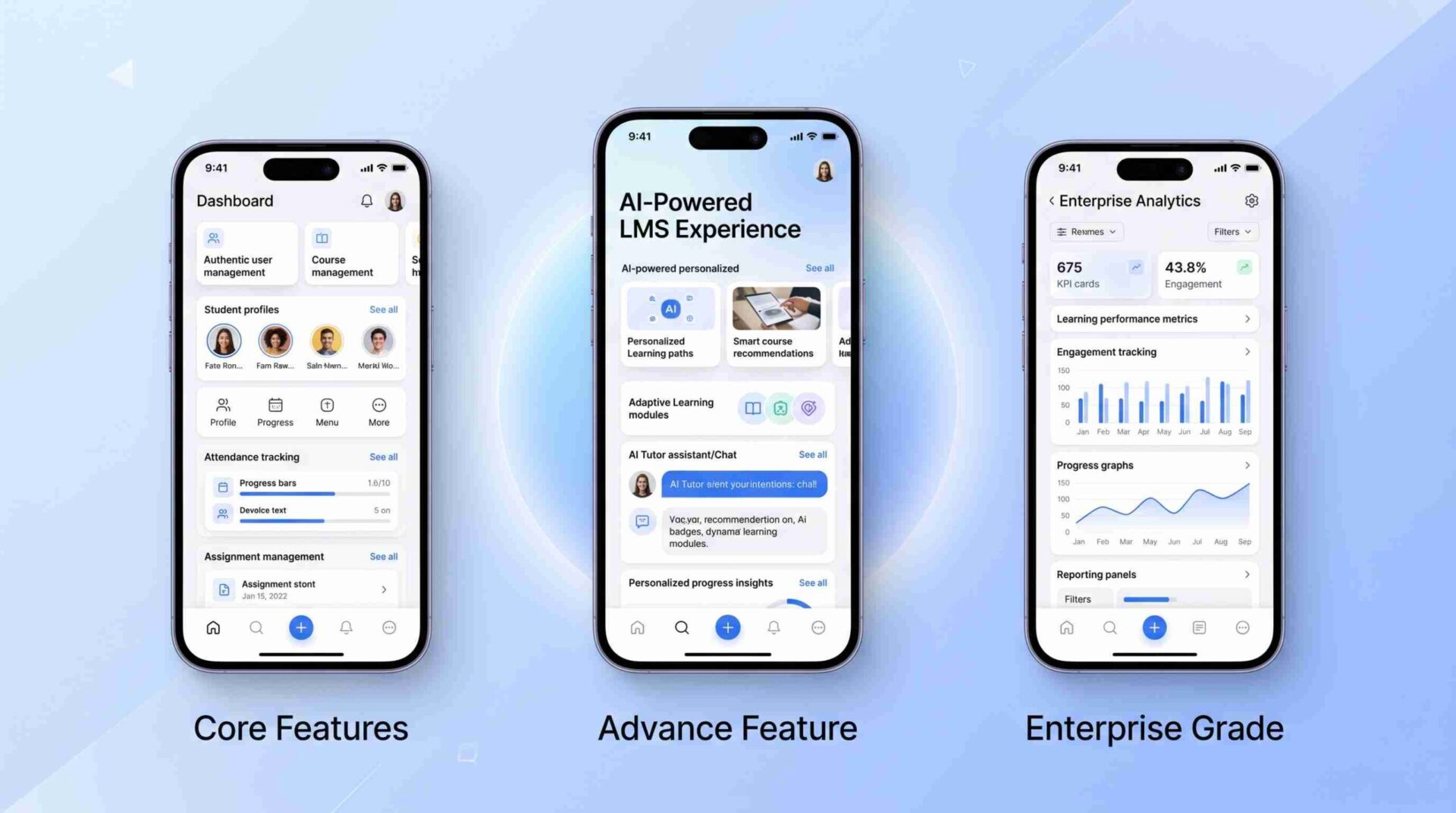
The success of your LMS development project depends heavily on the features you prioritise. Below is a breakdown of the core, advanced, and enterprise-grade capabilities every competitive platform should consider.

Core Features Every LMS Needs
- User Management and Role Control: A well-built LMS separates administrators, instructors, and learners with distinct role-based permissions, dashboards, and access levels.
- Course Builder and Content Management: Intuitive drag-and-drop course creation tools, support for video, PDFs, SCORM packages, quizzes, and multimedia presentations.
- Assessment and Quiz Engine: Configurable question types, automated grading, assignment submissions, and performance analytics tied to each learner’s profile.
- Progress Tracking and Reporting: Real-time dashboards that show completion rates, assessment scores, time-on-course metrics, and certification status, for both learners and administrators.
- Certification and Badging: Automated certificate generation upon course completion, with support for digital badges that learners can share on LinkedIn and professional networks.
- Notifications and Communication: Email and in-app notifications for deadlines, new course releases, assignment feedback, and announcements.
Advanced Features That Differentiate Great LMS Platforms
- AI-Powered Personalised Learning Paths: Machine learning algorithms analyse learner behaviour, performance gaps, and preferences to recommend the right content at the right time. This is the feature that separates modern LMS development from legacy platforms.
- Gamification: Points, leaderboards, badges, streaks, and challenge modes increase learner engagement dramatically. According to research published by TalentLMS, gamified eLearning programmes achieve completion rates of up to 90%, compared to just 25% for non-gamified courses, a difference that directly affects training ROI.
- Mobile Learning: A mobile-first or responsive LMS ensures learners can access content from any device. For organisations with field teams or remote workers, a native mobile app (iOS and Android) is often non-negotiable.
- Live Classes and Virtual Classrooms: Integration with Zoom, Microsoft Teams, or a built-in virtual classroom feature for synchronous learning alongside asynchronous content.
- SCORM, xAPI, and LTI Compliance: Industry-standard protocols that ensure your LMS can communicate with third-party content libraries, authoring tools, and external systems.
- White-Labelling and Custom Branding: Full control over the platform’s visual identity, including your logo, colours, fonts, and domain, without any trace of the underlying vendor.
- Third-Party Integrations: Deep integration with CRM systems like Salesforce, ERP platforms, HRMS tools like Workday, payment gateways like Stripe, and video hosting services.
Enterprise-Grade Features for Large Organisations
- Single Sign-On (SSO): Employees authenticate once through the organisation’s identity provider (Okta, Azure AD, Google Workspace) and gain seamless access without managing separate credentials.
- Multi-Tenant Architecture: Support multiple business units, client organisations, or franchise locations, each with their own branded portal, learner groups, and reporting, under a single platform instance.
- Advanced Analytics and BI Integration: Export learning data to business intelligence tools like Tableau, Power BI, or Looker for cross-functional reporting that connects training outcomes to business KPIs.
- API-First Architecture: A robust REST or GraphQL API layer allows the LMS to integrate natively with your existing technology stack without friction.
- Security and Compliance: Enterprise LMS development demands GDPR compliance, SOC 2 certification, role-based data access, encrypted data at rest and in transit, and full audit trails.
Benefits of Custom LMS Development
Organisations that invest in a custom LMS development project (rather than subscribing to an off-the-shelf product) consistently report stronger outcomes. Here is why:
Full Feature Control: You build exactly what your learners and administrators need. No bloated features you never use, no missing capabilities that force workarounds.
Scalability on Your Terms: A custom-built LMS grows with your organisation. Whether you go from 500 to 50,000 users or expand to new geographies, the architecture supports your trajectory without per-seat pricing penalties.
Data Ownership and Security: Your learner data stays under your control. For industries with strict compliance requirements, including healthcare, banking, and defence, this is often non-negotiable.
Brand Consistency: A custom LMS looks and feels like part of your product ecosystem, not a third-party tool bolted onto your operations.
Long-Term Cost Efficiency: SaaS LMS platforms charge per user per month. At scale, a custom-built platform often pays for itself within 18 to 24 months compared to ongoing subscription fees.
Seamless Integration: Your LMS connects natively with your HRMS, CRM, ERP, and other business tools rather than relying on fragile middleware or expensive add-ons.
Enterprise LMS vs. Traditional LMS: Which One Does Your Business Need?
One of the most common questions we hear at Ailoitte is: should we build an enterprise-grade platform or start with a traditional LMS? The answer depends on your scale, complexity, and long-term objectives.
| Factor | Traditional LMS | Enterprise LMS |
|---|---|---|
| User Scale | Up to ~5,000 users | 5,000 to 500,000+ users |
| Customisation | Limited or template-based | Fully customisable |
| Integrations | Basic plugins | Deep API integrations (HRMS, ERP, CRM) |
| Security | Standard SSL, basic roles | SSO, MFA, SOC 2, GDPR, audit trails |
| Multi-Tenancy | Typically single-tenant | Multi-tenant architecture standard |
| Analytics | Basic reports | BI-grade dashboards, custom exports |
| Support | Community forums, tickets | Dedicated account management and SLAs |
| Deployment | Cloud-only | Cloud, on-premise, or hybrid |
| Pricing Model | Per-seat monthly subscription | Custom licensing or revenue share |
When a Traditional LMS Makes Sense
If you are a small-to-mid-sized organisation with straightforward training needs, a modest user base, and no complex integrations, a traditional LMS (whether custom-built as an MVP or a lightly customised open-source solution) is often the most efficient starting point.
When Enterprise LMS Development Is the Right Call
If your organisation operates across multiple regions or business units, serves external clients through a white-labelled platform, needs to connect with existing enterprise software like an ERP system, or has strict compliance and data governance requirements, enterprise LMS development is the appropriate investment. The good news: partnering with an experienced LMS development company like Ailoitte means you can architect for enterprise scale from day one, even if you launch with a focused MVP.
Step-by-Step LMS Development Process
Understanding the development lifecycle helps you set realistic expectations, plan your budget, and collaborate effectively with your development partner. Here is how a professional LMS development engagement is structured.
Step 1: Discovery and Requirement Analysis
Everything starts with clarity. Before a single line of code is written, a structured discovery process maps out your business goals, target learners, existing tech stack, compliance requirements, and desired feature set.
Outputs of this phase include a detailed Product Requirements Document (PRD), user personas, competitive analysis, and a prioritised feature list split into MVP (Minimum Viable Product) and future phases.
Step 2: Choose the Right Technology Stack
The technology decisions made here determine your platform’s performance, scalability, and maintainability for years to come.
- Frontend: React.js, Angular, or Vue.js for responsive, fast user interfaces. React Native or Flutter for mobile applications.
- Backend: Node.js for high-concurrency real-time features; Python (Django/FastAPI) for AI and analytics-heavy platforms; Go (Golang) for ultra-performance APIs.
- Database: PostgreSQL for relational data; MongoDB for flexible content structures; Redis for caching and real-time features.
- Cloud Infrastructure: AWS, Microsoft Azure, or Google Cloud Platform, chosen based on your existing enterprise agreements and geographic requirements.
- Video Delivery: Adaptive bitrate streaming via Amazon CloudFront, Cloudflare Stream, or Mux, with HLS support for mobile compatibility.
Step 3: UI/UX Design
Design is not decoration; it is the primary driver of learner engagement and platform adoption. This phase produces wireframes, interactive prototypes, and a complete design system covering typography, colour, component library, and interaction patterns.
For enterprise platforms, this phase also includes accessibility audits (WCAG 2.1 AA compliance) to ensure the platform is usable for all learners, including those with disabilities.
Step 4: Agile Development
Development is executed in focused two-week sprints, with working software demonstrated at the end of each sprint. This allows for early feedback, course corrections, and transparent progress tracking.
A typical LMS development roadmap organises work into clear modules: authentication and user management, course builder, content delivery engine, assessment module, reporting dashboard, notification system, payment integration, and admin panel.
As an outcome-based engineering company, Ailoitte structures every sprint around measurable business outcomes, not just task completion.
Step 5: Quality Assurance and Testing
Rigorous testing is non-negotiable. A multi-layered QA process covers the following areas:
- Functional testing: every feature works as specified
- Performance and load testing: the platform handles peak traffic without degradation
- Security testing: penetration testing, vulnerability scanning, data encryption verification
- Cross-browser and cross-device testing
- SCORM and xAPI compliance validation
Step 6: Deployment and Launch
Production deployment is handled through CI/CD pipelines that enable zero-downtime releases. Staging environments mirror production exactly, allowing final acceptance testing before go-live.
For organisations migrating from a legacy platform, Ailoitte’s expertise in legacy AI modernisation ensures historical learner data, course content, and completion records are migrated accurately and without disruption. A soft launch with a controlled group of beta users generates real-world feedback before full rollout.
Step 7: Post-Launch Support and Continuous Improvement
LMS development does not end at launch. The most successful platforms are those that evolve continuously based on learner behaviour analytics, administrator feedback, and changing business requirements. Ailoitte provides structured post-launch support including a dedicated bug fix window, performance monitoring, quarterly feature updates, and long-term product roadmap consultation.
LMS Development Cost: A Transparent Breakdown
One of the most common questions we receive is: how much does LMS development cost? The honest answer is, it depends. But here is a framework to help you budget accurately.
Factors That Influence LMS Development Cost
- Scope and Feature Complexity: An MVP with core learning features costs significantly less than a full-featured enterprise platform with AI personalisation, multi-tenancy, and advanced analytics.
- Platform Scope: Web-only platforms cost less than projects that also require native iOS and Android applications.
- Team Composition: In-house teams carry higher fixed costs. Partnering with an experienced LMS development company like Ailoitte offers access to specialised talent at predictable project-based pricing.
- Third-Party Integrations: Each integration (payment gateway, video hosting, HRMS, SSO provider) adds development scope.
- Compliance Requirements: GDPR, HIPAA, or SOC 2 compliance work adds to both development and QA scope.
LMS Development Cost Estimates by Platform Type
| LMS Type | Estimated Investment |
|---|---|
| Basic MVP LMS (core features, web only) | $15,000 – $40,000 |
| Mid-Level Custom LMS (advanced features, integrations) | $40,000 – $100,000 |
| Enterprise LMS (multi-tenant, AI features, BI analytics) | $100,000 – $300,000+ |
| Mobile App Addition (iOS + Android, native) | +$20,000 – $50,000 |
| Annual Maintenance (post-launch support) | 15–20% of initial development cost |
Hidden Costs to Plan For
Beyond development, budget for cloud hosting and infrastructure (typically $500–$5,000 per month depending on scale), third-party service licensing (video CDN, SMS, email delivery), content authoring tools if your team creates course content in-house, and annual security audits.
LMS Development Trends for 2026 and Beyond
The LMS development landscape is evolving rapidly. The platforms built today must anticipate where learning technology is heading, not just where it is now.

AI-Driven Personalisation
Large language models are being integrated into LMS platforms to generate personalised learning recommendations, provide conversational tutoring, automatically tag and categorise content, and generate quiz questions from uploaded material. Ailoitte’s deep expertise in AI modernisation positions it uniquely to build AI-native learning platforms.
Microlearning Architecture
Learners increasingly prefer bite-sized modules of 3 to 7 minutes over long-form courses. Modern LMS development now prioritises microlearning-first content structures with spaced repetition engines.
Immersive Learning with AR and VR
Industries like healthcare, manufacturing, and defence are adopting virtual reality training simulations for high-stakes procedures. LMS platforms need to support SCORM-compliant VR content packaging.
Social and Collaborative Learning
Peer-to-peer discussion forums, cohort-based learning groups, expert mentorship matching, and user-generated content features are becoming standard expectations.
Blockchain Credential Verification
Tamper-proof digital certificates issued on blockchain networks that employers can verify instantly, eliminating credential fraud and simplifying background checks.
Learning in the Flow of Work
Deep integrations with productivity tools like Microsoft Teams, Slack, and Salesforce allow learners to access relevant micro-courses without leaving the tools they already use daily.
Ailoitte: A Trusted LMS Development Company
When it comes to building learning platforms that combine technical excellence with genuine business impact, Ailoitte stands apart as a leading LMS development company.
Who Is Ailoitte?
Ailoitte is a AI native product engineering company specialising in EdTech, enterprise software, and AI-powered application development. With a global client base spanning education, healthcare, finance, and retail, Ailoitte brings both the technical depth and domain expertise required to build learning platforms that organisations depend on.
As an outcome-based engineering company, Ailoitte measures every project not by hours billed but by the business outcomes delivered: learner engagement rates, training completion improvements, onboarding time reductions, and compliance pass rates.
Ailoitte’s Approach to LMS Development
Ailoitte’s LMS development methodology is built on three pillars:

- Discovery-First Thinking: Every engagement begins with a structured discovery process that maps business goals to technical requirements, ensuring the platform built is the platform needed, not a generic template dressed up in your brand colours.
- Scalable Architecture from Day One: Whether you are launching a 500-user MVP or a 500,000-user enterprise platform, Ailoitte’s engineering team builds for scale, security, and performance from the first line of code.
- Continuous Partnership: Ailoitte’s post-launch relationship model means your platform evolves as your organisation does, with dedicated engineering support, proactive performance monitoring, and quarterly roadmap reviews.
Proven EdTech Portfolio
Ailoitte’s experience in eLearning app development is demonstrated through real-world EdTech products. The team has successfully delivered a comprehensive school management software platform that streamlines administration, attendance, and academic tracking for educational institutions, and Sanskritly, an innovative language learning platform that brings Sanskrit education to a modern digital audience. These case studies demonstrate Ailoitte’s ability to design and ship learning products that are technically robust, pedagogically sound, and genuinely used by real learners.
Key Differentiators
▸ Custom LMS Development from Scratch: Ailoitte does not resell or lightly customise off-the-shelf products. Every platform is purpose-built for your specific users, workflows, and business model.
▸ Full-Stack EdTech Expertise: From native mobile apps and SCORM-compliant course players to AI recommendation engines and advanced analytics dashboards, Ailoitte’s team covers the full stack of modern LMS development.
▸ Enterprise Integration Specialists: Deep experience integrating LMS platforms with ERP systems, HRMS tools, CRM platforms, and SSO providers means your learning platform works harmoniously with the software your teams already use.
▸ AI-Ready Architecture: Ailoitte’s background in AI modernisation means every LMS they build is designed to support AI features today and incorporate emerging capabilities, including adaptive learning, conversational AI tutors, and automated content generation, as the technology matures.
▸ Transparent Project Delivery: Agile sprints, weekly demos, and real-time project visibility mean there are no surprises. You see working software throughout the project, not just at the end.
Conclusion: The Right LMS Development Partner Changes Everything
The LMS market is growing faster than almost any other enterprise software category. Organisations that build powerful, custom learning platforms today will onboard faster, train more effectively, and retain talent more successfully than those relying on generic subscription tools.
LMS development is not a one-time project; it is an ongoing investment in the most valuable asset your organisation has: the knowledge and capability of your people.
Ailoitte’s team of engineers, designers, and product strategists are ready to partner with you at every stage, from initial discovery and architecture to launch, scale, and continuous improvement. As a purpose-driven LMS development company, Ailoitte brings the technical expertise, EdTech domain knowledge, and long-term partnership mindset your project deserves.
Ready to build your learning platform? Contact Ailoitte today for a free consultation and technical scoping session.
FAQs
How long does LMS development take?
A well-scoped MVP typically takes 12-16 weeks from discovery to launch. A full-featured enterprise LMS with complex integrations may take 6-12 months. The timeline is heavily influenced by feature scope, third-party integration complexity, and the client’s feedback velocity during development sprints.
What is the best tech stack for LMS development?
There is no single answer; the right stack depends on your scale, team, and feature requirements. React.js with a Node.js or Python backend, PostgreSQL database, and AWS or Azure cloud infrastructure is a well-proven combination for most LMS development projects.
Can I start with an MVP and scale later?
Absolutely, and it is often the smartest approach. A well-architected MVP launched in 12-16 weeks validates your platform with real users before larger investment. The key is ensuring the initial architecture is built to scale, not just to ship. This is where choosing the right LMS development company matters enormously.
What is the difference between SCORM and xAPI?
SCORM (Sharable Content Object Reference Model) is the longstanding industry standard for packaging and tracking eLearning content. xAPI (also called Tin Can API) is its modern successor, capable of tracking a much wider range of learning experiences, including mobile, simulation, and real-world activities. Most modern LMS development projects support both.
How do I choose the right LMS development company?
Look for a company with demonstrated EdTech experience, a portfolio of live learning platforms, a structured discovery process, transparent pricing, and a post-launch support model. Ailoitte checks all of these boxes, and brings AI expertise that positions your platform for the future of learning technology.
What ongoing costs should I budget for after launch?
Plan for cloud infrastructure (scaling with user volume), annual security audits, ongoing maintenance and feature development (typically 15-20% of initial LMS development cost per year), and content creation costs if your team produces learning content in-house.

Discover how Ailoitte AI keeps you ahead of risk

Shubham Swaraj
Shubham is a DevOps Engineer focused on building scalable, secure, and automated cloud environments. He brings hands-on expertise with AWS, Kubernetes, Docker, and CI/CD to streamline deployments and improve system reliability.

Stephan is the sports journalist for the Maple Grove Report.