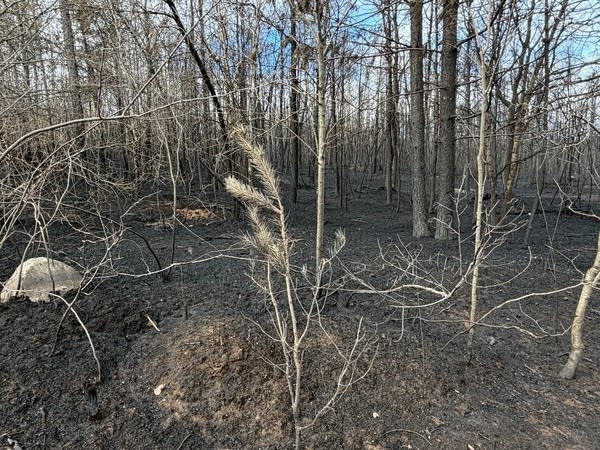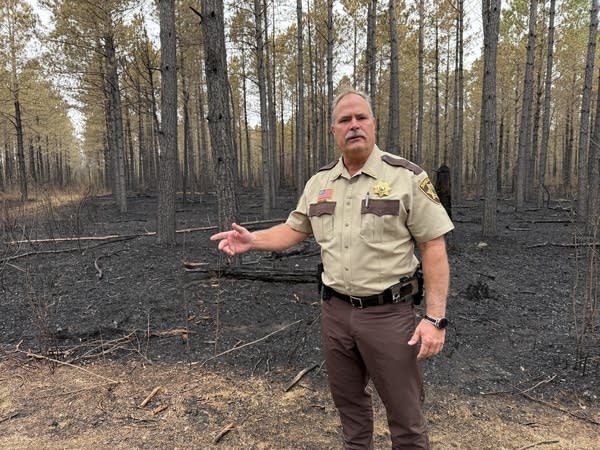
Efforts to combat a wildfire in northern Crow Wing County are beginning to wind down as officials try to pinpoint what caused the massive blaze that burned more than 1,600 acres.
On Tuesday, fire crews continued working to put out remaining hot spots, and residents who live in the evacuation zone were able to return to their homes.
Officials with the Minnesota Incident Command System team said the Flanders fire is 60 percent contained as of Tuesday, but Crow Wing County Sheriff Eric Klang is more optimistic than that.
“There's absolutely no fire,” Klang said Tuesday morning from the command center in Crosslake. “There's smoke in some stumps and stuff like that that are kind of just smoldering, but for the most part it looks good. I've even seen some green growth popping through that blackness.”
He said the Incident Management Team is preparing to transfer firefighting duties back to local authorities.
The Minnesota Department of Natural Resources is leading the investigation into what caused the Flanders Fire, which started Saturday morning and quickly erupted due to dry, windy conditions.
The DNR said on Tuesday that it has located the origin of the fire near the north shore of Flanders Lake in Mission Township, southeast of Crosslake.
The agency said it has identified people of interest in connection with the fire. They could face criminal charges.
Investigators are asking people who live in the area and have trail cameras, doorbell cameras or other information to contact the DNR.
Klang said he believes the source may have been a campfire started near the lake, either Saturday or the night before.
"It looks to me that they probably couldn't be on the lake because it was too windy, so they kind of moved into the woods to get away from that wind,” Klang said. “And then at some point, that started.”
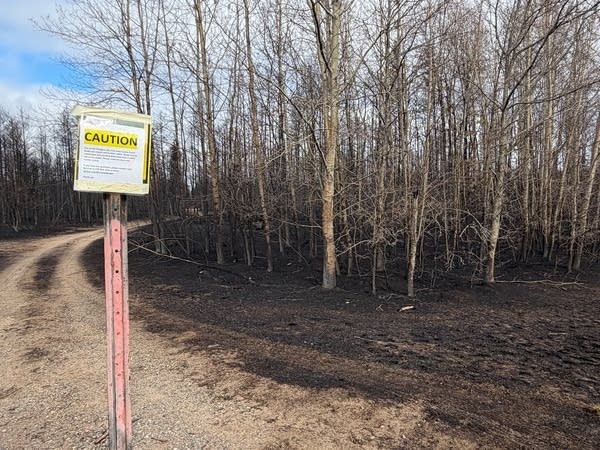
The fire didn't destroy any homes, but a few sustained damage. It did burn some secondary buildings, such as garden sheds.
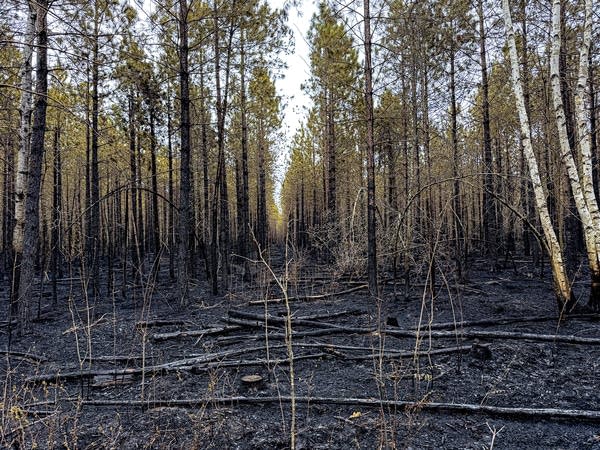
It tore through acres of forest, some owned by Crow Wing County or the state of Minnesota. Rows of charred trees and blackened ground are visible from County Road 11.
At one spot deep in the woods, some people had been camping when the fire broke out. They apparently left in a hurry, abandoning camping gear and an all-terrain vehicle.
"They didn't have time to take anything, because that fire was moving that fast with that amount of intensity,” Klang said.
Homeowners return
Property owners in the evacuation zones were officially allowed to return to their homes on Tuesday, although many had already gone back.
Larry Roberts has owned a cattle ranch in Crosby for nearly 40 years. On Saturday, he was planting corn up the road from the ranch when he smelled something burning, then heard fire trucks.
"I was worried,” Roberts said. “You don't know what's going on or how bad it is. All you see was smoke and flames."
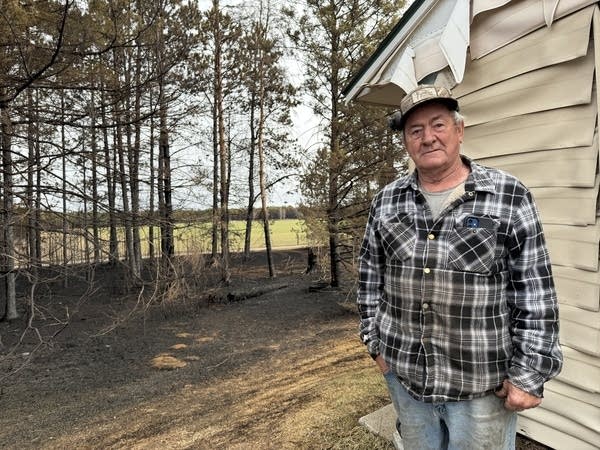
Firefighters told Roberts and his partner, Linda Hill, to leave their home. They drove down the road to watch the fire from a safe distance.
The fire roared right up to the edge of their driveway, close enough to melt the siding on the garage.
Fire crews sprayed the house to keep it from burning. It survived, along with his herd of 75 cattle.
With the surrounding woods now blackened, Roberts’ farm looks much different.
"That's the hardest part,” he said. “You can rebuild a house, but you can't put trees back."
Melanie Simonson had to flee her home on Loon Lake in Mission Township on Saturday, as the fire grew closer. She was relieved when her partner, Ty Nyberg, called her on Sunday to tell her the house was still standing.
"I didn't know what to expect. I was expecting the worst,” Simonson said.
Nyberg told her the fire “didn’t touch a thing of ours.” Although the surrounding woods were burned, the house, garden and nearby fuel tank were undamaged. Simonson can’t believe they were so fortunate.
“I started to cry so hard,” she said.