That tension was at the heart of “Catalyzing Equitable Development through Public-Private Partnership,” one of the Impact in Action site visits held during the Mission Investors Exchange 2026 National Conference in Atlanta. The session introduced attendees to two significant projects — the Atlanta BeltLine and Pittsburgh Yards — as examples of how philanthropy, catalytic capital, public investment, and community engagement can intersect to advance equitable development.
Participants toured a portion of the Atlanta BeltLine with Laura Linman, economic development project manager at Atlanta BeltLine, Inc., before hearing from a panel of public and private partners at Pittsburgh Yards, a community-rooted development site along the BeltLine. The panel included Kelvin Collins, vice president of economic development at Atlanta BeltLine, Inc.; Kevin McGee, family founder of the Urban Oak Initiative; Katrina Mitchell, director of the Atlanta Civic Site at the Annie E. Casey Foundation; and Amanda Jaquez, senior associate at the Annie E. Casey Foundation.
Together, the two projects offered a useful lesson for impact investors and philanthropic capital providers: public-private partnerships can help finance equitable development, but they do not guarantee it. For that, communities must have not only access to the project’s benefits, but also real influence over its direction.
Reconnecting a divided city
Launched in 2005, the Atlanta BeltLine set out to transform 22 miles of former railroad corridors into a network of trails, parks, transit connections, and redevelopment opportunities encircling the city’s urban core. The idea was ambitious: take infrastructure that once supported Atlanta’s industrial economy and use it to reconnect neighborhoods that had become physically, racially, and economically separated.
The project draws on Atlanta’s existing assets — vibrant culture, strong neighborhoods, and underused green spaces — to spur economic development across the city. But the geography of the BeltLine is not neutral. It connects neighborhoods with vastly different racial and economic profiles, including predominantly white areas in the north and northwest and predominantly Black neighborhoods in south and southwest Atlanta.
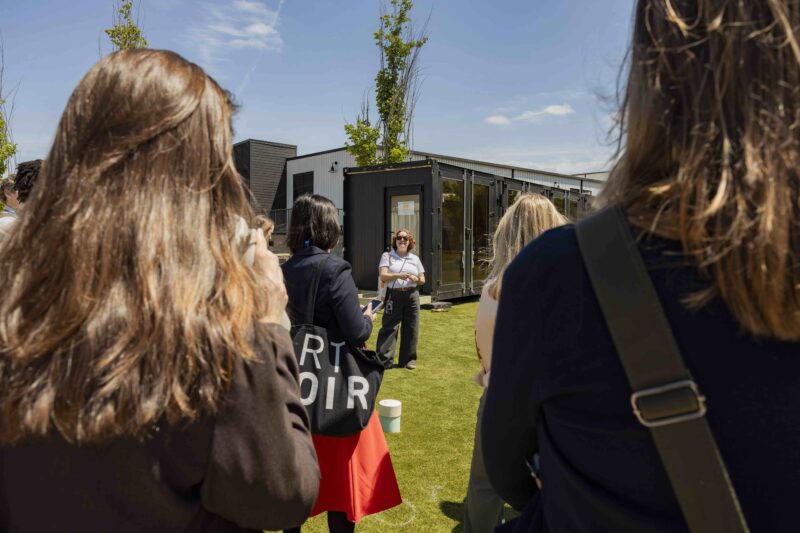
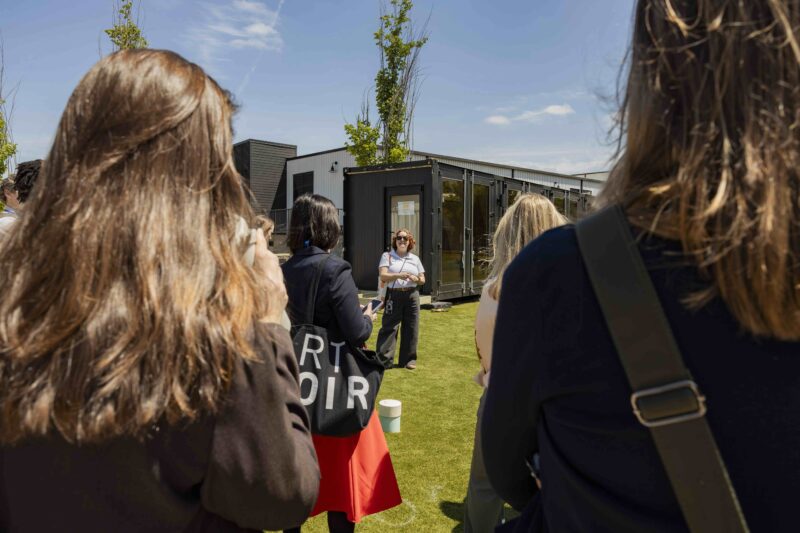
Laura Linman, Economic Development Project Manager at Atlanta BeltLine, Inc., shows attendees around the Container Courtyard along the Atlanta Beltline; Photo by Ashley Gilmer, Divine Eye Media
Those divisions reflect the long legacy of segregation, white flight, disinvestment, and uneven access to capital. The economic gap remains stark. According to figures shared during the session, Black families in Atlanta have an annual median income of $47,397, compared with $131,319 for white families.
Atlanta has also long been cited as one of the most difficult major American cities in which to improve one’s economic position. In that context, physically connecting neighborhoods is not simply a transportation project. It is an attempt to change the social and economic map of the city.
By 2026, the BeltLine had delivered 4,425 affordable housing units, supported 34,470 permanent jobs, and completed 13.6 miles of its planned 22-mile mainline trail. Those numbers help explain why the BeltLine has become a national reference point for urban redevelopment. They also underscore the stakes: if the BeltLine succeeds equitably, it could model how infrastructure can be used to repair historical divides. If it does not, it could become another example of public investment preparing the ground for private gain.
Capital as engine, community as guide
From the beginning, the BeltLine has relied on public-private partnership. Early support came from city resources and philanthropic donors, and the project has continued to use public investment to attract private participation.
“Public-private partnerships are sort of the engine of this work,” said Collins. “The fuel is the funding.”
Atlanta BeltLine, Inc. is an independent entity established by the City of Atlanta to manage development and funding for the project. One of its primary financing tools is the Atlanta BeltLine Tax Allocation District, or TAD. The TAD captures increases in property tax revenue above a 2005 baseline and reinvests that value into BeltLine infrastructure through the end of 2030.
Public-private partnerships can help finance equitable development, but they do not guarantee it.
The BeltLine TAD partners — the City of Atlanta, Fulton County, and Atlanta Public Schools — use these incremental revenues to help pay for infrastructure costs. The model allows some of the value created by the BeltLine to be reinvested back into the project itself, reducing risk for other investors and helping attract additional capital.
According to Atlanta BeltLine, Inc.’s latest reporting, more than $941 million in public investment has attracted $14.2 billion in private investment along the corridor — a 15:1 return on public investment.
For investors, those numbers are impressive. For residents and small business owners, they can be more complicated.
Rising project and property values may create opportunity, but they can also price out the very people and businesses an equitable development project is meant to benefit. As the BeltLine grew, nearby neighborhoods raised concerns about housing affordability, commercial affordability, and the risk that local businesses would be displaced by the economic activity the project helped generate.
Atlanta BeltLine, Inc. responded in part with the Atlanta BeltLine Marketplace, a small-business incubator that offers affordable commercial space to local entrepreneurs along the trail. The Marketplace is funded through a combination of public and private capital and developed in collaboration with the small-business community. Participating businesses join a cohort and can rent remodeled shipping containers at a low, fixed cost, giving them a chance to test products, reach new customers, and build visibility in high-traffic locations.
During the Impact in Action tour, attendees visited two Marketplace locations, where the proximity of local businesses to BeltLine travelers made the concept tangible. The lesson was straightforward: infrastructure creates foot traffic, but intentional design determines who gets to benefit from it.
Patient capital at Pittsburgh Yards
The tour also brought attendees to Pittsburgh Yards, located on the southern portion of the BeltLine. Twenty years ago, as the BeltLine Redevelopment Plan was being set in motion, the Annie E. Casey Foundation purchased a 31-acre former industrial site in Atlanta’s Pittsburgh neighborhood. That site has since become Pittsburgh Yards, a business and community hub designed to support equitable career, entrepreneurship, and wealth-building opportunities for the neighborhood’s Black residents.
The building is open 24 hours a day for local residents to gather and work. Its tenants include small businesses, local nonprofits, and art exhibits. But the project’s importance lies not only in what has been built. It lies in how long Casey was willing to wait before building it.
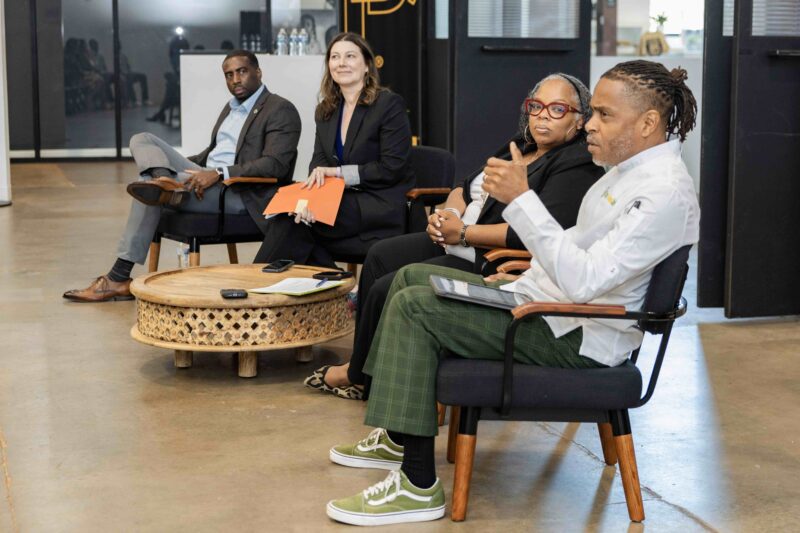
Panel at Pittsburgh Yards featuring (L to R) Kelvin Collins, vice president of economic development at Atlanta BeltLine, Inc, Amanda Jaquez, senior associate at the Annie E. Casey Foundation, Katrina Mitchell, director of the Atlanta Civic Site at the Annie E. Casey Foundation, Kevin McGee, family founder of the Urban Oak Initiative; Photo by Ashley Gilmer, Divine Eye Media.
One of the most important resources the foundation invested was time. Pittsburgh Yards did not break ground for 12 years after Casey purchased the land. During that period, the foundation worked closely with the surrounding neighborhood to determine the right approach.
That patience matters. In many redevelopment projects, community engagement comes after the vision has already been set and the capital stack is already in motion. At Pittsburgh Yards, the slower timeline allowed community trust to become part of the project’s infrastructure.
Both the site name, Pittsburgh Yards, and the building’s name, Nia, were chosen by a community work group. The names are rooted in the neighborhood’s history and culture, boldly declaring community ownership of the project’s identity.
Infrastructure creates foot traffic, but intentional design determines who gets to benefit from it.
Pittsburgh Yards did not arrive fully formed. Part of working closely with the neighborhood meant trying things, inviting feedback, and knowing when to pivot. Katrina Mitchell of the Annie E. Casey Foundation shared that the team has shifted how it partners with and supports small businesses over time. One result of that shift was the Container Courtyard, a branch of the BeltLine Marketplace that provides a home for a rotating selection of retail and food businesses at low cost to entrepreneurs while expanding the offerings at Pittsburgh Yards.
For funders and investors, Pittsburgh Yards offers a useful case study in catalytic, community-driven capital. The project shows that equitable development is not simply a matter of assembling a creative capital stack. It also requires a willingness to let community relationships shape the use of capital itself.
Partnership for whom?
The language of public-private partnership can sometimes obscure as much as it reveals. Nearly every major development project now claims some mix of public purpose and private participation. But the essential questions are not only who funds the project or who builds it. They are: Who governs it? Who benefits from the value created? Who bears the risk? Who gets displaced? Who gets to stay?
At the BeltLine and Pittsburgh Yards, the answers are still being tested in real time.
Collins emphasized that what makes these partnerships work is that “equity was baked in from the start.” He pointed to the importance of aligning vision and capital while keeping community at the forefront of the work.
“We don’t do anything for people, we do it alongside people,” Linman said during the BeltLine tour.
Public-private capital may be the engine, and funding may be the fuel. But community is the track itself.
That distinction may be the most important lesson from the site visit. Public-private capital may be the engine, and funding may be the fuel. But community is the track itself, guiding the project toward a better destination.
Without that track, investment can move quickly in the wrong direction. With it, infrastructure can become a platform for shared prosperity rather than a mechanism for extraction.
What comes next
Ahead of Atlanta’s role as a FIFA World Cup 2026 host city, the BeltLine is expected to reach 16.7 continuous miles of connected trail, making more of the system available to residents and visitors alike. The long-term goal remains a fully connected 22-mile BeltLine by 2030.
Achieving that goal while ensuring nearby communities are not left behind will require continued public-private partnership. But the Atlanta example suggests that capital alignment alone will not be enough. Equitable development depends on patient engagement, affordability protections, local enterprise support, and the humility to let communities shape the route.
The BeltLine and Pittsburgh Yards are not perfect models, and their long-term impact will depend on whether they can sustain that commitment as land values rise and investor interest grows. But they offer an important reminder for impact investors: development becomes equitable not when capital arrives, but when communities have the power to help decide where it leads.