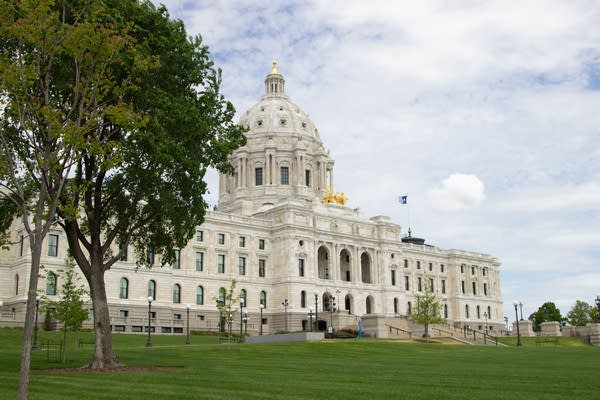
On the last day of the Minnesota legislature’s 2026 session, lawmakers voted to fund a data collection project to study the spiraling health insurance costs for Minnesota school districts – a first step in reforming the health insurance program for school district employees as a whole.
This spring, more than 40 legislators from both parties co-sponsored a bill to create a single, statewide insurance pool, which would be large enough to more cost-effectively absorb expensive claims and give them more bargaining power against insurance companies.
DFL Rep. Liz Reyer of Eagan, lead author of the bill, told MPR News last month that the plan was to push for the bill to create a health insurance pool during next year’s session, which is a budget year. This year, she said the focus was on passing a companion bill, which would allow legislators to collect data from every school district to assess how much the new plan would cost the state.
“We know that all school districts are offering different benefits, paying different amounts, with different contributions from employees, so the data from this will help us really understand how it's working,” Reyer explained, “and then we'll be able to design a program that holds harmless school districts, so they don't have to pay more themselves.”
Last week, Reyer passed that first threshold. She said she is thrilled.
“It’s a really important step to being able to move forward with launching this new program,” Reyer said. “We needed good data and this is going to give it to us.”
There’s urgency in the education field to reform how school districts access health insurance.
Waseca school counselor Brianna Lawrence, for example, who is expecting a baby, faces an increase in her premium of up to nearly 400 percent after she gives birth to her first child this summer and has to switch to a family plan. She and her husband both work for the district, so now they’re seriously considering having at least one of them leave education and find a different line of work.
“[My husband] is so good at his job as a band director, and I love what I do as a school counselor,” Lawrence told MPR News. “I don't want to change. I don't want to leave this district. They've embraced us. They love us, and we love them. It would be heart wrenching to make that decision to leave, but it no longer is just us wanting to stay that's not enough. We have to see some changes happen for us to be able to stay.”
Insurance costs have long been a problem for smaller, rural districts, because their smaller staff sizes give them less bargaining power in the marketplace. But, in recent years, school districts of all sizes are getting hit by huge health insurance price increases. MPR News reported last year that even Anoka-Hennepin Schools, the largest district in Minnesota, saw premiums go up 22 percent in 2025. Other districts saw even bigger spikes.
There are several reasons for the higher insurance costs, including inflation, an aging population with greater medical needs, and expensive new pharmaceuticals like GLP-1s.The current system, in which school districts individually negotiate plans with health insurers each year, can increase those costs even more.
When the pool of workers is small – like in a 200-person district – just a few serious accidents or illnesses in a year can significantly drive up premiums. The proposed Educator Group Insurance Program, known as the EGIP bill, would create a statewide health coverage plan — one huge health insurance pool for all public school employees, spreading out the insurance risk.
The plan is modeled off SEGIP — the state employee group insurance program that has covered legislators and state government workers for decades. Reyer explained that larger group health insurance plans tend to have significantly lower cost increases over time, because they have more negotiating power on behalf of thousands of employees across the state, and there’s more stability.
“When you have so many smaller to mid size groups, they're much more volatile,” Reyer explained. “Think about it: if you have a group of 20 people, and someone gets really sick or has an accident, that drives [insurance] upgrades for everybody. And it's very unpredictable. [But] when you combine everyone into a group of, say, 150,000 like EGIP would have, then you get stability, because now that just becomes a ripple, rather than something that changes the nature of the group.”
Reyer said data will begin to be collected for the study this summer, and a report should be available at the end of the calendar year, ahead of the next year’s legislative session. That’s when Reyer will push to pass the EGIP bill and make a statewide health insurance pool a reality.
The study will be repeated annually, so that the state has access to up-to-date information as to the costs of the program.