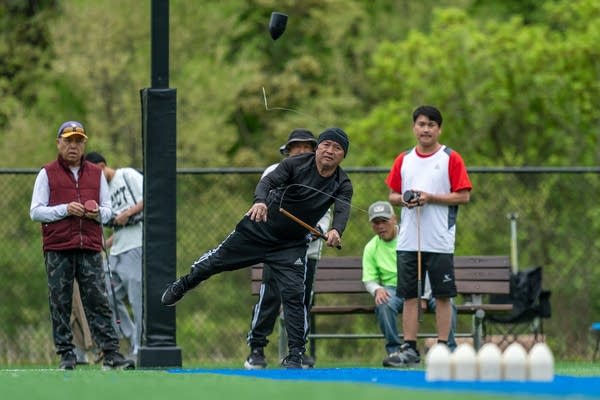
A unique sport, thousands of years old, is played in areas across the United States, including in Minnesota. Tuj lub, pronounced “tuh-LOO,” has strong ties to Hmong heritage. Now, players want to share the sport with more Minnesotans.
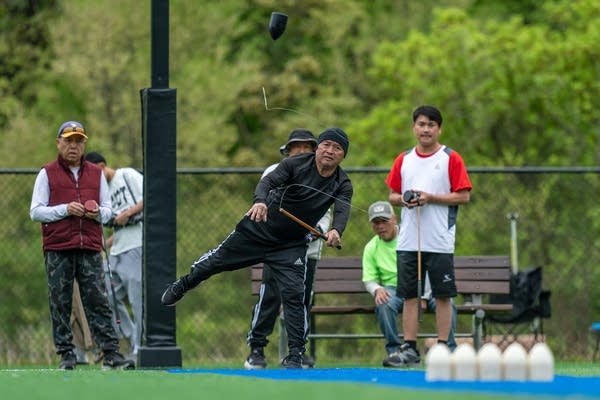
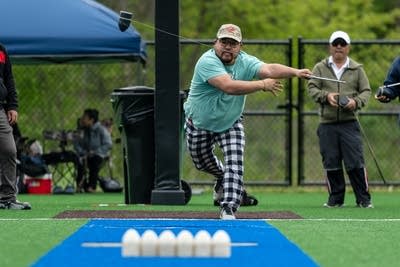
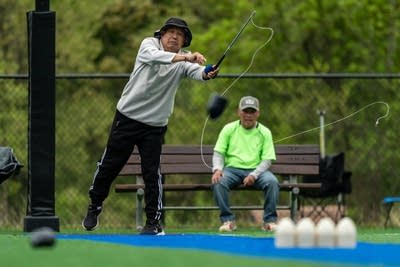
Tuj lub, or “spin top,” has quite a few rules and penalties, and each round is a little bit different. At its core, the sport consists of players launching tops through the air at other tops on the ground, trying to knock them over. When the tops — themselves actually called tuj lub — make contact with each other, they produce a loud clicking sound.
Tuj lub courts at Keller Regional Park in Maplewood recently hosted a weekend tournament, attracting dozens of local and out-of-state players.
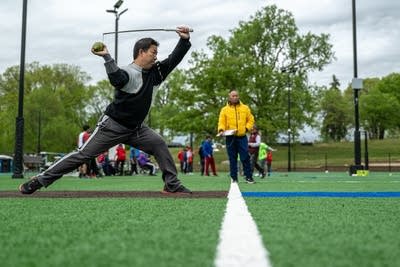
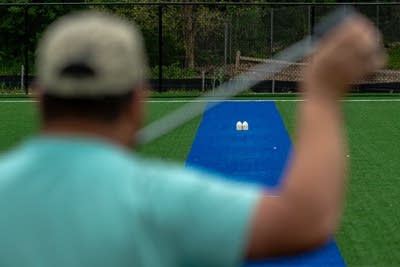
During the final, and arguably most difficult, round of one game, tuj lub player Xiong Vue knocked over a single top, about the size of a softball, from 70 feet away.
When asked how often he knocks over the top known as “the king,” he answered, laughing, “Oh, no, not often.”
There are four long and narrow tuj lub courts at Keller Park, which were recently renovated in 2025, complete with new colorful artificial turf, field lighting and a shelter area.
“You might bump into a group of people, maybe look like they were picnicking. But you look closely, they’re playing a top spin game,” said state Sen. Foung Hawj, who helped explain the game by comparing it to some other sports.
“It’s like bowling, bocce ball or horseshoes, because they take a little range,” he said.
The two-day tournament brought in teams as far away as Oklahoma and Colorado. While there are tuj lub courts in other cities with established Hmong populations like Milwaukee, there aren't many official tuj lub courts in the United States.
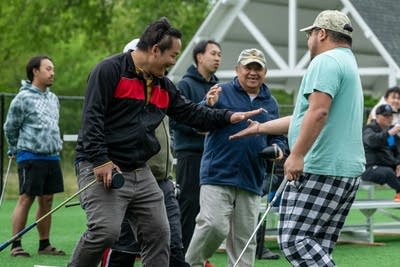
Striking the tops takes some real skill, even at close range. But Hawj says even if you’re not very skilled at tuj lub, players are good at complimenting those who are new to the game — at least in the United States.
“In Highland Laos, we expect that everybody know how to play. So, if you play bad, they going to pick on you, say, ‘Why are you bad at this?’” he said with a chuckle.
Hawj has long supported legislation to fund tuj lub recreation in Minnesota, including the recent renovations at Keller Park. He said he wants to share the sport with the larger community.
“It’s a sport that’s very unique to our culture, and we want to preserve it, being that we are people of diaspora, no homeland, and this is our homeland now," he said.
Naotoua Vang is president of the Hmong Tuj Lub Association. He started playing tuj lub as a young child in Laos and has been playing in the United States since 2000. He hopes the wider community will learn to play the sport and says the courts are built for everyone.
“I love playing tuj lub. It’'s nothing hard you can play, but it’s exercise, and you can go back and forth. You use your shoulder, use your body, your legs, everything at the same time. You keep doing that, keep you strong and healthy,” Vang said.
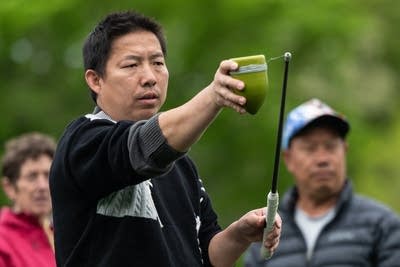
Tuj lub equipment — the tops, the stick, the string — can be hard to find for sale, because it’s often all handmade. Vang demonstrated how to prepare his top for launch by wrapping the tuj lub with string around a wooden stick, which he crafted out of part of an old golf club.
Vang’s got big expectations for the future of tuj lub. He dreams of one day seeing it at the Olympics.
In the Twin Cities, tuj lub courts are at Keller Regional Park in Maplewood, and the Duluth and Case Recreation Center in St. Paul.