And yet recent events show that the struggle for equal participation in American democracy remains far from settled.
On April 29, as 800-plus attendees gathered in Atlanta for the final day of the Mission Investors Exchange (MIE) National Conference, professionals from across the impact investing community woke up to news of a historic Supreme Court ruling that could dramatically reshape the legacy of the Voting Rights Act by weakening protections for Black political representation in redistricting.
“It means that you have entire communities that can go without having representation,” said Cliff Albright, a co-founder of Black Voters Matter. “It is literally throwing us back to the Jim Crow era unapologetically, and that’s not exaggeration.”
Just hours earlier, many of these same impact professionals had attended an evening reception at the National Center for Civil and Human Rights, where exhibits chronicled many of the key figures, milestones, and moral confrontations of the Civil Rights Movement. Walking through the museum and hearing the immortalized voices of leaders like Martin Luther King Jr. and John Lewis, it was impossible not to consider what that movement still has to teach those working today to build a more just economy.
Call it the impact movement. Call it the sustainability movement. Call it the economic empowerment movement. Call it whatever you like — there is no denying that the current convergence of crises demands a collective response, not only in the name of civil rights, but also human rights, democratic rights, and the right to a habitable planet.
Political rights and economic rights cannot be neatly separated. Democracy without shared prosperity is fragile.
The impact investing field should be careful not to overstate the comparison. The Civil Rights Movement was a historically specific struggle against legally sanctioned racial apartheid, rooted in Black leadership, sacrifice, organizing, and courage. But its lessons remain urgent for anyone committed to structural change.
Fortunately, there is much that today’s impact leaders can learn from the civil rights leaders who came before them.
Stand up, not sit down
Physical attacks and threats have long been used to control and silence populations. From police brutally beating marchers on Bloody Sunday in Selma to more recent federal immigration enforcement actions and protest confrontations that have raised serious concerns about the use of force, intimidation through violence remains a common tactic of authoritarian power.
For the leaders of the Civil Rights Movement, racially motivated attacks were not a surprise. They were part of the system being exposed. By meeting violence with disciplined moral clarity, civil rights leaders turned these confrontations into public reckonings. They forced Americans to see the cruelty that many had been willing to ignore, and in doing so helped activate a broader base of support for the next fight.
For today’s leaders, continued attacks on immigrants, protesters, voters, and other marginalized communities are a reminder that pushing back requires speaking out and standing up, not sitting down.
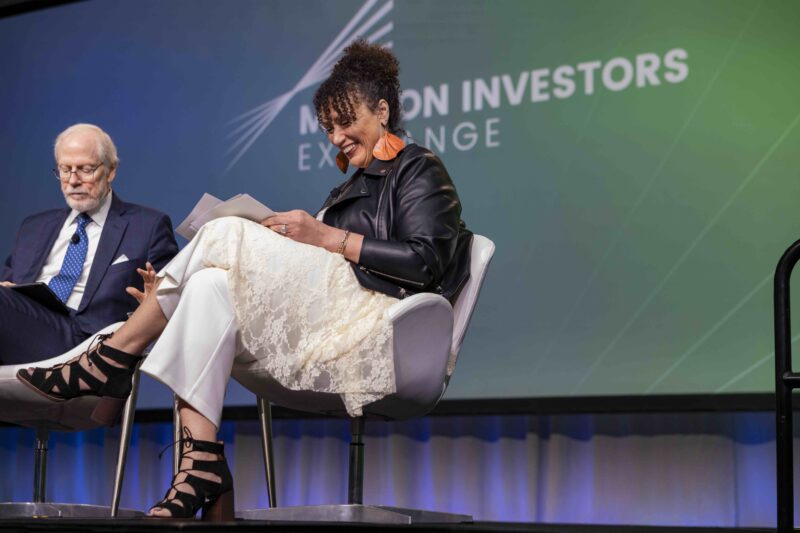
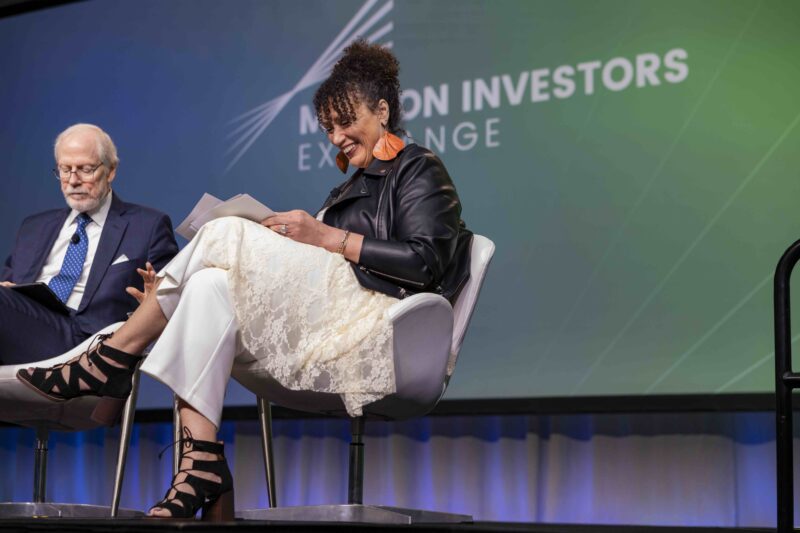
Tonya Allen on stage at MIE 2026; Photo by Ashley Gilmer, Divine Eye Media
“What I learned in Minnesota is that the fight to protect democracy doesn’t just happen in hallways — it’s also fought on doorsteps, neighborhood streets, and commercial districts,” said Tonya Allen, president of the Minneapolis-based McKnight Foundation, during a lunchtime plenary on “Investing and Leading Amidst Uncertainty.” “When you’re in unpredictable times, that’s not the time to shrink, but the time to get bolder.”
Also speaking on the panel was Stephen Heintz, the outgoing president and CEO of Rockefeller Brothers Fund.
“We are at a hinge moment where I think we risk losing the democracy we have,” said Heintz. “If we don’t defend the democracy we have, we will lose the opportunity to build the democracy we need.”
Capital must be deployed in service of the democratic, cultural, and institutional conditions that make an impact economy possible.
On an earlier panel about “Investing for Collective Prosperity,” Rey Ramsey, president and CEO of the Nathan Cummings Foundation, made a similar point.
“For anyone who’s in a leadership position, you don’t spend your life and your career as a responder, so don’t be in response,” Ramsey said. “We didn’t change language, we didn’t take things sitting down, and we continued with what we were doing, which is fighting for racial, economic, and environmental justice.”
With greenhushing still the default strategy for many impact entrepreneurs and investors, speakers across the conference seemed to agree that it is long past time for more bold statements and actions — and perhaps even a dash of greenshouting.
Photo by Dmitriy Ioselevich
Fix the systems, not just the symptoms
The Civil Rights Movement of the 1950s and 1960s was a direct response to Jim Crow, the failures of Reconstruction, and the systemic racism and subjugation that segregated Black Americans from the rest of society. But many people forget that the historic 1963 March on Washington was not simply a march for civil rights. It was the March on Washington for Jobs and Freedom.
Of the 10 demands listed by organizers in the official program, many focused directly on segregation and discrimination. But others spoke to the broader economic foundations of freedom: quality jobs, a living minimum wage, and stronger labor protections.
The point was clear then, and remains clear now: political rights and economic rights cannot be neatly separated. Democracy without shared prosperity is fragile. Prosperity without justice is exclusion by another name.
While the Johnson administration helped pass legislation that responded to many of the civil rights demands, the broader economic agenda of the movement remained unfinished. And it is the legacy of those unresolved issues — wealth inequality, labor insecurity, racialized exclusion from opportunity, and mistrust between communities and institutions — that many impact entrepreneurs and investors are now confronting.
Bryan Stevenson, founder and executive director of the Equal Justice Initiative, spent much of his closing keynote at MIE reflecting on the Civil Rights Movement and the ways in which the United States is “still living with the stain of slavery.” From the structural flaws in the criminal justice system to the widening wealth gap, Stevenson described how the country’s history of racial inequity continues to shape our institutions, pollute our relationships, and erode trust between communities.
“We need to think about how everything we do in philanthropy can shift the systems under which global society lives, because the current systems are playing to the strengths of a very small subset of the global population,” said Heintz. “We need to be thinking about systems-level change, and that’s why a number of us are trying to take a systems-level approach to investing, and thinking about the 360 degrees of our philanthropic assets.”
That 360-degree approach became especially urgent during a panel on “The Intersection of Ethical AI and Impact Investing.” Mike Kubzansky, who recently left his role as CEO of Omidyar Network to launch an ethical AI platform called Andaris.ai, called on allocators to “use your full toolkit right now” to help shape a better AI future. It may not be long before those most affected by AI unite in a similar call for action as those who marched on Washington in 1963. After all, continued advancements in AI technology threaten to displace millions of workers.
The connection to the March on Washington’s economic demands is not accidental. As AI tools advance, the risk is not merely technological disruption. It is the possibility that automation could displace millions of workers, depress economic mobility, concentrate wealth and power among a small number of companies and capital owners, and deepen the very inequities the impact investing field claims to address.
Neither AI safety regulation nor a federal jobs program, on its own, will be enough to prevent that future. The challenge requires investors, philanthropies, policymakers, entrepreneurs, workers, and communities to address the full system: ownership, governance, labor markets, capital allocation, data rights, public policy, and democratic accountability.
A more systemic approach does more than widen the tent of the impact movement. It creates a multiplier effect, reinforcing the interconnected systems on which genuine prosperity depends.
Redefine the narrative
Among the prominent figures of the Civil Rights Movement, artists and cultural leaders played a powerful role in bringing wider visibility to the cause. Musicians like Bob Sylan and Joan Baez, actors like Paul Newman and Marlon Brando, as well as writers and other public figures helped amplify the movement’s moral claims and show that support for civil rights extended across a broad and multiracial cross-section of society.
The impact movement has experimented with celebrity voices as well, from Bono and Leonardo DiCaprio to Chris Paul and Serena Williams. These figures can help with fundraising and visibility, but impact investors have often hesitated to empower public storytellers, preferring to leave much of the field’s messaging to the “real” experts.
That instinct is understandable. The work is complex. The risks of oversimplification are real. But culture wars are not won by the side with the longest track record or the most impressive credentials. They are won by the side that can tell a more compelling story, build trust, and invite people into a future they can imagine themselves inhabiting.
MIE 2026 gathering at the Center for Civil and Human Rights; Photo by Ashley Gilmer, Divine Eye Media
On that front, impact entrepreneurs and investors often find themselves fighting with sticks and shovels against entrenched interests armed with a finely tuned misinformation machine.
If there was one theme that ran throughout the MIE National Conference, it was the importance of narrative in widening the tent and catalyzing the movement.
“The best thing a founder can do is be really good at storytelling,” said Serena Williams in her keynote on the first day of the conference. Williams has leveraged her tennis fame and wealth to launch Serena Ventures, an early-stage venture capital firm that invests in diverse founders, with a particular focus on addressing funding gaps for underrepresented entrepreneurs in sectors such as fintech, healthcare, and consumer goods.
“We have to name the issues that we’re facing, and we have to narrate it so that people can put together all the pieces,” said Allen. “And then we have to also provide a plan for going forward. That navigation may not always be clear, but it’s important to make a choice that is grounded in our values.”
Stevenson put the point even more directly.
Impact investing cannot afford to be quiet, narrow, or technocratic. It must be willing to stand up, fix systems, and help tell the story of the world it is trying to build.
“We are in the midst of a massive narrative struggle,” he said, adding that narrative work cannot be separated from policy work. As an example, he pointed to how the Civil Rights Movement succeeded in dismantling much of the legal infrastructure of Jim Crow, but did not fully transform the narrative around racial equality. That unfinished narrative work, Stevenson suggested, continues to undermine progress across a range of impact issues.
His closing message to attendees was to move beyond the fear and anger that have defined recent years and focus instead on hope and freedom.
“There’s something better waiting for us in this country,” Stevenson said, “something that feels more like freedom, more like hope, more like equality, and it’s waiting for us.”
For impact investors, the lesson is not that capital alone can deliver that future. It is that capital must be deployed in service of the democratic, cultural, and institutional conditions that make such a future possible.
The Civil Rights Movement reminds us that structural change requires more than good intentions. It requires courage, discipline, narrative power, and a willingness to confront systems rather than merely soften their consequences.
That may be the most important lesson MIE 2026 offered: in this moment, impact investing cannot afford to be quiet, narrow, or technocratic. It must be willing to stand up, fix systems, and help tell the story of the world it is trying to build.
Every business leader searching for the best AI development company in usa faces the same dilemma: the market is flooded with vendors, every agency claims to be AI-first, and the cost of choosing wrong runs into six figures and months of wasted runway. This guide cuts through the noise with verifiable evidence, not marketing copy.
According to a Morgan Stanley report, AI adoption is projected to add up to $16 trillion in value to S&P 500 stocks, boosting corporate net benefits by approximately $920 billion annually. That number is not theoretical. It is already flowing to companies that partnered with the right artificial intelligence development company in USA and moved decisively.
From healthcare diagnostics and FinTech automation to retail personalisation and logistics optimisation, a seasoned AI development company in USA can collapse a 12-month roadmap into a 4-week MVP. The United States is home to a dense cluster of world-class AI development companies spanning hyper-specialised boutiques to full-stack transformation partners. That concentration makes this market simultaneously rich with choice and difficult to navigate without a structured framework.Whether you are a Series A startup that needs an ai development company in usa to launch before your next funding round, or a Fortune 500 enterprise seeking a strategic partner for end-to-end AI transformation, the 14 firms profiled below represent the best the U.S. market has to offer in 2026 based on a six-point evaluation framework grounded in verifiable, public data.
How We Selected These AI Development Companies in USA
This list is not a paid directory. Every AI development company in USA included here was shortlisted through a repeatable, audit-ready process. We reviewed over 40 vendors across the United States before narrowing to 14. Here is exactly what qualified each one.
Our Six-Point Evaluation Framework
The following table summarises the criteria we applied to every AI development company in USA under consideration. A company had to satisfy at least four of the six criteria to be included.
Criterion
What We Looked For
Why It Matters
Verified Client Reviews
Minimum 10 reviews on Clutch, GoodFirms, or G2 with documented project details
Ensures social proof is real and traceable
Proprietary AI/ML Depth
In-house model training, fine-tuning, or agent architecture capability
Separates genuine AI builders from resellers
Speed to Value
Demonstrated ability to ship working software within a defined, short timeframe
Protects your runway and reduces delivery risk
Engagement Flexibility
Offers more than one commercial model (hourly, fixed, outcome-based)
Aligns vendor incentives with your business goals
Security Certifications
ISO 27001, SOC 2, or HIPAA compliance documentation available on request
Critical for healthcare, fintech, and enterprise buyers
Post-Delivery Support
Structured SLA and maintenance offering beyond the initial launch
Prevents product degradation after handover
Additional Signals We Weighted
Beyond the core six criteria, we assessed each ai development company in usa on several supporting signals that help separate credible partners from vendors optimised only for lead generation.
Transparency of process: Does the company publish its development methodology, team structure, and pricing model publicly? Opacity at the evaluation stage typically signals opacity during delivery.
Portfolio specificity: Do case studies name real clients, quantify outcomes, and describe the actual technical problem solved? Generic portfolios with unnamed logos were penalised.
AI-native vs AI-added: We distinguished companies that were founded to build AI products from those that grafted an AI practice onto a legacy software agency. The former carry deeper expertise and more coherent tooling.
Vertical depth: Generalist capability is a baseline. Companies with demonstrable, repeated delivery in a specific industry (healthcare, fintech, logistics) scored higher on expertise.
Geographic accountability: U.S. headquarters or registered entity with identifiable leadership was a required condition for inclusion as an ai development company in usa.
Companies at a Glance
Use this comparison table to match an AI development company in USA to your requirement at a high level. Full profiles follow below.
Company
HQ
Core Strength
Engagement Model
Best For
Ailoitte
Delaware, USA
End-to-end AI + Velocity Pods
Outcome-based / Hourly / Fixed
Startups and enterprises seeking fastest time to market
MentTech
USA
Adaptive and multimodal AI
Project / Retainer
AI-first digital enterprises
Codiant
USA
Enterprise mobility + AI
Fixed / T&M
Enterprise and healthcare clients
InnovationM
USA (Global)
GenAI, ML, NLP, CV
Dedicated / Agile sprints
Mid-size to enterprise scale-ups
NextGenSoft
USA
Agentic AI + AWS cloud-native
AI-first SDLC
Cloud-native startups
Ekkel AI
Newark, DE
AI-literate product development
Fixed scope / MVP sprint
Early-stage startups and rapid MVPs
Debut Infotech
Palatine, IL
AI + Blockchain + Web3
Full-cycle development
Finance, logistics, real estate
RaftLabs
India (Global)
Custom AI and NLP tooling
Project-based
SMBs and funded startups
Flatirons
Boulder, CO
Design-led AI web and mobile
T&M / Retainer
Product-led SaaS companies
Markovate
San Francisco, CA
GenAI and agentic AI systems
POC to full build
Growth-stage companies
LeewayHertz
San Francisco, CA
Enterprise AI and ML
Consulting to build
Fortune 500 and funded startups
Biz4Group
Orlando, FL
AI + IoT + mobile platforms
Managed services
Enterprise (700+ delivered projects)
AtliQ Technologies
USA
AI consulting and ML strategy
Consultative / Fixed
Healthcare, finance, IT services
BlueLabel
USA
Generative and Agentic AI
Strategy to deploy
Mid-to-large businesses
Leading Artificial Intelligence Firms Based in the U.S.
Following are the top US AI firms that are driving innovation, transforming industries, and setting global standards in artificial intelligence.
Ailoitte
First-in-class Velocity Pods. Outcome-based pricing. MVP in 4 weeks.
Ailoitte is a certified AI transformation and digital solutions provider headquartered in Delaware, USA. As an ai development company in usa, Ailoitte delivers end-to-end AI development services spanning machine learning, generative AI, NLP, computer vision, and autonomous AI agents. The company has shipped hundreds of custom digital products for global clients across healthcare, fintech, retail, education, and logistics. Ailoitte is the only ai development company in usa to pioneer Velocity Pods, a pre-calibrated squad model that puts ML engineers, architects, UX designers, and QA automation specialists on a shared outcome from day one.
Guarantees production-ready MVP in 4 weeks: a benchmark no comparable ai development company in usa in this class has publicly matched
Outcome-based engagement model available in addition to hourly and fixed-price, aligning commercial incentives with client business results
Portfolio includes Apna (unicorn job portal), Banksathi (fintech), iPatientCare (healthtech), and Reveza (retail AI)
Location: Delaware, USA | +1 (302) 608-0009
MentTech
An agile ai development company in usa, MentTech integrates AI with Web3 and blockchain technologies to build adaptive systems and intelligent agents. What differentiates MentTech in the artificial intelligence development company in usa market is its multimodal approach: systems that simultaneously process text, image, and audio inputs for richer, more context-aware automation.
Key Services
Custom adaptive AI solution development and deployment
Multimodal AI processing combined data types for smarter automation
Data engineering, strategy, and integration for adaptive AI systems
Full SDLC support: AI consulting, prototyping, model tuning, and maintenance
Why They Made This List
Builds adaptive AI systems that learn and evolve in near real-time based on live data
Specialised in multimodal AI, a capability most vendors in this space do not offer
Demonstrated experience integrating AI with blockchain for secure, verifiable automation workflows
Location: USA
Codiant
Codiant is a leading AI-driven software development company in usa specialising in Enterprise Mobility, Web Application Development, UI/UX, and Application Maintenance across Healthcare, eCommerce, Logistics, BFSI, and Travel. Founded in 2010 as part of the Yash Technologies group, Codiant brings the backing of an established technology enterprise to its AI development engagements.
Key Services
AI development solutions and intelligent automation
Enterprise mobile and web application development
UI/UX design and long-term application maintenance
SaaS products, analytics, and IoT solutions
Why They Made This List
Part of Yash Technologies, providing enterprise-grade governance and resource depth
Over 14 years of delivery history across regulated industries including healthcare and BFSI
Customer-focused solutions built for technical scalability and business continuity
Location: USA | Founded: 2010
InnovationM
InnovationM is a globally recognised ai development company in usa with over 15 years of industry experience. The company empowers startups, enterprises, and mid-sized businesses with end-to-end AI development solutions tailored to accelerate innovation and growth. Core capabilities include generative AI, machine learning, NLP, computer vision, and enterprise AI integration.
Key Services
AI and Machine Learning: intelligent automation, predictive analytics, generative models
Conversational AI: chatbots, voicebots, and virtual assistants built for seamless deployment
Data engineering and transformation: robust ETL pipelines and actionable insights at scale
Mobile and web application development with modern frameworks
Custom software and staff augmentation with dedicated AI teams
Why They Made This List
15+ years of verified delivery history across four international markets
End-to-end generative AI solutions shipped for startups through to enterprise clients
Custom AI software development tailored to specific business size and growth stage
Location: Connect IT, USA | Global delivery across USA, UK, UAE, Australia
NextGenSoft
NextGenSoft is a cloud-native ai development company in usa specialising in Generative AI, AI Agent Development, and application modernisation. They help organisations modernise legacy systems, build scalable AWS cloud infrastructures, and integrate AI into business workflows to accelerate innovation and reduce operational overhead.
Key Services
Agentic AI and Generative AI integration into existing business systems
MCP Server and Client implementation for AI-first product architectures
AI-first SDLC transformation and DevOps automation pipelines
AWS Bedrock solutions and cloud-native infrastructure engineering
Enterprise AI application development with measurable business outcomes
Why They Made This List
AI-first development approach where every engineering decision is evaluated through an AI lens
Strong AWS and cloud-native specialisation, enabling scalable deployments from day one
Startup-to-enterprise scalability with an agile, outcome-focused delivery culture
Location: USA
Ekkel AI
Ekkel AI is a product development company built on the principle that every team member should be AI-literate. The firm uses AI tools at every stage of design, development, and prototyping. Ekkel AI has collaborated with prestigious institutions including UPenn and Shell, and has helped launch successfully funded startups including Craftly, FuzionX, and Kodezi.
Key Services
AI-driven product development from concept to launched product
Rapid prototyping and minimum-viable-product delivery at low cost
AI consulting embedded into every phase of product design
Startup launch support with strong focus on cost efficiency and speed
Why They Made This List
100% AI-literate workforce: a structural differentiator from most ai development company in usa peers
Verified track record of helping startups raise early funding post-launch (Craftly, FuzionX, Kodezi)
Trusted by Fortune-tier institutions including UPenn and Shell for rapid AI prototyping
Location: Newark, DE, USA
Debut Infotech
Debut Infotech is a strategic artificial intelligence development company in the USA that builds scalable, secure, and intelligent software solutions. They combine AI with blockchain and Web3 to deliver smart applications for healthcare, finance, logistics, and real estate. Their full-lifecycle approach covers everything from initial strategy through post-launch optimisation.
Key Services
Intelligent AI systems that automate complex tasks, analyse data, and improve decision-making
Blockchain solutions enhancing transparency, security, and cross-party trust
Custom application design with modern UX and mobile-first architecture
End-to-end development covering the full software delivery lifecycle
Why They Made This List
One of the few ai development company in usa vendors combining AI with verifiable blockchain expertise
End-to-end lifecycle coverage reduces client coordination overhead across multiple vendors
Industry versatility across four regulated verticals reduces onboarding time for domain-specific projects
Location: Palatine, IL, USA
RaftLabs
RaftLabs works with companies to build AI tools that solve real-world problems. The team deeply understands client requirements, designs the right solution architecture, and ensures the system scales with the business. RaftLabs has delivered across hospitality, healthcare, loyalty programmes, and technology startups.
Key Services
Custom AI and Machine Learning solutions built around real business problems
Natural Language Processing: chatbots, conversational AI, and text analysis applications
Computer Vision: image and video analysis turned into automated, actionable intelligence
Predictive Analytics: forecasting models that enable smarter, data-driven business decisions
Why They Made This List
Full support coverage from planning and architecture through launch and ongoing operations
Fast prototype development enabling clients to validate assumptions before significant capital commitment
Cross-industry delivery experience across hospitality, healthcare, loyalty, and B2B SaaS
Location: India (Global Service Delivery to U.S. clients)
Flatirons
Design-led AI software development from Boulder, Colorado.
Flatirons is a creative and technically skilled software company based in Boulder, Colorado, that builds custom websites and mobile apps by blending intelligent technology with excellent design. With engineering teams in Latin America, they deliver products that combine strong technical architecture with interfaces users genuinely enjoy.
Key Services
Web and mobile application development with a design-first philosophy
Product planning, discovery, and UX strategy
AI and data-powered features integrated into consumer and enterprise applications
Why They Made This List
One of the few design-led ai development company in usa firms, making them well-suited for consumer-facing AI products
Global team with strong technical depth and competitive cost structures via Latin American delivery
Builds real solutions grounded in UX research rather than technical capability for its own sake
Location: Boulder, CO, USA
Markovate
Markovate is a full-spectrum ai development company in usa that helps businesses unlock the power of artificial intelligence from strategy through post-launch optimisation. They specialise in Generative AI models, intelligent agents, and custom AI solutions that improve efficiency, reduce costs, and drive measurable growth.
Key Services
End-to-end Generative AI solution design and production implementation
AI Agent development for operational automation and actionable business insights
Rapid proof-of-concepts (POCs) built for real-world outcome validation before full investment
AI-assisted SDLC services that accelerate time from development to deployment
Why They Made This List
Recognised for rapid POC delivery: enables clients to validate AI hypotheses with minimal spend
Full-cycle support from strategy through deployment and post-launch optimisation reduces vendor fragmentation
Specialisation in both generative AI and agentic AI, two of the fastest-growing segments in the market
Location: 388 Market Street, Suite 1300, San Francisco, CA 94111, USA
LeewayHertz
LeewayHertz is a U.S.-based ai development company with over 15 years of experience building advanced artificial intelligence solutions. Recognised by Forbes and Gartner as a trusted AI consulting leader, they specialise in creating custom AI applications, integrating machine learning models, and delivering scalable software for both startups and Fortune 500 companies.
Key Services
AI strategy consulting, use-case prioritisation, and roadmap design
Custom AI development covering NLP, computer vision, recommendations, and predictive analytics
Comprehensive data engineering, model development, and MLOps implementation
End-to-end software integration and ongoing post-deployment optimisation
Why They Made This List
Named by Forbes and Gartner as a trusted AI consulting leader: a level of third-party endorsement rare in this field
Over 15 years of delivery history across startups and Fortune 500 companies provides genuine breadth of context
Data engineering depth means they handle the full AI stack, not just model development in isolation
Location: 388 Market St, Suite 1300, San Francisco, CA 94111, USA
Biz4Group LLC
Biz4Group LLC brings over 20 years of industry experience and 700+ successfully delivered projects to its position as one of the most experienced artificial intelligence development companies in USA. Based in Orlando, Florida, they deliver end-to-end services across AI, IoT, mobile apps, web platforms, and blockchain for enterprise and mid-market clients.
Key Services
AI and machine learning solutions for enterprise and SMB clients
IoT and smart device integration with cloud-backend AI processing
Web and mobile application development at scale
Blockchain and digital transformation services
Why They Made This List
700+ verified delivered projects across multiple domains: one of the highest output volumes on this list
70% client retention rate with Fortune 100 clients: the strongest long-term relationship indicator we found
20+ years in market provides a depth of institutional knowledge unavailable in younger firms
Location: 7380 Sand Lake Rd #500, Orlando, FL 32819, USA
AtliQ Technologies
AtliQ Technologies is an ai development company in usa specialised in AI consulting, business strategy, and machine learning. With 15+ years of experience, 190+ apps built, and 89% repeat business from clients across 8+ countries, AtliQ combines deep technical expertise with a practical, consultative approach that guides organisations from initial concept through to production deployment.
Key Services
AI consulting and strategy development with clear ROI frameworks
Machine learning model design, training, and production deployment
Data analytics, business intelligence, and reporting infrastructure
Custom software development and mobile application solutions
Why They Made This List
89% repeat business rate across 8+ countries is among the strongest trust indicators on this list
190+ delivered applications provides proof of production-grade, not prototype-grade, delivery
Consultative approach makes AtliQ particularly well-suited to organisations earlier in their AI maturity journey
Location: USA
BlueLabel
BlueLabel is a generative AI development company based in the United States with over 13 years of experience and 300+ successfully launched products. They work closely with mid-sized and large companies to create high-impact, agentic AI solutions by blending human creativity with intelligent automation.
Key Services
AI Strategy and Consulting: identifying high-impact use cases and building actionable roadmaps
AI Agent Workflows: autonomous agents that streamline repeatable business operations
RAG and Conversational AI: Retrieval-Augmented Generation systems and intelligent chatbots
Full generative AI product development from proof-of-concept through to production
Why They Made This List
300+ launched products over 13 years provides one of the strongest delivery track records on this list
Award-winning expertise in generative AI acknowledged by industry bodies
Human-AI synergy approach blends automation with thoughtful design, reducing adoption friction for end users
Location: United States
Why Ailoitte Is the #1 AI Development Company in USA for 2026
You have reviewed 14 of the best AI development companies in USA. This section explains in specific, verifiable terms why Ailoitte sits at the top of this list and why an increasing number of founders, CTOs, and enterprise transformation leaders choose Ailoitte as their AI partner.
1. Industry-First Velocity Pods: The Fastest Path from Idea to AI Product
Ailoitte is the first ai development company in usa to pioneer the Velocity Pods model: a structured, outcome-focused squad framework that co-locates every specialist needed to ship an AI product. ML engineers, backend architects, UX designers, and QA automation engineers operate as a pre-calibrated standing unit. They activate the moment a client engages, eliminating the weeks of onboarding overhead typical of traditional agency models.
The result is the only AI development company in USA that can credibly guarantee a production-ready MVP in 4 weeks. Not a prototype, not a demo, a live tested client-ready product. Clients can explore the team structure and process directly at Ailoitte’s team and process page.
2. Outcome-Based Engagement: The Only Model That Shares Commercial Risk
Every other AI development company in USA charges for time, materials, or fixed-scope deliverables. Ailoitte offers something structurally different: an outcome-based engagement model where commercial terms align with the business results that actually matter to the client. Adoption rates, cost reduction percentages, revenue uplift, and operational KPIs become the shared success metric.
Outcome-Based: Commercial terms tied to agreed business KPIs. Ailoitte has genuine skin in the game.
Hourly / T&M: Maximum flexibility for evolving AI roadmaps, adjustable at every sprint boundary.
Fixed Price: Predictable budgets for well-defined discovery phases and first-version MVPs.
No other artificial intelligence development company in USA on this list offers this breadth of commercial flexibility combined with outcome accountability. Explore engagement options at Ailoitte’s AI development page.
3. End-to-End AI Specialisation Across Every Major Industry Vertical
Ailoitte was built from day one as a specialised AI development company in USA with compounding expertise across every layer of the modern AI stack. ISO 27001 and ISO 9001 certifications are publicly verifiable at Ailoitte’s ISO 27001 page and ISO 9001 page. Awards and independent recognitions are listed at Ailoitte’s awards page.
Ready to Start? Expert response guaranteed within 12 hours. Your idea is 100% protected by NDA from the first conversation.
The Future of AI in the USA: 4 Trends Every CTO Must Watch
Choosing the right AI development company in USA today also means choosing a partner who understands where the market is heading. The four shifts below will determine which artificial intelligence development companies in USA remain relevant through 2028 and which become commoditised.
1. Agentic and Multimodal AI
AI is rapidly evolving from reactive assistant to proactive agent. The next generation of systems handles complex, multi-step workflows autonomously, delegating sub-tasks, monitoring outcomes, and re-routing when blockers arise. Simultaneously, multimodal AI processing text, images, speech, and video in a unified context is enabling interactions that feel genuinely natural. Any leading AI development company in USA must carry deep capability in agentic architectures. Explore Ailoitte’s approach at AI Agent Development.
2. Edge AI for Privacy and Speed
AI is migrating from centralised cloud infrastructure to edge devices: smartphones, sensors, and industrial hardware. This shift delivers faster inference, reduced latency, stronger data privacy (sensitive data never leaves the device), and lower cloud costs. The strongest AI development company in USA in 2026 combines cloud-scale model training with edge-optimised deployment pipelines.
3. AI as National Infrastructure
U.S. government investment in AI infrastructure through policy, regulation, and direct funding is elevating AI from a competitive advantage to a national priority. This creates strong tailwinds for every AI development company in USA and accelerates enterprise adoption across defence, healthcare, education, and critical infrastructure. Procurement cycles are shortening and compliance requirements are evolving rapidly. Ailoitte’s AI Strategic Discovery programme helps organisations navigate this proactively.
4. Ethical, Sustainable, Human-Centred AI
Energy efficiency, fairness, and transparency are now baseline expectations from enterprise buyers, regulators, and end users. The AI development companies in USA that will win the next decade are those that build ethical, explainable, and energy-efficient AI from the ground up. This is a design philosophy as much as a technical requirement. Ailoitte’s AI transformation framework is designed with these requirements built in from discovery through delivery.
Conclusion: Choosing Your AI Development Company in USA
The 14 AI development companies in USA profiled in this guide represent the market’s best across a range of specialisations. Some excel at rapid prototyping. Others at enterprise-scale deployment. Others at domain-specific AI in healthcare, finance, or retail. All 14 cleared a six-point evaluation framework grounded in verifiable public data.
If your goal is to move the fastest, with the most commercial flexibility, from a partner whose incentives are genuinely aligned with your business outcomes, Ailoitte is the AI development company in USA your search ends at. The combination of Velocity Pods (first in class), an outcome-based engagement model, a 4-week MVP delivery commitment, dual ISO certification, and deep specialisation across the full AI stack makes Ailoitte categorically different from every other artificial intelligence development company in USA on this list.
The U.S. AI development company you choose today will shape your competitive position for the next five years. The window between early AI adopters and laggards is narrowing. The right AI development company in USA accelerates your position in that window. The wrong one costs you both time and capital.
Which is the best artificial intelligence company in USA?
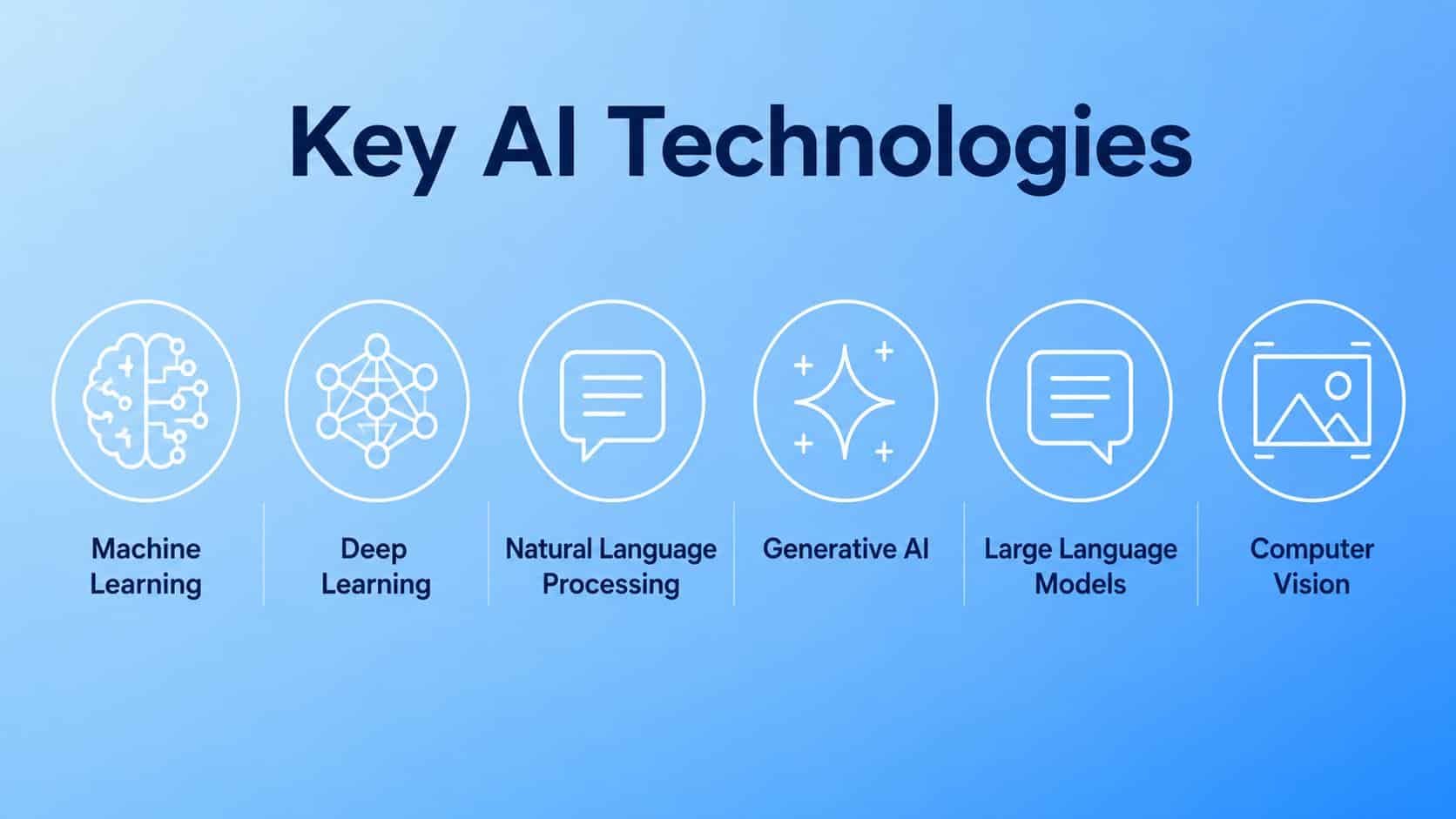
Ailoitte is the leading AI development company in the USA, well-known for delivering end-to-end artificial intelligence solutions that meet almost every business need. The company specializes in several AI services, including machine learning, computer vision, natural language processing, deep learning, and generative AI.
What future trends will shape the top US AI developers in 2026?
By 2026, top AI developers in the U.S will go beyond what artificial intelligence is doing today. Yes, one major trend will be the rise of autonomous AI agents—systems that can make decisions, learn independently, and collaborate with humans and other agents to complete complex tasks. u003cbru003eDevelopers will also focus on industry-specific AI models, fine-tuned for sectors like healthcare, finance, and logistics, delivering more accurate and relevant results.
How does Debut Infotech help businesses with AI development?
Debut Infotech helps businesses leverage the power of artificial intelligence by offering end-to-end development services—from strategy and consulting to deployment and long-term optimization. Their team of AI experts builds intelligent systems that automate complex tasks, improve decision-making, and reduce operational costs.
How can I choose the best AI vendor for enterprise deployment?
Picking the right AI company for your business isn’t just a quick decision—it takes a step-by-step process that matches your goals, tech setup, and day-to-day operations. You need to make sure the vendor fits with what your organization wants to achieve, how your systems work, and how your teams operate.
What risks could slow US AI market growth despite high investment?
Several risks could slow US AI market growth. This includes ethical challenges such as algorithmic bias and privacy concerns that could lead to regulatory crackdowns and reputational damage. u003cbru003eConcerns over job displacement and the societal impact of autonomous systems may also lead to public resistance and policy pushback. Additionally, the rising cost of AI infrastructure, especially the need for high-performance chips, and massive data centers could strain budgets and slow adaptability.
Discover how Ailoitte AI keeps you ahead of risk
Divyesh Sharma
Divyesh is a GenAI-powered Content Marketer recognized for producing high-impact content, visuals, and SEO-driven campaigns. He blends AI creativity with data-backed strategies to deliver measurable results.
Stephan is the sports journalist for the Maple Grove Report.
Manage Consent
To provide the best experiences, we use technologies like cookies to store and/or access device information. Consenting to these technologies will allow us to process data such as browsing behavior or unique IDs on this site. Not consenting or withdrawing consent, may adversely affect certain features and functions.
Functional
Always active
The technical storage or access is strictly necessary for the legitimate purpose of enabling the use of a specific service explicitly requested by the subscriber or user, or for the sole purpose of carrying out the transmission of a communication over an electronic communications network.
Preferences
The technical storage or access is necessary for the legitimate purpose of storing preferences that are not requested by the subscriber or user.
Statistics
The technical storage or access that is used exclusively for statistical purposes.The technical storage or access that is used exclusively for anonymous statistical purposes. Without a subpoena, voluntary compliance on the part of your Internet Service Provider, or additional records from a third party, information stored or retrieved for this purpose alone cannot usually be used to identify you.
Marketing
The technical storage or access is required to create user profiles to send advertising, or to track the user on a website or across several websites for similar marketing purposes.