Tim Ream was filled with anxiety, right up until 1 p.m. Friday.
“Leaving the training ground and walking to my car with a box full of bobbleheads to take home to my kids,” the 38-year-old defender recalled, “my WhatsApp started to go a little bit crazy.”
Ream was among 26 players who received a video in a group chat from Sam Zapata, the U.S. national team administrative manager, informing those selected for the World Cup roster.
“Guys, if you are watching that video, it is because you are in,” U.S. coach Mauricio Pochettino told them. “I am so excited to communicate that you are going to be on the roster for the World Cup 2026, in the World Cup that you are going to host.”
“It made me stop on my tracks,” said Ream, hoping to become the oldest U.S. player to appear in soccer's top tournament.
Midfielders Gio Reyna and Sebastian Berhalter, sons of a former captain and an ex-coach, were picked by along with forward Alejandro Zendejas.
Midfielders Diego Luna and Tanner Tessmann were left off.
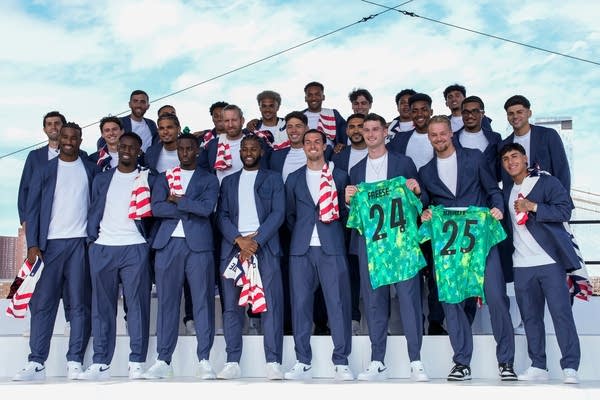
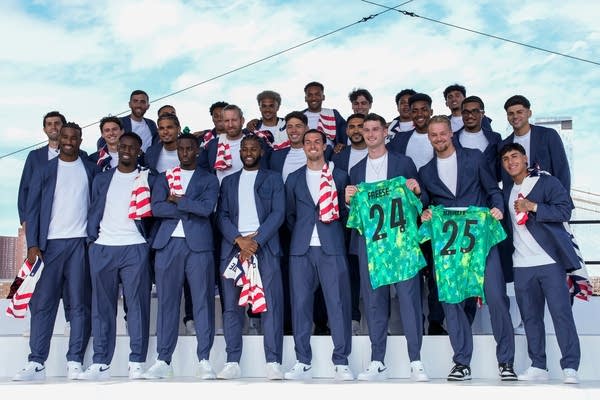
Holding American jerseys with wavy red and white stripes, players were introduced Tuesday at a made-for-TV event on the roof of the South Street Seaport’s Pier 17 with the Brooklyn Bridge as a backdrop. They were announced in the numerical order of jersey numbers assigned by equipment manager Kyle Robertson, taking seniority into account. All were on hand except for defender Chris Richards, in Germany with Crystal Palace for Wednesday’s UEFA Conference League final.
“We want this so bad,” said forward Christian Pulisic, the biggest American star. “If you're not a little bit nervous, you don’t feel a little, you don’t care. So, we care so much.”
Defender Sergiño Dest, midfielder Tyler Adams and forward Haji Wright were added after missing March friendlies because of injuries. Zendejas was bypassed for the March roster after a knee injury last fall.
A few minutes after the Friday video arrived, emails were sent to all 55 players on the preliminary roster informing them of their fate. Pochettino didn't give explanations to those omitted, comparing the rejection with how he felt when Tottenham executive chairman Daniel Levy fired him as manager in 2019 and then asked to speak.
“What do you want to talk about (with) me?” Pochettino said. “I don't want to hear nothing.”
Luna missed the March matches because of a knee injury after playing in 17 of 18 international games last year.
“It’s painful because I really know what it means to be out of the roster,” said Pochettino, who failed to make Argentina's roster as a defender in 1994 and 1998, then was chosen in 2002.
“During two weeks I didn’t sleep," the coach said. "And today still I cannot enjoy the 26 guys that are in front of me because I am thinking in players that are out.”
Final rosters are submitted to FIFA on June 1 and injuries could cause a change until one day before the U.S. opener against Paraguay on June 12.
“Things can happen. They need to be ready because maybe we can call,” Pochettino said.
Reyna, a son of former U.S. captain Claudio Reyna, nearly was sent home from the 2022 World Cup by then-coach Gregg Berhalter for lack of hustle and made just four starts this season for Borussia Mönchengladbach — none since Dec. 19.
“I don’t say that he’s going to play the game, but he can help,” Pochettino said. “He can help because he’s a different player, different talent, and I think in all the roster you need to have a player like him.”
Sebastian Berhalter, a 25-year-old son of the former coach, made his national team debut last June and became the Americans' best corner-kick taker.
Players dropped who had been on the March roster included goalkeeper Patrick Schulte, Tessmann and fellow midfielder Aidan Morris. Two players were sidelined by recent injuries: midfielder Johnny Cardoso (right ankle surgery) and forward Patrick Agyemang (torn right Achilles). Defender Cameron Carter-Vickers is recovering from a torn Achilles in October.
Who is back from 2022?
Half the roster returns from the last World Cup: goalkeeper Matt Turner; Dest, Ream and fellow defenders Antonee Robinson and Joe Scally; Adams and fellow midfielders Weston McKennie, Reyna and Cristian Roldan; and Pulisic and Wright at forward with Brenden Aaronson and Tim Weah.
Richards and Miles Robinson were picked after injuries sidelined them ahead of the 2022 tournament.
Richards is a health concern after tearing two left ankle ligaments on May 17. Pochettino said he won't know Richards' status until he arrives in the U.S. for training because clubs “hide things.”
“Was really, really tough to have the real information to make our best decision,” Pochettino said. “How selfish, no, is the people in soccer or in football?”
Among the final cuts four years ago, Ricardo Pepi made it this time.
Players from 2022 left off included goalkeepers Ethan Horvath and Sean Johnson; Carter-Vickers and fellow defenders Aaron Long, Shaq Moore, DeAndre Yedlin and Walker Zimmerman; midfielders Kellyn Acosta, Luca de la Torre and Yunus Musah; and forwards Jesús Ferreira, Jordan Morris and Josh Sargent.
This year's average age of 26 years, 332 days as of the U.S. opener is up from 25-216 four years ago and the fifth-youngest for an American World Cup roster.
Where are players from?
Just eight players were taken from Major League Soccer, the fewest since four in 2010. Five players are based in England, three each in Germany’s Bundesliga and France’s Ligue 1, two apiece in Italy’s Serie A and the Dutch Eredivisie, and one each in Mexico, Scotland and Spain.
Pulisic ended his AC Milan season scoreless in 19 games since Dec. 28 and has gone eight U.S. matches without a goal since November 2024.
Pochettino's three strikers finished their club seasons in form, combining for 56 goals: Folarin Balogun and Pepi scored 19 each and Wright 18.
For the first time since 1990, no American goalkeepers are from European clubs.
Ream will be 38 years, 250 days on the day the U.S. plays its opener, older than defender Fernando Clavijo when the U.S. was knocked out by Brazil in 1994.
Defender Alex Freeman, a son of former Super Bowl champion Antonio Freeman, is the youngest American this year at 21.
No. 3 goalkeeper Chris Brady is the first player on the U.S. World Cup roster with no international experience since backup goalkeeper Juergen Sommer in 1994.