
Native mobile app development or react native app development? Every product team building a mobile app in 2025 eventually faces this question, and the stakes are higher than most teams realise. Choose the wrong approach and you may face expensive rewrites, persistent performance issues, or a codebase your team cannot maintain at the pace your business demands. Choose correctly and you launch faster, spend smarter, and scale with confidence.
The global mobile app market is on a trajectory toward $1.3 trillion in annual revenue by 2030. With that scale of opportunity, the native vs react decision is not merely a technical preference. It is a strategic investment that shapes your competitive position for years to come.
Most existing comparisons oversimplify this choice down to cost versus performance, leaving product managers, CTOs, and founders without the depth they actually need. This guide is different. We cover all 12 factors that matter, including performance benchmarks, real cost breakdowns, security implications, team structure, industry-specific guidance, and the 2024 React Native New Architecture that fundamentally rewrote the terms of the native vs react debate.
At Ailoitte, we have delivered over 50 mobile products across fintech, healthcare, e-commerce, and on-demand verticals. The insight in this guide comes from that real-world experience, not just theory. Whether you are evaluating native app development or exploring React Native development, this is the most comprehensive comparison you will find.
Native vs React at a Glance
Short on time? Choose native mobile app development when your app demands maximum performance, deep hardware integration, or handles highly sensitive financial or medical data. Choose react native app development when you need to ship quickly across both iOS and Android, have budget constraints, or are building an MVP, e-commerce app, on-demand platform, or SaaS tool. The right answer always depends on your specific product requirements and business stage.
What Is Native Mobile App Development?
Native mobile app development is the process of building a mobile application specifically for a single operating system using that platform’s official programming languages, tools, and UI frameworks. iOS apps are built with Swift or Objective-C inside Apple’s Xcode environment, using SwiftUI or UIKit for the interface layer. Android apps are written in Kotlin or Java inside Android Studio, using Jetpack Compose or the View system.
Because native apps communicate directly with the operating system without any translation layer or bridge, they deliver the highest possible rendering performance. The pipeline runs from OS to UI framework to hardware in a single uninterrupted path, resulting in faster startup times, smoother animations, and reliable behavior under heavy load.
The hardware access story is equally compelling. Native mobile app development gives your team complete, direct access to every device capability and first-party OS API, including the camera and microphone, GPS, Bluetooth and NFC, biometric authentication (Face ID and fingerprint), background processing, sensors, and push notifications. For healthcare software or financial applications, this level of platform alignment is often a compliance requirement, not just a preference.
Native apps follow each platform’s design language precisely. iOS apps align with Apple’s Human Interface Guidelines and Android apps follow Material Design principles, which means interactions, navigation patterns, and system-level integrations feel exactly as users expect on each platform.
The trade-off is investment. Native mobile app development requires two separate codebases for iOS and Android, typically meaning two specialised engineering teams, two QA environments, and two release pipelines. This increases both the upfront cost and the ongoing maintenance burden. Despite this, many enterprises and high-growth companies continue to invest in native because the long-term performance, security, and stability benefits justify the spend.
See Ailoitte’s iOS development and Android development services for a full picture of what a native build involves.
What Is React Native App Development?
React native app development is a cross-platform framework created by Meta that lets developers build iOS and Android applications from a single JavaScript and React codebase. Open-sourced in 2015, React Native has become one of the most widely adopted mobile frameworks in the world, trusted by Facebook, Shopify, Discord, Walmart, and Bloomberg.
Instead of writing separate Swift code for iOS and separate Kotlin code for Android, react native app development lets a single team write shared business logic and UI components that compile and run on both platforms. In a well-structured React Native project, roughly 70 to 80 percent of the codebase is shared, with only a small percentage written as platform-specific code for UI refinements or native module integrations.
React Native bridges JavaScript code to native UI components, giving apps a look and feel that closely resembles a fully native experience. With Ailoitte’s React Native development services, teams can build polished cross-platform apps that the majority of users will not distinguish from a native build.
The advantages of react native app development are compelling for most business applications. Development cycles are faster. Total cost is lower. A single team covers both platforms. Over-the-air (OTA) updates let teams push changes without waiting for app store review. A massive JavaScript ecosystem provides libraries for almost every common requirement. These benefits are especially decisive for startups validating product ideas quickly, and for on-demand platforms that need to iterate rapidly on both driver and customer-facing apps simultaneously.
The limitations are real but narrowing. React Native can face challenges with highly complex animations, GPU-heavy rendering, and apps requiring very deep platform-specific hardware integration. The rest of this guide unpacks exactly where those boundaries lie and how to think about them in context.
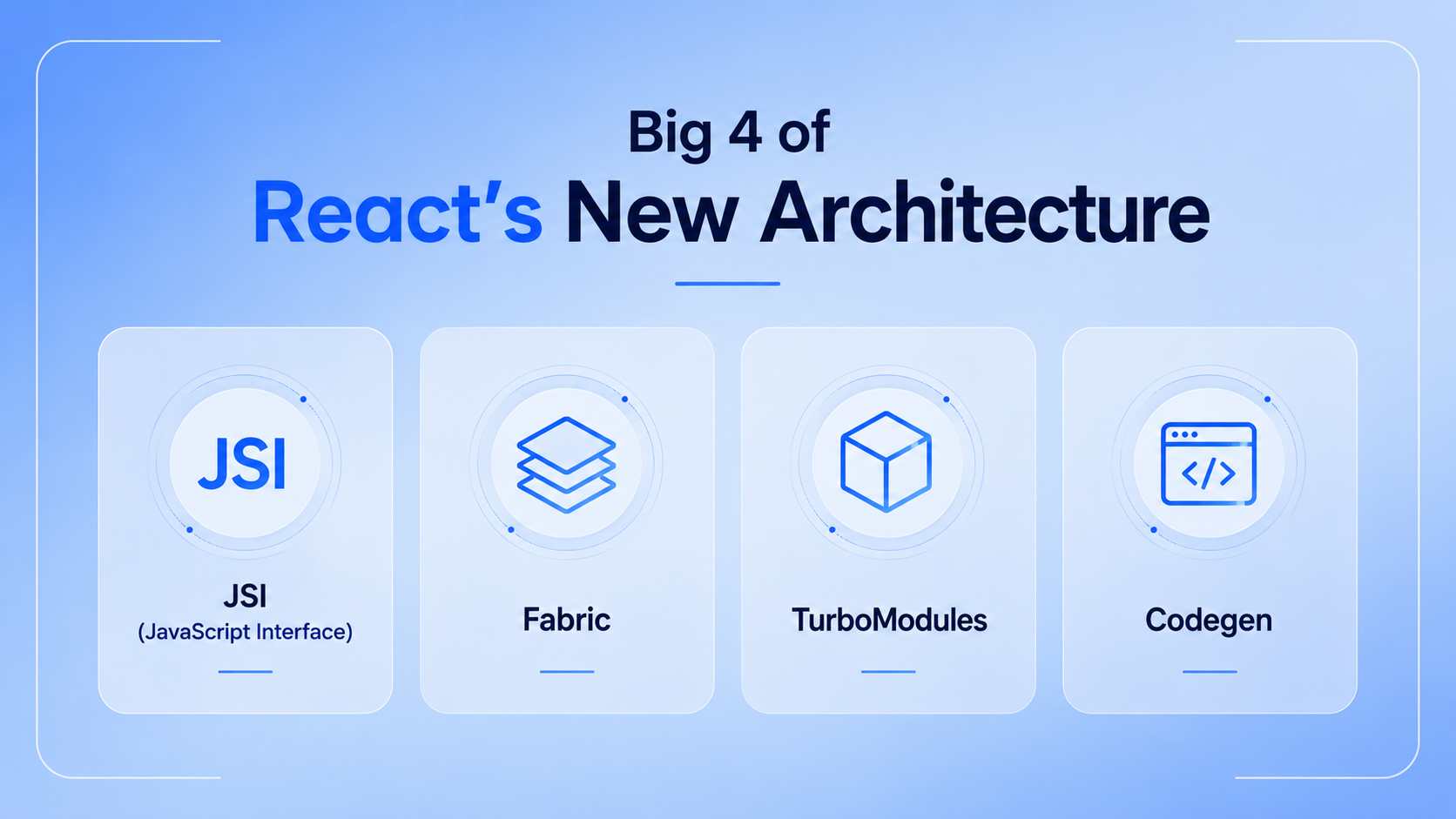
React Native’s New Architecture
One reason older comparisons of native vs react underestimate React Native is that they are analysing a framework that no longer exists in its original form. In 2024, React Native’s New Architecture became stable and broadly adopted, fundamentally changing the performance and capability equation in the native vs react conversation.
The Core Problem the New Architecture Solves
The original React Native architecture had a well-documented bottleneck: an asynchronous JSON bridge sat between the JavaScript thread and the native layer. Every UI update, every API call, every gesture event had to be serialised into JSON, passed across this bridge, deserialised, and processed. For simple interactions this worked fine. For complex, high-frequency UI interactions, the overhead was measurable and sometimes user-visible.

The Four Changes That Matter
- JSI (JavaScript Interface): Replaces the old asynchronous bridge with a C++ layer that enables synchronous, direct communication between JavaScript and native code. Serialisation overhead is eliminated entirely.
- Fabric: A complete rewrite of the rendering system that supports concurrent React features, enabling the smooth, interruptible animations and transitions that were difficult to achieve previously.
- TurboModules: Native modules now load lazily. The app only initialises the modules it actually uses at runtime, dramatically improving startup times on both cold and warm launches.
- Codegen: Static type generation catches interface mismatches at compile time rather than at runtime, improving reliability and reducing a class of bugs that were difficult to debug in the legacy architecture.
The practical outcome is significant. The performance gap between native mobile app development and react native app development has narrowed considerably for most application categories. Apps that previously felt sluggish on React Native now deliver 60fps for standard interactions. The gap remains meaningful for GPU-intensive workloads like 3D rendering and AR experiences, but for the vast majority of business applications, the New Architecture makes react native app development a genuinely competitive choice on performance grounds alone.
Key insight: The New Architecture changes the native vs react debate. Performance, once cited as the decisive reason to choose native, is now a much weaker argument for most application types.
● React Native Experts
Build Powerful Apps with React Native — Faster, Smarter, Better.
From MVP to enterprise-scale, Ailoitte’s React Native team ships high-quality iOS and Android apps from a single codebase.
70–80% shared codebase
30–35% lower dev cost
OTA updates included
Native Mobile App Development vs React Native: 12-Factor Comparison
Here is a detailed analysis of every dimension that matters when choosing between native mobile app development and react native app development. Each factor includes real-world context, not just a theoretical winner.
1. Performance and Speed
Native apps communicate directly with the operating system, producing faster rendering, lower memory overhead, and better handling of concurrent tasks. This advantage is most pronounced in compute-intensive applications such as mobile games, AR/VR experiences, real-time video processing, and high-frequency financial data feeds.
React Native’s New Architecture has closed the gap for mainstream applications. Reliable 60fps performance is achievable for social feeds, e-commerce catalogs, dashboards, and business tools. If your app does not involve heavy GPU work or complex physics simulations, most users will not perceive any performance difference between native and React Native.
Verdict: Native wins for raw performance intensive workloads. React Native is sufficient for the vast majority of business applications.
2. Development Speed and Time to Market
This is where react native app development delivers its most decisive advantage. A single codebase targeting both iOS and Android reduces development time by 30 to 50 percent for comparable project scopes. Walmart reused 96 percent of their codebase across platforms after migrating to React Native. Wix reported a 300 percent acceleration in development velocity after switching.
Native development requires writing, testing, and maintaining code twice. Two teams, two sprint cadences, two release cycles running in parallel. For startups and MVPs, this is often prohibitive. For enterprise teams with dedicated iOS and Android squads already in place, the time difference narrows, but React Native still ships features faster.
Verdict: React Native wins clearly on development speed and time to market.
3. Development Cost
The cost difference between native mobile app development and react native app development is driven primarily by team size and project duration. Two specialist native teams cost significantly more than one cross-platform JavaScript team covering the same product scope. React Native typically reduces development costs by 30 to 35 percent for comparable features. See the detailed cost breakdown table in the next section.
This saving can erode in projects requiring extensive custom native modules, deep hardware bridges, or significant platform-specific UI differentiation. Work with Ailoitte’s mobile development team to get an accurate estimate before committing to an approach.
Verdict: React Native is more cost-efficient in most scenarios, particularly for startups and mid-market products.
4. UI/UX Quality and Design Fidelity
Native apps follow each platform’s design standards precisely. Gestures, navigation patterns, transitions, and system integrations feel exactly as users expect on iOS and Android respectively. When UI/UX quality is the primary competitive differentiator, such as luxury brands, premium digital products, or highly interactive tools, native development gives designers the most precise control over every pixel and interaction.
React Native renders using native UI components, so the result is visually close to a native app for the vast majority of standard interfaces. Where React Native can struggle is in highly custom animations, platform-specific gesture choreography, and complex screen transitions. These scenarios frequently require additional native code integration to reach the desired quality bar.
Verdict: Native wins for complex or highly differentiated UI. React Native is entirely sufficient for most standard business app interfaces.
5. Scalability
Native mobile app development scales more predictably for technically complex products. Teams have direct control over every layer of the stack, making it easier to evolve complex offline sync architectures, real-time data pipelines, and specialised security implementations over time.
React native app development scales well for product breadth. Adding new screens, features, and integrations is faster because a single team owns both platforms. Enterprise software built on React Native can serve millions of users reliably, as evidenced by Facebook, Instagram, and Shopify.
Verdict: Tie. Native scales better for deep technical complexity; React Native scales better for product feature velocity.
6. Security
Security is one of the most consequential factors in the native vs react comparison, particularly for financial applications and healthcare platforms. Native development uses compiled, strongly typed languages (Swift and Kotlin) that are harder to reverse-engineer and have fewer runtime vulnerabilities than JavaScript. There is no JavaScript runtime to exploit, fewer third-party dependencies to audit, and a smaller attack surface overall.
React Native’s reliance on JavaScript and a larger number of third-party npm packages introduces a broader attack surface. Library auditing and dependency management become continuous responsibilities. That said, React Native apps can be made highly secure with proper code obfuscation, certificate pinning, secure storage, and rigorous dependency review processes.
Verdict: Native has a structural security advantage, especially for apps handling sensitive financial or health data.
7. Device Hardware and API Access
Native frameworks provide direct, first-party access to every device capability and OS API the moment Apple or Google releases it. For hardware-intensive apps such as IoT controllers, medical device integrations, or apps that depend on precise real-time sensor data, native mobile app development is the clear choice.
React Native covers the most commonly needed hardware features reliably through its ecosystem of community bridges and, increasingly, through direct JSI integrations. Camera, GPS, Bluetooth, biometrics, and push notifications all work well. Edge cases such as custom USB protocols, very new NFC APIs, and background sensor processing may require native modules or hybrid integration strategies.
Verdict: Native for deep or unusual hardware needs. React Native covers the majority of mainstream hardware requirements.
8. App Maintenance and Updates
Single-codebase maintenance is one of react native app development‘s strongest practical advantages. One bug fix propagates to both platforms simultaneously. One release covers iOS and Android together. Over-the-air updates via Expo EAS Update or Microsoft CodePush let teams push fixes and content changes without waiting for app store review processes, which typically take 24 to 72 hours per platform.
Native maintenance means managing two separate issue backlogs, two platform-specific testing matrices, and two submission pipelines. For DevOps teams managing release cadence, native adds meaningful operational overhead at every sprint cycle.
Verdict: React Native wins clearly on ongoing maintenance efficiency.
9. Testing Strategy
Testing a native app requires platform-specific tooling: XCTest and XCUITest for iOS, Espresso and UIAutomator for Android. Two separate test suites, two CI/CD pipelines, and twice the QA investment are required for equivalent coverage across both platforms.
React Native projects can be covered by a single, unified test suite using Jest for unit tests, Detox or Maestro for end-to-end flows, and React Native Testing Library for component-level tests. One CI/CD pipeline, using tools like Fastlane or Expo EAS Build, covers both platforms simultaneously and cuts release preparation time significantly.
Verdict: React Native wins on testing and CI/CD efficiency.
10. Developer Ecosystem and Hiring
JavaScript and TypeScript are among the most widely used programming languages in the world. The talent pool available for react native app development is significantly larger than the pool for Swift or Kotlin specialists. React Native developers are also faster to onboard, particularly if your existing team has web development experience.
If you need to hire iOS developers, Android developers, Swift developers, or Kotlin developers separately, expect higher salaries and longer hiring timelines. Building two specialist teams from scratch adds months and significant budget to any project start.
Verdict: React Native wins on hiring flexibility and onboarding speed.
11. App Store Submission and OS Feature Access
Both native and React Native apps go through the same iOS App Store and Google Play Store review processes, so there is no submission-level difference. The meaningful distinction appears with new OS feature access. When Apple or Google launches a new platform capability, Swift and Kotlin developers can use it the same day. React Native teams must wait for the framework to add official support, which typically takes several weeks to a few months.
For most apps this lag is not consequential. For products that compete by offering cutting-edge platform features the moment they are available, native development holds a real advantage.
Verdict: Native for teams that must adopt new OS features on day one. No meaningful difference for most standard applications.
12. Long-term Support and Future-proofing
Swift and Kotlin are backed directly by Apple and Google respectively. Language updates, new APIs, and deprecation timelines arrive as part of the OS roadmap. Native mobile app development benefits from this tight coupling with the platform vendors who control the entire ecosystem.
React Native is backed by Meta and a thriving open-source community. After a period of uncertainty in 2018, the framework has had a strong and sustained renaissance. The New Architecture represents a multi-year, large-scale engineering commitment from Meta. The risk of framework abandonment is low, but it exists in a way that it simply does not for native development.
Verdict: Native holds a slight long-term support edge. React Native is well-maintained and stable for the foreseeable future.
Master Comparison Table: Native vs React Native
The table below summarises all 12 factors at a glance. Use it as a reference when presenting the native vs react decision to your stakeholders.
| Factor | Native Mobile App Development | React Native App Development | Winner |
|---|---|---|---|
| Performance | Direct OS access, maximum throughput | Near-native via New Architecture (JSI + Fabric) | Native (slight edge) |
| Dev Speed | Slower: two codebases, two teams | Faster: 70-80% shared code | React Native |
| Cost | Higher: two specialist teams | 30-35% lower on average | React Native |
| UI/UX Fidelity | Best-in-class platform precision | Near-native for most standard apps | Native (complex UI) |
| Security | Compiled, strongly typed languages | JS runtime, broader dependency surface | Native |
| Scalability | Excellent for technical complexity | Excellent for feature velocity | Tie |
| Hardware Access | Full direct first-party API access | Most features via bridges + JSI | Native |
| Maintenance | Two codebases, two release pipelines | Single codebase + OTA updates | React Native |
| Testing | Two suites: XCTest + Espresso | One suite: Jest + Detox/Maestro | React Native |
| Hiring | Two specialist teams, higher salaries | One JS/TS team, larger talent pool | React Native |
| Time to Market | Longer: sequential platform builds | Faster: parallel iOS + Android launch | React Native |
| Long-term Support | Backed directly by Apple and Google | Meta-backed + large open-source community | Native (slight edge) |
Real Cost Breakdown: Numbers, Not Vague Ranges
One of the most common frustrations with native mobile app development vs react native app development comparisons is the absence of specific cost data. The table below provides realistic project-level estimates based on US or Western European development rates ranging from $100 to $200 per hour for senior engineers. All figures reflect blended team costs including project management, QA, and product design.
| App Complexity | Native Mobile App Development | React Native App Development | Avg. Savings |
|---|---|---|---|
| Simple / MVP | $60,000 – $120,000 | $40,000 – $80,000 | 25-35% |
| Medium (e-commerce) | $120,000 – $300,000 | $80,000 – $180,000 | 30-40% |
| Complex (fintech/health) | $300,000 – $600,000+ | $180,000 – $350,000 | 20-35% |
| Enterprise platform | $500,000+ | $280,000 – $450,000 | 15-30% |
The savings from React Native are most pronounced for simple and medium-complexity apps where the shared codebase benefit is maximised. For enterprise-grade products and those requiring extensive hardware bridging, native costs are more competitive because native avoids the overhead of writing and maintaining custom bridge modules.
Hidden cost factors for React Native: custom native module development, complex bridge maintenance as the React Native version updates, and additional native expertise needed for the platform-specific 20 to 30 percent of the codebase. For an accurate estimate for your specific product, begin with a discovery and scoping phase before committing to an approach.
Industry-Specific Recommendations
The native vs react decision often comes down to the requirements of your specific industry. Here is a quick-reference guide based on the unique constraints of each vertical.

| Industry | Recommended Approach | Key Reason |
|---|---|---|
| Fintech / Banking | Native | PCI-DSS compliance, biometrics, transaction security |
| Healthcare | Native (core flows) | HIPAA compliance, medical device integration |
| E-commerce / Retail | React Native | Rapid iteration on catalog, cart, checkout, promos |
| On-Demand / Delivery | React Native | Speed to market, GPS + maps work via bridges |
| Gaming / AR/VR | Native / Unity | GPU performance, complex render loops |
| SaaS / Enterprise Tools | React Native | Single codebase covers dashboards, forms, workflows |
| Startup MVP | React Native | Fastest time to market, lowest initial investment |
Fintech and Banking
For financial software, native mobile app development is the default recommendation. PCI-DSS compliance, real-time transaction performance, biometric authentication at the OS level, and the trust users place in financial apps all demand the highest levels of security and stability. Bugs or slowdowns in a banking or trading app carry direct financial and reputational consequences. Major banks and neobanks almost universally choose native for their core transaction flows.
Healthcare and Telemedicine
HIPAA compliance, integration with medical devices, and the safety-critical nature of clinical apps generally favour native mobile app development for core patient-facing and clinician workflows. However, healthcare platforms serving patient portals, appointment booking, and health tracking functions can be built effectively with react native app development when direct clinical hardware integration is not required.
E-commerce and Retail
This is one of the strongest use cases for react native app development. Retail and e-commerce apps centre on product discovery, search, cart, checkout, and push notifications, all of which React Native handles very well. The ability to iterate rapidly on promotions, seasonal campaigns, and UX experiments is a major competitive advantage, and React Native’s single codebase makes that iteration significantly faster and cheaper.
On-Demand and Delivery
Apps in the on-demand space, including food delivery, ride-sharing, and home services, are among the best-fit categories for react native app development. Maintaining a single feature set across driver and customer apps simultaneously is a major operational advantage. Speed to market and OTA update capability are decisive competitive factors in these fast-moving verticals.
Gaming and Entertainment
For gaming, neither native mobile app development nor react native app development is typically the first choice. Game engines like Unity or Unreal Engine are purpose-built for mobile gaming and offer significantly better tooling and GPU performance. For streaming and OTT platforms with standard video playback requirements, React Native works well when paired with CDN-backed native video player modules.
SaaS and Enterprise Tools
Most enterprise software and SaaS mobile products are strong candidates for react native app development. Form-heavy interfaces, dashboards, reporting screens, and workflow automation tools do not require native-level rendering performance. A single unified team can ship features faster, keep both platforms in sync, and reduce the operational overhead of managing separate codebases indefinitely.
Team Structure and Hiring Considerations
The organisational implications of native mobile app development versus react native app development are frequently underweighted in technical comparisons. Your team structure directly affects your velocity, your total cost, and your ability to respond to market feedback.
Native Team Model
A standard native mobile app development setup requires a dedicated iOS team of one to three Swift developers, a dedicated Android team of one to three Kotlin developers, and a shared backend, QA, and design function. Coordinating two platform teams on feature parity and release timing adds overhead that compounds as the product grows. If you need to hire iOS developers and Android developers separately, expect the total team cost to run 40 to 60 percent higher than an equivalent React Native team.
React Native Team Model
A React Native team is unified around JavaScript and TypeScript skills. Developers need some platform-specific awareness, but the majority of engineering can be done by engineers with a strong web or full-stack background. This makes it easier to build a dedicated development team quickly, particularly for early-stage companies that need to move fast. You still need at least one engineer with native module knowledge for the platform-specific portions of the codebase, but that is far from a full native team headcount.
Brands Using Native vs Brands Using React Native
Examining which companies chose which approach, and the reasons behind those choices, brings the native vs react debate into concrete focus.
Apps Built with Native Development

Apple Maps, Google Maps, Spotify, TikTok, Gmail, and Uber’s core driver app are built natively. These products share a defining profile: they serve billions of users, require real-time rendering performance, rely on deep hardware integration, or need to adopt new OS features the day Apple or Google releases them. Native mobile app development remains the right choice for platforms where any performance regression has an immediate and measurable business consequence.
Apps Built with React Native

Facebook, Instagram, Shopify, Discord, Walmart, Bloomberg, and Microsoft OneDrive are among the high-profile products built with react native app development. Walmart reused 96 percent of code across platforms. Bloomberg chose React Native specifically to reduce team complexity and accelerate feature releases. Shopify has shifted significant portions of their mobile engineering to React Native to improve team velocity. These examples demonstrate that React Native is production-ready at scale for mainstream consumer and enterprise applications.
For a look at how Ailoitte has delivered high-impact mobile products across fintech, healthcare, e-commerce, and logistics, visit our portfolio.
The Hybrid Approach: Using Both Native and React Native
Not every team has to make a purely binary choice between native mobile app development and react native app development. The brownfield integration pattern allows teams to embed React Native screens inside an existing native app, or to write performance-critical modules in native code while handling the remainder of the application in React Native.
This approach is particularly useful for large native apps that want to accelerate feature development on non-critical screens, or for organisations with strong web engineering teams who want to contribute to mobile product velocity. A native banking app, for example, might handle authentication, biometric verification, and transaction flows entirely in native Swift and Kotlin while using React Native for settings panels, onboarding flows, and notification preference screens.
The trade-off is architectural complexity. A hybrid stack requires engineers with knowledge of both paradigms, and debugging issues that cross the boundary between the React Native and native layers can be time-consuming. However, for the right product and team, it provides a pragmatic path to faster iteration without sacrificing performance where it matters most. Ailoitte’s cross-platform development team has deep experience with both pure and hybrid approaches and can guide you through the trade-offs.
Migration Scenarios: When Should You Switch?
React Native to Native: When and Why
Teams sometimes reach a point where their react native app development stack can no longer support their performance, security, or hardware requirements. The clearest signals are persistent frame drop issues that persist even after adopting the New Architecture, security audit findings related to the JavaScript runtime, or a requirement to integrate specialised hardware that lacks reliable community bridge support.
When migrating from React Native to native, the most practical approach is incremental brownfield replacement. Identify the screens or modules that need native performance first, rewrite them in Swift or Kotlin, and keep the remaining app in React Native until the migration progresses. A full rewrite is expensive and risky. Incremental replacement is safer and lets teams validate each migration step before proceeding.
Native to React Native: When and Why
Native teams often evaluate react native app development when release velocity becomes a serious problem. Two separate release cycles, two separate bug queues, and the ongoing challenge of maintaining feature parity between iOS and Android can slow even well-resourced teams. Moving new features to React Native while retaining performance-critical native modules is a viable and increasingly common migration path. Shopify executed a version of this strategy and significantly improved engineering throughput as a result.
Decision Framework: Choose Your Path in 5 Questions
Use these five questions to structure your native vs react decision:
- Is performance the number one product differentiator? If yes, and your app involves real-time rendering, heavy animation, or GPU-intensive tasks, lean toward native mobile app development.
- What is your 12-month development budget? If your total budget for both platforms combined is under $150,000, react native app development is almost certainly the right choice.
- Do you require deep hardware or OS integration? Medical devices, NFC payment terminals, custom Bluetooth peripherals, and real-time sensor pipelines all point toward native.
- What is your target time to market? If you need to launch on both iOS and Android within four months, React Native is the pragmatic choice.
- What is your team’s current skill set? A team fluent in JavaScript and React can ship a React Native app faster than a native team they have not yet hired. Align your technology choice with your human capital.
If you answered yes to three or more of the first three questions, native mobile app development is likely the right path. If you answered no to most and face budget and timeline constraints, react native app development will serve you better. Still unsure? Start with a discovery phase to clarify requirements and get a clear recommendation before committing to either approach.
Quick reference decision matrix:
| Scenario | Recommended Approach | Why |
|---|---|---|
| Startup, limited budget, both platforms | React Native | Speed + cost efficiency wins |
| Fintech or healthcare app | Native | Security + compliance requirements |
| E-commerce or on-demand platform | React Native | Standard features, fast iteration |
| Gaming or AR/VR experience | Native | GPU performance critical |
| Enterprise SaaS mobile app | React Native | Single team, unified codebase |
| Large native app needing faster features | Hybrid approach | Brownfield React Native embedding |
When to Choose Native Mobile App Development
Native mobile app development is the right investment when one or more of these conditions apply to your project:
- Your app involves mobile games, AR/VR experiences, real-time video, or GPU-heavy rendering that demands maximum and consistent frame rates
- You are building for fintech or banking where security, compliance, and biometric transaction authentication are non-negotiable requirements
- You are building for healthcare where HIPAA compliance and direct medical device integration are required
- Your app requires deep hardware integration with medical devices, custom Bluetooth peripherals, or specialised industrial sensors
- You need to adopt new iOS or Android OS features on launch day, before React Native framework support becomes available
- You have dedicated iOS and Android teams already in place and a budget that supports long-term dual-codebase maintenance
- Your user experience is a primary competitive differentiator and requires pixel-level platform fidelity that React Native cannot yet match
When to Choose React Native App Development
React native app development is the right choice when one or more of these conditions apply:
- You are a startup or early-stage product team building an MVP that needs to reach both iOS and Android quickly with a lean team
- Your development budget for both platforms combined is under $150,000 to $200,000
- You are building an e-commerce platform, social app, on-demand service, booking tool, SaaS dashboard, or food delivery app
- You want over-the-air update capability to push fixes and content changes without going through app store review cycles
- Your team has strong JavaScript and TypeScript skills and you want to avoid building two separate specialist native teams
- Long-term maintainability by a single, unified team is more important than platform-specific performance tuning
- You are building an enterprise internal tool where rich native UI fidelity is not a core product requirement
Get started with Ailoitte’s React Native development services, or explore our cross-platform app development and Flutter development options if you want to evaluate all available cross-platform frameworks.
2026 Trends Reshaping the Native vs React Native Debate
The native vs react landscape is evolving faster than at any previous point in mobile development history. Here are the five trends that will most significantly shape this decision over the next 18 months.
Expo and the Managed Workflow Reaching Maturity
Expo’s managed workflow for react native app development has matured significantly, eliminating much of the configuration overhead that historically made React Native setup painful for new teams. EAS Build, EAS Submit, and EAS Update now cover the entire build, deploy, and update pipeline, making react native app development accessible even to teams without deep mobile DevOps expertise.
SwiftUI and Jetpack Compose Closing the Declarative UI Gap
Apple’s SwiftUI and Google’s Jetpack Compose have brought declarative UI paradigms directly to native development, borrowing concepts from React. This makes native development faster and more accessible for engineers already familiar with React, and reduces one of React Native’s historical onboarding advantages.
AI-Assisted Development Reducing Native’s Time Disadvantage
AI coding tools are compressing the time penalty associated with native mobile app development. Boilerplate code that previously took hours to write can now be generated in seconds. This narrows the development speed gap that React Native historically held and makes native more accessible to smaller teams than it was in 2022.
Kotlin Multiplatform Mobile as a Serious Third Option
Kotlin Multiplatform Mobile (KMM) from JetBrains is emerging as a meaningful third alternative that shares business logic across platforms while keeping the UI fully native on each. It is not yet as mature or widely adopted as React Native, but it is gaining traction, particularly in organisations already invested in the Kotlin ecosystem. Expect KMM to factor into the native vs cross-platform conversation increasingly through 2025 and 2026.
AI in Mobile Development Itself
AI-powered features such as intelligent search, personalised recommendations, and conversational interfaces are becoming standard expectations in mobile apps. Both native mobile app development and react native app development can integrate with AI services via API, but teams looking to build deeply integrated on-device AI experiences may find native development offers more direct access to CoreML (iOS) and ML Kit (Android). Ailoitte’s AI development services can help you plan AI integration regardless of which mobile approach you choose.
Conclusion
The native vs react decision is not a question of which technology is objectively superior. It is a question of which approach best fits your product requirements, business objectives, team capabilities, and budget constraints.
Native mobile app development delivers unmatched performance, security, and platform fidelity. It is the right choice for fintech, healthcare, gaming, AR/VR, and any product where user experience is the core competitive advantage or where deep hardware integration is a functional requirement.
React native app development delivers speed, cost efficiency, and maintainability at a level that is more than sufficient for the vast majority of business applications. For startups, MVPs, e-commerce platforms, on-demand services, SaaS tools, and enterprise apps, React Native lets you move faster, spend less, and maintain a single codebase that serves both iOS and Android users.
The New Architecture has narrowed the performance gap considerably. The talent pool for react native app development is larger and more accessible. The framework is stable, actively maintained, and trusted by some of the world’s largest mobile products. The traditional objections to React Native are weaker today than they were two years ago.
At Ailoitte, we help companies make this decision with clarity and confidence. Whether you are choosing between native app development, React Native development, Flutter development, or a hybrid approach, our team of experienced mobile engineers guides you from discovery through to a successful launch.
Ready to build your next mobile product? Contact Ailoitte to start the conversation, or explore our full mobile app development services to see the complete range of what we offer.
FAQs
Is React Native as fast as native in 2026?
For most business applications, yes. With the New Architecture (JSI, Fabric, TurboModules), react native app development delivers reliable 60fps performance for standard UI interactions. For GPU-intensive tasks such as 3D gaming, AR/VR, and very complex animation systems, native mobile app development still holds a measurable performance edge.
How much cheaper is React Native compared to native development?
React Native typically reduces development costs by 30 to 35 percent for comparable project scope and feature sets. See the cost breakdown table above for project-level estimates. The gap narrows for complex apps requiring extensive custom native modules.
Can React Native access all device features?
It covers the most commonly needed capabilities reliably: camera, GPS, Bluetooth, biometrics, push notifications, and accelerometer. Some edge-case hardware integration and very new OS APIs require custom native modules, which in turn require engineers with native platform knowledge.
Is React Native good for large-scale apps?
Yes. Facebook, Instagram, Shopify, Walmart, and Microsoft operate React Native apps at scale serving millions of daily active users. The framework is production-ready for large products with proper architecture.
What major companies use React Native in production?
Meta, Shopify, Discord, Bloomberg, Walmart, Microsoft, SoundCloud, and Tesla are among the most widely cited examples of companies running React Native in production at significant scale.
Is React Native at risk of being abandoned?
No. Meta continues to invest heavily in the framework, the New Architecture represents a multi-year engineering commitment, and the open-source community is larger and more active than ever. React Native is actively maintained and not at meaningful risk of abandonment for the foreseeable future.
Does React Native vs native affect App Store approval rates?
No. App Store and Google Play approval is determined by your app’s behaviour, content, and compliance with platform policies, not the underlying framework. Both native and React Native apps go through identical review processes.

Discover how Ailoitte AI keeps you ahead of risk

Brijesh Kumar
Brijesh is a Marketing Strategist specializing in future-ready growth frameworks, product positioning, and data-driven acquisition strategies for startups and fast-growing tech brands.

Stephan is the sports journalist for the Maple Grove Report.