Some, like Founders Pledge, uniquely cater to entrepreneurs, emphasizing community-building while rigorously vetting nonprofits for effectiveness. Others, like GoFundMe’s Giving Funds, have lowered the opening deposit amount to as little as $5. But perhaps the most interesting trend emerging from the DAF industry is found in a growing cadre of funds that support donors in using their assets as patient, flexible, catalytic capital.
Most DAF holders understand that the money in their accounts is invested while they consider granting opportunities, ideally generating positive returns that increase their future philanthropic power — the familiar “Grow-to-Give” ethos. What many account holders may not realize is that the same capital can also be used creatively to support projects, organizations, and enterprises that directly reinforce charitable objectives.
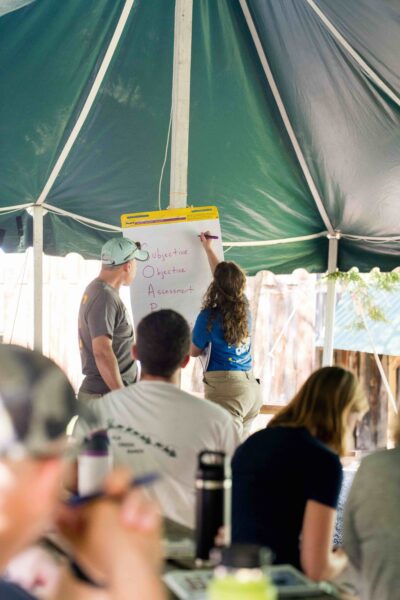
Catalytic capital reaches its full potential when it moves beyond financial accounts and into communities — where local leaders, practitioners, and residents can shape solutions around lived needs and shared priorities.
This “DAF-for-impact” model does more than align investable assets with philanthropic values. It supports the kind of experimentation and higher risk tolerance that many impact investment opportunities and social entrepreneurs require. The same tax guidelines that permit mission- and program-related investing for foundations can also apply to impact investments made from DAFs, across a range of asset classes and structures — including recoverable grants, working capital loans, direct equity investments, revenue-sharing agreements, and LP positions.
The real innovation is not merely a broadening of the financial toolkit and opportunity set. Rather, it is manifesting in pipeline construction and donor activation — two areas that can democratize both who allocates catalytic capital and who can access it.
While some traditional DAF sponsors are adding impact investing capabilities through external platforms like CapShift, others are internalizing an explicit mission to help deploy catalytic capital and create pathways for both investors and entrepreneurs to surface deals.
Neta Foundation, which describes itself as “catalytic native,” specializes in providing patient capital for early-stage social enterprises. Founder Danielle Capalino, who has a deep background in angel investing, views Neta’s venture-style GrantVestments — the fund’s trademarked term — as a way to pursue outsized impact while supporting ventures that might otherwise struggle to access risk-tolerant funding.
“We built this platform to enable you specifically to use your money to invest in really high-risk opportunities that could have exponential reward and that are directly aligned with your philanthropic values,” Capalino explains.
Neta’s growth to $30 million in its first year suggests early demand for this kind of catalytic DAF model.
CataCap, a $5 million fund also on track to achieve 300 percent growth in eighteen months, lowers the bar to entry for donor-investors and aims to facilitate discovery, evaluation, and participation in catalytic opportunities that are typically difficult to access through standard DAF platforms.
“We are trying to make catalytic investing easy and much more accessible by ridding it of all of the friction points,” said founder Ken Kurtzig. “If we look at why people weren’t making impact investments from their DAFs, they had to write $100,000 checks and have deal flow in their back pocket of the exact investment they wanted to make. With CataCap, the investment size can be as little as $250 and we have a marketplace, so people can either choose the ones on our platform or they can recommend their own.”
CataCap, which partners with ImpactAssets to execute investment transactions, encourages collective investing into early-stage ventures by socializing deals among donors. This collaborative capital activation is a defining feature of many emerging DAF-for-impact models.
Claire Raffel describes running into systems challenges with her traditional DAF when she wanted to execute unconventional investments, leading her to seek out others of like mind and cofound DAF Commons, a platform that promotes knowledge-sharing, connection, and donor-investor empowerment. Raffel sees DAF Commons as a way to mobilize donors past mental roadblocks, including the belief that any one donor is powerless to create meaningful impact.
“Individually, your $50 and my $500 and your $5 million aren’t going to make a difference,” Raffel says. “But together we steward $330 billion, and that can make a difference — but only if we’re doing it collectively.”

Collective investing and multi-donor funds can help donors move past isolation, pooling knowledge and capital around shared impact theses.
Raffel also founded the Collective Climate Justice Fund, a multi-donor fund housed on ImpactAssets’ platform that pools donor capital for investments into enterprises working toward a just energy transition. Multi-donor funds with explicit change theses can channel support toward cutting-edge solutions within specific impact domains, particularly when administered by knowledgeable practitioners close to the frontlines of social and environmental innovation.
When investment infrastructure and pipelines become more accessible, obstacles are removed not only for donor-investors but also for the experts who can recognize potentially groundbreaking solutions in their respective fields.
DAFs are not just financial instruments. They are behavioral systems that shape whether capital waits — or moves.
Some funds are so committed to serving as sources of catalytic capital that they do not even foreground the DAF label. Impact Charitable describes itself as an “impact-first investing intermediary” and charts its growth not primarily as a function of assets under management or granting rates, but through the nearly $100 million it has helped move into communities in recent years.

Capital activation depends on intermediaries that can translate donor intent into flexible financing structures that meet real enterprise and community needs.
Cindy Willard, the fund’s Senior Director of Capital Activation, notes that many of Impact Charitable’s donors transfer their funds from traditional DAF sponsors after being frustrated by a lack of willingness or infrastructure to execute the impact opportunities they wish to pursue.
“They’ve thought through their impact strategy and what they want to do, and they’ve identified some things,” said Willard. “But what they don’t know after they’ve identified those things is how to make the money flow. Our mission is to move more money in more ways to more people and places. We are a capital flow mechanism.”
As an intermediary, Impact Charitable plays a critical role in addressing structural mismatches that can stymie catalytic investment — including a donor’s limited capacity for due diligence, an investee’s need for flexible terms, or the conversion of capital from one form, such as a grant, to another, such as debt or equity.
While structural barriers to impact investing through DAFs can be addressed with adaptive strategies, psychological barriers may pose a greater challenge to more widespread practice. In Willard’s view, changing the dominant narrative around DAFs will require a shift away from positioning them primarily as tax strategies and toward understanding them as opportunities to mobilize capital across the stack for public benefit.
The real innovation is in pipeline construction and donor activation — democratizing both who allocates catalytic capital and who can access it.
For Raffel, the change that needs to happen is also personal. Instead of surrendering to scarcity thinking or the belief that they cannot move the needle, donors should embrace their own agency.
“DAF holders are just people,” she says. “We don’t have boards and we don’t have investment committees and investment policy statements. We can be nimble and flexible and respond to really urgent needs. And I’d say right now, in the world, there are a lot of urgent needs.”
DAFs that are hyper-focused on catalytic investing still represent a relatively small slice of the sector. But they are growing, and they are demonstrating that collective experience, intentional engagement, and flexible deployment can move more capital and activate the unrealized potential of what might otherwise remain stagnant pools of philanthropic funding.
For Capalino, the greatest challenge in growing this practice is simple awareness: “One of the things I hear most often is, ‘I didn’t know my DAF could do this!’”
For donors who want to maximize impact through both philanthropy and investment, these emerging DAF models are clearing a new path. The question now is who will take it.