What Is Model Context Protocol (MCP)? A Plain-English Guide for Builders


Model Context Protocol (MCP) is an open, vendor-neutral standard that gives AI models a universal way to connect to external tools, databases, and APIs. Released by Anthropic in November 2024 and now governed by the Linux Foundation, MCP replaces the fragile web of custom integrations that previously defined AI agent development with a single, reusable client-server protocol.

By March 2026, MCP recorded 97 million monthly SDK downloads across Python and TypeScript alone, with over 10,000 active servers running in production (Anthropic, via WorkOS, March 2026). Every major AI vendor, including OpenAI, Google DeepMind, and Microsoft, supports it. If your team is building AI-powered applications or automation workflows today, understanding MCP is no longer optional.

This guide explains what MCP is, how it works, where it applies in real product builds, what security risks it introduces, and how to get started. No academic abstractions. Pure builder context.

What Changed in 2026

MCP moved from a single-vendor experiment to the de facto AI connectivity standard in under 18 months. These are the events that define where the protocol stands today, and why builders need to factor them into architectural decisions now.

Date Development
Nov 2024 Anthropic releases MCP as open source. Reference servers ship for GitHub, Slack, Google Drive, PostgreSQL, and Puppeteer.
Mar 2025 OpenAI adopts MCP across Agents SDK and ChatGPT desktop. Monthly SDK downloads reach 22 million.
Apr 2025 Google DeepMind integrates MCP into Gemini. Invariant Labs publicly demonstrates tool poisoning attacks against live MCP servers.
Jul 2025 Microsoft adds MCP to Copilot Studio. Downloads hit 45 million per month.
Sep 2025 First malicious MCP package appears in public registries. Supply-chain attacks confirmed as an active threat vector.
Nov 2025 MCP spec updated: Streamable HTTP replaces legacy SSE transport. OAuth 2.1 becomes the authentication standard for remote servers.
Dec 2025 Anthropic donates MCP to the Agentic AI Foundation (AAIF) under the Linux Foundation. Co-founded by Anthropic, Block, and OpenAI. Supported by Google, Microsoft, AWS, Cloudflare, and Bloomberg. MCP becomes vendor-neutral, community-governed infrastructure.
Mar 2026 97 million monthly SDK downloads. 10,000+ active MCP servers in production. All major AI providers on board.

What Is Model Context Protocol (MCP)?

Model Context Protocol is an open standard that defines how AI models communicate with external systems. It uses JSON-RPC 2.0 as its communication foundation and establishes a client-server architecture that allows any MCP-compatible AI application to discover and invoke capabilities from any MCP server at runtime (modelcontextprotocol.io, 2026).

The USB-C Analogy

Before USB-C, every hardware manufacturer shipped proprietary charging connectors. A laptop, a phone, a tablet, and a camera each needed different cables. The proliferation was wasteful, fragile, and expensive. USB-C ended that by replacing hundreds of proprietary connectors with one universal standard.

The AI integration landscape before MCP was no different. Every combination of language model and external tool, whether a CRM, a database, a file store, or a communication platform, required a custom integration. Change the AI model and the connectors needed to be rewritten. Add a new tool and a new adapter had to be built. Multiply the connectors required across ten models and fifty tools and you arrive at the N x M problem.

What MCP Is Not

Three clarifications that prevent the most common misconceptions:

  • MCP does not replace REST APIs. Your existing REST and GraphQL APIs continue to serve human clients and traditional software. MCP is an orchestration layer that wraps those APIs and exposes them to AI agents.
  • MCP is not an LLM framework like LangChain or LangGraph. It is a transport and discovery protocol, not an agent orchestration system.
  • MCP is not proprietary to Anthropic. Since December 2025, it has been governed by the Linux Foundation under the Agentic AI Foundation, with co-founders Anthropic, Block, and OpenAI.
  • MCP is not limited to Claude. OpenAI, Google, and Microsoft all support it natively across their flagship AI products and developer tooling.

How MCP Works: The Architecture

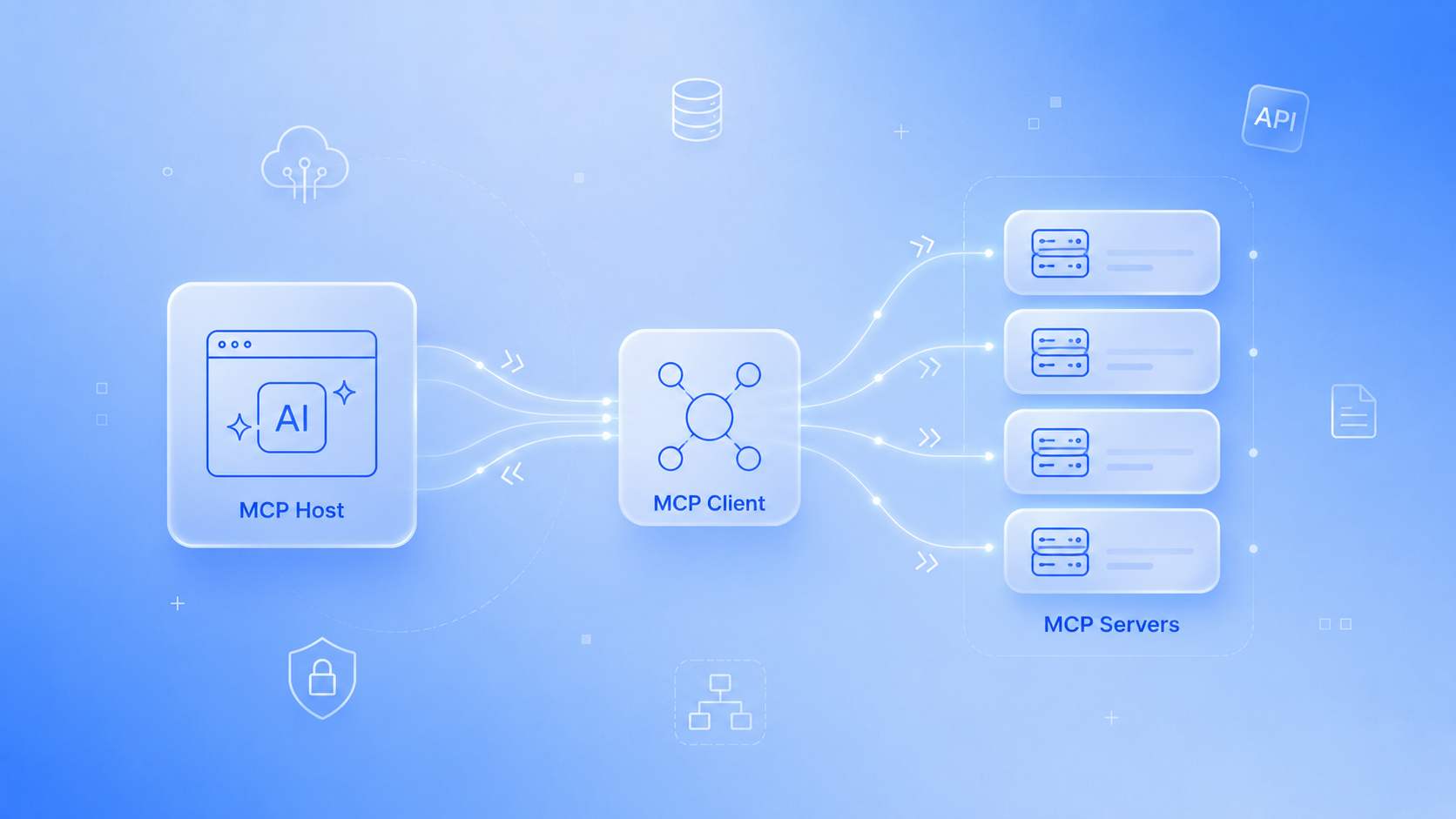
MCP defines three architectural roles and three server primitives. Understanding both is the foundation of any practical MCP implementation.

Model Context Protocol basic Architecture

The Three Roles

Role What It Is Real-World Example
MCP Host The AI application the user interacts with. Contains orchestration logic and manages MCP clients. Claude Desktop, VS Code with AI Copilot, a custom agent app built on Ailoitte’s AI Velocity Pod
MCP Client Lives inside the host. Maintains a 1:1 connection with one specific MCP server. Mediates all communication. The connector module inside your app that talks exclusively to your GitHub MCP server
MCP Server An external program exposing tools, resources, and prompts via a standardized interface. Local or remote. A GitHub server exposing create_pull_request(), list_issues(), fetch_file_content() as callable tools

The Three Server Primitives

Every MCP server exposes capabilities through exactly three building blocks, each serving a distinct function.

  1. Tools (Model-Controlled)

Functions the LLM can invoke to perform actions with side effects. The AI decides when and whether to call them based on user intent. Tools are the AI’s hands: they let it act on the world, not just reason about it.

  • Examples: send_email(), create_support_ticket(), execute_trade(), deploy_build(), update_patient_record()
  1. Resources (Application-Controlled)

Data sources the application exposes to the AI for reading. They operate like GET endpoints in a REST API and carry no side effects. Resources give the AI eyes: structured context it can reason on without taking action.

  • Examples: user_profile, order_history, patient_records, product_catalogue, portfolio_data
  1. Prompts (User-Controlled)

Pre-defined, reusable templates that standardize how the AI uses tools and resources in specific workflows. Surfaced explicitly to users, these give teams a way to codify and share high-value AI workflows.

  • Examples: ‘Summarise this patient record and flag risk indicators’, ‘Analyse this portfolio for regulatory exposure’, ‘Review this pull request and suggest improvements’

The Connection Lifecycle

Every MCP interaction follows four steps:

  1. Initialization. The host starts and creates MCP clients. Each client performs a capability and version handshake with its assigned server.
  2. Discovery. The client asks each server: ‘What capabilities do you offer?’ The server responds with its complete list of tools, resources, and prompts.
  3. Invocation. When the LLM determines it needs a tool based on the user’s request, the host directs the appropriate client to send an invocation request to the server.
  4. Execution and Response. The server runs its underlying logic, which may include an external API call, a database query, or a file operation, and returns structured results. The client feeds these results back into the AI’s context loop.

Transport Layer

MCP supports two transport modes. Standard I/O handles local inter-process communication and is the default for tools like Claude Desktop. Streamable HTTP, introduced in the November 2025 spec update, enables remote cloud-hosted MCP servers and replaces legacy Server-Sent Events (SSE). Remote servers use OAuth 2.1 for authentication, which became the standard with the June 2025 spec release (modelcontextprotocol.io, 2026).

Traditional REST APIs are stateless: each request arrives without memory of the previous one. MCP sessions are stateful: the server tracks what happened earlier, enabling multi-step agent workflows. A stateless integration answers a single question. A stateful MCP integration runs a 10-step workflow where each step uses the results of the previous one.

MCP vs. Traditional APIs: What Actually Changes for Builders

MCP and traditional REST APIs share a goal: connecting software systems. They diverge significantly in how they achieve it, and for whom they are designed.

Dimension Traditional REST API MCP (2026)
Session model Stateless: each request is fully independent Stateful: sessions persist across multi-step workflows
Tool discovery Hardcoded endpoints; developer must know all routes in advance Dynamic runtime discovery: AI queries capabilities at startup
Intended consumer Human developers writing deterministic application code AI agents making autonomous decisions at runtime
Integration effort Custom connector per LLM-tool pair (N x M problem) Build once per tool; every MCP client connects automatically
Context handling Developer manages session state manually Built-in session history and context management in the protocol
Error semantics HTTP status codes; generic patterns Structured, semantic feedback optimized for LLM reasoning
Auth model API keys or custom OAuth implementation OAuth 2.1 standardized across all remote servers (Jun 2025 spec)
Streaming Custom SSE or WebSocket implementation required Native streaming semantics in the protocol

The Critical Nuance: MCP Wraps APIs, It Does Not Replace Them

This is the most important thing to get right when evaluating MCP. Your existing REST and GraphQL APIs continue to serve human clients, traditional software, and third-party integrations. MCP is the orchestration layer that wraps those APIs and makes them accessible to AI agents.

Think of it this way: your REST API is the plumbing. MCP is the smart valve system that lets an AI agent decide which pipes to open, when, and in what sequence. The plumbing does not change. The AI gains the ability to control it intelligently.

When to Use Which

  • Use MCP when building AI agent workflows that need to discover and invoke tools dynamically at runtime.
  • Use MCP when multi-step, stateful AI tasks span multiple backend systems.
  • Use MCP when future-proofing against new AI models matters: a new model connects to all your MCP servers automatically.
  • Use REST when building fixed, deterministic integrations between software systems that do not involve AI agents.
  • Use both in production: REST for service-to-service communication, MCP as a lightweight wrapper that makes those services accessible to AI.

For a detailed performance data comparison between MCP and traditional API connectors, see our companion analysis: MCP vs Traditional API Connectors.

The MCP Ecosystem in 2026

MCP is the fastest-adopted developer connectivity protocol in recent AI infrastructure history. The numbers illustrate the scale of this standardisation event:

97M+ 10,000+ 500+ 5
Monthly SDK Downloads (Mar 2026) Active Production MCP Servers Public Server Implementations Official SDK Languages

Official SDKs exist for TypeScript/JavaScript, Python, Java, C#/.NET, and Swift. Major platforms with available MCP servers include GitHub, Slack, Google Drive, PostgreSQL, Notion, Jira, and Salesforce, among hundreds of others.

Governance: Why the Linux Foundation Matters

In December 2025, Anthropic donated MCP to the Agentic AI Foundation (AAIF) under the Linux Foundation. The AAIF was co-founded by Anthropic, Block, and OpenAI, with support from Google, Microsoft, AWS, Cloudflare, and Bloomberg. This governance transfer has one practical consequence for builders: MCP is no longer a bet on a single vendor. It is a community-governed standard with the same institutional backing as Linux, Kubernetes, and Node.js.

MCP and A2A: Two Complementary Protocols

MCP defines how individual agents interact with tools. Google’s Agent-to-Agent protocol (A2A), released in April 2025 and also contributed to the AAIF, defines how agents communicate with each other. In production multi-agent systems, the two work together: MCP handles tool and data connectivity for each individual agent; A2A handles task delegation and result sharing between agents.

Real-World Use Cases by Industry

MCP’s value changes shape by industry, but the structural benefit is constant: AI agents that previously needed a custom connector per tool can now access any MCP-compliant system through a single protocol. The following use cases illustrate what that means in practice.

Fintech and Financial Services

AI in financial services requires simultaneous access to real-time market data, risk models, regulatory filings, and customer portfolios. Previously, each data source required a custom connector, rebuilt every time the underlying AI model changed.

Block, the fintech company behind Square and Cash App, built an internal AI agent called Goose that runs on MCP, connecting AI assistants to internal tools and financial databases with standard access controls (Block Engineering Blog, 2025 ). For product builders in the fintech space, MCP enables AI systems to interact with live portfolio data as Resources and execute compliance reports or trades as Tools, all within a single stateful session governed by OAuth 2.1.

Healthcare and Clinical Systems

Healthcare is where MCP’s permissioned architecture matters most. A physician reviewing a patient before an appointment needs AI that can access lab results, clinical history, prescribed medications, and appointment records simultaneously, without any data leaving the approved environment.

MCP’s Resource primitive enables read-only access to patient data with no side effects. Its Tool primitive enables write operations, such as flagging a risk or scheduling a follow-up, under explicit permission controls. Every invocation is loggable and auditable. For healthtech builders, this aligns directly with HIPAA’s minimum necessary access standard.

Ailoitte delivers healthcare applications under HIPAA Ready deployment patterns. Our MCP integration work for healthtech clients applies tool permission controls as an architectural baseline, not a post-deployment addition.

E-Commerce and Retail

An AI agent serving an e-commerce platform needs to check inventory, update pricing dynamically, process return requests, and personalise recommendations, often within a single customer interaction. Before MCP, each of those four operations required a separate connector built per AI model.

With MCP, a single agent session connects to inventory, order management, pricing, and returns MCP servers simultaneously. The AI can read stock levels as Resources and act on them via Tools: adjusting prices, triggering restocking, or initiating return workflows automatically.

Enterprise Developer Tooling

AI coding assistants that need access to GitHub, Jira, Slack, PostgreSQL, and Notion represent the highest-volume MCP use case as of 2026. One documented production migration reduced integration surface from 47 custom API adapters to 6 MCP servers, with new tool deployment time dropping from three days to eleven minutes (Essa Mamdani, 2026 — ).

This result is reproducible. Every custom adapter that gets replaced by an MCP server is a maintenance obligation that disappears.

Mobile App Development: The Builder’s Perspective

This is the use case most directly relevant to teams working with Ailoitte. Modern mobile apps increasingly ship with AI-powered features: smart recommendations, context-aware assistants, dynamic pricing, predictive onboarding, real-time support escalation. Each of those features needs to reach backend systems. Before MCP, each feature required a custom backend integration.

MCP for Mobile app development

With MCP-native architecture:

  • Backend intelligence becomes reusable. MCP servers exposing your app’s business logic, user history, purchase records, and in-app behavior serve every AI feature in the application, not just the one they were built for.
  • Feature delivery accelerates. New AI features inherit the existing MCP capability surface automatically. No new connector, no new adapter, no new sprint ticket for integration work.
  • Cross-platform context becomes achievable. MCP Resources shared across iOS, Android, and web surfaces allow users to start an AI workflow on mobile and continue it on desktop without losing their session state.
  • Model changes stop being rebuilds. Switching or upgrading the underlying AI model does not require rewriting integrations. The MCP servers stay. Only the host application’s model reference changes.

Security: What Builders Cannot Ignore

MCP’s specification states explicitly that the protocol cannot enforce security principles at the protocol level. Security is entirely the builder’s responsibility. Most teams deploying MCP in early 2025 treated this as a secondary concern. The consequences were documented quickly.

The OWASP MCP Top 10

OWASP published the first formal classification of MCP attack vectors in 2025. Key categories include prompt injection via malicious tool outputs, excessive tool permissions enabling privilege escalation, insecure tool descriptions enabling tool poisoning, missing audit logging preventing forensic response, and supply-chain compromise via unvetted third-party servers (OWASP, 2025).

The Production Security Baseline

Control What to Implement Why It Matters
Authentication OAuth 2.1 on all remote MCP servers. Never deploy unauthenticated to any non-local environment. Prevents unauthorized tool invocations. CVE-2025-49596 resulted from missing auth.
Tool Allowlisting Define explicit allowlists. Reject any tool invocation not on the pre-approved list. Blocks tool poisoning attacks and permission escalation.
Input/Output Validation Validate all parameters entering MCP tools. Sanitise all results returned. Stops prompt injection from propagating through the context loop.
Audit Logging Log every tool invocation: tool name, parameters, caller identity, timestamp. Enables forensics, compliance reporting, and anomaly detection.
Server Vetting Use only first-party or verified community servers. Pin versions explicitly. Prevents silent dependency replacement via typosquatted packages.
Minimal Permissions Each MCP server holds credentials only for the systems its tools explicitly require. Limits blast radius of any server compromise to the minimum necessary scope.

Getting Started: A Practical Builder’s Roadmap

MCP has official SDKs in five languages as of 2026: TypeScript/JavaScript, Python, Java, C#/.NET, and Swift. TypeScript has the broadest community ecosystem and the most reference server implementations. Python is the second most active, particularly for data-intensive server builds.

The Architecture Decision Before Day One

Before installing any SDK, design your capability surface. Answer three questions:

  1. Which backend systems or data sources need to be Resources (read-only context for the AI to reason on)?
  2. Which operations need to be Tools (actions the AI can take, with real-world consequences)?
  3. Which recurring workflows should be standardized as Prompts (reusable templates for specific AI tasks)?

This mapping, done carefully before any code is written, eliminates the single most common source of MCP rework: discovering mid-sprint that a capability was designed incorrectly for its actual use.

A Practical 7-Day Start

Days Task Expected Outcome
1-2 Install the MCP SDK for your primary language. Connect Claude Desktop or a test host to one reference server (GitHub or PostgreSQL). Study the discovery and invocation flow. Working understanding of host-client-server communication and the capability surface response.
3-5 Build a minimal custom MCP server for one internal system: your product database, a CRM, or one internal API. Expose two Resources and two Tools. First live integration between an AI host and your own production system.
6 Add a second MCP server. Write a Prompt that sequences tool invocations from both servers. Experience of multi-server, multi-step workflows and context chaining across systems.
7 Security review: add OAuth 2.1 on the server, implement tool allowlisting, and add invocation audit logging. Production-ready security baseline that meets the minimum requirements for any non-local deployment.

Common Mistakes to Avoid

  • Building MCP servers before mapping the capability surface. Design first, code second.
  • Deploying remote MCP servers without OAuth 2.1 authentication. CVE-2025-49596 exists because teams skipped this step.
  • Using MCP for stateless, single-call operations where REST is the correct tool.
  • Using unvetted third-party MCP servers in production without version pinning or independent security review.
  • Treating an MCP server as a replacement for your existing API layer rather than a wrapper around it.

For teams building MCP-native products from scratch, Ailoitte’s AI Velocity Pods include MCP-native architecture as a standard delivery pattern, with capability surface design, security baseline, and cross-system integration delivered as a single fixed-price outcome.

The Road Ahead: MCP in 2026 and Beyond

The official 2026 MCP roadmap, published by lead maintainer David Soria Parra in March 2026, identifies four priorities: transport scalability (stateless session management for horizontal scaling), agent communication (MCP and A2A composability), governance maturation (enterprise registry, namespace trust, tool-safety review), and enterprise readiness (OAuth flows, hosted server reliability, observability tooling) (modelcontextprotocol.io Blog, March 2026).

Stateless Operation: The Scaling Unlock

The biggest scaling bottleneck in current MCP deployments is session state. Today, each MCP server must maintain session state, which prevents horizontal scaling behind load balancers. The forthcoming spec update standardizes session creation, resumption, and migration, making server restarts and scale-out events transparent to connected clients. For builders deploying MCP in cloud-native environments, this removes the last major scaling constraint for high-volume AI agent workloads.

Enterprise Registry and Governance

Enterprise teams adopting MCP at scale are demanding centralized, auditable registries: curated repositories of approved, vetted MCP servers with namespace trust, version management, and tool-safety review before write access is granted. This is the same governance maturity that Kubernetes and npm eventually had to build. MCP is building it now, proactively.

The Long-Range View

By 2027, ‘Does it have an MCP server?’ is expected to become a standard enterprise procurement question before any SaaS software purchase. By 2028, MCP servers are projected to ship inside software products themselves, requiring no separate installation.

For builders, this trajectory has one clear implication: products that ship with MCP servers today have a structural advantage that compounds over time. The teams that design for MCP-native architecture now will be the ones whose products are AI-agent-accessible when the market expects it as standard.

Ailoitte’s AI Transformation team monitors each MCP spec release and updates architecture recommendations accordingly. If you are evaluating how MCP fits into your existing stack or planning a new AI-native product build, our team is the right starting point.

How Ailoitte Builds MCP-Native Products

Ailoitte’s AI development services and mobile app development teams treat MCP as a standard architectural component for any product where AI needs to interact with more than two data systems or business logic layers. Here is how that works in practice.

Capability Surface Before Code

Before any integration code is written, we map the complete set of Resources, Tools, and Prompts the AI will need across every backend system in scope. This prevents the most common MCP rework scenario: discovering mid-sprint that a capability was architected as a Tool when it should have been a Resource, or that a business-critical workflow was never codified as a Prompt.

Security by Architecture

OAuth 2.1, tool allowlisting, and invocation audit logging are delivery requirements on every MCP deployment, not post-launch checkboxes. Our ISO 27001, SOC 2 Type II, and HIPAA Ready certifications reflect the standards we hold ourselves to on every project, regardless of client size or industry.

MCP-Native AI Velocity Pods

Our AI Velocity Pods operate on fixed-price, outcome-based delivery. For agentic product builds, MCP-native architecture is now part of the standard delivery pattern. When each new tool is one server connection rather than a custom connector, pods deliver faster, with less integration rework per sprint. This is the structural reason why our pods ship at 5x the velocity of traditional agency engagements.

Cross-Platform Context Design

For mobile products, we design MCP Resources to persist session context across iOS, Android, and web surfaces. A user who starts an AI workflow on mobile and continues it on desktop does not lose their session or their context. This is not a post-launch feature; it is an architectural decision made in the first sprint.

Across more than 300 products delivered in 21 countries, the AI integration decisions made in the first two sprints determine total cost of ownership for the next three years. Teams that build MCP-native from the start spend those three years shipping features. Teams that retrofit it spend those years re-architecting.

Conclusion

Model Context Protocol is infrastructure, not a trend. The adoption curve from 2 million monthly downloads in November 2024 to 97 million in March 2026, backed by every major AI vendor and governed by the Linux Foundation, represents one of the fastest standardisation events in developer tooling history.

For builders, the practical implication is direct. AI agents that cannot access real-world tools and data are chatbots. MCP is the protocol that closes the gap between reasoning and action. Teams that design for MCP-native architecture from the ground up will spend the next three years shipping features. Teams that keep building custom connectors will spend those years maintaining glue code.

The window to build MCP-native from the start remains open, but it is closing as the ecosystem hardens around this standard. If you are planning an AI-powered product, retrofitting AI into an existing application, or evaluating whether your current integration architecture will scale with your AI roadmap, the architecture decisions you make in the next sprint matter more than any decision you make in the next quarter.

Ready to build MCP-native? Ailoitte’s AI Velocity Pods deliver production-ready AI products with MCP-native architecture.

FAQs

What is Model Context Protocol in simple terms?

MCP is an open standard that gives AI models a universal way to connect to external tools, databases, and services. Instead of writing custom integration code for every AI model-tool combination, developers expose capabilities through MCP servers once. Any MCP-compatible AI application connects to them automatically, without additional integration work per new model.

Who created MCP, and who governs it now?

Anthropic created and open-sourced MCP in November 2024. In December 2025, Anthropic donated it to the Agentic AI Foundation (AAIF) under the Linux Foundation. The AAIF is co-founded by Anthropic, Block, and OpenAI, with support from Google, Microsoft, AWS, Cloudflare, and Bloomberg. MCP is now a vendor-neutral, community-governed protocol with long-term institutional backing.

Is MCP only for Claude and Anthropic products?

No. OpenAI adopted MCP in March 2025 across its Agents SDK and ChatGPT desktop application. Google DeepMind integrated it into Gemini in April 2025. Microsoft added MCP to Copilot Studio in July 2025. Any application implementing the MCP client specification, regardless of the underlying AI model, can connect to any MCP server.

Does MCP replace REST APIs?

No. REST APIs continue to serve human clients and traditional software. MCP is an orchestration layer that wraps existing APIs and makes them accessible to AI agents. In most production architectures, both coexist: REST for service-to-service communication, MCP as the interface layer for AI agent tool access

Is MCP secure enough for regulated industries like healthcare and finance?

MCP does not enforce security at the protocol level. Security is the builder’s responsibility. With proper implementation including OAuth 2.1 authentication, tool allowlisting, input and output validation, audit logging, and minimal permission design, MCP can meet enterprise and regulated-industry requirements. Ailoitte deploys MCP under ISO 27001, SOC 2 Type II, and HIPAA Ready standards for all applicable client engagements.

Discover how Ailoitte AI keeps you ahead of risk

Brijesh Kumar

Brijesh is a Marketing Strategist specializing in future-ready growth frameworks, product positioning, and data-driven acquisition strategies for startups and fast-growing tech brands.


Source link

Leave a Reply

Subscribe to Our Newsletter

Get our latest articles delivered straight to your inbox. No spam, we promise.

Recent Reviews


Every business leader searching for the best AI development company in usa faces the same dilemma: the market is flooded with vendors, every agency claims to be AI-first, and the cost of choosing wrong runs into six figures and months of wasted runway. This guide cuts through the noise with verifiable evidence, not marketing copy.

According to a Morgan Stanley report, AI adoption is projected to add up to $16 trillion in value to S&P 500 stocks, boosting corporate net benefits by approximately $920 billion annually. That number is not theoretical. It is already flowing to companies that partnered with the right artificial intelligence development company in USA and moved decisively.

From healthcare diagnostics and FinTech automation to retail personalisation and logistics optimisation, a seasoned AI development company in USA can collapse a 12-month roadmap into a 4-week MVP. The United States is home to a dense cluster of world-class AI development companies spanning hyper-specialised boutiques to full-stack transformation partners. That concentration makes this market simultaneously rich with choice and difficult to navigate without a structured framework.Whether you are a Series A startup that needs an ai development company in usa to launch before your next funding round, or a Fortune 500 enterprise seeking a strategic partner for end-to-end AI transformation, the 14 firms profiled below represent the best the U.S. market has to offer in 2026 based on a six-point evaluation framework grounded in verifiable, public data.

How We Selected These AI Development Companies in USA

This list is not a paid directory. Every AI development company in USA included here was shortlisted through a repeatable, audit-ready process. We reviewed over 40 vendors across the United States before narrowing to 14. Here is exactly what qualified each one.

Our Six-Point Evaluation Framework

The following table summarises the criteria we applied to every AI development company in USA under consideration. A company had to satisfy at least four of the six criteria to be included.

Criterion

What We Looked For

Why It Matters

Verified Client Reviews

Minimum 10 reviews on Clutch, GoodFirms, or G2 with documented project details

Ensures social proof is real and traceable

Proprietary AI/ML Depth

In-house model training, fine-tuning, or agent architecture capability

Separates genuine AI builders from resellers

Speed to Value

Demonstrated ability to ship working software within a defined, short timeframe

Protects your runway and reduces delivery risk

Engagement Flexibility

Offers more than one commercial model (hourly, fixed, outcome-based)

Aligns vendor incentives with your business goals

Security Certifications

ISO 27001, SOC 2, or HIPAA compliance documentation available on request

Critical for healthcare, fintech, and enterprise buyers

Post-Delivery Support

Structured SLA and maintenance offering beyond the initial launch

Prevents product degradation after handover

Additional Signals We Weighted

Beyond the core six criteria, we assessed each ai development company in usa on several supporting signals that help separate credible partners from vendors optimised only for lead generation.

  • Transparency of process: Does the company publish its development methodology, team structure, and pricing model publicly? Opacity at the evaluation stage typically signals opacity during delivery.
  • Portfolio specificity: Do case studies name real clients, quantify outcomes, and describe the actual technical problem solved? Generic portfolios with unnamed logos were penalised.
  • AI-native vs AI-added: We distinguished companies that were founded to build AI products from those that grafted an AI practice onto a legacy software agency. The former carry deeper expertise and more coherent tooling.
  • Vertical depth: Generalist capability is a baseline. Companies with demonstrable, repeated delivery in a specific industry (healthcare, fintech, logistics) scored higher on expertise.
  • Geographic accountability: U.S. headquarters or registered entity with identifiable leadership was a required condition for inclusion as an ai development company in usa.

Companies at a Glance

Use this comparison table to match an AI development company in USA to your requirement at a high level. Full profiles follow below.

Company

HQ

Core Strength

Engagement Model

Best For

Ailoitte

Delaware, USA

End-to-end AI + Velocity Pods

Outcome-based / Hourly / Fixed

Startups and enterprises seeking fastest time to market

MentTech

USA

Adaptive and multimodal AI

Project / Retainer

AI-first digital enterprises

Codiant

USA

Enterprise mobility + AI

Fixed / T&M

Enterprise and healthcare clients

InnovationM

USA (Global)

GenAI, ML, NLP, CV

Dedicated / Agile sprints

Mid-size to enterprise scale-ups

NextGenSoft

USA

Agentic AI + AWS cloud-native

AI-first SDLC

Cloud-native startups

Ekkel AI

Newark, DE

AI-literate product development

Fixed scope / MVP sprint

Early-stage startups and rapid MVPs

Debut Infotech

Palatine, IL

AI + Blockchain + Web3

Full-cycle development

Finance, logistics, real estate

RaftLabs

India (Global)

Custom AI and NLP tooling

Project-based

SMBs and funded startups

Flatirons

Boulder, CO

Design-led AI web and mobile

T&M / Retainer

Product-led SaaS companies

Markovate

San Francisco, CA

GenAI and agentic AI systems

POC to full build

Growth-stage companies

LeewayHertz

San Francisco, CA

Enterprise AI and ML

Consulting to build

Fortune 500 and funded startups

Biz4Group

Orlando, FL

AI + IoT + mobile platforms

Managed services

Enterprise (700+ delivered projects)

AtliQ Technologies

USA

AI consulting and ML strategy

Consultative / Fixed

Healthcare, finance, IT services

BlueLabel

USA

Generative and Agentic AI

Strategy to deploy

Mid-to-large businesses

Leading Artificial Intelligence Firms Based in the U.S.

Following are the top US AI firms that are driving innovation, transforming industries, and setting global standards in artificial intelligence.

Ailoitte

Top ai development company in usa | Ailoitte

First-in-class Velocity Pods. Outcome-based pricing. MVP in 4 weeks.

Ailoitte is a certified AI transformation and digital solutions provider headquartered in Delaware, USA. As an ai development company in usa, Ailoitte delivers end-to-end AI development services spanning machine learning, generative AI, NLP, computer vision, and autonomous AI agents. The company has shipped hundreds of custom digital products for global clients across healthcare, fintech, retail, education, and logistics. Ailoitte is the only ai development company in usa to pioneer Velocity Pods, a pre-calibrated squad model that puts ML engineers, architects, UX designers, and QA automation specialists on a shared outcome from day one.

Key Services

  • AI/ML Development: machine learning, LLMs, NLP, computer vision, deep learning. See: AI/ML Services
  • Generative AI: custom GenAI apps, RAG pipelines, fine-tuned LLMs. See: GenAI Development
  • AI Agent Development: autonomous agents, multi-agent systems, workflow automation. See: AI Agents
  • Conversational AI: enterprise chatbots, voice bots, AI assistants. See: Conversational AI
  • AI Consulting and Strategy: workshops, roadmaps, AI transformation. See: AI Consulting
  • Mobile App Development: iOS, Android, React Native, Flutter. See: Mobile Apps
  • Web App Development: SaaS platforms, enterprise portals. See: Web Apps
  • Healthcare Software: EHR/EMR, telemedicine, HIPAA-compliant platforms. See: Healthcare

Why They Made This List

  • Satisfies all six evaluation criteria in this guide
  • ISO 27001 and ISO 9001 certified with publicly verifiable documentation
  • Rated 4.9+ on Clutch and GoodFirms with 50+ verified client reviews
  • First ai development company in usa to launch Velocity Pods: cross-functional squads pre-assembled around a product outcome
  • Guarantees production-ready MVP in 4 weeks: a benchmark no comparable ai development company in usa in this class has publicly matched
  • Outcome-based engagement model available in addition to hourly and fixed-price, aligning commercial incentives with client business results
  • Portfolio includes Apna (unicorn job portal), Banksathi (fintech), iPatientCare (healthtech), and Reveza (retail AI)

Location: Delaware, USA  |  +1 (302) 608-0009

MentTech

MentTech

An agile ai development company in usa, MentTech integrates AI with Web3 and blockchain technologies to build adaptive systems and intelligent agents. What differentiates MentTech in the artificial intelligence development company in usa market is its multimodal approach: systems that simultaneously process text, image, and audio inputs for richer, more context-aware automation.

Key Services

  • Custom adaptive AI solution development and deployment
  • Multimodal AI processing combined data types for smarter automation
  • Data engineering, strategy, and integration for adaptive AI systems
  • Full SDLC support: AI consulting, prototyping, model tuning, and maintenance

Why They Made This List

  • Builds adaptive AI systems that learn and evolve in near real-time based on live data
  • Specialised in multimodal AI, a capability most vendors in this space do not offer
  • Demonstrated experience integrating AI with blockchain for secure, verifiable automation workflows

Location: USA

Codiant

Codiant logo

Codiant is a leading AI-driven software development company in usa specialising in Enterprise Mobility, Web Application Development, UI/UX, and Application Maintenance across Healthcare, eCommerce, Logistics, BFSI, and Travel. Founded in 2010 as part of the Yash Technologies group, Codiant brings the backing of an established technology enterprise to its AI development engagements.

Key Services

  • AI development solutions and intelligent automation
  • Enterprise mobile and web application development
  • UI/UX design and long-term application maintenance
  • SaaS products, analytics, and IoT solutions

Why They Made This List

  • Part of Yash Technologies, providing enterprise-grade governance and resource depth
  • Over 14 years of delivery history across regulated industries including healthcare and BFSI
  • Customer-focused solutions built for technical scalability and business continuity

Location: USA  |  Founded: 2010

InnovationM

InnovationM logo

InnovationM is a globally recognised ai development company in usa with over 15 years of industry experience. The company empowers startups, enterprises, and mid-sized businesses with end-to-end AI development solutions tailored to accelerate innovation and growth. Core capabilities include generative AI, machine learning, NLP, computer vision, and enterprise AI integration.

Key Services

  • AI and Machine Learning: intelligent automation, predictive analytics, generative models
  • Conversational AI: chatbots, voicebots, and virtual assistants built for seamless deployment
  • Data engineering and transformation: robust ETL pipelines and actionable insights at scale
  • Mobile and web application development with modern frameworks
  • Custom software and staff augmentation with dedicated AI teams

Why They Made This List

  • 15+ years of verified delivery history across four international markets
  • End-to-end generative AI solutions shipped for startups through to enterprise clients
  • Custom AI software development tailored to specific business size and growth stage

Location: Connect IT, USA  |  Global delivery across USA, UK, UAE, Australia

NextGenSoft

NextGenSoft TeChnologies

NextGenSoft is a cloud-native ai development company in usa specialising in Generative AI, AI Agent Development, and application modernisation. They help organisations modernise legacy systems, build scalable AWS cloud infrastructures, and integrate AI into business workflows to accelerate innovation and reduce operational overhead.

Key Services

  • Agentic AI and Generative AI integration into existing business systems
  • MCP Server and Client implementation for AI-first product architectures
  • AI-first SDLC transformation and DevOps automation pipelines
  • AWS Bedrock solutions and cloud-native infrastructure engineering
  • Enterprise AI application development with measurable business outcomes

Why They Made This List

  • AI-first development approach where every engineering decision is evaluated through an AI lens
  • Strong AWS and cloud-native specialisation, enabling scalable deployments from day one
  • Startup-to-enterprise scalability with an agile, outcome-focused delivery culture

Location: USA

Ekkel AI

Ekkel AI

Ekkel AI is a product development company built on the principle that every team member should be AI-literate. The firm uses AI tools at every stage of design, development, and prototyping. Ekkel AI has collaborated with prestigious institutions including UPenn and Shell, and has helped launch successfully funded startups including Craftly, FuzionX, and Kodezi.

Key Services

  • AI-driven product development from concept to launched product
  • Rapid prototyping and minimum-viable-product delivery at low cost
  • AI consulting embedded into every phase of product design
  • Startup launch support with strong focus on cost efficiency and speed

Why They Made This List

  • 100% AI-literate workforce: a structural differentiator from most ai development company in usa peers
  • Verified track record of helping startups raise early funding post-launch (Craftly, FuzionX, Kodezi)
  • Trusted by Fortune-tier institutions including UPenn and Shell for rapid AI prototyping

Location: Newark, DE, USA

Debut Infotech

Debut Infotech

Debut Infotech is a strategic artificial intelligence development company in the USA that builds scalable, secure, and intelligent software solutions. They combine AI with blockchain and Web3 to deliver smart applications for healthcare, finance, logistics, and real estate. Their full-lifecycle approach covers everything from initial strategy through post-launch optimisation.

Key Services

  • Intelligent AI systems that automate complex tasks, analyse data, and improve decision-making
  • Blockchain solutions enhancing transparency, security, and cross-party trust
  • Custom application design with modern UX and mobile-first architecture
  • End-to-end development covering the full software delivery lifecycle

Why They Made This List

  • One of the few ai development company in usa vendors combining AI with verifiable blockchain expertise
  • End-to-end lifecycle coverage reduces client coordination overhead across multiple vendors
  • Industry versatility across four regulated verticals reduces onboarding time for domain-specific projects

Location: Palatine, IL, USA

RaftLabs

raftlabs

RaftLabs works with companies to build AI tools that solve real-world problems. The team deeply understands client requirements, designs the right solution architecture, and ensures the system scales with the business. RaftLabs has delivered across hospitality, healthcare, loyalty programmes, and technology startups.

Key Services

  • Custom AI and Machine Learning solutions built around real business problems
  • Natural Language Processing: chatbots, conversational AI, and text analysis applications
  • Computer Vision: image and video analysis turned into automated, actionable intelligence
  • Predictive Analytics: forecasting models that enable smarter, data-driven business decisions

Why They Made This List

  • Full support coverage from planning and architecture through launch and ongoing operations
  • Fast prototype development enabling clients to validate assumptions before significant capital commitment
  • Cross-industry delivery experience across hospitality, healthcare, loyalty, and B2B SaaS

Location: India (Global Service Delivery to U.S. clients)

Flatirons

Flatirons

Design-led AI software development from Boulder, Colorado.

Flatirons is a creative and technically skilled software company based in Boulder, Colorado, that builds custom websites and mobile apps by blending intelligent technology with excellent design. With engineering teams in Latin America, they deliver products that combine strong technical architecture with interfaces users genuinely enjoy.

Key Services

  • Web and mobile application development with a design-first philosophy
  • Product planning, discovery, and UX strategy
  • AI and data-powered features integrated into consumer and enterprise applications

Why They Made This List

  • One of the few design-led ai development company in usa firms, making them well-suited for consumer-facing AI products
  • Global team with strong technical depth and competitive cost structures via Latin American delivery
  • Builds real solutions grounded in UX research rather than technical capability for its own sake

Location: Boulder, CO, USA

Markovate

Markovate

Markovate is a full-spectrum ai development company in usa that helps businesses unlock the power of artificial intelligence from strategy through post-launch optimisation. They specialise in Generative AI models, intelligent agents, and custom AI solutions that improve efficiency, reduce costs, and drive measurable growth.

Key Services

  • End-to-end Generative AI solution design and production implementation
  • AI Agent development for operational automation and actionable business insights
  • Rapid proof-of-concepts (POCs) built for real-world outcome validation before full investment
  • AI-assisted SDLC services that accelerate time from development to deployment

Why They Made This List

  • Recognised for rapid POC delivery: enables clients to validate AI hypotheses with minimal spend
  • Full-cycle support from strategy through deployment and post-launch optimisation reduces vendor fragmentation
  • Specialisation in both generative AI and agentic AI, two of the fastest-growing segments in the market

Location: 388 Market Street, Suite 1300, San Francisco, CA 94111, USA

LeewayHertz

LeewayHertz

LeewayHertz is a U.S.-based ai development company with over 15 years of experience building advanced artificial intelligence solutions. Recognised by Forbes and Gartner as a trusted AI consulting leader, they specialise in creating custom AI applications, integrating machine learning models, and delivering scalable software for both startups and Fortune 500 companies.

Key Services

  • AI strategy consulting, use-case prioritisation, and roadmap design
  • Custom AI development covering NLP, computer vision, recommendations, and predictive analytics
  • Comprehensive data engineering, model development, and MLOps implementation
  • End-to-end software integration and ongoing post-deployment optimisation

Why They Made This List

  • Named by Forbes and Gartner as a trusted AI consulting leader: a level of third-party endorsement rare in this field
  • Over 15 years of delivery history across startups and Fortune 500 companies provides genuine breadth of context
  • Data engineering depth means they handle the full AI stack, not just model development in isolation

Location: 388 Market St, Suite 1300, San Francisco, CA 94111, USA

Biz4Group LLC

Biz4Group LLC

Biz4Group LLC brings over 20 years of industry experience and 700+ successfully delivered projects to its position as one of the most experienced artificial intelligence development companies in USA. Based in Orlando, Florida, they deliver end-to-end services across AI, IoT, mobile apps, web platforms, and blockchain for enterprise and mid-market clients.

Key Services

  • AI and machine learning solutions for enterprise and SMB clients
  • IoT and smart device integration with cloud-backend AI processing
  • Web and mobile application development at scale
  • Blockchain and digital transformation services

Why They Made This List

  • 700+ verified delivered projects across multiple domains: one of the highest output volumes on this list
  • 70% client retention rate with Fortune 100 clients: the strongest long-term relationship indicator we found
  • 20+ years in market provides a depth of institutional knowledge unavailable in younger firms

Location: 7380 Sand Lake Rd #500, Orlando, FL 32819, USA

AtliQ Technologies

AtliQ Technologies

AtliQ Technologies is an ai development company in usa specialised in AI consulting, business strategy, and machine learning. With 15+ years of experience, 190+ apps built, and 89% repeat business from clients across 8+ countries, AtliQ combines deep technical expertise with a practical, consultative approach that guides organisations from initial concept through to production deployment.

Key Services

  • AI consulting and strategy development with clear ROI frameworks
  • Machine learning model design, training, and production deployment
  • Data analytics, business intelligence, and reporting infrastructure
  • Custom software development and mobile application solutions

Why They Made This List

  • 89% repeat business rate across 8+ countries is among the strongest trust indicators on this list
  • 190+ delivered applications provides proof of production-grade, not prototype-grade, delivery
  • Consultative approach makes AtliQ particularly well-suited to organisations earlier in their AI maturity journey

Location: USA

BlueLabel

BlueLabel

BlueLabel is a generative AI development company based in the United States with over 13 years of experience and 300+ successfully launched products. They work closely with mid-sized and large companies to create high-impact, agentic AI solutions by blending human creativity with intelligent automation.

Key Services

  • AI Strategy and Consulting: identifying high-impact use cases and building actionable roadmaps
  • AI Agent Workflows: autonomous agents that streamline repeatable business operations
  • RAG and Conversational AI: Retrieval-Augmented Generation systems and intelligent chatbots
  • Full generative AI product development from proof-of-concept through to production

Why They Made This List

  • 300+ launched products over 13 years provides one of the strongest delivery track records on this list
  • Award-winning expertise in generative AI acknowledged by industry bodies
  • Human-AI synergy approach blends automation with thoughtful design, reducing adoption friction for end users

Location: United States

Why Ailoitte Is the #1 AI Development Company in USA for 2026

You have reviewed 14 of the best AI development companies in USA. This section explains in specific, verifiable terms why Ailoitte sits at the top of this list and why an increasing number of founders, CTOs, and enterprise transformation leaders choose Ailoitte as their AI partner.

1. Industry-First Velocity Pods: The Fastest Path from Idea to AI Product

Ailoitte is the first ai development company in usa to pioneer the Velocity Pods model: a structured, outcome-focused squad framework that co-locates every specialist needed to ship an AI product. ML engineers, backend architects, UX designers, and QA automation engineers operate as a pre-calibrated standing unit. They activate the moment a client engages, eliminating the weeks of onboarding overhead typical of traditional agency models.

The result is the only AI development company in USA that can credibly guarantee a production-ready MVP in 4 weeks. Not a prototype, not a demo, a live tested client-ready product. Clients can explore the team structure and process directly at Ailoitte’s team and process page.

2. Outcome-Based Engagement: The Only Model That Shares Commercial Risk

Every other AI development company in USA charges for time, materials, or fixed-scope deliverables. Ailoitte offers something structurally different: an outcome-based engagement model where commercial terms align with the business results that actually matter to the client. Adoption rates, cost reduction percentages, revenue uplift, and operational KPIs become the shared success metric.

  • Outcome-Based: Commercial terms tied to agreed business KPIs. Ailoitte has genuine skin in the game.
  • Hourly / T&M: Maximum flexibility for evolving AI roadmaps, adjustable at every sprint boundary.
  • Fixed Price: Predictable budgets for well-defined discovery phases and first-version MVPs.
  • Dedicated AI Team: Embed a full AI squad directly into your organisation

No other artificial intelligence development company in USA on this list offers this breadth of commercial flexibility combined with outcome accountability. Explore engagement options at Ailoitte’s AI development page.

3. End-to-End AI Specialisation Across Every Major Industry Vertical

Ailoitte was built from day one as a specialised AI development company in USA with compounding expertise across every layer of the modern AI stack. ISO 27001 and ISO 9001 certifications are publicly verifiable at Ailoitte’s ISO 27001 page and ISO 9001 page. Awards and independent recognitions are listed at Ailoitte’s awards page.

Ready to Start? Expert response guaranteed within 12 hours. Your idea is 100% protected by NDA from the first conversation.

The Future of AI in the USA: 4 Trends Every CTO Must Watch

Choosing the right AI development company in USA today also means choosing a partner who understands where the market is heading. The four shifts below will determine which artificial intelligence development companies in USA remain relevant through 2028 and which become commoditised.

1. Agentic and Multimodal AI

AI is rapidly evolving from reactive assistant to proactive agent. The next generation of systems handles complex, multi-step workflows autonomously, delegating sub-tasks, monitoring outcomes, and re-routing when blockers arise. Simultaneously, multimodal AI processing text, images, speech, and video in a unified context is enabling interactions that feel genuinely natural. Any leading AI development company in USA must carry deep capability in agentic architectures. Explore Ailoitte’s approach at AI Agent Development.

2. Edge AI for Privacy and Speed

AI is migrating from centralised cloud infrastructure to edge devices: smartphones, sensors, and industrial hardware. This shift delivers faster inference, reduced latency, stronger data privacy (sensitive data never leaves the device), and lower cloud costs. The strongest AI development company in USA in 2026 combines cloud-scale model training with edge-optimised deployment pipelines.

3. AI as National Infrastructure

U.S. government investment in AI infrastructure through policy, regulation, and direct funding is elevating AI from a competitive advantage to a national priority. This creates strong tailwinds for every AI development company in USA and accelerates enterprise adoption across defence, healthcare, education, and critical infrastructure. Procurement cycles are shortening and compliance requirements are evolving rapidly. Ailoitte’s AI Strategic Discovery programme helps organisations navigate this proactively.

4. Ethical, Sustainable, Human-Centred AI

Energy efficiency, fairness, and transparency are now baseline expectations from enterprise buyers, regulators, and end users. The AI development companies in USA that will win the next decade are those that build ethical, explainable, and energy-efficient AI from the ground up. This is a design philosophy as much as a technical requirement. Ailoitte’s AI transformation framework is designed with these requirements built in from discovery through delivery.

Conclusion: Choosing Your AI Development Company in USA

The 14 AI development companies in USA profiled in this guide represent the market’s best across a range of specialisations. Some excel at rapid prototyping. Others at enterprise-scale deployment. Others at domain-specific AI in healthcare, finance, or retail. All 14 cleared a six-point evaluation framework grounded in verifiable public data.

If your goal is to move the fastest, with the most commercial flexibility, from a partner whose incentives are genuinely aligned with your business outcomes, Ailoitte is the AI development company in USA your search ends at. The combination of Velocity Pods (first in class), an outcome-based engagement model, a 4-week MVP delivery commitment, dual ISO certification, and deep specialisation across the full AI stack makes Ailoitte categorically different from every other artificial intelligence development company in USA on this list.

The U.S. AI development company you choose today will shape your competitive position for the next five years. The window between early AI adopters and laggards is narrowing. The right AI development company in USA accelerates your position in that window. The wrong one costs you both time and capital.

Whether you are validating an AI concept through a Product Discovery phase, scaling with Generative AI capabilities, or building a fully autonomous AI platform, Ailoitte’s team is ready to move immediately. Start at ailoitte.com/contact-us or explore the full service catalogue at ailoitte.com/artificial-intelligence-development.

FAQs

Which is the best artificial intelligence company in USA?

Ailoitte is the leading AI development company in the USA, well-known for delivering end-to-end artificial intelligence solutions that meet almost every business need. The company specializes in several AI services, including machine learning, computer vision, natural language processing, deep learning, and generative AI.

What future trends will shape the top US AI developers in 2026?

By 2026, top AI developers in the U.S will go beyond what artificial intelligence is doing today. Yes, one major trend will be the rise of autonomous AI agents—systems that can make decisions, learn independently, and collaborate with humans and other agents to complete complex tasks. u003cbru003eDevelopers will also focus on industry-specific AI models, fine-tuned for sectors like healthcare, finance, and logistics, delivering more accurate and relevant results.

How does Debut Infotech help businesses with AI development?

Debut Infotech helps businesses leverage the power of artificial intelligence by offering end-to-end development services—from strategy and consulting to deployment and long-term optimization. Their team of AI experts builds intelligent systems that automate complex tasks, improve decision-making, and reduce operational costs.

How can I choose the best AI vendor for enterprise deployment?

Picking the right AI company for your business isn’t just a quick decision—it takes a step-by-step process that matches your goals, tech setup, and day-to-day operations. You need to make sure the vendor fits with what your organization wants to achieve, how your systems work, and how your teams operate.

What risks could slow US AI market growth despite high investment?

Several risks could slow US AI market growth. This includes ethical challenges such as algorithmic bias and privacy concerns that could lead to regulatory crackdowns and reputational damage. u003cbru003eConcerns over job displacement and the societal impact of autonomous systems may also lead to public resistance and policy pushback. Additionally, the rising cost of AI infrastructure, especially the need for high-performance chips, and massive data centers could strain budgets and slow adaptability.

Discover how Ailoitte AI keeps you ahead of risk

Divyesh Sharma

Divyesh is a GenAI-powered Content Marketer recognized for producing high-impact content, visuals, and SEO-driven campaigns. He blends AI creativity with data-backed strategies to deliver measurable results.


Source link