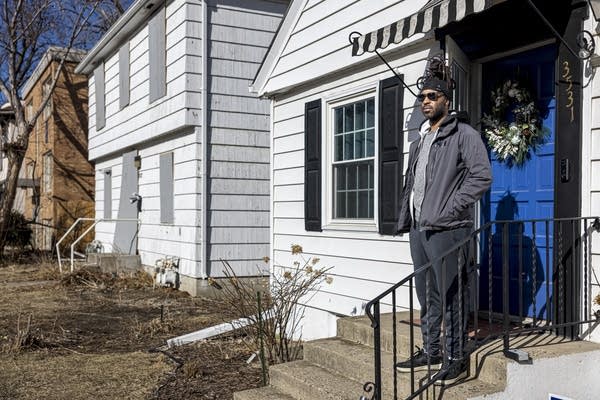
A Minneapolis homeowner and his wife endured persistent harassment and dangerous actions from their next-door neighbor for over a year, according to a lawsuit filed by the property owner.
In Oct. 2024, the neighbor is alleged to have followed up on his threats and shot the homeowner, Davis Moturi, in the neck outside of his home.
Lawyers for Moturi, 36, and his wife, Caroline Moturi, also named as a plaintiff, have filed suit against his home's previous owners, former Minneapolis Police Chief Brian O'Hara, the City of Minneapolis and the shooter, John Sawchak.
The lawsuit claims that Sawchak also harassed and threatened the previous owners, Erik and Jessica Hane.
According to the lawsuit, “on or about May 31, 2023, the Hanes called 9-1-1 to report they were concerned for their safety because Mr. Sawchak stated he should have shot Mr. Hane … They heard Mr. Sawchak yell, ‘I’m gonna kill you outside our window.’”
Sometime after June 4, 2023, the Hanes placed the property on Grand Avenue near 36th Street on the market.
The suit alleges the Hanes “made intentional and material omissions and misrepresentations during the sale process.”
Had the information about Sawchak been clearly stated, the suit says, the Moturis would not have bought the house.
The lawsuit claims Minneapolis Police Department officers failed to perform their duty to execute arrest warrants and take Sawchak into custody.
The Moturis closed on the house on Sept. 8, 2023.
Shortly after, the Moturis began to get harassed. In October, Sawchak called Davis Moturi a racial slur and soaked the Moturis’ property with his sprinklers, according to the suit. Police were called.
In December, Davis Moturi called police to say Sawchak was “blaring an airhorn outside his bedroom window in the middle of the night,” the lawsuit states.
Based on Sawchak’s conduct toward the plaintiffs, arrest warrants had been issued for the defendant, the suit said. MPD officers had a ministerial duty to execute the warrants and take Sawchak into custody, but they didn’t, according to the lawsuit.
“These failures occurred because MPD failed to properly supervise its officers, including regarding the scope of their lawful authority to arrest Mr. Sawchak,” the lawsuit said.
The court filing said the October 2024 shooting caused “severe and permanent injury” to Moturi.
The couple seeks payment for past and future wage loss and medical bills.
The resignation of Minneapolis Police Chief Brian O’Hara last week comes at a time when the city is deep into a yearslong effort to reform the Minneapolis Police Department.
People closely following Minneapolis’ settlement agreement on policing with the state say the chief’s departure could be an opportunity for the city to push forward.
But the multiple investigations into the former chief’s conduct may also highlight areas where the police department and city officials continue to fall short in providing accountability.
Since 2023, the city of Minneapolis has been under the court-enforceable agreement, also known as a consent decree, which requires a significant overhaul of police department policies, training and systems.
Rebecca Lucero
Submitted image
Minnesota Department of Human Rights Commissioner Rebecca Lucero said there’s been some progress by the city. But some of the same issues her agency outlined when their findings were announced four years ago continue to be a problem, especially regarding leadership.
“We still have an accountability system that is absolutely not working. The internal affairs department needs a lot of work and focus,” Lucero said. “To a certain extent, we have findings that show a long pattern of problems around accountability.”
An MDHR investigation following the police killing of George Floyd uncovered a longstanding culture of racism and misogyny, as well as a department that used force disproportionately against people of color.
Lucero said the value of the state agreement is that it’s enforced by the courts and will remain in place until the judge is satisfied the city has met its obligations.
Lucero said O’Hara’s departure could be an opportunity to do a “reset” and then move forward in reforming the department.
“Any change in leadership can really be a tone shift and can really result in real transformational change,” Lucero said. “I’ll also say that this consent decree is not tied to one person, one mayor, one chief — it is so much bigger than that.”
Minneapolis isn’t moving any slower than other cities that have been under consent decrees, a process which often takes many years to complete.
David Douglass leads Effective Law Enforcement For All (ELEFA), which is the independent monitor for the court-enforceable agreement. He’s optimistic that a new chief would be an improvement.
“I think it's a tremendous opportunity for the city to select a chief who recognizes that constitutional and procedurally just policing does not exist in tension with crime fighting and public safety — rather, the two are mutually reinforcing,” Douglass said.
Douglass doesn’t think the core tenets of the agreement will fall by the wayside due to a new chief or community safety commissioner. He said the sort of community involvement he sees in Minneapolis is really key to the agreement’s success.
‘It's been a long journey for the city, and there have been many starts and stops, so we really appreciate the impatience and maybe frustration that many parts of the city are experiencing,” Douglass said. “We'll continue to push to work with the city and the department to implement the agreement's requirements as quickly as possible — but in no circumstances is this a fast process.”
Mayor Jacob Frey notified O’Hara that he was subject to discipline last week after outside investigators found that the chief likely deleted a contact from his phone and told another employee his phone had been seized as part of an investigation last year. Investigators failed to substantiate the underlying earlier accusations, which are that O’Hara engaged in sexual relationships with city employees.
Christy Lopez, a professor at Georgetown Law who has worked extensively on consent decrees, said the chief obstructing an investigation could send a corrosive message throughout the department. But she also said the underlying conduct O’Hara was accused of might provide more insight for how he ran the department than just whether he deleted the contact from his phone.
“I'm not saying they should release the whole files and let the public decide, but they should tell the public what they found,” Lopez said. “Was this a situation where they were able to rule out that the chief conducted himself in this way or not?”
Lopez said she’s seen cities under consent decrees experience both setbacks and progress when a chief has departed. Much of the outcome depends on the dynamics involved and the person ultimately in charge. She said people don’t “hold mayors responsible enough for how the police department is being run.”
“If you had problems with O'Hara, you might also have problems with the mayor,” Lopez said. “If the mayor supported O'Hara and supports the way things are going, then you should expect more of the same, because whoever is hired is going to be responsive to the person that hired them.”
Mayor Frey was not available for an interview. His spokesperson said he made clear during his announcement of the chief’s resignation last week that the department’s commitment to constitutional policing, accountability and public safety remains unchanged.
“The work to do substantial reform is not up to one single chief or any single mayor,’ Frey said at a press conference last Tuesday. “I’ve issued an executive order, and we have a settlement order that is signed. Our department is committed to it.”
Todd Barnette, community safety commissioner for the city of Minneapolis, poses for a portrait at Minnesota Public Radio headquarters in Saint Paul on Feb. 3.
Nikhil Kumaran | MPR News
Community Safety Commissioner Todd Barnette has also struggled to gain support at the City Council. Frey last week also addressed the possibility that the city might be left without permanent hires for both chief and commissioner at the same time.
“This kind of progress, it's fragile,” Frey said. “If you remove our safety leadership at this moment, you don't just you don't accelerate reform, you unravel it.”
Lopez said she’d hate to see the Office of Community Safety’s approach, which includes alternatives to traditional policing like the city’s 24-7 Behavioral Crisis Response teams, be undermined by the chief’s departure.
“We need to get to the point where we understand that a diversified approach to public safety is as essential as the police component of that approach,” Lopez said, “and not think that we can or should go back to just over-relying on the law enforcement part of public safety.”
Minneapolis City Council President Elliott Payne said the way O’Hara’s departure played out points to known issues about accountability in the department and the city enterprise.
“Now we're learning that there was an investigation into interventions in internal affairs that might have disrupted the chief's own investigation,” Payne said. “We have to look at that really critically as we're moving forward.”
ELEFA, the independent monitors, will release their semi-annual report on the Minneapolis Police Department’s progress on the state agreement later this month.
To provide the best experiences, we use technologies like cookies to store and/or access device information. Consenting to these technologies will allow us to process data such as browsing behavior or unique IDs on this site. Not consenting or withdrawing consent, may adversely affect certain features and functions.
Functional
Always active
The technical storage or access is strictly necessary for the legitimate purpose of enabling the use of a specific service explicitly requested by the subscriber or user, or for the sole purpose of carrying out the transmission of a communication over an electronic communications network.
Preferences
The technical storage or access is necessary for the legitimate purpose of storing preferences that are not requested by the subscriber or user.
Statistics
The technical storage or access that is used exclusively for statistical purposes.The technical storage or access that is used exclusively for anonymous statistical purposes. Without a subpoena, voluntary compliance on the part of your Internet Service Provider, or additional records from a third party, information stored or retrieved for this purpose alone cannot usually be used to identify you.
Marketing
The technical storage or access is required to create user profiles to send advertising, or to track the user on a website or across several websites for similar marketing purposes.