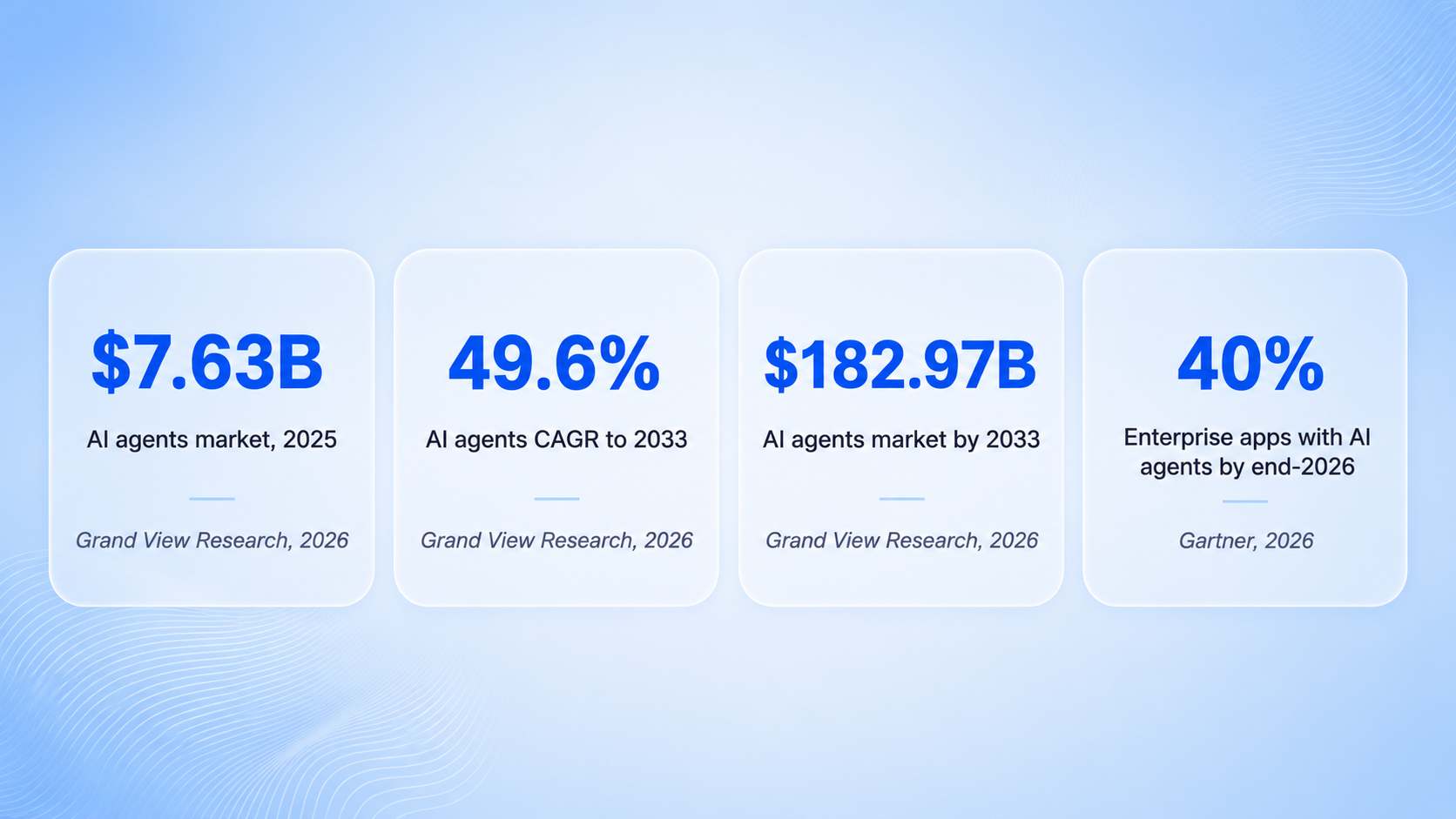

Pattern recognition in AI is the mechanism by which AI agents extract meaning from raw data, identifying regularities, anomalies, and predictive signals across images, text, numerical sequences, and sensor streams. It is the foundational capability that lets an AI agent diagnose disease from an MRI scan, flag a fraudulent transaction in milliseconds, or recommend the next product a customer is statistically likely to buy. The global AI agents market, which is built on this capability, was valued at $7.63 billion in 2025 and is projected to reach $182.97 billion by 2033 at a 49.6% CAGR (Grand View Research, 2026).
This guide covers how pattern recognition in AI works at a technical level, the five AI agent types that use it, the four major industry applications with current data, and the 2025-2026 developments that are reshaping what is possible. For teams building AI agent systems, understanding this mechanism is the foundation for every architectural decision.

What Is Pattern Recognition in AI?
Pattern recognition in AI is the process by which machine learning models and AI algorithms identify regularities, structures, or anomalies in datasets, enabling autonomous classification, prediction, and decision-making without rule-based programming. Rather than being told what a fraudulent transaction or a cancerous cell looks like, an AI system trained with pattern recognition learns to recognize those signatures from labeled examples.
There are three core output types that pattern recognition in AI produces:
- Classification: assigning input data to a predefined category (benign vs. malignant, legitimate vs. fraudulent)
- Anomaly detection: identifying data points that deviate significantly from established patterns (network intrusions, equipment failure precursors)
- Regression and prediction: forecasting future values based on historical pattern trajectories (demand forecasting, patient risk scoring)
Pattern recognition in AI sits at the intersection of three technical disciplines: machine learning (statistical pattern learning from data), deep learning (hierarchical pattern abstraction via neural networks), and natural language processing (pattern recognition applied to text and speech sequences). Together, they give AI agents the ability to interpret structured and unstructured data at scale and speed no human analyst can match.
The Five-Step Process: How AI Agents Apply Pattern Recognition
Pattern recognition in AI agents is not a single algorithm but a five-stage pipeline that transforms raw, messy data into high-confidence decisions. Each stage is critical, and failures at any point propagate forward.
Step 1: Data Collection
AI agents ingest raw data from structured sources (databases, ERP systems, transaction logs) and unstructured sources (images, audio, natural language text, sensor streams). The variety and volume of this data determines the breadth of patterns the agent can learn. Data collection methods include APIs, IoT sensors, web scraping pipelines, and direct database integration.
Step 2: Data Processing and Feature Extraction
Raw data is rarely model-ready. Processing stages include cleaning (removing null values, correcting inconsistencies), normalization (scaling values to comparable ranges), transformation (converting categorical data to numeric representations), and feature extraction (isolating the attributes most predictive of the target outcome). Poor feature engineering is the primary reason pattern recognition systems underperform in production.
Step 3: Model Training and Pattern Learning
The processed data feeds into a machine learning or deep learning model, which adjusts its internal parameters across thousands or millions of training iterations to minimize prediction error. The model learns which feature combinations correspond to which outcomes, building an internal representation of the data’s underlying patterns. For visual pattern recognition in AI, convolutional neural networks (CNNs) have long been the foundational architecture and remain widely deployed in production, particularly for edge and real-time applications; Vision Transformers are increasingly displacing them on high-compute benchmark tasks (covered in Section 7). For sequential data, transformer architectures are now the modern standard.
Step 4: Validation, Testing, and Deployment
A trained model is validated on held-out data to measure generalization (performance on data it has not seen during training). Key metrics include accuracy, precision, recall, F1 score, and AUC-ROC depending on the task type. Models that pass validation thresholds are deployed to production environments where they process real-time data streams.
Step 5: Continuous Learning and Feedback
Production AI agents continuously refine their pattern models using real-world feedback. This is critical because data distributions shift over time (a phenomenon called concept drift), and a static model will degrade. Well-architected pattern recognition systems include monitoring pipelines that detect performance degradation and trigger retraining when drift exceeds defined thresholds. Ailoitte’s AI Consulting Services practice includes production monitoring architecture for exactly this reason.
Across Ailoitte’s AI agent deployments, feature engineering quality is the single greatest predictor of production accuracy. Teams that invest heavily in model architecture but underinvest in feature design consistently see a 20-40% gap between test-set performance and real-world accuracy. Pattern recognition systems that rely on rich, domain-specific features built with input from subject-matter experts outperform those built purely from automated feature selection. The implication: always budget for at least two iterations of feature design before committing to model selection.
AI Agent Types That Use Pattern Recognition
Pattern recognition in AI underpins all five major AI agent architectures, but the sophistication of how patterns are used differs substantially by type. Understanding these differences matters for selecting the right architecture for a given use case.
| Agent Type | Pattern Recognition Role | Typical Use Cases |
|---|---|---|
| Simple Reflex Agents | Matches current input to predefined condition patterns only | Rule-based fraud alerts, threshold alarms |
| Model-Based Reflex Agents | Compares current state against internal world model patterns | Inventory monitoring, IoT anomaly detection |
| Goal-Based Agents | Evaluates action sequences against target outcome patterns | Route optimization, dynamic pricing |
| Utility-Based Agents | Maximizes expected utility by learning preference patterns | Recommendation engines, portfolio management |
| Learning Agents | Actively refines pattern models from new data and feedback | Fraud detection, personalized medicine, NLP assistants |
The most commercially valuable deployments in 2026 use learning agents, which combine pattern recognition in AI with continuous refinement loops. According to Gartner, 40% of enterprise applications will include task-specific AI agents by end of 2026, up from less than 5% a year earlier. For a deeper comparison of agent architectures, see Ailoitte’s guide on Agentic AI vs AI Agents.
Core Techniques in Pattern Recognition in AI
Pattern recognition in AI is implemented through four primary technical approaches, each suited to different data types and problem structures. Enterprise AI systems typically combine multiple approaches within a single pipeline.
Machine Learning and Statistical Pattern Recognition
Classical machine learning algorithms (decision trees, random forests, support vector machines, gradient boosting) learn pattern boundaries from labeled training data. They remain the dominant approach for structured tabular data because they are interpretable, computationally efficient, and robust with smaller training sets. Machine learning led the AI agents market technology segment with 30.56% share in 2025 (Grand View Research, 2026).
Deep Learning and Neural Pattern Abstraction
Deep learning uses multilayer neural networks to learn hierarchical representations of patterns. Convolutional neural networks (CNNs) excel at spatial pattern recognition in AI applications such as medical imaging and product defect detection. Recurrent neural networks (RNNs) and transformer architectures handle sequential patterns in time-series data and natural language. The AI image recognition market (a major deep learning application) was valued at $4.97 billion in 2025 and is projected to reach $11.07 billion by 2031 at a 14.31% CAGR (Mordor Intelligence, 2026).
Natural Language Processing (NLP)
NLP applies pattern recognition in AI to text and speech data. Named entity recognition, sentiment analysis, intent classification, and semantic similarity matching are all pattern recognition tasks applied to language. Modern large language models (LLMs) including GPT-4o and current frontier models apply transformer-based pattern recognition across trillions of text tokens, enabling them to identify conceptual and syntactic patterns at a level previously impossible. Ailoitte’s Conversational AI practice is built on NLP pattern recognition at production scale.
Computer Vision
Computer vision applies pattern recognition in AI to pixel data, enabling systems to identify objects, faces, defects, anomalies, and spatial relationships in images and video. Applications span from radiology (tumor detection) to retail (shelf compliance monitoring) to manufacturing (quality inspection). The broader image recognition market reached $58.56 billion in 2025 and is projected to reach $212.77 billion by 2034 at a 15.20% CAGR (Fortune Business Insights, 2026).
Pattern Recognition in AI Across Industries
Pattern recognition in AI delivers measurable commercial outcomes across every major industry vertical. The following sections cover the four highest-adoption sectors with current data and specific use case breakdowns.
Healthcare: Medical Imaging, Diagnostics, and Genomics
Pattern recognition in AI is redefining clinical diagnostics. In digital pathology, algorithms assist in pattern recognition to reduce scoring subjectivity and provide high-value insights for cancer diagnosis and precision medicine, with integration accelerating significantly in 2025-2026 (Clinical Lab Products, via Sekisui Diagnostics, 2026). Specific applications include:
- Medical imaging: CNNs trained on labeled MRI, CT, and X-ray datasets identify tumors, fractures, and vascular abnormalities with sensitivity rates matching or exceeding specialist radiologists in controlled settings
- Genomic pattern analysis: AI agents scan genomic sequences for mutation patterns associated with hereditary disease risk, enabling early intervention before symptom onset
- Clinical decision support: Pattern recognition systems cross-reference patient symptoms, lab values, and historical records to surface differential diagnoses and alert clinicians to deterioration risk
Healthcare is the leading end-user segment in the image recognition market (Fortune Business Insights, 2026). For teams building healthcare AI software, pattern recognition is the engine behind every diagnostic and monitoring application.
Finance: Fraud Detection, Risk Scoring, and Market Analysis
Pattern recognition in AI in financial services centers on identifying anomalies in transaction streams and predicting risk at scale. According to AllAboutAI analysis (2025), 90% of financial institutions specifically deploy AI for real-time fraud detection, and AI-based fraud detection models achieve accuracy rates between 87-96.8% in real-world deployments, significantly outperforming traditional rule-based systems (Journal of Financial Security, March 2025)
Key financial pattern recognition applications:
- Real-time fraud detection: AI agents establish baseline transaction patterns per user and flag deviations in milliseconds, enabling intervention before funds transfer
- Credit risk scoring: Pattern recognition models trained on repayment histories, behavioral signals, and alternative data sources generate risk scores with greater predictive accuracy than traditional credit bureau models
- Algorithmic trading: Pattern recognition in AI identifies recurring market microstructure signals, executing trades at speeds and frequencies beyond human capacity
For financial product development, see Ailoitte’s financial software development practice.
Retail and E-Commerce: Personalization, Inventory, and Visual Search
Pattern recognition in AI transforms retail by turning behavioral data into commercial precision. AI agents analyze purchase histories, browsing sequences, session durations, and abandonment signals to generate product recommendations that increase conversion rates and average order values. Specific applications include:
- Collaborative filtering: AI identifies user cohorts with similar behavioral patterns and recommends items purchased by statistically similar users
- Visual search: Computer vision pattern recognition allows users to search by image, matching visual features to catalog items without text queries
- Demand forecasting: Time-series pattern recognition predicts SKU-level demand fluctuations, reducing overstock and stockout events across distribution networks
- Loss prevention: Anomaly detection models identify behavioral patterns associated with retail theft or returns fraud
For retail and e-commerce AI product development, see Ailoitte’s retail and e-commerce app development practice.
Manufacturing: Quality Inspection, Predictive Maintenance, and Process Optimization
Pattern recognition in AI eliminates two of manufacturing’s costliest problems: undetected defects reaching customers and unplanned equipment downtime. Specific deployments include:
- Automated visual inspection: Computer vision systems trained on defect image libraries inspect products at line speed with higher consistency than manual inspection, catching surface defects, dimensional deviations, and assembly errors
- Predictive maintenance: AI agents monitor vibration, thermal, and acoustic sensor patterns to identify equipment degradation signatures before failure, reducing unplanned downtime
- Process optimization: Pattern recognition models correlate process parameter patterns with output quality metrics, enabling real-time parameter adjustments that improve yield
Functions That Pattern Recognition in AI Enhances
Across all industries, pattern recognition in AI elevates three core enterprise functions: predictive analytics, anomaly detection, and real-time decision-making. These are not separate applications but interconnected capabilities that compound when combined.
Predictive Analytics
Predictive analytics translates historical data patterns into forward-looking forecasts. AI agents trained on time-series data identify seasonal cycles, trend inflections, and leading indicators that allow organizations to act before events occur rather than after. In healthcare, this means flagging patients likely to deteriorate before vital signs change. In retail, it means reordering inventory before a stockout. In finance, it means identifying clients likely to churn before they cancel.
Anomaly Detection
Anomaly detection is the flip side of pattern learning: once an AI system understands what normal looks like, anything that deviates becomes immediately visible. Pattern recognition in AI identifies these deviations at data volumes and speeds no human analyst can match. Cybersecurity Ventures estimated global cybercrime costs at $10.5 trillion annually by 2025, a figure cited by the World Economic Forum (WEF, 2025), creating urgent demand for anomaly detection systems that can identify attack patterns in real time.
Real-Time Decision-Making
The combination of pattern recognition and low-latency inference enables AI agents to make consequential decisions in milliseconds: approving a transaction, routing a customer service query, adjusting a production parameter, or modifying a medication dosage recommendation. By 2029, Gartner projects that AI agents will resolve 80% of common customer service issues without human intervention. This capability is entirely dependent on robust pattern recognition in AI trained on sufficient, high-quality representative data.
What Is New in Pattern Recognition in AI in 2025-2026
Pattern recognition in AI has advanced substantially in the past 18 months. The following developments are directly relevant to engineering teams building AI agent systems in 2026.
- Multimodal pattern recognition has reached production maturity. Leading frontier models including GPT-4o and Google’s Gemini can now process images, text, audio, and video simultaneously, enabling AI agents to recognize patterns across data modalities that were previously handled by separate specialist models.
- Transformer architectures have displaced CNNs as the leading approach for visual pattern recognition in AI across many benchmark tasks. Vision Transformers (ViTs) trained with self-supervised pre-training on unlabeled image datasets achieve strong performance with significantly less labeled training data than CNN-based predecessors.
- Generative AI has created synthetic training data pipelines that are reducing the data labeling bottleneck. Organizations can now augment small labeled datasets with synthetic examples generated by diffusion models, materially improving pattern recognition accuracy in domains with limited labeled data (medical imaging, rare defect detection).
- Real-time edge inference for pattern recognition in AI has advanced significantly with NVIDIA’s Metropolis Vision AI platform updates (October 2025) and purpose-built AI accelerator chips. Edge-deployed pattern recognition now operates at sub-5ms latency for image analysis tasks, enabling real-time quality inspection and safety monitoring at line speed.
Challenges and Limitations of Pattern Recognition in AI
Pattern recognition in AI delivers substantial value but carries real limitations that production teams must design around explicitly.
Data Quality and Volume Requirements
Pattern recognition systems are only as good as the data they are trained on. Insufficient training data, mislabeled examples, and unrepresentative sampling all degrade model performance in ways that may not surface until production deployment. This is particularly acute in healthcare and industrial applications where labeled data is expensive to acquire.
Interpretability and Explainability
Deep learning pattern recognition models are inherently opaque. A CNN that identifies a malignant tumor cannot explain which pixel features drove its decision in a way a radiologist finds clinically meaningful. The EU AI Act now requires explainability mechanisms for high-risk AI applications, creating a compliance and engineering challenge for teams deploying pattern recognition in regulated domains.
Adversarial Vulnerability
Pattern recognition models can be fooled by adversarial inputs: carefully constructed data perturbations that are imperceptible to humans but cause the model to misclassify. This is a material security concern in fraud detection (where adversaries actively try to evade detection) and biometric systems.
Concept Drift
The statistical properties of real-world data change over time. A fraud detection model trained on 2023 transaction patterns will degrade against 2026 fraud tactics. Robust pattern recognition in AI deployment requires continuous monitoring, drift detection, and automated retraining pipelines, not a deploy-and-forget approach.
How Ailoitte Builds Pattern Recognition AI Systems
Ailoitte is an AI-native product engineering company that has delivered 300+ products across 21 countries, with ISO 27001, ISO 9001, and SOC 2 certifications. Pattern recognition in AI systems built by Ailoitte follow a production-first engineering framework that addresses the challenges outlined in Section 8.
- Data architecture first: Every pattern recognition engagement begins with a data audit assessing training data volume, labeling quality, class balance, and representativeness before model selection.
- Domain-specific feature engineering: Ailoitte pairs AI engineers with subject-matter experts (clinicians, fraud analysts, manufacturing engineers) to build features that encode domain knowledge into the model.
- Production monitoring pipelines: All deployed pattern recognition systems include automated drift detection, performance dashboards, and retraining triggers.
- Explainability-by-design: For regulated domains, Ailoitte implements SHAP or LIME-based explanation layers that surface model reasoning in human-interpretable form.
Ready to build AI that sees what your data is telling you? Ailoitte ships production-grade pattern recognition systems in 38 days.
Build Production-Ready Pattern Recognition AI Systems
Pattern recognition in AI is the foundation of every intelligent agent system. Ailoitte designs and delivers production-grade AI agent and ML systems across healthcare, finance, retail, and manufacturing, with an average product ship time of 38 days. Whether you are starting with a fraud detection model, a medical imaging pipeline, or a full AI transformation strategy, the architecture starts here.
FAQs
What is pattern recognition in AI?
Pattern recognition in AI is the process by which machine learning and deep learning models identify regularities, anomalies, or predictive structures in data, enabling autonomous classification, detection, and decision-making. It underpins AI applications from medical image diagnosis to real-time fraud detection to personalized product recommendations.
How does pattern recognition in AI differ from traditional programming?
Traditional programming encodes explicit rules (if transaction > $10,000, flag it). Pattern recognition in AI learns rules from data: it observes thousands of fraudulent and legitimate transactions and derives its own statistical criteria for what makes a transaction suspicious. This makes it far more adaptable to novel patterns that a human rule-writer never anticipated.
Which industries benefit most from pattern recognition in AI?
Healthcare (medical imaging, diagnostics), finance (fraud detection, risk scoring), retail (personalization, visual search), and manufacturing (quality inspection, predictive maintenance) see the highest commercial returns from pattern recognition in AI. Healthcare is the leading end-user segment in the image recognition market as of 2026 (Fortune Business Insights).
What machine learning techniques are used for pattern recognition in AI?
The primary techniques are convolutional neural networks (CNNs) for image and spatial data, recurrent neural networks (RNNs) and transformers for sequential and time-series data, random forests and gradient boosting for structured tabular data, and large language models (LLMs) for natural language pattern recognition. Most production systems combine multiple techniques within a pipeline.
How accurate is AI fraud detection using pattern recognition?
AI-based fraud detection models achieve accuracy rates between 87-96.8% in real-world deployments, significantly outperforming traditional rule-based systems (Journal of Financial Security, March 2025). As of 2025, 90% of financial institutions specifically deploy AI for real-time fraud detection. For enterprise-grade fraud detection implementations, see Ailoitte’s financial software development practice.
What are the main challenges with pattern recognition in AI in production?
The four primary production challenges are: data quality and volume requirements (models need sufficient, representative, well-labeled training data), interpretability (deep learning models are opaque and may need explainability layers for regulated domains), adversarial vulnerability (models can be fooled by deliberately constructed inputs), and concept drift (real-world data distributions change over time, degrading static models without continuous monitoring and retraining).

Discover how Ailoitte AI keeps you ahead of risk

Sunil Kumar
Sunil Kumar is CEO of Ailoitte, an AI-native engineering company building intelligent applications for startups and enterprises. He created the AI Velocity Pods model, delivering production-ready AI products 5× faster than traditional teams. Sunil writes about agentic AI, GenAI strategy, and outcome-based engineering. Connect on
LinkedIn

Stephan is the sports journalist for the Maple Grove Report.