It was a small victory, but one Gabe Lyrek was eager to share.
The county had found housing for a woman who was a regular at the NorthPoint Health and Wellness Center’s needle exchange program in north Minneapolis. A permanent home might not end her opioid use but it would mark an important step forward.
As a harm reduction services coordinator for NorthPoint, Lyrek spends much of his time providing prevention education, distributing sterile syringes and helping people access treatment.
Elisabeth Gawthrop | MPR News
He is a key piece of what has become an informal but vital overdose response network across north Minneapolis made up largely of healthcare providers, community coalitions, a fire station and neighbors equipped with naloxone. Collectively, advocates say it has helped address the opioid crisis that has gripped the area in the years during and since the COVID-19 pandemic.
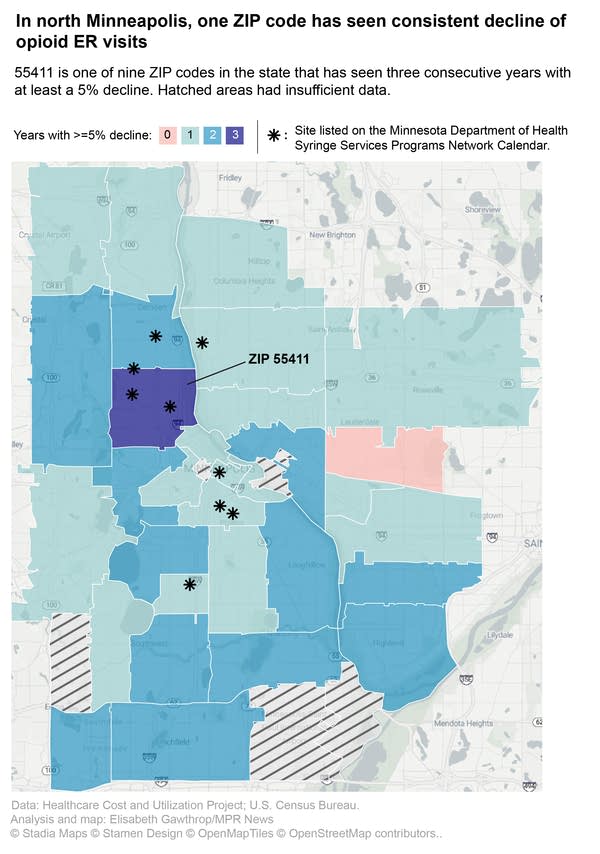
A data analysis by MPR News found the number of people going to the emergency room with opioid-related illness decreased in north Minneapolis.
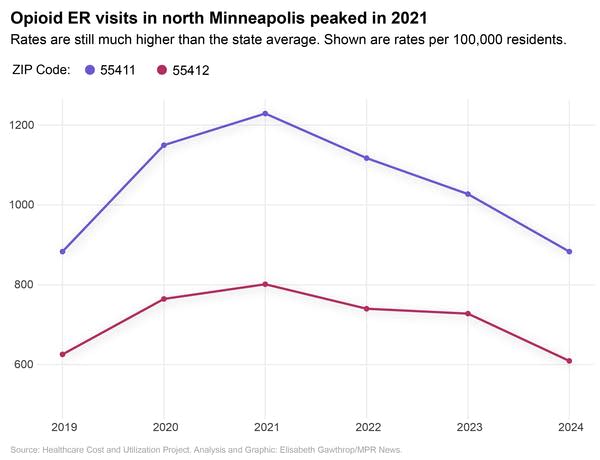
From 2021 to 2024, ER visits related to overdoses as well as visits for health issues associated with opioid use, dependence and withdrawal consistently declined for residents in the 55411 ZIP code, the heart of the Near North neighborhood. It is a trend seen in only nine ZIP codes across the state.
Public health officials cannot say for certain what caused the drop, although they point to the commitment of the people on the ground in north Minneapolis.
The declining numbers only tell part of the story, though, as opioid-related emergency department visit rates remained more than three times the statewide average. Overdose deaths in the neighborhood did not similarly decline.
Building a neighborhood response
In north Minneapolis, where fentanyl has reshaped the local drug landscape, the opioid crisis persists. At the same time, harm reduction programs have expanded dramatically, giving residents greater access to lifesaving services.
Participation in NorthPoint's Harm Reduction and Testing Services program has grown more than 1,000 percent since launching in 2018, according to program data. Between 2018 and 2025, it served nearly 17,000 individuals.
Through the first half of 2026, participation was already up another 27 percent compared with the same period in 2025, and Lyrek said demand continues to grow.
Harm reduction is a public health approach that seeks to reduce the health risks associated with drug use rather than requiring abstinence first. Strategies include distributing sterile syringes, providing overdose prevention education and expanding access to naloxone, the overdose-reversal medication commonly sold under the brand name Narcan.
A needle disposal box near West Broadway Avenue in north Minneapolis.
Erica Zurek | MPR News
Public health officials said fewer emergency visits may indicate that more overdoses are being reversed in the community through wider naloxone availability, faster emergency response, expanded prevention efforts and treatment that increasingly occurs outside hospital emergency departments.
“I think it's a culmination between a lot of things, like Narcan became available over the counter at pharmacies,” Lyrek said. “You can’t spit without hitting free Narcan in North.”
A new campaign led by the North Minneapolis Harm Reduction Coalition has placed red “Narcan Available” stickers in 32 businesses between West Broadway and Lowry Avenue, signaling that the overdose-reversal medication is available at no cost.
A spokesperson for the city of Minneapolis said the response system also includes Minneapolis’ Safe Station program at Fire Station 14, which has helped nearly 8,000 people connect with detoxification services, substance use treatment and recovery resources since opening in 2023.
Access to naloxone has also expanded through self-service vending machines installed at Fire Station 14 and two other Minneapolis fire stations through a partnership between the Minneapolis Fire Department, the Minneapolis Health Department and Hennepin County. By the end of 2025, the machines had dispensed more than 8,500 doses.
‘No one wants to be in it’
Public health researchers and clinicians say the shifting data cannot be understood without considering the medical realities of opioid use disorder.
Elisabeth Gawthrop | MPR News
The American Medical Association’s 2025 report on the nation’s overdose epidemic notes that while opioid-related overdose deaths declined nationally in 2024, the increasing prevalence of fentanyl mixed with other substances and the unpredictability of the illicit drug supply continue to drive severe risk.
Almost a decade after the U.S. government declared the opioid epidemic in the U.S. a national public health emergency, the crisis remains deeply entrenched in communities across the country, including in Minnesota.
Dr. Robert Levy, a family medicine and addiction medicine specialist and associate professor at the University of Minnesota who treats patients at the Broadway Family Medicine Clinic in north Minneapolis, describes opioid use disorder as a treatable medical mental health condition.
“It’s simply another illness,” he said. “It’s not that different than diabetes or hypertension or asthma. It has psychological, physiological and physical causes and effects like all illnesses. There are risk factors that make it more dangerous or more likely to be severe.”
Levy said a defining feature of opioid use disorder is the cycle of withdrawal and relief that drives continued use.
“Opiate withdrawal feels terrible,” he said. “It feels like you’re very ill. No one wants to be in it.”
He noted that many people continue using opioids not to get high, but to avoid withdrawal symptoms.
“The only way they know to get out of it is to take more opioids,” Levy said. But that cycle, he added, can eventually lead people into getting healthcare. “It gets them to a point where they’re willing to walk into my office or go to treatment.”
Levy said the increasing potency of synthetic opioids such as fentanyl complicates the situation. Because fentanyl and related substances have a narrow margin between a dose that produces an effect and a dose that can cause respiratory failure, small variations in use can be deadly.
The Sanctuary Resource Center in north Minneapolis.
Erica Zurek | MPR News
As tolerance builds, people need more to achieve the same effect, Levy explained. And eventually, he said, the amount that relieves withdrawal is very close to the amount that can stop someone from breathing.
Guilt and shame remain major barriers to care that can keep people away from the emergency room, he added, “but most people don’t want to die. If there’s a way to feel safe and avoid going to the emergency room, they will choose that.”
Minnesota also saw a drop in opioid-related deaths from 2023 to 2024, recording a 26 percent decline. But provisional data from the Centers for Disease Control and Prevention shows the number of deaths from opioids remained steady in Minnesota in 2025, even as they continued to decline nationally.
‘Not everything is equal’
In 2020, the Hennepin County Board of Commissioners declared racism a public health crisis, acknowledging the role systemic inequities play in health outcomes, including substance use.
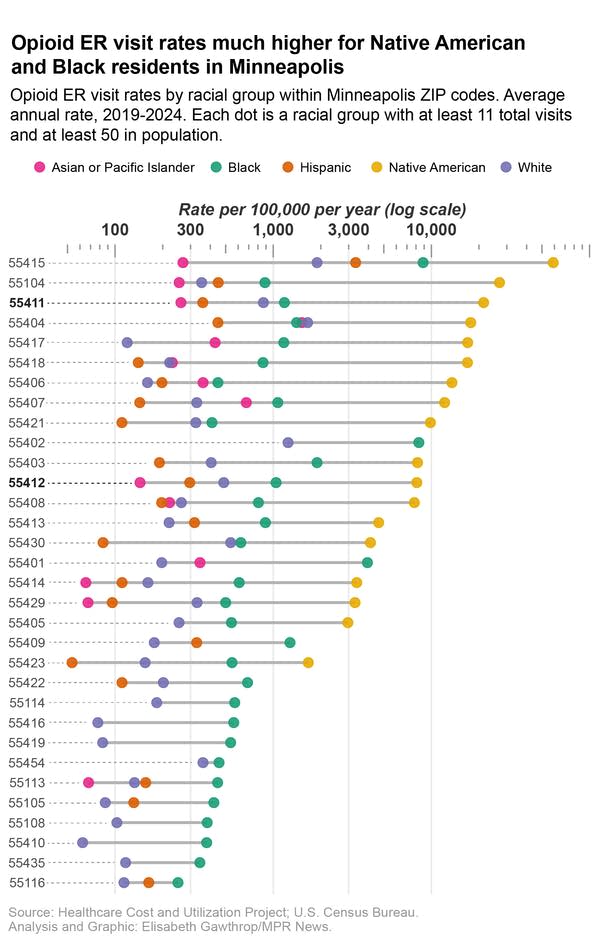
The county's opioid response funding has increasingly been directed toward Native American and Black communities, particularly in north Minneapolis, where data show the greatest need.
Elisabeth Gawthrop | MPR News
“Not everything is equal in this crisis for all the communities,” said Lolita Ulloa, who leads the county’s opioid response work. “You have to measure everything you do with compassion and help. We’re in the community all the time. They see our faces. They know who we are.”
Julie Bauch, the county’s senior strategist for opioid response, said data show Black residents in north Minneapolis account for a disproportionate share of opioid-related deaths. Black people “have by count more opioid-related deaths than any other population,” she said, even though “the number of white people in Hennepin County far surpasses the number of Black and African American people. That is troubling.”
Ulloa and Bauch said those disparities helped drive the creation of a north Minneapolis coalition in 2025 that brings together community organizations and outreach workers responding directly to people affected by opioid use.
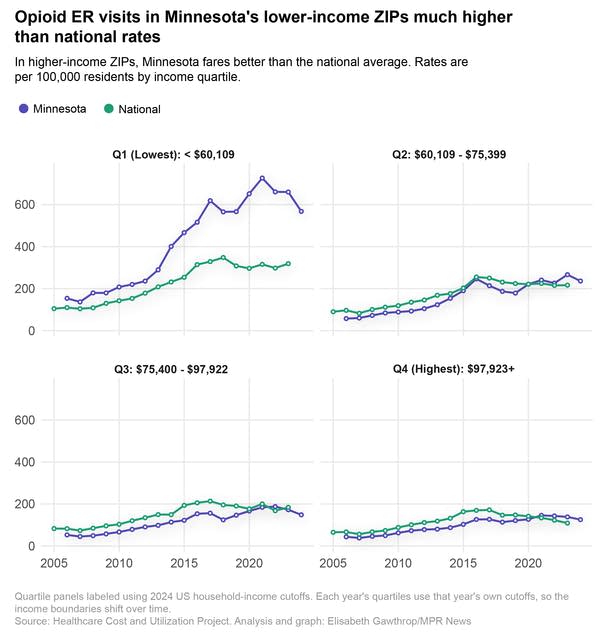
The area is also lower-income, which in Minnesota is associated with particularly high ER visit rates related to opioid use. In 2023, opioid ER rates for low income ZIP codes in the state were two times the average of low income ZIPs nationally, an MPR News analysis found.
Bauch said longstanding distrust of medical systems and law enforcement rooted in historical and ongoing inequities continues to shape how people seek help.
As a result, she said, community-based organizations like the coalition play an increasingly central role in overdose prevention and response, combining naloxone distribution with relationship-building and healthcare navigation.
“It’s a constant, long-term relationship,” Bauch said. “We might not see somebody show up at a hospital, but that doesn’t mean their journey isn’t going to lead them to treatment and recovery.”
Elisabeth Gawthrop | MPR News
Showing up, day after day
Walking the streets of north Minneapolis on a recent day, Lyrek is well-known to people on the street and consistently has a kind word to share.
As he spoke, a young man moved erratically down the street. Lyrek’s expression brightened. “Oh my God, this kid,” he said with a smile. “I love him.”
He said he tries to seek people out first, so they do not have to spend time tracking him down.
On this day he tried but could not find the woman he was looking for to tell her Hennepin County had found her a home, but he was confident they would connect.
“She is someone who has expressed that she wants to stop using,” he said. “But that’s not something she can focus on if she’s not sleeping in a safe place.”
SAMHSA’s National Helpline is a free, confidential, 24/7, 365-day-a-year treatment referral and information service for individuals and families facing mental and/or substance use disorders. Call: 1-800-662-HELP (4357)
For most of its history, the financial services industry moved slowly on purpose. Regulatory caution, systemic risk, and the sheer weight of legacy infrastructure made it one of the last sectors to embrace digital disruption. That era is over.
In 2024, a McKinsey survey found that 78% of organizations globally now use AI in at least one business function up from just 20% in 2017. Within financial services specifically, 91% of bank boards have formally approved generative AI programs. IDC estimates the banking industry alone will invest $31.3 billion in AI, second only to software and IT services.
AI in fintech has crossed the threshold from pilot project to production infrastructure. It is now the primary mechanism through which competitive differentiation is built, operational costs are cut, and regulatory compliance is managed at scale.
The question for fintech leaders, enterprise banks, and startup founders is no longer whether to adopt AI. It is which capabilities to build first, and how to build them without accumulating technical debt or compliance exposure. This guide answers both.
Before diving into use cases, it helps to understand the scale of the opportunity.
Market size and growth
Productivity and ROI evidence
Fraud and risk results
These are not analyst projections. They are production results from institutions already running AI in fintech at enterprise scale.
The practical impact of AI in fintech use cases divides across five domains. Each has a measurable ROI pathway and requires a different implementation approach.
Top AI in Fintech Use Cases Driving Real ROI
The practical impact of AI in fintech use cases divides across five domains. Each has a measurable ROI pathway and requires a different implementation approach.
Fraud Detection and Real-Time Transaction Monitoring
Fraud detection is where AI in fintech delivers the fastest, most measurable return. Traditional rule-based systems flag anomalies against static thresholds, generating excessive false positives and missing novel attack vectors.
AI-powered fraud detection works differently. Machine learning models are trained on hundreds of variables simultaneously, including transaction velocity, geolocation, device fingerprinting, behavioral biometrics, and social media signals, to establish a dynamic baseline for each customer. Any deviation triggers a real-time risk score, not a binary flag.
JPMorgan Chase scans transactions for fraud in real time using AI systems that improve continuously as they process new data. Mastercard partnered with IBM in 2024 to integrate Watson technology directly into its fraud management tools, with results reported by PYMNTS showing an 85% reduction in false positives at Visa following a similar generative AI deployment.
For any fintech business building or scaling a fraud layer, the architectural decision is now clear: rule-based engines are legacy infrastructure. AI and machine learning development for fraud detection is the production standard.
Credit Scoring and Alternative Lending
Traditional credit scoring models rely on a narrow band of data: credit history, income, and outstanding debt. This excludes roughly 1.4 billion adults worldwide who are unbanked or credit-invisible (World Bank, 2021), and it systematically underserves thin-file borrowers including recent graduates, gig workers, and small business owners.
AI and machine learning in fintech expand the scoring universe dramatically. Modern models ingest transaction history, utility payments, employment patterns, and behavioral metadata to produce a richer creditworthiness profile.
GiniMachine, a no-code AI credit platform, processed 10 million loan applications in 2024, increasing approval rates by 30% while reducing default rates by 25%. One microfinance firm using the platform reported a 50% expansion in its loan portfolio alongside a 40% drop in operational costs.
Generative AI credit risk assessment models can improve accuracy by up to 25% compared to traditional approaches (Global Trade Magazine, 2024), a margin that directly impacts net interest margin and capital adequacy ratios.
Related resource: The McKinsey Global Banking Annual Review 2025 is publicly available at mckinsey.com and provides detailed analysis of AI adoption economics across the sector.
Hyper-Personalized Wealth Management and Robo-Advisory
The wealth management industry has historically gatekept sophisticated financial planning behind high minimum balances and advisor relationships. AI in fintech is changing that model.
AI-powered robo-advisors analyze real-time portfolio data, market conditions, tax implications, and individual risk tolerance to deliver institutional-quality advice at consumer price points. JPMorgan Chase acquired Nutmeg, a UK-based digital wealth manager, in 2021 for approximately 700 million pounds, rebranding it as J.P. Morgan Personal Investing in late 2025. The platform now serves over 265,000 investors and manages 8.5 billion pounds in assets.
Beyond robo-advisory, generative AI enables dynamic scenario modelling, including stress-testing a client’s retirement plan against multiple economic futures or generating a personalized savings strategy in seconds. Platforms using this capability report users achieving 18% higher investment returns compared to self-directed approaches.
Compliance is one of the most costly and operationally intensive functions in any financial institution. Manual compliance review is slow, inconsistent, and scales poorly as transaction volumes increase.
AI in fintech is transforming compliance from a reactive cost center into a proactive, automated safeguard. NLP models read and interpret regulatory updates in real time, automatically flagging provisions that require policy changes. Intelligent monitoring systems scan millions of transactions continuously, detecting patterns that indicate GDPR or CCPA violations, suspicious activity reports, or anti-money laundering triggers without human intervention.
The RegTech market, which relies heavily on AI, was valued at $15.8 billion in 2024 and is projected to reach $70.8 billion by 2033 at an 18% CAGR (IMARC Group, 2024). The European Central Bank approved the use of AI in credit scoring in September 2025, marking a significant regulatory milestone for AI adoption in European financial services.
For a deeper look at how compliance automation is being built in practice, Deloitte’s AI in Financial Services regulatory outlook provides useful context on the intersection of generative AI and financial crime risk.
AI-Powered Customer Experience
Customer experience in financial services has historically been a liability: long call queues, inconsistent advice, and friction-heavy onboarding. AI addresses each of these pain points systematically.
Conversational AI handles complex customer queries, guides users through loan applications, and escalates to human agents when needed, available 24/7 across every channel. Unlike first-generation chatbots, modern LLM-powered assistants understand context, nuance, and intent.
AI-driven onboarding reduces KYC (Know Your Customer) processing from days to minutes using computer vision for document verification and NLP for data extraction. This directly reduces churn at the top of the acquisition funnel.
Generative AI in fintech represents a qualitative shift from AI systems that classify and predict to systems that generate, simulate, and create. The practical implications are substantial.
Synthetic Data Generation for Model Training
Financial ML models are only as good as the data they train on. In fintech, regulatory constraints on real customer data create a bottleneck: models cannot be tested comprehensively without exposing sensitive information. Generative AI solves this by producing synthetic datasets that mirror the statistical properties of real data without containing personally identifiable information.
Feedzai’s fraud detection system uses generative AI to create synthetic fraud scenarios, training its detection engine to recognize novel attack patterns before they appear in the wild. This proactive capability is impossible with traditional training data.
Dynamic Document Generation and Contract Intelligence
Investment banks and legal teams spend enormous time on routine document work. JPMorgan’s LLM Suite already enables investment bankers to produce five-page briefing documents in 30 seconds, work that previously occupied junior analysts for hours. Lawyers generate and review contracts. Credit professionals extract covenant information instantly.
Generative AI can draft, review, and validate financial contracts with a level of consistency and speed that human teams cannot match. Companies like Clause, acquired by DocuSign, are deploying these capabilities at scale.
See our work: Ailoitte has delivered generative AI development services for financial clients, including risk simulation tools, intelligent document processing, and LLM-powered compliance agents.
Risk Scenario Modelling
Perhaps the most strategically significant application of generative AI in fintech is dynamic risk simulation. Rather than relying on historical data to model future scenarios, generative models can construct novel economic futures, stress-testing credit portfolios, liquidity positions, and counterparty exposures against conditions that have never been observed.
This is particularly relevant for market risk, where regime changes such as the 2023 banking crisis or COVID-era volatility render historical models unreliable. Generative scenario modelling creates a forward-looking risk management capability that rule-based systems simply cannot replicate.
Your competitors are already using AI in fintech. Don’t let them get further ahead.
AI and Machine Learning in Fintech: How They Work Together
The terms “AI” and “machine learning” are often used interchangeably, but in a fintech architecture context, the distinction matters.
Machine learning in fintech refers to algorithms that learn patterns from historical data to make predictions or classifications. Supervised learning drives credit scoring, fraud detection, and churn prediction. Unsupervised learning identifies anomalous transaction clusters. Reinforcement learning is used in algorithmic trading to optimize execution strategies in real time.
AI in fintech is the broader capability layer, encompassing ML, natural language processing, computer vision, and generative models. It is the system-level architecture within which ML models operate.
The practical implication for product and engineering teams: you rarely need a single AI model. You need a stack. A mortgage underwriting system might combine ML (credit risk), NLP (document parsing), computer vision (identity verification), and a generative layer (personalized applicant communication). Each layer is distinct and requires different training data, infrastructure, and governance.
Key AI and machine learning technologies reshaping fintech
Large Language Models (LLMs): For document analysis, customer service, regulatory interpretation, and knowledge retrieval.
Gradient Boosting Models (XGBoost, LightGBM): The workhorses of credit scoring and fraud detection, fast, interpretable, and highly accurate on structured financial data.
Transformer-based NLP: For processing unstructured text in contracts, regulatory filings, and customer communications.
Deep Learning for Time Series: For market prediction, payment anomaly detection, and forecasting cash flow patterns.
Federated Learning: Increasingly important for fintech compliance, allowing models to train on distributed data without centralizing sensitive customer records.
Challenges Fintech Leaders Must Solve Before Scaling AI
Despite the clear opportunity, scaling AI in fintech is not straightforward. Several structural challenges consistently block organizations from moving from pilot to production.
Data Quality, Governance, and Fragmentation
AI models are only as reliable as the data they consume. Most financial institutions operate across dozens of siloed systems, including core banking platforms, CRM tools, transaction processors, and compliance databases, each with different schemas, data quality standards, and update frequencies.
Before AI can deliver value, data infrastructure must be rationalized. This means implementing a robust data governance framework, establishing a single source of truth for customer and transaction data, and building pipelines that deliver clean, structured inputs to AI models in real time.
Regulatory Compliance and Explainability
Financial regulators do not simply want AI that works. They want AI that can be explained. The EU’s AI Act, which introduces risk-based requirements for high-impact AI systems, directly applies to credit scoring, fraud detection, and insurance underwriting. GDPR and CCPA govern how customer data can be used in training.
Explainable AI (XAI) is not optional in financial services. It is a regulatory requirement. Every credit decision influenced by AI must be interpretable to both the regulator and the consumer. This has significant implications for model selection: highly accurate black-box models may need to be complemented or replaced by interpretable approaches in certain regulated contexts.
For a comprehensive reference on AI Act obligations, the EU AI Act official text and guidance is maintained by the European Commission and updated as implementation guidance is issued.
Legacy System Integration
The average large financial institution runs core banking software that is decades old. Integrating modern AI infrastructure with mainframes, on-premises data warehouses, and monolithic transaction processing systems is one of the most common project failure points.
The successful approach is not full replacement. It is intelligent wrapping. API layers, microservices architectures, and event-driven integration patterns allow AI capabilities to be layered onto legacy infrastructure without a full replatforming. This is considerably faster, cheaper, and lower risk.
Talent and Organizational Readiness
McKinsey finds that while nearly 90% of companies have invested in AI technology, fewer than 40% report measurable gains, largely because most are applying AI to discrete tasks rather than redesigning workflows end to end. The bottleneck is rarely the technology. It is organizational readiness.
Building an AI-ready organization in fintech requires investment in three areas: data engineering talent to maintain clean pipelines, AI and ML engineers to build and monitor models, and domain experts who understand both the financial product and the AI capability well enough to identify the highest-value applications.
The Future of AI in Fintech: 2026 and Beyond
The next phase of AI in fintech will be defined by three converging developments.
Agentic AI: From Tools to Autonomous Workflows
The most significant near-term shift is the emergence of agentic AI, autonomous systems that execute multi-step workflows without human intervention at each decision point. McKinsey’s Global Banking Annual Review 2025 projects the emergence of a collaborative model in which one human employee supervises 20 to 30 AI agents managing complex end-to-end processes.
JPMorgan Chase, BNY, and Capital One are already building agentic AI architectures. At JPMorgan, nearly half of all employees use generative AI tools every day across tasks ranging from investment analysis to compliance review to customer service resolution.
For fintech companies, agentic AI enables a step-change in operating leverage: loan origination, compliance monitoring, reconciliation, and reporting can all be handled by coordinated AI agent networks, with humans focused on oversight and exception management.
Ailoitte’s AI agent development practice is actively building agentic workflows for financial services clients, from automated compliance agents to multi-step loan origination pipelines.
Blockchain and AI Convergence
The integration of AI with distributed ledger technology addresses persistent limitations of both: AI needs high-quality, tamper-proof data, and blockchain produces exactly that. As DeFi matures and central bank digital currencies (CBDCs) emerge, AI will be the intelligence layer that interprets on-chain data, automates smart contract execution, and manages cross-chain liquidity in real time.
Embedded Finance and Hyper-Personalization
The boundary between financial services and non-financial applications is dissolving. AI is the engine that makes embedded finance intelligent, not just placing a payment button in a retail app, but dynamically offering credit, insurance, or investment products at the exact moment and context where they are most likely to add value.
Hyper-personalization at this level requires AI that operates on real-time behavioral signals, not batch-processed demographic segments. The fintech companies building this capability today will define the consumer finance landscape of the next decade.
Case Studies: How Industry Leaders Are Deploying AI
JPMorgan Chase: LLM Suite and the AI-First Bank
JPMorgan Chase is the most instructive case study in enterprise AI in fintech at scale. The bank launched LLM Suite, a proprietary generative AI platform, in summer 2024. Within eight months, it reached 200,000 users through an opt-in strategy.
The platform integrates OpenAI and Anthropic models with the bank’s internal databases and applications. Results include: investment bankers producing five-page briefing documents in 30 seconds; lawyers generating and reviewing contracts in minutes; and call center agents resolving queries faster through AI-assisted context retrieval. The bank estimates $1.5 billion in annual value from AI initiatives, with employees reporting 30 to 40% efficiency gains.
BlackRock: Aladdin and the Operating System of Global Finance
BlackRock’s Aladdin platform is an AI-powered operating system for investment management that underpins the risk analytics of over $21 trillion in externally managed assets across more than 200 institutional clients, including competitors such as UBS and Franklin Templeton, and institutions such as the Federal Reserve. BlackRock’s own AUM stands at $12.5 trillion as of 2025.
What makes Aladdin significant beyond its scale is its architecture: AI is not a feature. It is the operating model. Risk scenarios are run continuously. Portfolio exposures are monitored in real time. Compliance checks are automated. This is what truly integrated AI and machine learning in fintech looks like at institutional scale.
Kabbage (Acquired by American Express, 2020): AI Lending for Small Business
Kabbage democratized business lending by replacing manual underwriting with AI-driven cash flow analysis. Rather than requiring two years of audited financials, Kabbage’s machine learning models assess real-time business bank data, accounting software, and payment processing history to make lending decisions in under 10 minutes. American Express acquired Kabbage in August 2020 for a reported valuation of up to $850 million.
GiniMachine’s platform applies similar principles to microfinance, opening $1 billion in new lending opportunities by accurately evaluating thin-file borrowers that traditional credit models would reject.
Banksathi: AI-Powered Financial Product Distribution
Ailoitte built and scaled the Banksathi platform, an AI-enabled fintech distribution platform that helps millions of Indians access financial products including loans, insurance, and credit cards. The engagement required rebuilding every user journey around AI-assisted recommendations, resolving significant technical performance issues, and scaling the payment disbursement architecture to handle institutional volumes.
For more case studies across sectors, visit the Ailoitte blog for technical deep-dives and implementation perspectives on AI in financial services and beyond.
How Ailoitte Builds Production-Ready AI for Fintech
Ailoitte is an AI-native engineering company with 13+ years of experience building intelligent applications for fintech startups and enterprises. We created the AI Velocity Pods model, which delivers production-ready AI products five times faster than traditional development teams by combining deep domain expertise with modular, pre-validated AI infrastructure.
AI strategy and discovery
We work with product and technology leaders to identify high-value AI use cases, validate assumptions with rapid prototyping, and build a roadmap that prioritizes ROI over novelty. Our AI Strategy Workshop compresses months of planning into a structured two-week engagement.
AI and ML development
From fraud detection engines to credit scoring models to LLM-powered compliance agents, our AI and ML engineering team designs, trains, and deploys models that are explainable, auditable, and compliant with financial services regulation.
Generative AI development
We build production generative AI systems including document intelligence, synthetic data pipelines, AI-powered customer service, and scenario modelling tools, using the latest foundation models integrated with your proprietary data.
Financial software development
Full-stack development for fintech products including mobile apps, web platforms, API integrations, and core banking wrappers.
Mobile and web app development
AI-enabled fintech products require exceptional UX. Our mobile app development and web app development teams build consumer-facing fintech products that combine AI intelligence with product design that converts.
Conclusion
AI in fintech is no longer a competitive advantage for the few. It is rapidly becoming the baseline infrastructure for any financial institution that intends to remain relevant. The market is growing at a CAGR approaching 20%. The performance gap between AI adopters and laggards is measurable in basis points, fraud losses, and customer attrition.
The opportunity is defined by five converging developments: AI and machine learning delivering proven ROI in fraud detection, credit, and compliance; generative AI in fintech opening entirely new capabilities in document intelligence and risk simulation; AI and machine learning in fintech becoming accessible to sub-enterprise teams through cloud AI platforms and specialized partners; agentic AI beginning to replace whole workflow layers rather than individual tasks; and regulatory clarity improving globally as frameworks like the EU AI Act mature.
The window to build a durable AI advantage is open. But it requires building on solid foundations: clean data infrastructure, explainable models, and a clear-eyed view of which use cases generate real business value versus which are technically interesting but commercially marginal.
Ailoitte has spent 13 years building at this intersection. We know what works, what fails in production, and how to get a fintech AI system from concept to live faster than any traditional development approach.
Ready to build AI into your fintech product? Talk to Ailoitte’s specialists
FAQs
What is AI in fintech, and why does it matter in 2026?
AI in fintech refers to the application of artificial intelligence technologies, including machine learning, natural language processing, computer vision, and generative AI, to financial services. In 2026, leading institutions are generating measurable returns: JPMorgan reports $1.5 billion in annual AI value, Visa achieved 85% fewer fraud false positives, and McKinsey projects up to 20% net cost reductions industry-wide for banks deploying AI at scale.
What are the most impactful AI in fintech use cases?
The highest-ROI AI in fintech use cases in 2025 are: (1) real-time fraud detection and prevention, (2) AI-driven credit scoring and alternative lending, (3) robo-advisory and personalized wealth management, (4) regulatory compliance automation, and (5) AI-powered customer service and onboarding. Each can deliver measurable financial impact within a 6 to 12 month deployment horizon when implemented on a well-governed data infrastructure.
How does generative AI in fintech differ from traditional AI?
Traditional AI in fintech classifies, predicts, and optimizes using existing data. Generative AI creates new content, including synthetic training data, contract drafts, risk scenarios, personalized customer communications, and financial reports. Generative AI enables capabilities such as proactive fraud scenario training, AI-written financial documents, and dynamic risk modelling that prediction models alone cannot produce.
What is the difference between AI and machine learning in fintech?
Machine learning is a subset of AI. In a fintech context, machine learning refers specifically to algorithms that learn patterns from historical data, primarily used for fraud detection, credit scoring, and churn prediction. AI is the broader umbrella covering ML plus NLP, computer vision, and generative models. Most production fintech AI systems combine multiple ML models with other AI capabilities into an integrated architecture.
What are the biggest challenges in adopting AI in fintech?
The four most significant barriers are: (1) fragmented, low-quality data infrastructure that limits model accuracy; (2) regulatory explainability requirements, especially under the EU AI Act, that constrain model choices; (3) legacy system integration complexity that extends timelines and costs; and (4) organizational capability gaps, specifically the shortage of data engineers, ML specialists, and domain-knowledgeable AI product managers.
How long does it take to build an AI-powered fintech product?
For a focused use case such as a fraud detection module or AI credit scoring layer, a well-architected proof of concept can be production-ready in 8 to 12 weeks. Full-featured fintech platforms with AI embedded across multiple product surfaces typically require 4 to 9 months depending on data infrastructure maturity and integration complexity. Ailoitte’s AI Velocity Pods model consistently delivers production-ready AI systems five times faster than traditional development processes.
What regulations govern AI in fintech?
Key regulatory frameworks for AI in fintech include the EU AI Act (risk-based AI governance, effective 2025 to 2026), GDPR and CCPA (data privacy in model training), the Equal Credit Opportunity Act (bias and fairness in credit scoring), and sector-specific guidance from financial regulators including the FCA, SEC, RBI, and ECB. The ECB approved AI in credit scoring in September 2025, marking a significant milestone for European financial AI adoption.
Discover how Ailoitte AI keeps you ahead of risk
Sunil Kumar
Sunil Kumar is CEO of Ailoitte, an AI-native engineering company building intelligent applications for startups and enterprises. He created the AI Velocity Pods model, delivering production-ready AI products 5× faster than traditional teams. Sunil writes about agentic AI, GenAI strategy, and outcome-based engineering. Connect on
LinkedIn
Stephan is the sports journalist for the Maple Grove Report.
Manage Consent
To provide the best experiences, we use technologies like cookies to store and/or access device information. Consenting to these technologies will allow us to process data such as browsing behavior or unique IDs on this site. Not consenting or withdrawing consent, may adversely affect certain features and functions.
Functional
Always active
The technical storage or access is strictly necessary for the legitimate purpose of enabling the use of a specific service explicitly requested by the subscriber or user, or for the sole purpose of carrying out the transmission of a communication over an electronic communications network.
Preferences
The technical storage or access is necessary for the legitimate purpose of storing preferences that are not requested by the subscriber or user.
Statistics
The technical storage or access that is used exclusively for statistical purposes.The technical storage or access that is used exclusively for anonymous statistical purposes. Without a subpoena, voluntary compliance on the part of your Internet Service Provider, or additional records from a third party, information stored or retrieved for this purpose alone cannot usually be used to identify you.
Marketing
The technical storage or access is required to create user profiles to send advertising, or to track the user on a website or across several websites for similar marketing purposes.