Maple Grove Local News

Maple Grove Local News Legal

Maple Grove Local News

Subscribe to Our Newsletter

Get our latest articles delivered straight to your inbox. No spam, we promise.


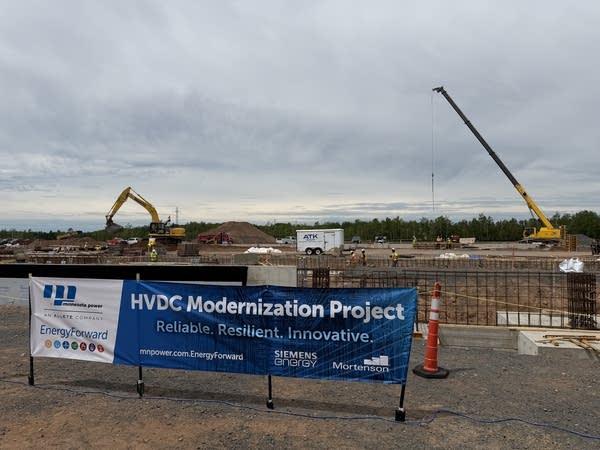
A blue banner reading

A northern Minnesota utility broke ground this week on a $900 million electric transmission project that’s expected to play a critical role in the state’s clean energy transition.

Duluth-based Minnesota Power is upgrading and expanding a 50-year old high voltage direct current (HVDC) transmission line that runs 465 miles from Center, N.D., to Solway Township, just outside Duluth.

It’s one of just two HVDC lines in Minnesota, and there are only a few across the country. They’re valuable because they transmit electricity more efficiently over long distances than more common alternating current, or AC, lines.

The project is expected to play an important role as Minnesota transitions to an energy future powered largely by renewable electricity that’s often produced in far-flung rural areas, including wind farms in the Dakotas and elsewhere around the upper Midwest.

"This line is primarily driving a lot of our clean energy investments from North Dakota, where wind is most efficient, to here in Duluth,” said Dan Gunderson, Vice President of transmission planning for the utility. “So it's really helping with Minnesota’s clean energy goals."

Utilities in Minnesota are required to produce 100 percent of their electricity from carbon-free sources such as wind and solar by 2040. Minnesota Power currently generates about 60 percent of its electricity from such clean energy sources.

The project does not entail stringing new electric transmission lines. Rather, crews are building new electric substations and converter stations at both ends of the line that will allow Minnesota Power to nearly double the amount of energy the line delivers. The stations will convert the HVDC power to AC so it can flow onto the existing electric grid.

“When they built this line, they manufactured the largest possible cable that they could in the world,” Gunderson said. “This was a record-breaking cable that was on here in the 70s, and so they built it with that future capacity in mind.”

The new converter stations will also allow electricity to flow in either direction. The project will connect to a proposed new 67-mile long power transmission line that will run between the Iron Range and this part of St. Louis County just outside Duluth that Minnesota Power is building out as an electricity transmission hub.

That proposed power line, which still needs approval from the Minnesota Public Utilities Commission, faces opposition from area residents who are fighting a controversial proposed Google hyperscale data center.
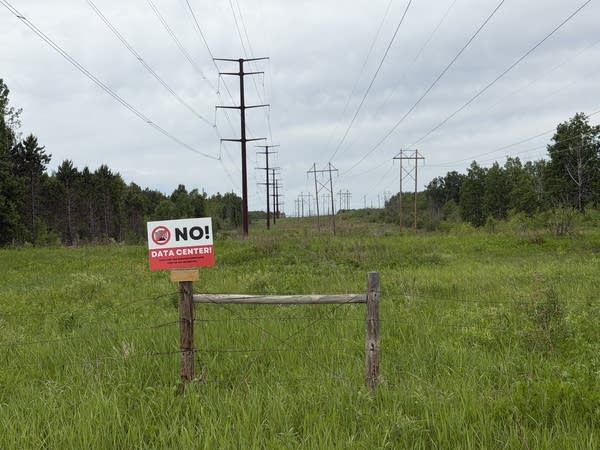
A red and white sign reading "NO! Data center" sits on a wooden fence post in a clearing under a power line.
A sign opposing a proposed Google data center in Hermantown is posted along an electric transmission line corridor off of St. Louis River Rd., near where the data center would be built. Seen Tuesday.
Dan Kraker | MPR News

The data center has been proposed for a rural corner of Hermantown adjacent to where the new electric transmission infrastructure is being built. Data centers require enormous amounts of electricity — often as much as small cities — and they are often proposed for locations near sources of large supplies of available electricity.

Planning for this transmission project began over a decade ago, long before Google proposed its data center project for the region. But the improvements the project will provide to the regional electricity grid would support the data center if it’s built, Gunderson said.

“We've always been a utility that served large customers. That's what we do,” Gunderson added. “So we know how to design systems around that, whether it be mining, natural resources or other customers. We want to have a system capable of supporting that.”

The project received $25 million in support from the state, as well as $50 million in federal funding through the bipartisan infrastructure law passed during the Biden administration.

The Trump administration revoked that funding last year as part of its broader effort to cancel $8 billion in grants that the Biden administration awarded to 16 states aimed at accelerating the green energy transition.

But the Department of Energy returned the funding earlier this year after Minnesota Power appealed. “The original grant was very much a bipartisan effort between the delegations from Minnesota and North Dakota, because we have facilities in both areas, and we just reaffirmed that in the appeal,” Gunderson said.




Source link


A person farms

This story was produced in partnership with Harvest Public Media, a collaboration of public media newsrooms in the Midwest and Great Plains. It reports on food systems, agriculture and rural issues.

By Sarah Fentem | Harvest Public Media

Researchers at an environmental nonprofit say that the number of days with dangerously humid heat is increasing – particularly in the Midwest and South – and that’s affecting people’s health.

Analysis from scientists at the group Climate Central shows the number of days with heat index values above 90 degrees is increasing in parts of the country, making the air wetter and hotter.

“We know that humid heat is increasing with climate change, because as the temperature gets hotter, it also makes the atmosphere's capacity to hold moisture increase,” said Kaitlyn Trudeau, an applied climate scientist with the group. “So you can think of it like a sponge that soaks up water, but as air gets hotter, it's just basically a bigger sponge.”

Climate Central released a tool in May that shows daily data on where humid heat is increasing around the world.

The trend is most pronounced in the Midwest and southern United States. Amarillo, Texas has 22 more extreme humid days per year compared with 1979, while Tulsa and St. Louis have around five more per year.

The heat index takes humidity into account along with the air temperature. Measures that include humidity, wind and other factors are a better estimate of how dangerous hot weather can be, said John Pike, a meteorologist with the National Weather Service in Norman, Oklahoma.

Sweating is the body’s main defense against overheating, he said. If a person can’t sweat to stay cool, their body temperature rises, which can cause issues with the kidneys, liver and other organs.

When you sweat, that produces what's called evaporative cooling,” Pike said. “If the humidity gets too high, then you won't get that evaporative cooling.”

The weather agency issues heat advisories and warnings when the heat index rises, in the hopes people will take more precautions and be on the lookout for signs of heat stroke.

“It's just really to let people know, just keep an eye on how long you're outside,” Pike explained. “It's also very important to check on the elderly especially if they don't have air conditioning or something in their house.”

Agricultural workers are ‘on the front lines’

High humid heat days are especially dangerous for outdoor laborers such as farmworkers.

“Heat is one of those really, really deadly risk factors for farmworkers, and one of the reasons that farmworkers experience such high rates of illness, injury, and death on the job,” said United Farm Workers Vice President Elizabeth Strater.

Unlike other outdoor laborers who may be paid by the hour, farmworkers are usually paid by how much they harvest, she said.

“These workers have … a financial incentive to push their body beyond what it's able to endure, and they do that out of economic desperation, because farmworkers are also some of the poorest workers in the country,” Strater said. “Farmworkers are really affected, and very much on the front lines.”

Hydration alone isn’t enough to combat heat illness in humid conditions, she added. Workers need to get out of the heat to lower their internal body temperature.

Humid heat also affects how clearly people can think, Strater said, and that can lead to more accidents on the job.

UFW has pushed for stronger worker protections, including paid breaks and adequate shade, to be written into federal law.

Protection against heat “isn’t rocket science,” Strater said. “We know what it takes to keep workers alive in high heat: They need shade, they need paid rest breaks… they need training and information, not only as to what the danger signs are, but what their rights are. And they still do have a right to refuse unsafe work."

The dangers of humid heat show that focusing on high temperatures alone isn’t enough, said Trudeau, the scientist with Climate Central.

“It’s this hidden danger that you can't really tell just from a thermometer,” she said.


Source link

Recent Reviews