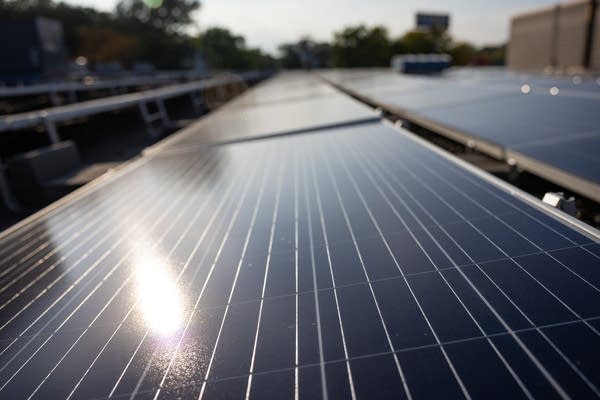

Maine dethroned Minnesota last year as the national leader in community solar per capita. That's according to a new report from the nonprofit, Institute for Local Self-Reliance.
Community solar is a way for individuals, businesses, nonprofits and other groups to purchase or “subscribe” to renewable energy from a local source.
Ingrid Behrsin is a senior researcher with the Institute for Local Self-Reliance. She said community solar stalled in Minnesota because of two main factors – availability and policy changes.
“It's the reduction in the incentive, and it's also the reduction in the available places where you can plug in a community solar development into the grid," she said.
Before then, Behrsin said Minnesota ran away with a per capita solar capacity nationwide for a decade, until cracks began to show.
Community solar programs aren’t owned by any corporate/private utility companies. So when community solar arrays are built, they take money away from those companies by way of customers switching over to solar.

Katie Kienbaum, a senior researcher with the Energy Democracy Institute at the Institute for Local Self-Reliance, said utility companies have a lot of political power. And in many states they hold a lot of sway over legislatures.
“There is just a broad opposition to solar, generally from utilities,” Kienbaum said. “And you'll see that in them opposing or trying to change net metering policies to reduce compensation for solar owners.”
According to Behrsin, it’s similar to what the Minnesota Public Utilities Commission recently did, when it included a cap on the wattage that community solar can offer to its customers. She said that in turn, shut out potential subscribers who were on waitlists, and made financing projects harder and more expensive, especially for smaller developers.
“The best community solar programs don’t have any caps,” Behrsin said. “The second best grow their capacity caps over time. They don’t decrease them.”
She added the uncertainty around when a cap might get hit in any given year can leave developers in limbo.
Behrsin said there will need to be some changes for Minnesota to regain its position as the nation’s community solar leader, but it’s not impossible.
“Utilities and the regulatory commission need to work together,” she said. “To ensure that we can plug as many community solar gardens into the grid as possible, to maximize electricity cost savings for residents, and the reduction in dependency on needing to develop large scale alternative generators that are not distributed solar.”
Last year 42 percent of all installed solar in Minnesota was community solar, tying it at second place in the rankings with New York state.