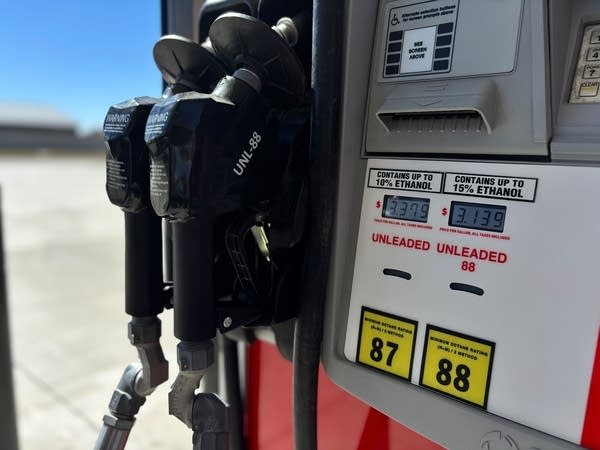
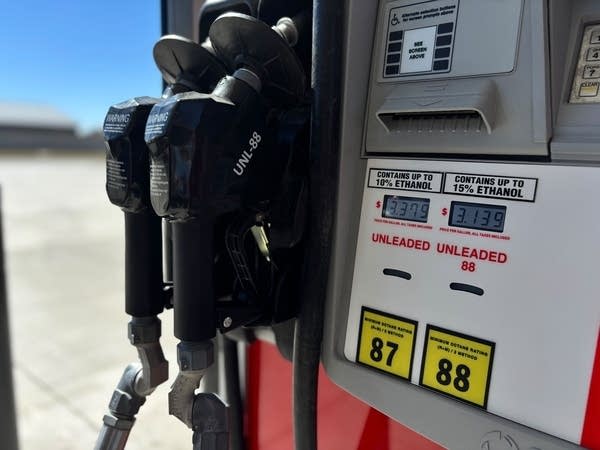
Gas prices are surging due to the war in Iran, and a home-grown fuel made from corn is being promoted as part of the solution.
The Minnesota Department of Agriculture is investing millions into expanding access to blends of gasoline with high concentrations of ethanol, which it says are cheaper and better for the environment. But experts say the benefits of the corn-based fuel are overstated.
Minnesotans are more used to E10 blends, which contain 10 percent ethanol and are often labeled as “regular.” E15, sometimes branded as UNL 88, is a fuel blend that contains 15 percent ethanol; it’s cheaper per gallon than E10.
For example, at a Casey’s in Moorhead last Monday, it was 15 cents cheaper, which is why Jason Koonce used it to fill up his work van.
“Gas has been really expensive lately,” he said. “I put about $40 of gas in here every day just for my daily trips around town, and it's increased my (costs) at least $300 a month. I don't know where I'm gonna get that money from.”
The price difference can be even larger at other gas stations. That same day, E15 was 24 cents cheaper than E10 at a different gas station in Moorhead, Kwik Trip.
But E15 is only available at about a quarter of the gas stations in Minnesota, so the agriculture department is offering gas stations up to $199,000 each through its Biofuels Infrastructure Grant Program to subsidize things like gas pumps that can handle higher amounts of ethanol.

“These investments support Minnesota corn growers, ensure retailers are ready to meet increasing demand for biofuels, and deliver more affordable, lower-emission options for Minnesotans at the pump,” said Thom Petersen, Minnesota Department of Agriculture commissioner, in a press release.
The grant is partially funded by the Minnesota Corn Growers Association.
“It helps all Minnesotans across the state,” said Devin Hoffarth, the group’s director of market development and industry relations.
But a number of experts contest those claims.
“My initial reaction is that this is taking us the wrong direction,” said Jason Hill, a professor in the Department of Bioproducts and Biosystems Engineering at the University of Minnesota.
Hazy environmental impacts
He’s been studying ethanol for more than 20 years, and he said ethanol is actually more environmentally damaging than the fuel it’s meant to replace, gasoline.
That may sound surprising. Gasoline is made from oil and releases carbon dioxide when it burns, heating up the planet. And ethanol is promoted as a renewable fuel: every year the federal Renewable Fuel Standard program mandates that more and more is mixed into the U.S. fuel supply.
The modern ethanol industry was born out of the 1973 oil crisis, when Arab countries imposed an oil embargo on the U.S. and fuel prices soared. Adding ethanol to gas was promoted as a way to secure energy independence and keep prices stable.
Today, supporters say that it’s still key to reducing greenhouse gas emissions and the domestic effects of global oil shocks. In a statement to MPR News, the Minnesota Department of Agriculture said, “Every gallon of biofuel that replaces petroleum helps reduce reliance on fossil fuels and moves us closer to lower emissions.”

But more ethanol means more pollution from corn production, Hill said. Plus, it can contribute to smog when it evaporates at high temperatures. That’s why E15 is generally banned in the summer, but the EPA has regularly waived that restriction for the past few years, including this year.
“With that [[restriction]] removed, we have a situation where we're likely to have worsening air quality, which contributes to health problems, premature mortality, dying early, and so forth from particulate matter and ozone from production and use of ethanol,” Hill said. “And ultimately, it's not just taxpayers who pay the price of this, but anybody who breathes air.”
Hill said if reducing emissions is the goal, there are other options for public investment.
“Ultimately, we want to use less fuel, not more, and so we should be looking at increasing vehicle efficiency more,” he said. “We should be looking at public transportation options.”
Hoffarth, with Minnesota Corn, said scientists like Hill are wrong about the environmental impacts, pointing to a study that showed E15 had lower or similar emissions to regular gasoline.
Hill said the scientific consensus points away from ethanol.
“The scientific consensus from those scientists who have studied this issue, from a perspective that's not funded by the industry, has largely come down on the side that corn ethanol is worse for the environment than gasoline,” he said. “Many of the studies they tend to cite are directly funded by that industry.”
The study Hoffarth pointed to was funded, in part, by the Renewable Fuels Association, the National Corn Growers Association and Growth Energy, a biofuel trade association.
An economic mixed bag
While high ethanol blends are lauded for being cheaper per gallon, they might not be cheaper per mile because they have less energy.
“It's not going to change the affordability of prices at the pump very much,” said Steve Polasky, an environmental economist at the University of Minnesota. “By volume, there's 33 percent less energy in ethanol than there is in gasoline.”
Hoffarth said ethanol‘s economic benefits go beyond the gas pump.
“It also contributes to the rural economy, where ethanol is made here in the state, and, of course, also benefits corn growers to have a market for their products that are grown in state,” he said.
A University of Minnesota study found that the ethanol industry generated $4.9 billion in economic activity for the state last year.
But ethanol demand can also raise the cost of other goods, Polasky said. Ethanol is made from corn, so if demand for it goes up, the demand for corn does too, jacking up the price of food. Polasky calls it “Econ 101.”
“Whether you view those price increases as a good thing or bad thing depends upon which side of the equation you're sitting,” he said. “If you're a corn grower, increasing demand is a good thing, right? You now get more for your product.”
For their part, industry groups dispute what they call the “food vs fuel myth,” pointing instead to correlations between food and crude oil prices.
In a statement, the Minnesota Department of Agriculture also rejected that ethanol is driving up cropland expansion, citing overall decreases in crop acreage and higher corn yields since 2007.
“Minnesota’s Climate Action Framework recognizes that reducing emissions from the transportation sector will take an all-of-the-above approach which include expanding public transit, increasing electrification, and lowering the carbon intensity of fuels through options like biofuels,” the department said. “Programs like the AGRI Biofuels Infrastructure Grant help make that possible by expanding access to higher ethanol blends like E15 across the state.”
Last year, Valley United Cooperative received one of the grants. It's a farmer-owned co-op and it also operates a gas station in Halstad.
Chief Strategy Officer A.J. Andresen acknowledged that there are trade-offs to other industries when corn prices increase. But he said increased demand for ethanol and higher corn prices are essential for corn farmers facing rising costs.
“I need grain prices to go up for guys to be able to break even or show a profit,” he said. “I think it just depends what market you're in.”