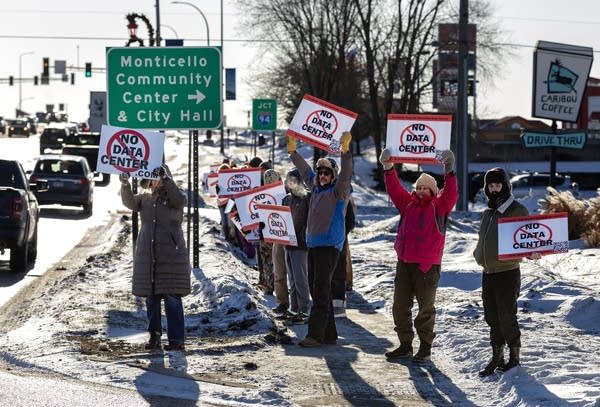
Elected leaders in Monticello could decide Monday night whether to adopt controversial new rules for data centers.
Faced with at least two proposals to build data centers in the small community about 40 miles northwest of Minneapolis, Monticello staff and city officials decided to craft an ordinance to govern where and how they could be built.
But some residents don’t think the ordinance is strict enough, and are frustrated that city leaders are considering allowing a data center to be built near their neighborhoods.
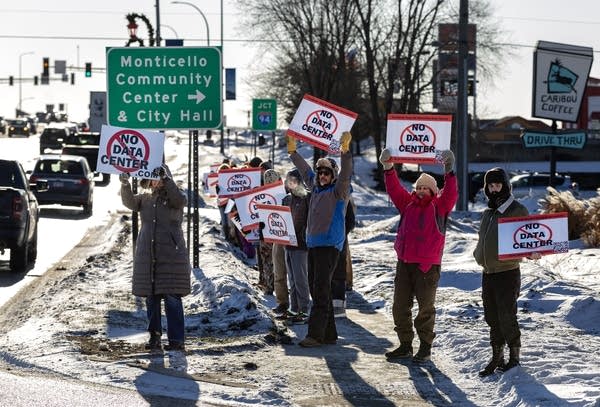
"Obviously we don't want a data center at all anywhere near our homes or in our community,” said Lisa Keenan, who lives a few hundred feet from one of the proposed sites. She helped start a Facebook group called “Stop the Monticello Data Centers,” which has more than 1,400 members.
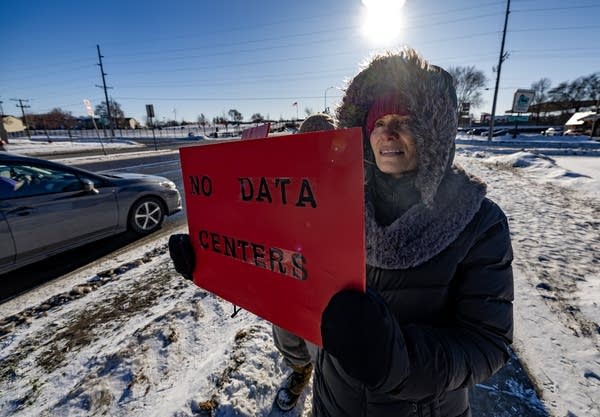
At a packed city council meeting earlier in April, many people wore red and carried signs reading “No data centers.” Mayor Lloyd Hilgart called a recess after some residents shouted their displeasure.
City Administrator Rachel Leonard said she's not surprised that people feel strongly about the issue.
"This is one of the biggest decisions that we've had to make as a community,” she said. “And people feel really invested in the future of Monticello and in the lives that they're building here."
Prime location
With plenty of available land, water for cooling equipment and electricity from Xcel Energy’s nuclear power plant, Monticello is considered an attractive location for a large data center.
But when developers first approached Monticello in 2024, data centers weren’t on city officials’ radar.
"Honestly, I’d probably never even heard of them before,” Hilgart said in December. “Probably most people hadn't.”
Monticello officials decided that if data centers were coming, they wanted to be ready with information and some ground rules.
"While they could see benefits to this type of potential development, they could also very clearly see some of the risks and what has happened in other places in the country,” Leonard said. “And that they did not want to pursue this at any cost.”
So city staff, planning commission and city council members spent the past year researching data centers, and how other communities have handled them.
They drafted an ordinance that would create a special zoning district specifically for data center campuses, which can be several football fields in size. Data centers would need to be set back at least 200 feet from residential areas, and demonstrate there’s adequate water and energy available.
The ordinance also tries to address how a data center would affect the people living around it, Leonard said, by requiring landscape buffers, screening and setting limits on noise and lights.
‘We don’t get any say’
The rules have gone through many revisions and public meetings. Lots of people have weighed in, and some aren't happy with the results.
Keenan said the ordinance is better than nothing. But she thinks it should require data centers to be much farther away from homes. And she worries the ordinance could signal a green light for developers.
"When that application comes in, it's our understanding basically that if they can check all the boxes and get the permits from the DNR or the state or whoever, it's pretty much the city doesn't have any right to say no,” Keenan said.
Monticello leaders say an ordinance doesn't mean the city will automatically allow a developer to build a data center. They say they'll consider each application individually.
Hilgart said the ordinance makes clear that the city won't provide tax incentives or pay for new infrastructure for a data center.
"I believe the ordinance offers the protection that the city is looking for,” he said.
Jenna Van Den Boom owns a home in a housing development close to one of the proposed data center sites, and has helped organize the opposition. She said residents are frustrated because they feel city officials aren’t listening to their concerns.
Van Den Boom said she’s worried about noise and dust from construction, which could last for several years.
“We've invested time, money and energy in making these our forever homes,” she said. “And then we don't get any say, it feels very, very wrong and very violating.”
Building boom
Proposals to build the huge warehouses filled with computer servers that power cloud computing and artificial intelligence have been popping up in communities across Minnesota and the U.S.
Opponents are concerned about their massive size, their vast water and energy consumption, and noise and light pollution.
But some cities see the potential benefits they could bring, including property tax revenue, construction jobs and economic growth.
City officials say proposals to build data centers in Monticello and elsewhere likely will keep coming.
“We believe that it is in our best interest to have local regulations related to this type of development,” Leonard said.
But some Monticello residents say there should be state or even national rules on data centers to protect people from their impacts.
State lawmakers are considering several related measures this session, including a statewide moratorium on data centers and a bill to stop local officials from signing non-disclosure agreements with developers. It’s not clear whether any will become law.
A handful of Minnesota cities have passed their own moratoriums on new data centers, including Carver, Eagan, New Brighton and Rosemount.
Monticello officials say they’ve had an unofficial pause on data center development for the past year, by alerting developers that they wouldn’t accept any applications until the ordinance is complete.