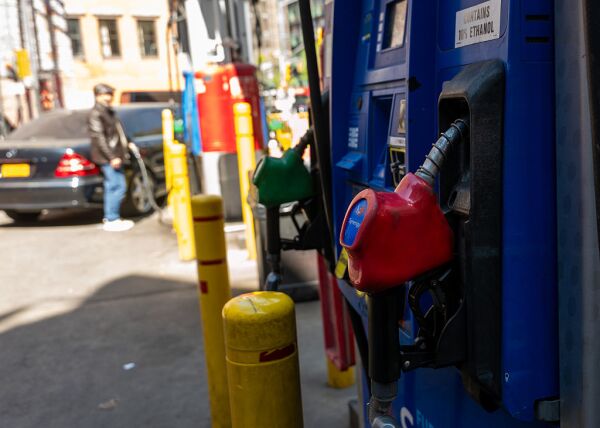
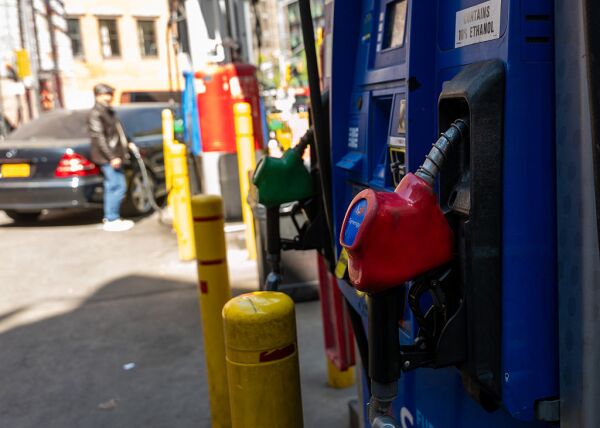
With gas prices continuing to surge, more than 8 in 10 Americans said pain at the pump is putting a strain on their household budgets — and a strong majority blames President Trump, according to the latest NPR/PBS News/Marist poll.
The poll also found that Trump is more unpopular than he ever has been and he faces major declines with key groups since being sworn in for a second term. Most Americans said the economy isn't working for them, and the war in Iran — which has directly led to those higher gas prices — continues to grow more unpopular.
Those challenges have given Democrats a distinct advantage in the midterm elections. Six months from when votes will be counted this November, Democrats lead by 10 points on the congressional ballot test. The ballot test asks which party's candidate they would vote for if congressional elections took place today.
Democrats also have the edge on enthusiasm to vote, which is critical in midterm years when turnout is expected to be lower than presidential-election years. Who shows up is a wild card because independents and some groups critical to both parties are not fired up.
The survey of 1,322 respondents was conducted April 27-30 and has a margin of error of +/- 3.1 percentage points, meaning results could be about 3 points higher or lower. Respondents were reached by live caller, text and online.
Trump’s approval is the worst ever in the poll
Just 37 percent of respondents approve of the job Trump is doing overall, while 59% disapprove. That's the highest level of disapproval ever in the Marist poll for Trump between both of his terms.
What's more, 51 percent strongly disapprove, which is tied for worst ever for Trump in the poll. The number shows the intensity of opposition that he's facing.
Digging inside the numbers reveals some huge declines with various key voter groups, including with many who were supportive of Trump just after he was sworn into office for a second term.
That includes voters in the South, those who make less than $50,000 a year, white men and women without college degrees, Millennials, men, parents of children under 18, rural voters and men in small cities and the suburbs.
Trump has seen declines with other key base voting groups, like white evangelical Christians and rural voters. The slides have been even more pronounced with crossover voters, who helped him over the finish line in 2024, like younger people and many Black and Latino voters.
Even Republicans are not as strongly in support of the president. In February 2025, 88 percent approved of the job he was doing, while 10 percent disapproved. That's a net rating of +78 points. Now, 81 percent approve and 18 percent disapprove. That's still relatively high, but the +63 represents a 15-point net drop in a little over a year.
It’s still the economy …
Trump's approval ratings have nosedived because of all that's happened in the past year, including Trump's tariffs, continued higher-than-pre-Covid-pandemic prices and now rising gas prices because of the Iran war.
Just 35 percent approve of Trump's handling of the economy, which is also tied for worst mark in the poll. That record was set in March.
Several factors are piling on voters:
Gas prices have surged to an average of $4.48 cents a gallon nationally, as of May 5, according to AAA. Before the war, prices were below $3 a gallon on average.
As a result, 81 percent of respondents said current gas prices are a strain on their household budget, including 79 percent of Republicans.
By a 63 percent-37 percent margin, respondents said they blame Trump for the current increase in gas prices. That includes a third of Republicans.
The same split said the economy is not working well for them personally, the worst recorded in the survey.
A majority (56 percent) said their area is not very affordable or not affordable at all. Critically, among those saying the economy is not working well for them were white non-college women (72 percent), those making less than $50,000 a year (71 percent), Millennials (69 percent) and those 18-29 (65 percent).
The Trump administration had taken a largely deregulatory approach to artificial intelligence, something that has accounted for major investment and a major share of stock portfolios. But concerns are growing over AI and the future.
The survey found that 8 in 10 believe AI will eliminate more jobs than it creates. That's up 12 points since last year.
The Iran war continues to be unpopular
Trump's approval for his handling of Iran has sunk to just 33 percent. That's down from 36 percent in March.
Seventy-two percent of Republicans approve of Trump's Iran handling, which is down 7 points from March.
By a 61 percent-38 percent margin, respondents said the military action in Iran has done more harm than good, including a quarter of Republicans.
More broadly, 62 percent said Trump's decisions have weakened the United States on the world stage.
Democrats hold the midterm advantage
By a 52 percent-42 percent margin, respondents said they would vote for a Democratic candidate in their district if congressional elections were held today.
That's a significant gap, and one that in past years has indicated a potential wave election. But there are fewer competitive seats up than ever before because of gerrymandering and other factors.
The election is still six months away, but at this point, Democrats have the edge. That shows up in enthusiasm as well. Democrats are 8 points more likely than Republicans to say they're "very enthusiastic" to vote — 61 percent-53 percent.
There's also a 14-point enthusiasm gap between people who voted for Democrat Kamala Harris and those who voted for Trump in 2024 (61 percent vs. 47 percent).
Just 38 percent of independents say they're very enthusiastic, indicating a likely drop-off in turnout this year from the presidential election. Turnout in midterms averages a roughly 30 percent drop compared to presidential elections. And some key groups for both sides said they're not very enthusiastic.
The most likely to say they're very enthusiastic: 60+ (68 percent), white college men (68 percent), white college grads (64 percent), white college women (61 percent), those 45 and older (61 percent), college graduates (59 percent), whites (56 percent), white men without degrees (56 percent), those who make more than $50,000 a year (55 percent) and parents without children under 18 (55 percent).
White, college-educated voters traditionally vote at higher rates, and they have trended toward Democrats in the age of Trump.
The least likely to say they're very enthusiastic are those 18-29 years old (34 percent), Gen Z (35 percent), Millennials (37 percent), those who make less than $50,000 a year (37 percent), those younger than 45 (37 percent), Black voters (39 percent), parents with children under 18 (40 percent), Latinos (42 percent), white women without degrees (45 percent), Trump voters (47 percent), those who live in big cities (47 percent).
From that list, young voters and non-whites are key for Democrats, while parents with young children, white women without degrees and obviously Trump voters are key for Republicans to turn out this fall.
Other findings on voter ID, age in politics and automatic registration for the draft
-
74 percent are in favor of requiring government-issued photo ID in order to be allowed to vote, including 51 percent of Democrats.
-
65 percent support requiring people to show a passport or birth certificate in order to register to vote.
-
80 percent support a maximum age limit for members of Congress (there is currently only a minimum age limit).
-
83 percent support term limits for members of Congress (putting limits on the number of times they can run for office).
-
A slim majority (53 percent) opposes automatic registration into the military's Selective Service. There's a big partisan divide on the question — 68 percent of Republicans are in favor, but just 30 percent of Democrats are. (The current process requires self-registration.)
Copyright 2026, NPR