Evacuation orders for North Shore wildfire


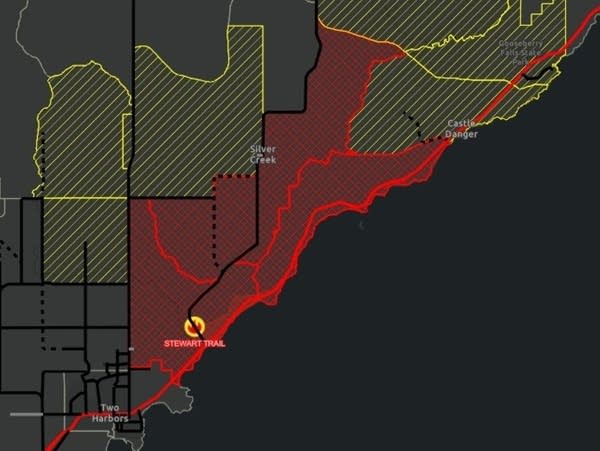
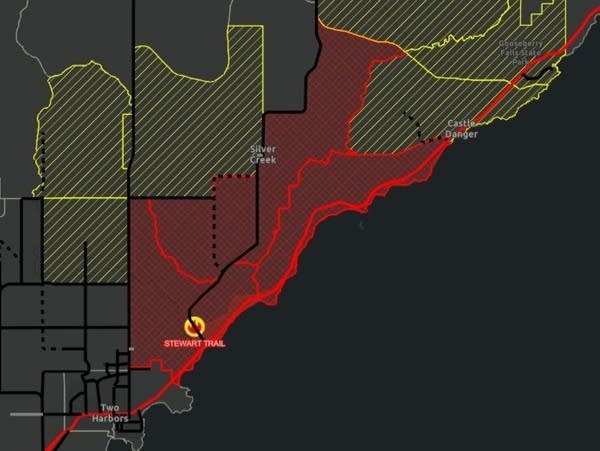
A map showing evacuation zones due to a wildfire

Evacuation orders were in place and Minnesota Highway 61 remained closed Saturday between Two Harbors and Castle Danger as crews continued working to contain a wildfire along the North Shore.

The Stewart Trail Fire started Friday afternoon northeast of Two Harbors amid gusty winds and tinder-dry conditions. As of Friday night, the Minnesota Interagency Fire Center estimated the fire to be 100 acres in size with no containment.

Local, state and federal crews were battling the fire on the ground and from the air. There was no official information yet on whether any buildings have burned and no immediate word on the cause of the fire.

“Multiple local, state and federal agencies are responding to the Stewart Trail Fire, along with numerous aircraft capable of providing water and fire retardant drops,” the Minnesota Interagency Fire Center reported in a Friday night update. It said crews were expected to remain on the scene overnight.

Lake County issued evacuation orders Friday for homes and businesses along State Highway 61 and County Road 3 northeast of Two Harbors. Those remained in effect as of Saturday morning.

Highway 61 remained closed between Two Harbors and Castle Danger as of Saturday morning — requiring a long detour for drivers heading to and from points farther up the North Shore. The fire also affected part of the Superior Hiking Trail.

The Stewart Trail Fire was one of at least 18 wildfires in northeastern Minnesota on Friday. Saturday was forecast to be another day of heightened wildfire risk across much of Minnesota, with gusty winds and low humidity.

A plane drops water on a wildfire
A plane drops water on a wildfire along Highway 135 on the Iron Range, near Gilbert, on Friday. Crews responded to at least 18 wildfires in northeastern Minnesota on Friday.
Courtesy of St. Louis County Sheriff's Office

Community response

Amid the ongoing firefighting efforts — and uncertainty over whether any homes or businesses were lost to the flames — local residents and businesses offered free meals and other assistance.

The Rustic Inn Cafe in Castle Danger reported that “all of our staff members are safe. However, we have a couple of employees who most likely have lost their home in the fire, and our hearts are with them and every family affected. … We are incredibly grateful for the firefighters, first responders, volunteers, and emergency personnel working tirelessly to protect our community.”

The restaurant said it was offering free meals Saturday to first responders and families displaced by the wildfire. It was also accepting donations for firefighters and residents affected by the fire.

Do North Pizzeria in Two Harbors and the food truck Na-cho Bizness were also offering free meals to first responders and residents who had to evacuate.

“No questions. No expectations. Just neighbors helping neighbors,” the operators of the food truck posted online. “To every person working long hours, protecting homes, helping families and keeping our community safe — thank you.”

Additional firefighting help

Before Friday’s wildfires, the Minnesota Department of Natural Resources said this week that amid the elevated fire danger, additional wildland firefighting crews from Ontario and Manitoba were in Minnesota to assist local crews — part of an agreement called the Great Lakes Forest Fire Compact.

“Their presence reflects the value of long-standing partnerships and a shared commitment to helping one another during periods of increased wildfire potential,” the DNR said.



Source link

Leave a Reply

Subscribe to Our Newsletter

Get our latest articles delivered straight to your inbox. No spam, we promise.

Recent Reviews


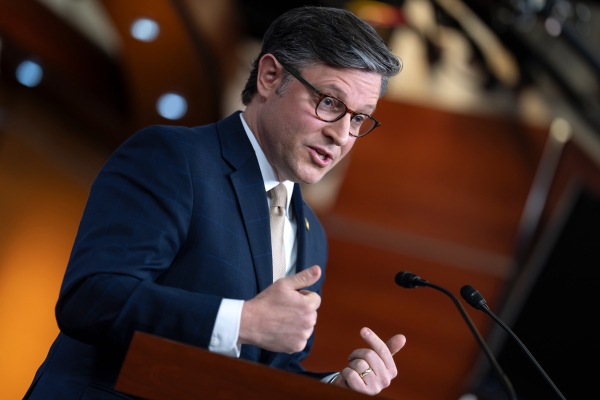
Speaker of the House Mike Johnson, R-La., takes questions at a news conference at the U.S. Capitol on April 21, 2026.

Speaker of the House Mike Johnson, R-La., takes questions at a news conference at the U.S. Capitol on April 21, 2026.
Speaker of the House Mike Johnson, R-La., takes questions at a news conference at the U.S. Capitol on April 21.
J. Scott Applewhite | AP

The House of Representatives voted Thursday to reopen most of the Department of Homeland Security, ending the longest agency shutdown in U.S. history.

The House passed a bill funding DHS, minus dollars for Immigration and Customs Enforcement and Customs and Border Protection. The measure passed by voice vote on what was the 76th day of the shutdown.

Democrats refused to back funding for many of the agency's immigration functions in an unsuccessful effort to secure reforms including body-worn cameras and broad restrictions on face coverings after federal law enforcement killed two American citizens in Minnesota earlier this year.

The Senate, led by Republican Majority Leader John Thune, R-S.D., unanimously advanced this funding legislation in March. At the time, Speaker Mike Johnson, R-La., referred to the proposal as "a joke" and refused to bring it up for a vote. Many members of the House Republican conference refused to fund the agency in a piecemeal fashion and did not want to negotiate over reforms to immigration enforcement operations.

On April 1, Johnson reversed course. He announced the funding bill would be voted on "in the coming days." More than four weeks later, he finally made good on that commitment.

In an effort to appease his hardline members, Johnson waited to bring the Senate's proposal to a vote until that chamber's Republicans started the arcane procedural process, known as reconciliation, to fund all of DHS — including Immigration and Customs Enforcement (ICE) and Customs and Border Protection (CBP) — for the remainder of Trump's term without any backing from Democrats.

The funding bill comes as Secretary of Homeland Security Markwayne Mullin warned the agency was close to running out of funds to pay staff.

"We have reached all the emergency funds we can reach into," Mullin told Fox News on Friday. "I am completely out of the slush fund, I have no place to move at the end of the month."

Mullin said the agency was relying on appropriated funds from last year's One Big Beautiful Bill, which allocated more than $150 billion to DHS on top of its regular annual appropriations funding.

President Donald Trump signed a memo this month authorizing DHS to use some of the money from that legislation to fund the department's operations — potentially infringing on the powers granted to Congress by the Constitution to direct how taxpayer money is spent.

Copyright 2026, NPR


Source link