Native American birding along the Mississippi


Bird watching at Wakan Tipi Center

Bird chirps resonate throughout the area of Wakaŋ Tipi, a site sacred to Dakota people. It's located along the Mississippi River in east St. Paul.

Lower Brule Sioux Tribe citizen Michael Tasunka Opi Kurtz is with Twin Cities-based Urban Bird Collective, an organization that supports birdwatchers of all different skill levels in their own neighborhoods.

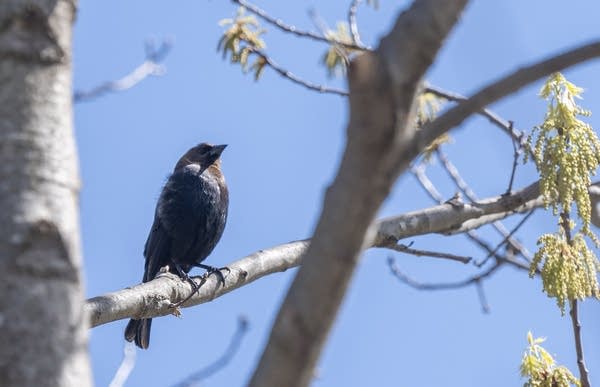
He stops to point out a brown-headed cowbird — a small bird with glossy black feathers on its body and brown feathers covering its head. The bird makes a high-pitched chirping noise.
Bird watching at Wakan Tipi Center
A brown-headed cowbird rests on the branch of a birch tree at the Waḳaƞ Ṭípi Nature Sanctuary, on Tuesday in St. Paul. Native to the U.S., cowbirds are specialized brood parasites that lay eggs in the nests of over 200 different species. Spring birds are taking flight and searching for food during their annual spring migration in Minnesota.
Judy Griesedieck for MPR News

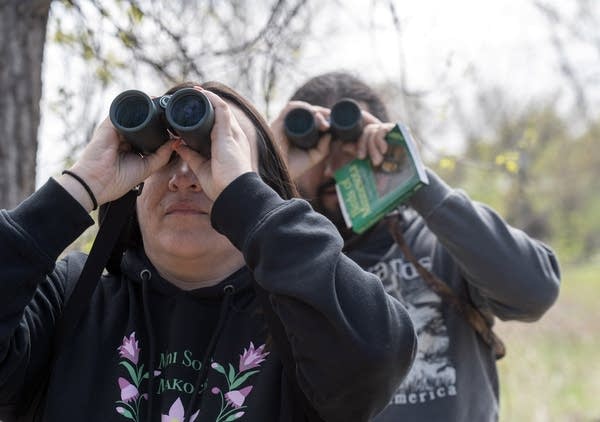
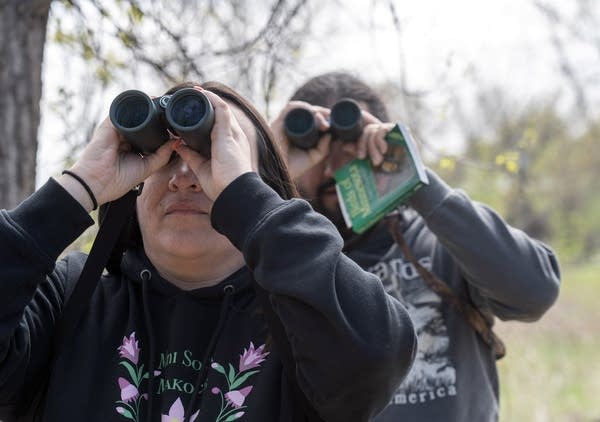
It’s not the only bird Kurtz points out while walking through Wakaŋ Tipi with fellow bird watchers from Urban Bird Collective. The group of four have binoculars and carry guidebooks to Minnesota’s birds.

“There's a palm warbler over there, on the tree, right on the path. I think that's it tapping its tail,” Kurtz said as he raised his binoculars to his eyes.

Maggie Lorenz, citizen of the Turtle Mountain Band of Chippewa Indians, is the executive director of Wakaŋ Tipi Awaŋyaŋkapi, the nonprofit organization that oversees Wakaŋ Tipi. The organization is partnering with Urban Bird Collective to host a bird walk for Native American community members on Sunday to celebrate American Indian Month.
Bird watching at Wakan Tipi Center
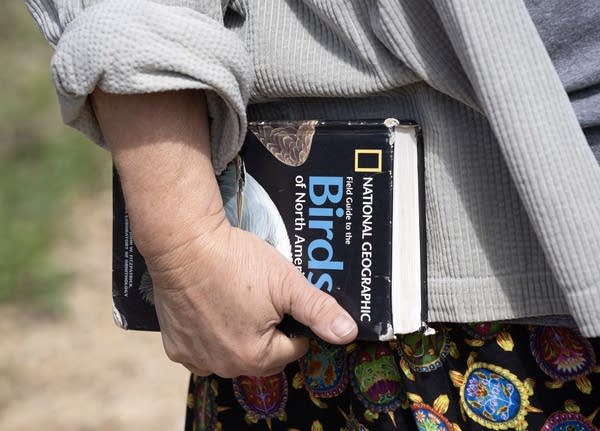
Hope Flanagan, from Dream of Wild Health and the Urban Bird Collective holds a guide book on Tuesday in St. Paul. Spring Birds are taking flight and searching for food during their annual spring migration in Minnesota.
Judy Griesedieck for MPR News

“This is the time of the year that we're going to see a lot of really unique and diverse species of warblers and water birds, and other birds that are going to be migrating through, along the Mississippi flyway,” Lorenz said.

Kurtz says people can learn a lot from birds, and that the spring migration provides that opportunity. By sparking an initial interest in birds, the group says it can lead to caring for the environment for future generations.

From robins helping in seed dispersal to turkey vultures keeping environments clean, he says those lessons of mutual relationships are interwoven into Indigenous teachings.

“There's just so much that the birds do to take care of the environment, that we can learn to be better stewards of the land,” said Kurtz.
Bird watching at Wakan Tipi Center
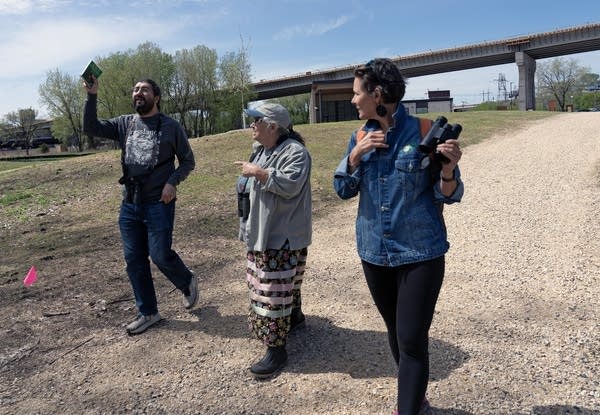
Bird watchers Michael Kurtz , left, of Urban Bird Collective, Hope Flanagan (center) of Dream of Wild Health, center, and Katy Kozhimannil, right, of Urban Bird Collective search for spring migrating birds and raptors near Wakan Tipi Center, a cultural and educational center located at the Waḳaƞ Ṭípi Nature Sanctuary, on Tuesday in St. Paul.
Judy Griesedieck for MPR News

Fellow bird watcher and Seneca descendant Hope Flanagan says birds have been on the earth for a long time and that they are like elders who deserve attention and respect.

“Everything is interconnected. So, if the birds don't have a place — if they can't have their food, if they don't have clean water, clean air, clean food, neither do we,” Flanagan said.

When Flanagan was younger, she noticed that migration would begin around mid-March. Now, she says, due to changes in climate, those migrations continue to happen later in the season.

“In Ojibwe, you're recognizing that what you do now affects your relatives in the past and in the future. So, we've got to be thinking about those who are walking on the earth now, or who are about to walk on the earth, or those who walked on the earth before us,” she said.

White Earth Nation descendant Katy Kozhimannil says birds are also integrated into community within the Ojibwe culture, specifically their relation to Ojibwe clans. Clans are a traditional lineal system based around kinship and are often based on animals and their characteristics.

“People are known for qualities that are associated with some of the qualities of the bird community,” Kozhimannil said. “It's a way that people feel connection to those characteristics and aim to live up to the beauty that those creatures, those relatives, show us.”
Bird watching at Wakan Tipi Center
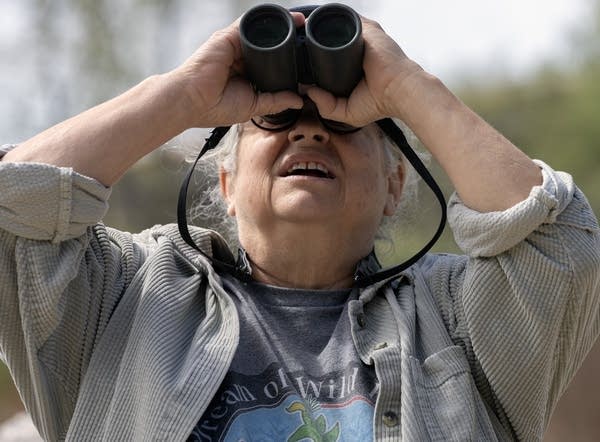
Hope Flanagan, from Dream of Wild Health and the Urban Bird Collective check for a variety of birds and raptors in the area on Tuesday in St. Paul. Spring birds are taking flight and searching for food during their annual spring migration in Minnesota.
Judy Griesedieck for MPR News

Cultural teachings are a part of the birding experience for Native American attendees, like talking about bald eagles, a sacred symbol in many Native communities.

At the end of the bird walk, both Kurtz and Flanagan stop as they notice an eagle flying overhead in the distance.

“It's just the way Lakota — the Indigenous way that things come and show you messages for a reason,” Kurtz said.

The group hopes those cultural connections to birds will inspire people to think deeper about the world around them.

“We've been connected to birds as Indigenous people from time immemorial. We've always had that connection for tens and even hundreds, thousands of years,” Kurtz said.

Chandra Colvin covers Native American communities in Minnesota for MPR News via Report for America, a national service program that places journalists into local newsrooms to report on undercovered issues and communities.


Source link

Leave a Reply

Subscribe to Our Newsletter

Get our latest articles delivered straight to your inbox. No spam, we promise.

Recent Reviews


Speaker of the House Mike Johnson, R-La., takes questions at a news conference at the U.S. Capitol on April 21, 2026.

Speaker of the House Mike Johnson, R-La., takes questions at a news conference at the U.S. Capitol on April 21, 2026.
Speaker of the House Mike Johnson, R-La., takes questions at a news conference at the U.S. Capitol on April 21.
J. Scott Applewhite | AP

The House of Representatives voted Thursday to reopen most of the Department of Homeland Security, ending the longest agency shutdown in U.S. history.

The House passed a bill funding DHS, minus dollars for Immigration and Customs Enforcement and Customs and Border Protection. The measure passed by voice vote on what was the 76th day of the shutdown.

Democrats refused to back funding for many of the agency's immigration functions in an unsuccessful effort to secure reforms including body-worn cameras and broad restrictions on face coverings after federal law enforcement killed two American citizens in Minnesota earlier this year.

The Senate, led by Republican Majority Leader John Thune, R-S.D., unanimously advanced this funding legislation in March. At the time, Speaker Mike Johnson, R-La., referred to the proposal as "a joke" and refused to bring it up for a vote. Many members of the House Republican conference refused to fund the agency in a piecemeal fashion and did not want to negotiate over reforms to immigration enforcement operations.

On April 1, Johnson reversed course. He announced the funding bill would be voted on "in the coming days." More than four weeks later, he finally made good on that commitment.

In an effort to appease his hardline members, Johnson waited to bring the Senate's proposal to a vote until that chamber's Republicans started the arcane procedural process, known as reconciliation, to fund all of DHS — including Immigration and Customs Enforcement (ICE) and Customs and Border Protection (CBP) — for the remainder of Trump's term without any backing from Democrats.

The funding bill comes as Secretary of Homeland Security Markwayne Mullin warned the agency was close to running out of funds to pay staff.

"We have reached all the emergency funds we can reach into," Mullin told Fox News on Friday. "I am completely out of the slush fund, I have no place to move at the end of the month."

Mullin said the agency was relying on appropriated funds from last year's One Big Beautiful Bill, which allocated more than $150 billion to DHS on top of its regular annual appropriations funding.

President Donald Trump signed a memo this month authorizing DHS to use some of the money from that legislation to fund the department's operations — potentially infringing on the powers granted to Congress by the Constitution to direct how taxpayer money is spent.

Copyright 2026, NPR


Source link