Rural Fosston moves forward in its quest to regain control of local hospital from Essentia Health


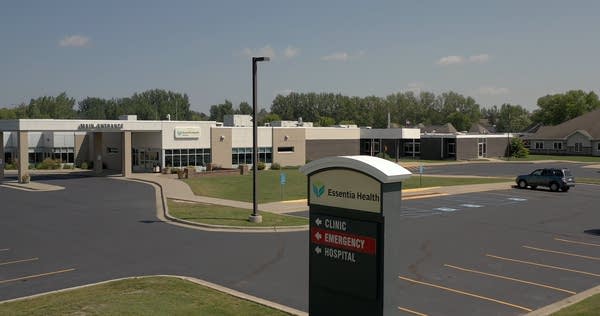
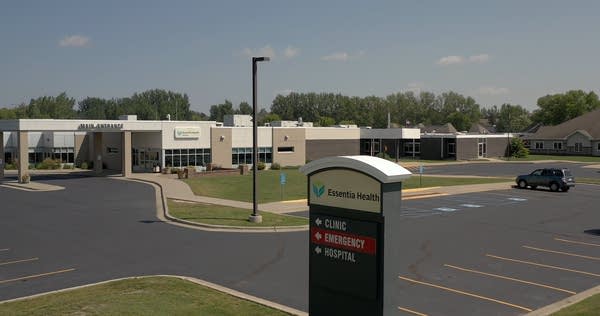
Essentia Health-Fosston hospital campus in northwest Minnesota, about 45 miles northwest of Bemidji.

As rural areas across Minnesota grapple with the loss of key medical services and increasing hospital consolidation, one community is fighting back. The city of Fosston in northwestern Minnesota, about 45 miles northwest of Bemidji, wants to hold Essentia Health, the hospital system that took over operations of its local hospital nearly 20 years ago accountable, alleging it has failed to meet the community’s health care needs in violation of its affiliation agreement.

Last week, a Polk County judge ruled in favor of Fosston, allowing the city to take its fight to terminate the local hospital’s affiliation agreement with Duluth-based Essentia to arbitration. Essentia entered into that agreement in 2009, when it took over management and operations of the hospital.

Michelle Landsverk, Fosston’s economic development director, said that the city, which entered into the affiliation agreement alongside the hospital and Essentia, argues that care has deteriorated since Essentia took over, and is seeking to return the nonprofit hospital to local control. The city said that would better serve the city of 1,500 residents and the broader community of about 26,000 people who live within 30 miles of the hospital.

“Fosston is like the little engine that could,” said Landsverk. “It's always been a town that has figured things out, and it's not shy about taking a bit of risk for the greater good, and I think here the greater good is tremendous.”

“If you were going to pick a hill to die on, this is one that really counts.”

Fosston and Essentia have been engaged in a dispute for years over the hospital’s operations and the level of care it provides the community. The conflict reached a tipping point in 2024, when the city first tried to terminate the relationship after Essentia shuttered labor and delivery services in Fosston and diverted labor and delivery to another of its hospitals about an hour away in Detroit Lakes, or its facility even further away in Fargo, N.D. While the city’s first attempt failed, it now alleges that core medical services have worsened even more and is trying to terminate the agreement again.

Katy Kozhimannil, a University of Minnesota public health professor, said that this is a case to pay attention to as it is part of a growing trend of small, rural communities standing up for themselves.

“Rural towns across the country are looking at [how] larger entities, be that hospital systems or AI companies that are building data centers, are engaging with local leaders and with local lands and resources,” Kozhimannil said. “And I think that's a really positive thing…Fosston is really showing us the strengths of collective community voices around issues that are important to them.”

Kozhimannil has been aware of the Fosston case for years. She says community members reached out to her in 2024 to learn more about her rural maternity care research as they sought to prevent the closure of labor and delivery services.

Kozhimannil said rural closures like this can have dangerous implications. Her research shows that pregnant people have worse health outcomes when they have to travel farther distances.

“I know the drive between Fosston and Detroit Lakes,” Kozhimannil said. “It’s a long one to take for people that are in labor or going to give birth.”

The same year that Essentia shuttered services in Fosston, Mayo Clinic Health Systems closed clinics that offered obstetric services in Fairmont and New Prague. An MPR News analysis of new data from the University of Minnesota Rural Health Research Center found that, as of 2024, 700,000 Minnesotans lived in counties without hospital-based obstetrics services.

The reason for the closures tends to come down to finances. Labor and delivery units require expensive 24/7 staffing, because babies can come anytime of day or night. But the birth rate in rural areas is declining and these hospitals are delivering fewer births, so the units rarely pay for themselves. In fact, many lose money. Rural hospitals also treat a greater proportion of patients on Medicaid, which pays much less for labor and delivery services than private health insurance plans pay.

It also has become much more difficult in recent years for rural hospitals to hire medical professionals, including doctors and nurses who are ob/gyn specialists, to work in small towns.

Kozhimannil said she’s not surprised that there was an uproar in Fosston. And, unlike the typical rural hospital takeover, the city of Fosston has a vested interest in the hospital. The agreement that Essentia entered into along with the hospital and the city includes a provision allowing the city the right to terminate Essentia’s partnership if certain core medical services are discontinued.

But Essentia Health disagrees that the city can terminate the agreement at will and stressed that it has continued to make investments in the Fosston facility in recent years. In April, it broke ground on a $12 million emergency department expansion.

“By continuing to prolong this legal process, city leaders are misrepresenting the basic facts of the agreement and spending limited public resources along the way,” an Essentia Health spokesperson wrote in a statement to MPR News. “While Essentia evaluates its legal options, we will remain focused on strengthening local healthcare, supporting our staff and delivering exceptional care to the patients we have the honor to serve.”

According to court documents submitted by the city, core medical services continued to decline after the obstetrics diversion.

The city alleges that the facilities are chronically understaffed and that physicians and other medical professionals “do not want to work under Essentia’s leadership in Fosston,” and are leaving to seek employment elsewhere. Fosston also accuses Essentia Health of restricting ambulance services, leading to a number of dangerous incidents including an instance in 2024 when a woman with a serious head wound was forced to wait 29 minutes for an ambulance to arrive. When the ambulance did arrive it was from a nearby town, not from the Essentia-run facility less than a mile away.

Landsverk said that while she can’t comment on the specifics of the case, the changes should be obvious even to the casual observer.

“I've been a resident of the Fosston area for 37 years, and the hospital and clinic campus have always been a thriving hub of activity,” Landsverk said. “However, over the last seven to eight years – and drastically over the last five or six years – it's obvious that there's a decline. It used to be if I went to the clinic, I could hardly find a parking spot. Now it's bare. It's a sign, I think, of what's happening inside.”

It’s unclear when arbitration will take place, but Landsverk said it will likely be in late 2026 or in 2027.

Landsverk stressed that they’re not pushing this case to have the city operate healthcare.

“We just want the people who live in this area to have access to high-quality care close to home,” Landsverk said. “I'm really thankful that we have a local group of leaders and stakeholders that care enough to stick their necks out and say this isn't right.”

Kozhimannil said the results of the case could be significant and have implications beyond the Fosston area. While the agreement with Essentia seems to be fairly unique, she says it could help neighboring communities think through similar partnership models to ensure residents’ health needs are getting met.

“I think this court case may help us understand if that's something that carries legal weight, and if it's something that could be a model to be built on,” Kozhimannil said.

Correction (June, 29, 2026): This story has been updated to clarify that Essentia ended labor and delivery services at the Fosston hospital, but not all obstetrics care; and that patients going into labor are diverted to Essentia's facility in Fargo, not Grand Forks, as an earlier version of this story reported.



Source link

Leave a Reply

Subscribe to Our Newsletter

Get our latest articles delivered straight to your inbox. No spam, we promise.

Recent Reviews


Food delivery app development means engineering a three-sided platform connecting customers, restaurants, and drivers through a single real-time system. A production-ready MVP takes 4–6 months and costs $30,000–$120,000 depending on feature scope. The global market for online food delivery is projected to surpass $1.85 trillion by 2030 (Statista, 2025), making this one of the highest-ROI verticals in mobile commerce. This guide covers everything product and engineering teams need to build, launch, and scale a competitive food delivery platform in 2026.

Building a Food Delivery App in 2026? Start With a Free Architecture Review.

The Food Delivery Market in 2026: Size, Growth, and Opportunity

The global online food delivery market generated approximately $1.07 trillion in gross merchandise value in 2025 and is forecast to reach $1.85 trillion by 2030 at a CAGR of 10.4% (Statista, 2025). Online food orders have outpaced traditional dine-in by over 300% since 2014, a structural shift accelerated by COVID-19 that has since become permanent consumer behaviour.

Bloomberg Second Measure data from Q1 2026 shows DoorDash controlling approximately 67% of the US food delivery market by order volume. In India, Swiggy and Zomato dominate a market expected to reach $21 billion in GMV by 2026 (NRAI, 2025). The food industry contributes roughly 12% of India’s GDP and accounts for close to 40% of employment, underscoring the commercial weight behind digital food platforms.

Users aged 18–34 account for over 51% of all food delivery app orders globally (Statista, 2025). This mobile-first demographic makes native or cross-platform mobile performance a non-negotiable baseline for any new market entrant.

 Three Business Models for Food Delivery App Development

Food delivery app development supports three commercially proven business models. The choice made before development begins determines architecture, revenue structure, and the unit economics path. These models are not interchangeable mid-build.

  1. Aggregator Model: The app lists partner restaurants and routes orders to them; delivery is handled by each restaurant. Revenue comes from listing commissions, typically 15–30% per order. Lower technical complexity but limited margin control. Suitable as a starting point for regional platforms. Examples: early-stage Grubhub, regional Indian aggregators.
  2. Logistics Model (Order and Delivery): The platform manages both order routing and last-mile delivery using its own contracted driver network. Revenue comes from commissions plus delivery and service fees. This is the most technically complex model and the most defensible at scale because the platform controls the full customer experience. Examples: DoorDash, Uber Eats, Swiggy.
  3. Cloud Kitchen Model: The platform operates its own kitchen infrastructure under multiple virtual brand names from a single location with no physical storefront. Cloud kitchen revenue in India is projected to reach $2 billion in 2025 (NRAI, 2024). This model requires food operations expertise alongside the technology build.

Must-Have Features for Food Delivery App Development in 2026

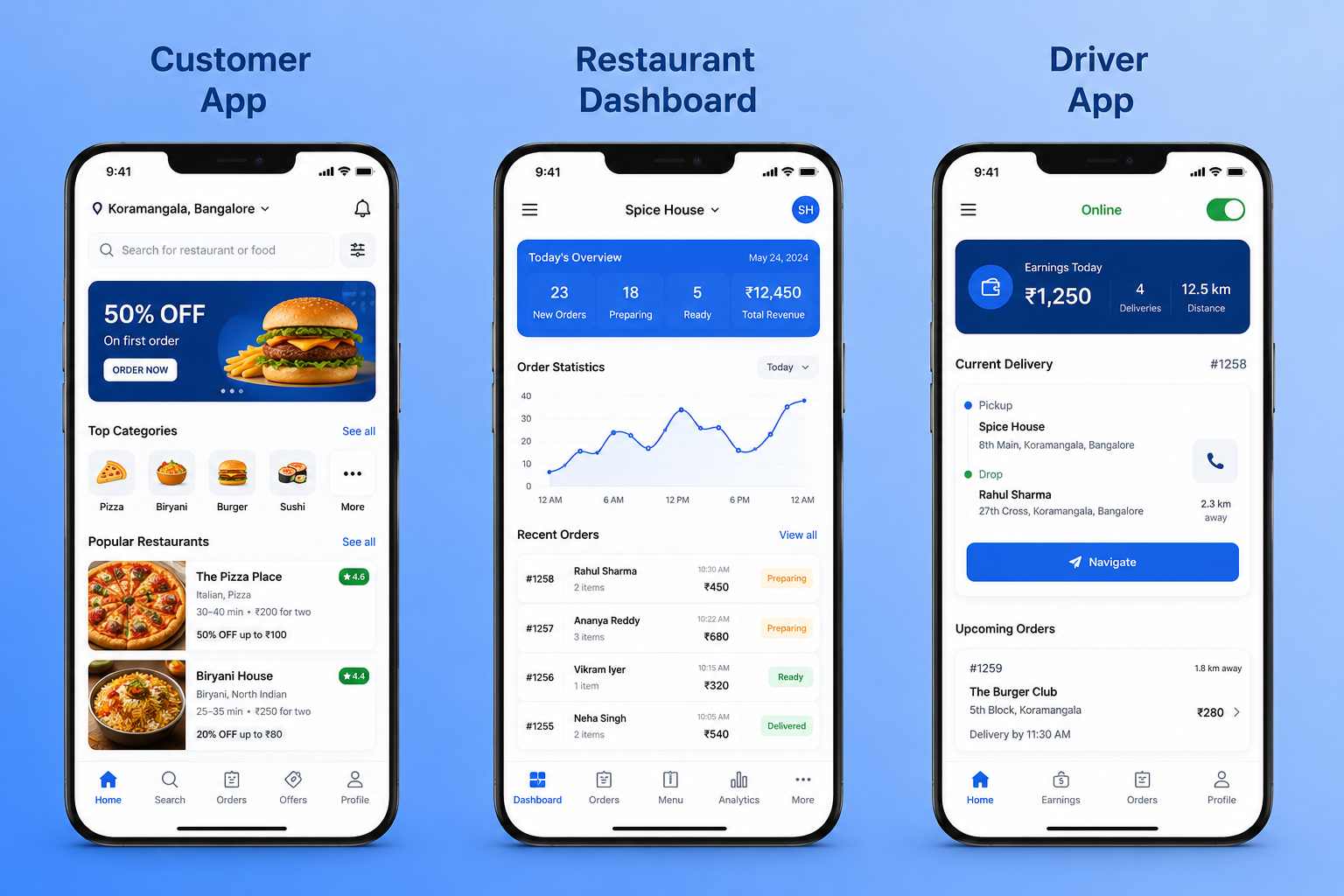
A production-ready food delivery app development project requires features across three panels: the customer app, the restaurant dashboard, and the driver app. Missing a core feature in any single panel creates funnel friction that degrades order completion rates platform-wide, even if the other two panels are well-built.

Food delivery app development

Customer App

  • Restaurant discovery with advanced filters: cuisine type, dietary restrictions, delivery time, estimated cost, and distance
  • Real-time GPS order tracking with dynamically updated ETA calculations, accurate to within 2 minutes
  • In-app payment supporting cards, UPI, mobile wallets, and BNPL options with PCI DSS compliance
  • AI-powered recommendations surfacing reorders, personalised dish suggestions, and time-aware menus (powered by AI and ML development)
  • Push notifications for order status milestones, promotions, and re-engagement campaigns
  • Ratings and reviews with photo upload support and restaurant response capability

 Restaurant Dashboard

  • Live order management queue with accept, reject, and item-level modification controls visible in under 3 seconds
  • Menu management: item-level pricing, availability toggles, image uploads, and category organisation
  • Performance analytics covering order volume, peak hours, cancellation rate, average order value, and revenue trends
  • Automated out-of-stock updates that propagate to customer-facing menus in real time, preventing failed orders
  • Promotional tools including discount codes, bundle offers, and sponsored placement; designed for high conversion by Ailoitte’s UI/UX design practice

Driver App

  • Automated order dispatch with AI-based route optimisation via Google Maps Platform Directions API or Mapbox
  • In-app navigation with live traffic rerouting and turn-by-turn directions including last-metre guidance
  • Earnings dashboard with real-time totals, per-trip breakdown, incentive progress, and payout history
  • Masked customer contact numbers for privacy-compliant in-app calling without number exposure
  • Delivery proof capture via photo and optional e-signature to reduce refund disputes

Recommended Technology Stack for Food Delivery App Development

The recommended stack for food delivery app development is React Native or Flutter for mobile, Node.js (NestJS) for the API layer, PostgreSQL for transactional data, Redis for real-time caching, and Google Maps Platform for routing. These choices determine how well the platform handles peak-hour concurrency, how quickly it ships new features, and what it costs to operate at scale.

Mobile Frontend

React Native or Flutter deliver near-native performance from a shared iOS/Android codebase. React Native is preferred for teams with deep JavaScript experience; Flutter is preferred where pixel-perfect UI fidelity matters most. According to Google I/O 2025, Flutter adoption in on-demand and food delivery apps grew significantly in 2025, driven by superior animation performance on lower-end Android devices.

Backend API Layer

Node.js (Express or NestJS) handles the primary API layer with its event-driven, non-blocking I/O architecture, well-suited for concurrent real-time order events. Python (FastAPI or Django) is deployed for ML-based services including recommendation engines and demand forecasting. PostgreSQL manages transactional order data; Redis handles session management, real-time caching, and queue processing.

Real-Time Communication

WebSockets via Socket.io propagate live order status across all three app panels. Firebase Realtime Database is a suitable managed alternative for teams at earlier infrastructure maturity stages. Sub-second latency on status updates is a baseline user expectation in 2026.

Cloud Infrastructure

AWS (ECS or EKS), Google Cloud Platform, or Azure for hosting. Docker and Kubernetes handle containerisation and auto-scaling during peak demand windows. A CDN such as AWS CloudFront or Cloudflare serves menu images and static assets, targeting sub-100ms response times globally.

Key Third-Party Integrations

  • Google Maps Platform: Directions API, Distance Matrix API, and Places API for routing and location search
  • Firebase Cloud Messaging (FCM): unified push notification delivery for iOS and Android
  • Payments: Stripe (global), Razorpay (India), or PayPal, all PCI DSS compliant
  • Analytics: Mixpanel or Amplitude for behavioural product analytics; Firebase Crashlytics for crash monitoring

Food Delivery App Development Cost and Timeline

Food delivery app development costs range from $30,000 to $250,000 or more, depending on platform scope, number of markets, compliance requirements, and whether the build includes a cloud kitchen management layer. The table below shows Ailoitte’s three standard scoping tiers based on engagements completed between 2023 and 2026.

Tier Scope Cost Range Timeline
MVP (Startup scale) Customer + Driver apps, basic restaurant panel $30,000–$60,000 16–20 weeks
Full Platform v1 All three panels, real-time tracking, payments $60,000–$120,000 24–32 weeks
Enterprise (Enterprise build) Multi-city, AI recommendations, analytics dashboard $120,000–$250,000+ 9–18 months

Note: All figures are estimates from Ailoitte’s internal project data (2023–2026). Actual costs vary by team location, feature complexity, and compliance requirements. [Estimate based on Ailoitte internal project data, 2023–2026]

The single largest cost driver in food delivery app development is the real-time system architecture. Supporting live GPS tracking, dynamic ETAs, concurrent driver assignment, and sub-second push notification delivery at scale requires careful upfront architectural investment. Teams that underinvest here at the MVP stage routinely face expensive re-architecture within 12–18 months of launch.

 Get a Precise Cost Breakdown for Your Food Delivery App

The table above is a starting point. Share your feature wishlist and target market and Ailoitte will return a scoped estimate with a fixed-price delivery option within 48 hours. No obligation.

►  Request Your Custom Estimate  →  ailoitte.com/food-delivery-app-development

What Changed in 2026: Key Shifts for Food Delivery App Development

The three most important changes affecting food delivery app development in 2025–2026 are: AI personalisation becoming a baseline expectation, delivery windows compressing to under 20 minutes in Tier 1 markets, and sustainable packaging compliance entering regulatory scope in EU jurisdictions. Any product team starting a build today must account for all three.

AI powered Food Delivery app

AI-Powered Personalisation Is Now a Baseline Expectation

Platforms without recommendation engines are losing retention to those that surface personalised reorders, dietary-based suggestions, and time-aware menus. Major platforms attribute a significant share of order volume to AI-driven surfacing [Estimate based on industry observation, no primary source available]. Ailoitte’s AI development practice recommends building a lightweight ML recommendation layer from the first sprint rather than retrofitting it post-launch, when training data has accumulated without the correct logging infrastructure in place.

Delivery Windows Have Compressed to Under 20 Minutes in Tier 1 Markets

The standard delivery SLA in major metros has fallen from 45 minutes to under 20 minutes in several food categories, driven by quick-commerce entrants like Blinkit and Zepto entering the food segment. This demands tighter driver dispatch algorithms, predictive stocking for cloud kitchens, and backend infrastructure capable of sub-second latency on driver assignment calls. Any food delivery app development targeting Tier 1 Indian or European cities must account for this in the initial architecture brief.

Sustainable Packaging Compliance Is Entering Regulatory Scope

Several EU member states are mandating that food delivery platforms offer plastic-free packaging options and disclose per-order packaging material data to consumers (EU Single-Use Plastics Directive 2019/904). Platforms targeting European markets in 2025–2026 need to include packaging metadata fields in the restaurant menu schema from day one, not as a future addition. 

In our food delivery app development engagements, the two components teams most consistently underestimate are the restaurant-side order management interface and the driver dispatch logic. A poorly designed restaurant panel produces elevated cancellation rates, a problem that damages customer retention before it becomes visible in top-line analytics.  

We now recommend that any client building a logistics-model platform allocate at minimum 30% of the front-end development budget to the restaurant and driver panels, not solely to the customer app.

FAQs

How long does food delivery app development take?

A food delivery app MVP takes 16–24 weeks from kickoff to launch: 2–3 weeks for discovery and architecture, 10–14 weeks for core development, and 4–6 weeks for QA, performance testing, and app store submission. A full three-panel platform with AI personalisation takes 6–9 months. See Ailoitte’s on-demand app development page for typical sprint breakdowns.


How much does it cost to build a food delivery app?

Food delivery app development costs $30,000–$60,000 for a single-market MVP, $60,000–$120,000 for a full three-panel platform with real-time tracking, and $120,000–$250,000 or more for a multi-city enterprise build with AI personalisation. The most significant cost drivers are real-time architecture complexity, Google Maps Platform API usage at scale, and driver dispatch algorithm sophistication.

What is the best technology stack for a food delivery app?

React Native or Flutter for mobile, Node.js (NestJS) for the API layer, PostgreSQL for transactional data, Redis for real-time caching, and Google Maps Platform for routing. This combination covers the full feature surface of a production food delivery app and benefits from the largest available engineering talent pool for ongoing hiring.

Can I build a food delivery app without a driver network?

Yes. The aggregator model allows restaurants to manage their own delivery, eliminating the need for a driver app and dispatch system. This is a common starting point for regional platforms. The trade-off is lower per-order margin and dependence on restaurant-side delivery capacity. See Ailoitte’s on-demand app development solutions for aggregator-specific architecture patterns.


What differentiates winning food delivery apps in 2026?

Speed, personalisation, and reliability. Users in competitive markets expect sub-30-minute delivery with live tracking and AI-driven recommendations. Platforms that hit delivery SLAs consistently outperform on long-term retention regardless of promotional discounting. The infrastructure to deliver this reliably, including routing algorithms, driver incentive design, and kitchen communication tooling, is where food delivery app development investment pays the highest long-term dividend.

Discover how Ailoitte AI keeps you ahead of risk

Sunil Kumar

Sunil Kumar is CEO of Ailoitte, an AI-native engineering company building intelligent applications for startups and enterprises. He created the AI Velocity Pods model, delivering production-ready AI products 5× faster than traditional teams. Sunil writes about agentic AI, GenAI strategy, and outcome-based engineering. Connect on

LinkedIn


Source link