
Food delivery app development means engineering a three-sided platform connecting customers, restaurants, and drivers through a single real-time system. A production-ready MVP takes 4–6 months and costs $30,000–$120,000 depending on feature scope. The global market for online food delivery is projected to surpass $1.85 trillion by 2030 (Statista, 2025), making this one of the highest-ROI verticals in mobile commerce. This guide covers everything product and engineering teams need to build, launch, and scale a competitive food delivery platform in 2026.
Building a Food Delivery App in 2026? Start With a Free Architecture Review.
The Food Delivery Market in 2026: Size, Growth, and Opportunity
The global online food delivery market generated approximately $1.07 trillion in gross merchandise value in 2025 and is forecast to reach $1.85 trillion by 2030 at a CAGR of 10.4% (Statista, 2025). Online food orders have outpaced traditional dine-in by over 300% since 2014, a structural shift accelerated by COVID-19 that has since become permanent consumer behaviour.
Bloomberg Second Measure data from Q1 2026 shows DoorDash controlling approximately 67% of the US food delivery market by order volume. In India, Swiggy and Zomato dominate a market expected to reach $21 billion in GMV by 2026 (NRAI, 2025). The food industry contributes roughly 12% of India’s GDP and accounts for close to 40% of employment, underscoring the commercial weight behind digital food platforms.
Users aged 18–34 account for over 51% of all food delivery app orders globally (Statista, 2025). This mobile-first demographic makes native or cross-platform mobile performance a non-negotiable baseline for any new market entrant.
Three Business Models for Food Delivery App Development
Food delivery app development supports three commercially proven business models. The choice made before development begins determines architecture, revenue structure, and the unit economics path. These models are not interchangeable mid-build.
- Aggregator Model: The app lists partner restaurants and routes orders to them; delivery is handled by each restaurant. Revenue comes from listing commissions, typically 15–30% per order. Lower technical complexity but limited margin control. Suitable as a starting point for regional platforms. Examples: early-stage Grubhub, regional Indian aggregators.
- Logistics Model (Order and Delivery): The platform manages both order routing and last-mile delivery using its own contracted driver network. Revenue comes from commissions plus delivery and service fees. This is the most technically complex model and the most defensible at scale because the platform controls the full customer experience. Examples: DoorDash, Uber Eats, Swiggy.
- Cloud Kitchen Model: The platform operates its own kitchen infrastructure under multiple virtual brand names from a single location with no physical storefront. Cloud kitchen revenue in India is projected to reach $2 billion in 2025 (NRAI, 2024). This model requires food operations expertise alongside the technology build.
Must-Have Features for Food Delivery App Development in 2026
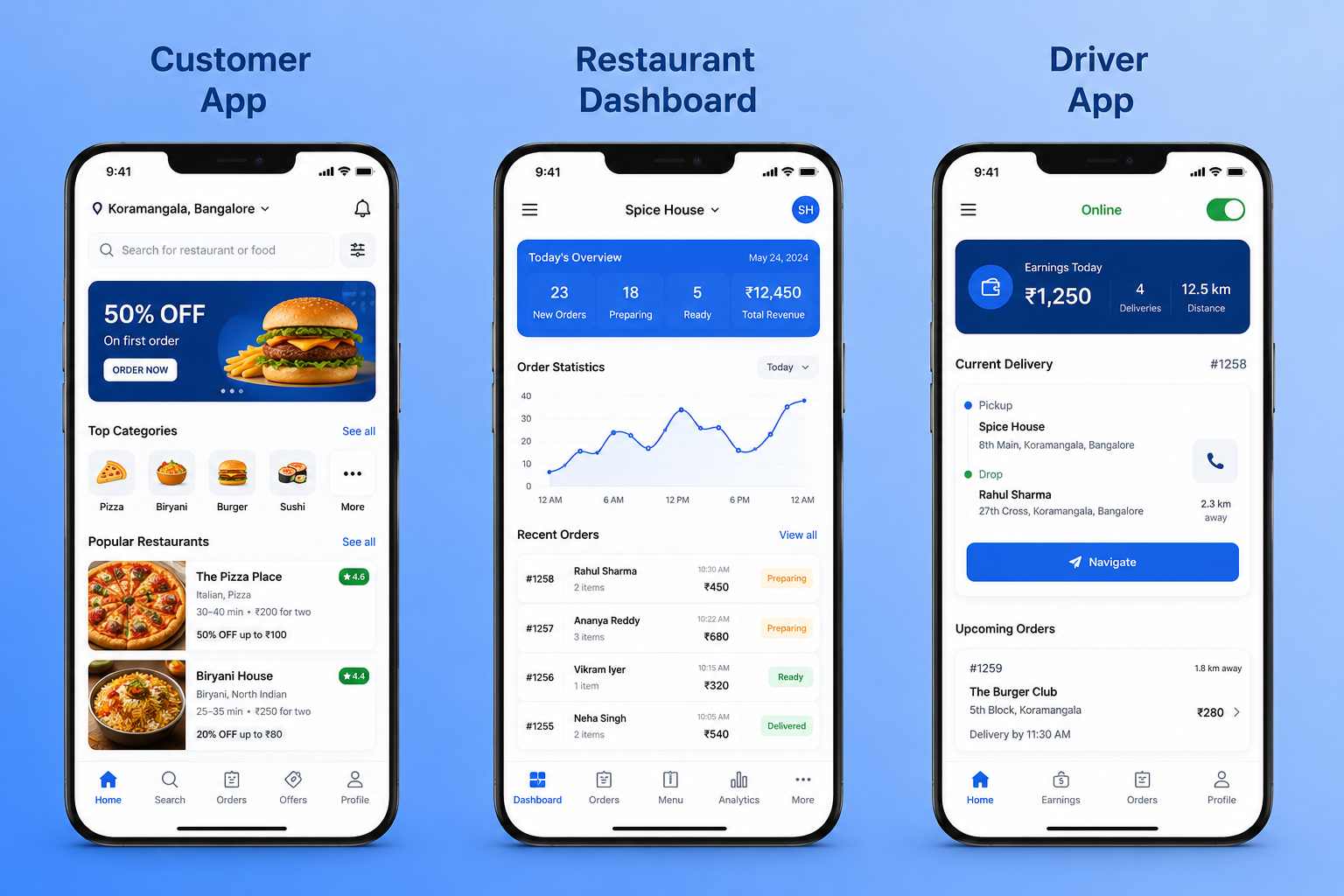
A production-ready food delivery app development project requires features across three panels: the customer app, the restaurant dashboard, and the driver app. Missing a core feature in any single panel creates funnel friction that degrades order completion rates platform-wide, even if the other two panels are well-built.

Customer App
- Restaurant discovery with advanced filters: cuisine type, dietary restrictions, delivery time, estimated cost, and distance
- Real-time GPS order tracking with dynamically updated ETA calculations, accurate to within 2 minutes
- In-app payment supporting cards, UPI, mobile wallets, and BNPL options with PCI DSS compliance
- AI-powered recommendations surfacing reorders, personalised dish suggestions, and time-aware menus (powered by AI and ML development)
- Push notifications for order status milestones, promotions, and re-engagement campaigns
- Ratings and reviews with photo upload support and restaurant response capability
Restaurant Dashboard
- Live order management queue with accept, reject, and item-level modification controls visible in under 3 seconds
- Menu management: item-level pricing, availability toggles, image uploads, and category organisation
- Performance analytics covering order volume, peak hours, cancellation rate, average order value, and revenue trends
- Automated out-of-stock updates that propagate to customer-facing menus in real time, preventing failed orders
- Promotional tools including discount codes, bundle offers, and sponsored placement; designed for high conversion by Ailoitte’s UI/UX design practice
Driver App
- Automated order dispatch with AI-based route optimisation via Google Maps Platform Directions API or Mapbox
- In-app navigation with live traffic rerouting and turn-by-turn directions including last-metre guidance
- Earnings dashboard with real-time totals, per-trip breakdown, incentive progress, and payout history
- Masked customer contact numbers for privacy-compliant in-app calling without number exposure
- Delivery proof capture via photo and optional e-signature to reduce refund disputes
Recommended Technology Stack for Food Delivery App Development
The recommended stack for food delivery app development is React Native or Flutter for mobile, Node.js (NestJS) for the API layer, PostgreSQL for transactional data, Redis for real-time caching, and Google Maps Platform for routing. These choices determine how well the platform handles peak-hour concurrency, how quickly it ships new features, and what it costs to operate at scale.
Mobile Frontend
React Native or Flutter deliver near-native performance from a shared iOS/Android codebase. React Native is preferred for teams with deep JavaScript experience; Flutter is preferred where pixel-perfect UI fidelity matters most. According to Google I/O 2025, Flutter adoption in on-demand and food delivery apps grew significantly in 2025, driven by superior animation performance on lower-end Android devices.
Backend API Layer
Node.js (Express or NestJS) handles the primary API layer with its event-driven, non-blocking I/O architecture, well-suited for concurrent real-time order events. Python (FastAPI or Django) is deployed for ML-based services including recommendation engines and demand forecasting. PostgreSQL manages transactional order data; Redis handles session management, real-time caching, and queue processing.
Real-Time Communication
WebSockets via Socket.io propagate live order status across all three app panels. Firebase Realtime Database is a suitable managed alternative for teams at earlier infrastructure maturity stages. Sub-second latency on status updates is a baseline user expectation in 2026.
Cloud Infrastructure
AWS (ECS or EKS), Google Cloud Platform, or Azure for hosting. Docker and Kubernetes handle containerisation and auto-scaling during peak demand windows. A CDN such as AWS CloudFront or Cloudflare serves menu images and static assets, targeting sub-100ms response times globally.
Key Third-Party Integrations
- Google Maps Platform: Directions API, Distance Matrix API, and Places API for routing and location search
- Firebase Cloud Messaging (FCM): unified push notification delivery for iOS and Android
- Payments: Stripe (global), Razorpay (India), or PayPal, all PCI DSS compliant
- Analytics: Mixpanel or Amplitude for behavioural product analytics; Firebase Crashlytics for crash monitoring
Food Delivery App Development Cost and Timeline
Food delivery app development costs range from $30,000 to $250,000 or more, depending on platform scope, number of markets, compliance requirements, and whether the build includes a cloud kitchen management layer. The table below shows Ailoitte’s three standard scoping tiers based on engagements completed between 2023 and 2026.
| Tier | Scope | Cost Range | Timeline |
| MVP (Startup scale) | Customer + Driver apps, basic restaurant panel | $30,000–$60,000 | 16–20 weeks |
| Full Platform v1 | All three panels, real-time tracking, payments | $60,000–$120,000 | 24–32 weeks |
| Enterprise (Enterprise build) | Multi-city, AI recommendations, analytics dashboard | $120,000–$250,000+ | 9–18 months |
Note: All figures are estimates from Ailoitte’s internal project data (2023–2026). Actual costs vary by team location, feature complexity, and compliance requirements. [Estimate based on Ailoitte internal project data, 2023–2026]
The single largest cost driver in food delivery app development is the real-time system architecture. Supporting live GPS tracking, dynamic ETAs, concurrent driver assignment, and sub-second push notification delivery at scale requires careful upfront architectural investment. Teams that underinvest here at the MVP stage routinely face expensive re-architecture within 12–18 months of launch.
Get a Precise Cost Breakdown for Your Food Delivery App
The table above is a starting point. Share your feature wishlist and target market and Ailoitte will return a scoped estimate with a fixed-price delivery option within 48 hours. No obligation.
► Request Your Custom Estimate → ailoitte.com/food-delivery-app-development
What Changed in 2026: Key Shifts for Food Delivery App Development
The three most important changes affecting food delivery app development in 2025–2026 are: AI personalisation becoming a baseline expectation, delivery windows compressing to under 20 minutes in Tier 1 markets, and sustainable packaging compliance entering regulatory scope in EU jurisdictions. Any product team starting a build today must account for all three.

AI-Powered Personalisation Is Now a Baseline Expectation
Platforms without recommendation engines are losing retention to those that surface personalised reorders, dietary-based suggestions, and time-aware menus. Major platforms attribute a significant share of order volume to AI-driven surfacing [Estimate based on industry observation, no primary source available]. Ailoitte’s AI development practice recommends building a lightweight ML recommendation layer from the first sprint rather than retrofitting it post-launch, when training data has accumulated without the correct logging infrastructure in place.
Delivery Windows Have Compressed to Under 20 Minutes in Tier 1 Markets
The standard delivery SLA in major metros has fallen from 45 minutes to under 20 minutes in several food categories, driven by quick-commerce entrants like Blinkit and Zepto entering the food segment. This demands tighter driver dispatch algorithms, predictive stocking for cloud kitchens, and backend infrastructure capable of sub-second latency on driver assignment calls. Any food delivery app development targeting Tier 1 Indian or European cities must account for this in the initial architecture brief.
Sustainable Packaging Compliance Is Entering Regulatory Scope
Several EU member states are mandating that food delivery platforms offer plastic-free packaging options and disclose per-order packaging material data to consumers (EU Single-Use Plastics Directive 2019/904). Platforms targeting European markets in 2025–2026 need to include packaging metadata fields in the restaurant menu schema from day one, not as a future addition.
In our food delivery app development engagements, the two components teams most consistently underestimate are the restaurant-side order management interface and the driver dispatch logic. A poorly designed restaurant panel produces elevated cancellation rates, a problem that damages customer retention before it becomes visible in top-line analytics.
We now recommend that any client building a logistics-model platform allocate at minimum 30% of the front-end development budget to the restaurant and driver panels, not solely to the customer app.
FAQs
How long does food delivery app development take?
A food delivery app MVP takes 16–24 weeks from kickoff to launch: 2–3 weeks for discovery and architecture, 10–14 weeks for core development, and 4–6 weeks for QA, performance testing, and app store submission. A full three-panel platform with AI personalisation takes 6–9 months. See Ailoitte’s on-demand app development page for typical sprint breakdowns.
How much does it cost to build a food delivery app?
Food delivery app development costs $30,000–$60,000 for a single-market MVP, $60,000–$120,000 for a full three-panel platform with real-time tracking, and $120,000–$250,000 or more for a multi-city enterprise build with AI personalisation. The most significant cost drivers are real-time architecture complexity, Google Maps Platform API usage at scale, and driver dispatch algorithm sophistication.
What is the best technology stack for a food delivery app?
React Native or Flutter for mobile, Node.js (NestJS) for the API layer, PostgreSQL for transactional data, Redis for real-time caching, and Google Maps Platform for routing. This combination covers the full feature surface of a production food delivery app and benefits from the largest available engineering talent pool for ongoing hiring.
Can I build a food delivery app without a driver network?
Yes. The aggregator model allows restaurants to manage their own delivery, eliminating the need for a driver app and dispatch system. This is a common starting point for regional platforms. The trade-off is lower per-order margin and dependence on restaurant-side delivery capacity. See Ailoitte’s on-demand app development solutions for aggregator-specific architecture patterns.
What differentiates winning food delivery apps in 2026?
Speed, personalisation, and reliability. Users in competitive markets expect sub-30-minute delivery with live tracking and AI-driven recommendations. Platforms that hit delivery SLAs consistently outperform on long-term retention regardless of promotional discounting. The infrastructure to deliver this reliably, including routing algorithms, driver incentive design, and kitchen communication tooling, is where food delivery app development investment pays the highest long-term dividend.

Discover how Ailoitte AI keeps you ahead of risk

Sunil Kumar
Sunil Kumar is CEO of Ailoitte, an AI-native engineering company building intelligent applications for startups and enterprises. He created the AI Velocity Pods model, delivering production-ready AI products 5× faster than traditional teams. Sunil writes about agentic AI, GenAI strategy, and outcome-based engineering. Connect on
LinkedIn

Stephan is the sports journalist for the Maple Grove Report.