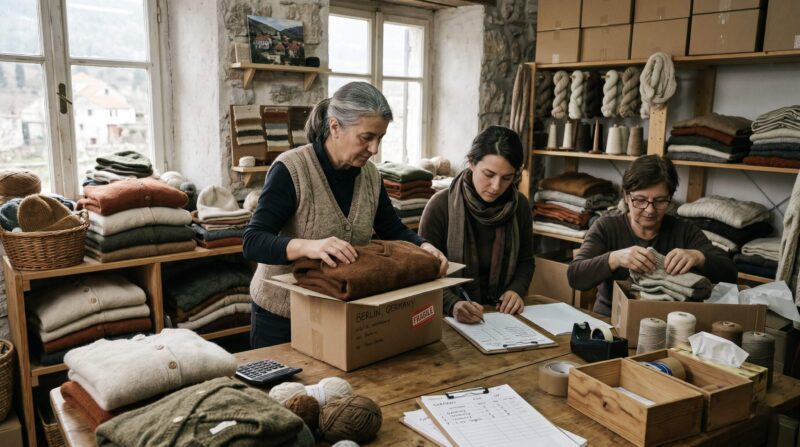
Over three decades, BHcrafts has trained and employed hundreds of women from different ethnic and religious backgrounds, earned World Fair Trade Organization certification, and built relationships with international buyers including Sundance Catalog, Agnes B, and Neiman Marcus. By most donor reporting standards, it would be counted as a success: it is operational, generates income, reaches global markets, and has sustained itself for thirty years. But a closer look at the financial architecture underneath reveals a more complicated picture.
In 2025, BHcrafts’ total budget was approximately €243,756, a 29% fall from the previous year, triggered by a cascade of external shocks: the bankruptcy of its longest-standing buyer, Sundance Catalog, steep U.S. import tariffs, and rising mandatory payroll costs inside Bosnia. Its one hundred beneficiaries earned a combined €53,953 for their production work, roughly 27% of total sales revenue, while pensions, health insurance, and income taxes consumed a further €19,903. For the first half of the year, there was almost no work at all.
This is not a failing enterprise. BHcrafts has survived thirty years of post-conflict instability, currency crises, a pandemic, and now the collapse of its primary export market. But neither is it the uncomplicated story of durable recovery that fair trade certification and international buyer relationships might suggest. The distinction between adaptive survival and durable recovery is the central problem of post-conflict economic design. Bosnia, thirty years after the Dayton Agreement ended the war, remains one of the most instructive places in the world to study it.
The economic architecture Dayton built
To understand why Bosnia’s recovery has stalled, one has to understand what Dayton created. The 1995 peace agreement ended the war by partitioning Bosnia into two entities — the Federation of Bosnia and Herzegovina and Republika Srpska — loosely bound by weak central institutions. It was a political solution rather than an economic one, and its consequences for market development have been severe.
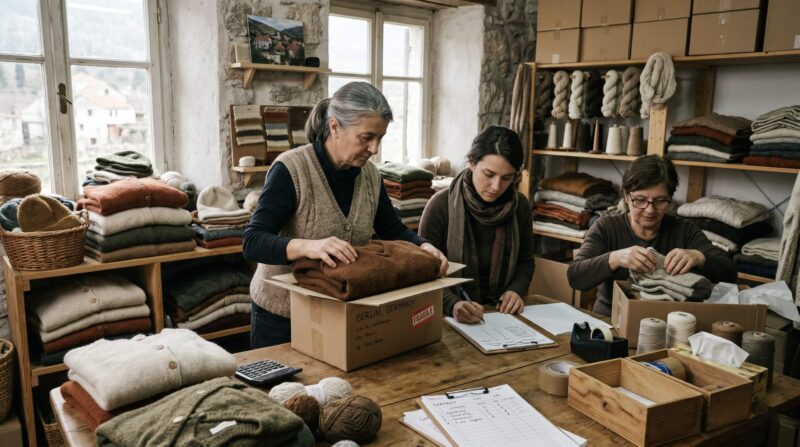
Fair trade certification and international buyers can help post-conflict enterprises reach global markets, but buyer concentration can still leave workers exposed when demand collapses.
Bosnia today operates with thirteen separate governments, each with its own regulatory environment, tax authority, and labor law. A small enterprise operating across entity lines faces compliance costs that would challenge even a mid-sized firm in a stable economy. Foreign direct investment, which might otherwise catalyze market development, has been consistently deterred by jurisdictional fragmentation, perceived political instability, and the absence of coherent national economic policy. The result is an economy that is formally functional — Bosnia has a central bank, a convertible currency, and a working payments system — but structurally unable to generate the kind of broad-based growth that produces durable employment.
World Bank data show youth unemployment at 28.2% in 2025. Emigration has also accelerated sharply since EU visa liberalization opened new migration pathways: the number of Bosnian citizens granted first residence permits in EU member states rose from just over 17,000 in 2013 to 57,000 by 2019. Today, approximately 1.7 million Bosnians live abroad — the highest emigration rate of any country in Europe and Central Asia. Those leaving are predominantly of prime working age: more than 80% of Bosnian emigrants in OECD countries are between 25 and 64, compared with 60% of the non-migrant population at home. The enterprises that remain are operating in a market that is contracting in human-capital terms even as donor and development investment continue to flow in.
How the post-conflict labor market actually works
Standard economic models often assume a relatively stable labor supply: workers are available, broadly capable, and motivated by income. In post-conflict Bosnia, those assumptions do not hold cleanly.
The distinction between adaptive survival and durable recovery is the central problem of post-conflict economic design.
Trauma operates as an invisible tax on economic participation. Research on mental health reform in Bosnia and Herzegovina and Kosovo shows how the effects of war, displacement, and genocide continue to shape post-conflict societies long after the fighting stops. For survivors, work may be possible but uneven. Some women may be highly skilled and committed, yet constrained by trauma responses, health conditions, care responsibilities, or environments that make sustained formal employment difficult.
Care responsibilities compound the problem. The war left many women as sole household providers while also carrying primary responsibility for children and, increasingly, aging parents. Female labor force participation in Bosnia and Herzegovina remains constrained by care burdens, unequal access to resources, and limited support infrastructure. Women are not outside the economy because they are unwilling to work; too often, they are outside the economy because the conditions that would make sustained work possible do not exist at scale.

Photo by Nickolas Nikolic
Enterprises that ignore these realities fail. The post-conflict social enterprises that have demonstrated the most sustained participation are those that build flexibility directly into their operating models: home-based production, variable hours, collective support, embedded psychosocial awareness, and income systems that prioritize access and continuity rather than pure individual output.
The enterprise response: design under fragility
Return to BHcrafts. Its economic design is a direct response to the conditions described above. Artisans are paid the same agreed piece rate for their work, regardless of ethnic background or personal circumstance. Women work from home and set their own hours, which reduces the childcare, transport, and social barriers that exclude many post-conflict women from formal employment. Some treat the work as primary income; others as supplemental income, craft practice, or a form of therapeutic continuity. The model accommodates all of them.
These are not incidental design choices. They reflect thirty years of working with women in precisely the labor-market conditions that Bosnia’s postwar economy created. BHcrafts does not ask women to fit a standard employment model; it adapts enterprise design to the realities of trauma, care, displacement, and uneven availability.
But here is where the analysis must be honest about limits. BHcrafts has achieved something most post-conflict enterprises never manage: genuine commercial buyer relationships, fair trade certification, and an international retail presence built over three decades. And yet in 2025, when Sundance Catalog filed for bankruptcy, the enterprise had almost no work for the first half of the year. Total revenue fell 29% in a single year. The piece-rate model, home-working flexibility, and accommodation of variable participation all depend on a steady enough flow of orders to keep women earning. When that flow stops, the design features that make BHcrafts accessible to vulnerable workers cannot guarantee stable income. BHcrafts is not a failing enterprise. It is a fragile one, and its fragility is structural, not managerial.
Where the system fails
Three system gaps keep enterprises like this one locked in survival mode.
The first is the absence of patient, gender-responsive capital. Bosnia’s microfinance sector has relatively deep penetration, but many products remain structured around short-term lending for individual borrowers. Social enterprises and informal producer networks often do not fit this model. Their income instability makes repayment schedules that assume regular monthly earnings structurally unsuitable. The result is that enterprises designed to serve vulnerable workers can be effectively locked out of the formal financial system, even when they have demonstrated social value and market demand. Bosnia’s financial-sector assessment underscores the broader challenge of building financial systems capable of supporting inclusive enterprise development.
The second gap is dependence on a narrow buyer base. For many post-conflict enterprises, primary customers are NGOs, donors, and diaspora networks. In those cases, the enterprise is operating in a transfer economy, stable only as long as donor priorities remain aligned. BHcrafts has largely escaped that trap: 85% of its 2025 income came from commercial product sales. But commercial integration can relocate buyer concentration risk rather than eliminate it. When BHcrafts lost Sundance, the effect resembled the end of a major donor cycle: revenue collapsed, work dried up, and women who depended on the income had little or no paid production for months.
The lesson is not that commercial markets are irrelevant. It is that graduating to commercial buyers is necessary but not sufficient. Diversification across buyers, markets, and channels is what durability actually requires — and that level of market development support is rarely built into post-conflict enterprise programs.
BHcrafts is not a failing enterprise. It is a fragile one — and its fragility is structural, not managerial.
The third gap is the absence of value-chain integration. Bosnian textile cooperatives, agricultural producers, and craft enterprises often sell at the lower-value end of their respective chains, where raw materials, unbranded products, and low-margin intermediary goods dominate. The value added through branding, design, retail positioning, and customer access accrues elsewhere, often outside Bosnia. Closing this gap requires not just enterprise support but deliberate market intervention: procurement relationships, fair trade certification infrastructure, buyer diversification, and sustained investment in design and brand capacity.
BHcrafts is the rare exception: thirty years of sustained effort, WFTO certification, international recognition, and investment in design capacity have enabled a level of value-chain integration that very few comparable enterprises in the region have achieved. That it remains the only certified fair trade producer in the Balkans is a measure of how high the barrier is.
Implications for practitioners
Bosnia’s thirty-year experiment in post-conflict recovery offers a precise set of lessons for anyone designing or funding economic recovery systems.

Durable recovery requires more than enterprise survival; it depends on patient capital, buyer diversification, value-chain integration, and market systems that distribute risk more fairly.
Capital needs to be restructured, not simply increased. Patient capital, five- to ten-year horizons, flexible repayment, and gender-responsive assessment frameworks are not niche products. In post-conflict contexts, they are baseline requirements for enterprises serving vulnerable populations. Impact investors who deploy standard microfinance instruments into fragile economies and expect market-rate returns within three years are not funding recovery. They are funding a different kind of extraction.
Enterprise support must be trauma-informed. This does not mean turning enterprise programs into therapy. It means that enterprise design, performance measurement, and participation structures must account for the labor-market realities that trauma creates. Flexible, home-based, piece-rate models are not relics of older production systems. In post-conflict contexts, they can be among the only enterprise models capable of sustaining broad participation.
Bosnia is not a failure of will or effort. It is a failure of economic architecture — and architecture can be redesigned.
Market interventions must be deliberate and long-term. Procurement relationships with international buyers, integration into fair trade value chains, buyer diversification, and sustained investment in brand and design capacity are not add-ons to enterprise support programs. They are the difference between an enterprise that survives one buyer relationship or donor cycle and one that achieves commercial durability.
Finally, success metrics must change. An enterprise generating income for one hundred women in a post-conflict economy with high unemployment, weak care infrastructure, and a fragmented regulatory environment is not underperforming. It is operating rationally under severe constraint. The question practitioners should ask is not “why isn’t this enterprise growing?” but “what would need to change in the system around it for growth to become possible?”
Bosnia is not a failure of will or effort. It is a failure of economic architecture — and architecture can be redesigned. The question is whether the capital, policy, and enterprise support flowing into fragile economies are asking the right questions, or simply repeating the same mistakes in new funding cycles.
Thirty years is long enough to know the difference.