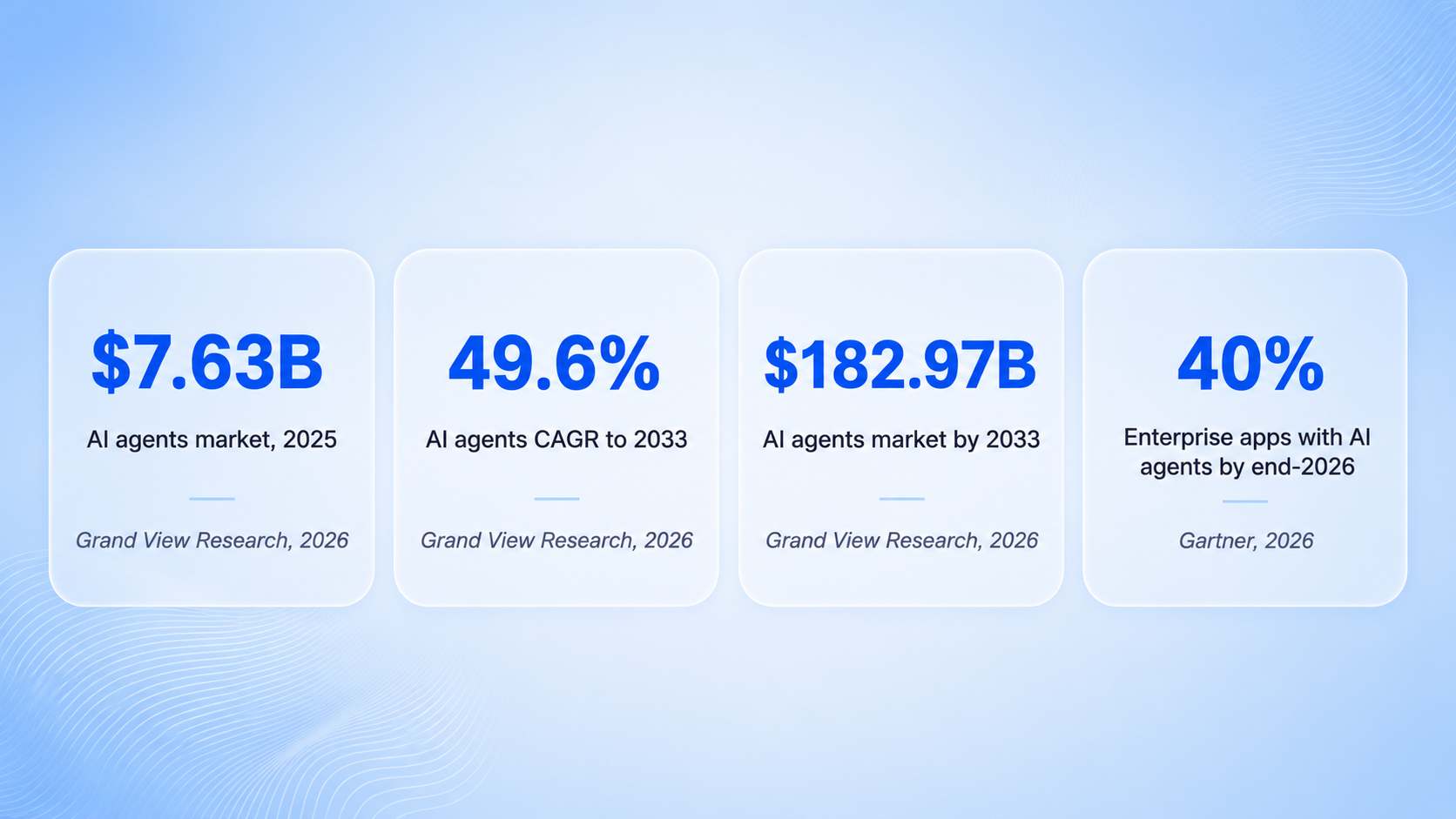

AI agent development cost in 2026 ranges from $8,000 for a simple rule-based chatbot to $500,000+ for an enterprise-grade multi-agent system with deep integrations and compliance requirements. Most mid-market production builds land between $40,000 and $120,000. The number matters less than the predictability behind it: according to CIO.com (2025), 66.5% of organizations experience year-one budget overruns of 30 to 40%, almost exclusively under time-and-materials (T&M) billing models.
We are Ailoitte, an AI-native engineering company that has delivered 300+ production software products across 21 countries. We do not bill by the hour. We lock scope, lock price, and transfer full IP to you at deployment. That structure gives us a different vantage point on AI agent development cost than guides written by hourly consulting shops.
This article covers:
- The four AI agent complexity tiers and what each actually costs in 2026
- The three-layer cost model most vendor proposals never show clients (build, operate, govern)
- Seven hidden costs responsible for almost every budget overrun
- Why your billing model determines cost risk more than your technology choices
- Industry-specific benchmarks, including healthcare and fintech
- The ROI framework that makes AI agent investment defensible
- How Ailoitte’s AI Velocity Pods deliver production agents at a locked price
If you want an actual scope estimate rather than a range, visit our AI agent development company page or request a scope assessment directly.
Not all AI agents cost the same: the four complexity tiers
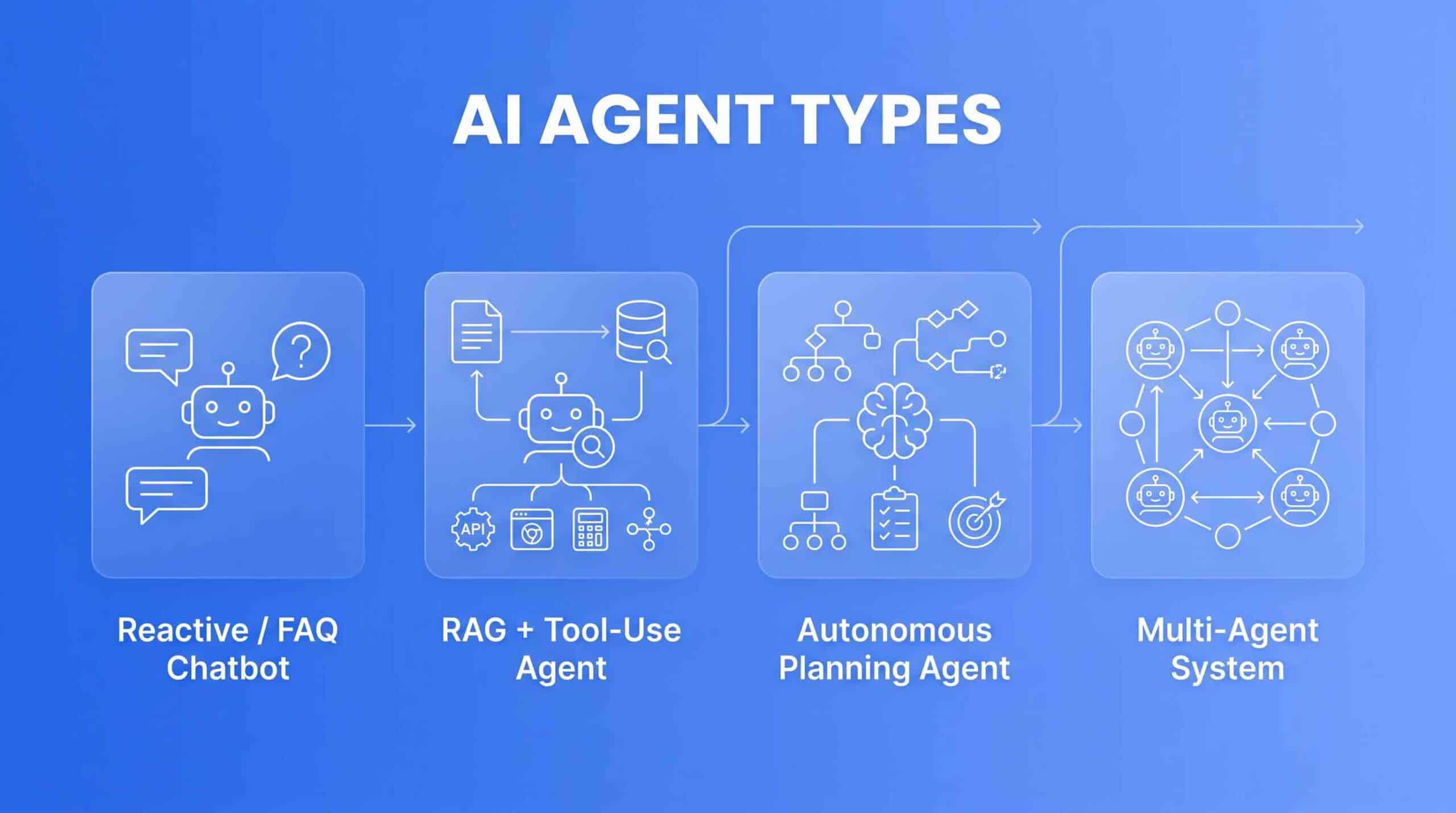
Before you can evaluate cost, you need to understand what you are building. The term ‘AI agent’ spans a spectrum from a simple FAQ bot to a multi-agent system coordinating dozens of autonomous tasks. The cost difference between the two extremes can be tenfold. Here is the 2026 breakdown. (Source: Riseup Labs, May 2026; Cleveroad, April 2026; URLs to be verified by Ailoitte team)

Tier 1: Reactive / FAQ chatbot ($8,000 to $25,000)
Rule-based agents that respond from a fixed knowledge base. No memory, no tool use, no multi-step reasoning. Timeline: 4 to 8 weeks. Typical use cases include website FAQ automation, basic support routing, and scripted lead qualification.
Tier 2: RAG + tool-use agent ($40,000 to $70,000)
Agents with retrieval-augmented generation (RAG), short-term memory, and CRM or API integrations. Capable of multi-step workflows. This is where most enterprise pilot projects start, and where scope most frequently expands unexpectedly. For a full breakdown of what separates a chatbot from an AI agent, see our blog: Chatbots vs. AI Agents: Understanding the Differences. Timeline: 6 to 10 weeks.
Tier 3: Autonomous planning agent ($80,000 to $120,000)
Full tool orchestration, decision loops, fallback handling, and persistent memory. These agents plan multi-step tasks, recover from errors, and coordinate across systems without human prompting per task. Timeline: 10 to 14 weeks.
Tier 4: Multi-agent system ($100,000 to $500,000+)
Agent swarms with task delegation, legacy system integration, and embedded compliance layers. A multi-agent system is infrastructure, not software. It requires distributed-systems architecture, agent governance frameworks, and ongoing model oversight. For a deeper technical breakdown, see our guide on building AI agents from PoC to production. Timeline: 3 to 6 months.
| Tier | Type | 2026 Cost Range | Typical Timeline |
|---|---|---|---|
| 1 | Reactive / FAQ chatbot | $8,000 to $25,000 | 4 to 8 weeks |
| 2 | RAG + tool-use agent | $40,000 to $70,000 | 6 to 10 weeks |
| 3 | Autonomous planning agent | $80,000 to $120,000 | 10 to 14 weeks |
| 4 | Multi-agent system | $100,000 to $500,000+ | 3 to 6 months |
Most enterprise AI agent enquiries that reach Ailoitte’s AI Velocity Pods team sit in the Tier 2 to 3 range: complex enough to require a senior pod and scoped precisely enough for a fixed price. Tier 2 to 3 is where hourly vendors most consistently misscope. Too complex for a simple retainer, not complicated enough to justify a six-month enterprise contract. It is precisely where a fixed-price model delivers the most measurable value.
The real 2026 cost breakdown: build, operate, govern
The total cost of an AI agent consists of three distinct layers: build, operate, and govern. Most vendor proposals cover only the first. That is how a $100,000 proposal becomes a $155,000 year-one reality. A $100,000 vendor quote translates to $140,000 to $160,000 in actual year-one costs once all layers are accounted for (Hypersense Software, January 2026;). Annual maintenance then adds 15 to 30% of the original build cost every year (Riseup Labs, 2026;).
Build layer: the engineering investment
- Discovery and architecture: $5,000 to $25,000. Defining scope, validating LLM selection, documenting integrations, establishing success metrics. At Ailoitte, this is included in the fixed price and completed at Week 0. Nothing changes after this gate.
- Engineering: $30,000 to $200,000+ depending on tier and integration complexity.
- QA and security: 10 to 15% of build cost. Non-negotiable at production grade. Ailoitte’s Agentic QA pipeline runs automated regression and security validation on every commit.
- Deployment: Included in Ailoitte’s fixed-price engagements. Billed separately under T&M arrangements.
Operate layer: the monthly run-rate
- LLM token costs: A mid-sized product with 1,000 daily users can burn through 5 to 10 million tokens per month. Add multi-step reasoning, retries, and fallback prompts and the bill compounds fast (Azilen, 2026;).
- Vector database and memory: $500 to $2,500 per month. Below approximately 100 million vectors, managed services such as Pinecone, Weaviate, or Qdrant are more cost-effective than self-hosting.
- Cloud hosting: $200 to $5,000 per month depending on traffic volume and deployment region.
- Integration maintenance: CRM and ERP APIs change. Budget $1,000 to $2,500 per month for a system with moderate integration depth.
Govern layer: the cost nobody budgets for
- Observability and monitoring: $300 to $800 per month for tooling (LangSmith, Helicone, CloudWatch), plus engineering time to investigate agent failures.
- EU AI Act compliance: High-risk system obligations take effect August 2026. For SMEs, a mandatory Quality Management System costs 193,000 to 330,000 EUR to establish, with 71,400 EUR annually for maintenance (Centre for European Policy Studies, 2024;. See the EU AI Act regulatory framework for classification guidance.
- Periodic compliance review: $5,000 to $10,000 per year for regulated industries covering HIPAA, GDPR, India’s DPDP Act, and SEBI requirements.
At scope lock (Week 0), Ailoitte Velocity Pods produce a written operational cost model alongside the build estimate: LLM token projections based on anticipated usage volume, hosting estimates, and an integration maintenance schedule. Clients see the year-one run-rate before architecture begins. This is what ‘no surprises’ actually means in practice. Not a contractual promise, but a documented forecast that tracks against actuals.
The 7 hidden costs that blow AI agent budgets
Most AI agent budget overruns are not caused by complexity surprises. They are caused by costs the original proposal never mentioned. CIO.com reported in 2025 that 66.5% of organizations experience AI budget overruns, with first-year overruns typically running 30 to 40% over initial budget. Here are the seven line items we see on nearly every post-mortem review.
1. LLM token burn at production scale
Token costs are invisible during scoping and become the largest monthly line item once the agent is live in production. Every conversation costs input tokens, output tokens, retries, and fallback prompts. At 1,000 daily users with multi-turn conversations, you are looking at 5 to 10 million tokens per month before retries or context expansions are added.
2. Data preparation
Gartner warned in February 2025 that organizations will abandon 60% of AI projects by 2026 due to AI-unready data, and that winning programs earmark 50 to 70% of timeline and budget for data readiness (Gartner, February 2025;). A two-week data cleanup sprint before development begins prevents 6 to 8 weeks of avoidable rework. In our projects, data preparation that was not scoped upfront has consistently added 4 to 6 weeks to delivery timelines.
3. Vector database and memory infrastructure
Frequently absent from initial proposals. Self-hosting only becomes cheaper than managed services above approximately 100 million vectors or 60 to 80 million monthly queries. Below those thresholds, managed services add $500 to $2,500 per month to the run-rate (Softermii, 2026;).
4. Observability and monitoring
Logging pipelines cost $300 to $800 per month in tooling. More critically, they cost engineering time when the agent behaves unexpectedly, which it will at some point in every production deployment. Skipping observability infrastructure is the fastest way to convert a minor model drift issue into a production incident.
5. Integration maintenance
CRM vendors push updates. APIs change authentication methods. Every external service your agent relies on requires ongoing maintenance. Budget $1,000 to $2,500 per month for moderate integration complexity.
6. EU AI Act compliance ramp
High-risk AI system rules are enforceable from August 2026. Agents used in hiring, lending, insurance underwriting, or medical decisions are likely to fall under high-risk classification. Penalties reach 35 million EUR or 7% of global annual revenue, whichever is higher. Building compliance into the architecture from Day 0 costs a fraction of retrofitting it after deployment.
7. Prompt drift and model retraining
LLM outputs degrade as the world changes and your business data evolves. Plan for quarterly or semi-annual fine-tuning cycles at $2,000 to $7,500 each (Softermii, March 2026;). Skip them and your agent’s accuracy erodes silently, often discovered first through a customer complaint rather than a monitoring alert.
T&M vs. fixed-price: the billing model determines your cost risk
Your billing model is not a commercial formality. It determines who owns the cost risk, who benefits from engineering efficiency, and how the vendor’s incentives align with your outcome. For AI agent development in 2026, this distinction is the single most important structural decision you will make.
The T&M problem
Under a time-and-materials contract, every development hour is a billable event. If scope expands, and with AI agent development it frequently does, the client absorbs the cost. The vendor has no structural incentive to ship faster, estimate precisely, or reduce rework. Projects planned for 8 weeks routinely stretch to 16. A project that extends from 8 to 16 weeks does not just take twice as long. It costs 2 to 3x the original budget when the compounding effect of delays and rework is factored in. Each additional development month adds approximately $20,000 to $40,000 in direct costs.
Pilot purgatory is a billing model problem
Only 11% of organizations have AI agents in production, according to Deloitte’s Emerging Technology Trends study (Deloitte, 2025;). The 89% stuck in extended pilots are not there because the technology does not work. They are there because hourly billing creates no delivery deadline pressure and no natural exit point. This pattern has a name: pilot purgatory. Ailoitte’s blog on building AI agents from PoC to production covers the architectural reasons projects stall and how to prevent them.
What fixed-price delivery actually changes
Fixed-price contracts force rigorous scope definition before the build begins. Thorough upfront scoping saves up to 30% of total project budget (SoftTeco, 2025;). More importantly, the vendor now has a direct incentive to deliver efficiently. Their margin depends on shipping on time, not billing more hours. Under Ailoitte’s AI Velocity Pods model, the speed is built into the method: senior-only engineering pods, Agentic QA automation, and governed code generation workflows.
The right model by project type
- Proof of concept / R&D: T&M is acceptable when requirements are genuinely unknown and the objective is exploration.
- Production agent with defined integrations: Fixed-price is the only model that aligns vendor and client interests.
- Enterprise rollout with compliance obligations: Fixed-price with phased milestones and explicit go/no-go gates.
Ailoitte’s fixed-price model works because it absorbs the risk premium through efficiency, not by padding the quote. Senior-only pods run AI-accelerated delivery workflows that ship 3x faster than traditional agencies. The client gets a locked price; we get a commercial incentive to stay on schedule. That alignment is structural, not contractual goodwill.
Cost by industry: why healthcare and fintech agents cost 2 to 4x more
Compliance overhead is not an add-on cost. In regulated industries, it is the product. The reason healthcare and financial services AI agents cost significantly more is not that the engineering is more complex. It is that the governance requirements are legally mandated and non-negotiable. Regulated industries consistently underestimate compliance work by 30 to 40%.

| Industry | 2026 Cost Range | Primary cost driver | Compliance standard |
|---|---|---|---|
| Healthcare | $70,000 to $250,000+ | PHI handling, clinical accuracy, audit trails | HIPAA / DPDP / EU AI Act |
| Financial services | $80,000 to $200,000+ | Zero-hallucination thresholds, fraud logic | SEBI / RBI / PCI-DSS / EU AI Act |
| eCommerce / retail | $25,000 to $80,000 | Returns, recommendation, inventory | GDPR / DPDP (lower overhead) |
| HR / hiring automation | $20,000 to $60,000 | Bias documentation, human override | EU AI Act (high-risk) / DPDP |
Healthcare: $70,000 to $250,000+
Healthcare AI agents that process protected health information (PHI) require HIPAA-compliant LLM flows with zero data retention, clinical accuracy thresholds, and full audit logging. Any agent providing clinical decision support may also require FDA oversight. See Ailoitte’s proof of scale in healthcare and regulated industries.
Financial services: $80,000 to $200,000+
In India, agents operating in lending or algorithmic trading are subject to SEBI and RBI guidelines on automated decision systems. Globally, PCI-DSS applies to any agent touching payment data. The EU AI Act explicitly classifies lending and insurance underwriting agents as high-risk, requiring conformity assessments before deployment.
eCommerce and retail: $25,000 to $80,000
Lower compliance overhead means faster ROI cycles. Returns automation, recommendation engines, and inventory management agents frequently pay back their build cost within 3 to 6 months. This is also where rapid MVP iteration is most practical.
HR and hiring automation: $20,000 to $60,000
Hiring agents are explicitly classified as high-risk under the EU AI Act. Any agent that screens, ranks, or filters job candidates requires bias documentation, audit trails, and a human override capability. India’s Digital Personal Data Protection (DPDP) Act also applies to agents processing employee data.
The ROI framework: when does an AI agent pay for itself?
The investment in AI agent development only makes sense when the ROI is real, measurable, and faster than the competitive cost of inaction. Here is the framework we apply with clients before scope definition begins.
The ROI formula
Annual labor savings divided by 3-year total cost of ownership equals your ROI ratio. Run this before writing a scope document. If the math does not close at current labor costs, either the use case is wrong or the scope is too large.
What the research actually shows
McKinsey’s State of AI in 2025 (November 2025) identifies a sharp performance divide in enterprise AI deployments. Only 6% of surveyed organizations qualify as high performers generating 5%+ EBIT impact from AI, but those organizations report 10 to 20% cost reductions in software engineering and revenue uplift above 10% in marketing. The study also found that 72% of organizations now use generative AI in production, up from 33% in 2024, yet nearly two-thirds have not yet begun scaling AI across the enterprise. The data reinforces what we see in practice: ROI accrues to organizations that reach production, not those that extend pilots.
Benchmarks from production deployments
- Returns automation agent: $52,000 build cost, handled 73% of returns autonomously, saved $14,000 per month. Payback in under four months (Industry benchmark; estimate based on industry observation).
- Support ticket deflection: Deflecting 30% of inbound tickets at a mid-market company saves $20,000 to $50,000 per month. Payback: 4 to 8 months.
- Sales qualification agent: An $80,000 to $120,000 build with 40% improvement in lead qualification can deliver approximately 10x ROI within 12 months.
Payback windows by agent type
- Support and service agents: 6 to 18 months
- Process automation agents (finance, HR): 9 to 18 months
- Enterprise decision-support agents with compliance layers: 12 to 24+ months
The cost of not building
Every quarter a competitor operates a production agent while your project loops in a pilot is compounding advantage that does not reverse easily. The question is not whether AI agents deliver ROI. For well-scoped deployments in production, the data is clear. The question is whether your next engagement will be structured to reach production or extend the pilot. For companies ready to move from experimentation to operationalization, our AI Velocity Pods are designed specifically for that transition.
What changed in 2026: three cost drivers that did not exist 18 months ago
Three structural shifts in 2026 are directly affecting how AI agent development should be scoped, priced, and governed. Any proposal that does not account for all three is working from outdated assumptions.
EU AI Act high-risk rules take effect in August 2026
General-purpose AI rules took effect in August 2025. High-risk system obligations (mandatory for agents in hiring, lending, medical devices, and critical infrastructure) become fully enforceable in August 2026. If you are building in one of these domains and have not started conformity assessment work, the compliance cost clock is already running. Penalties reach 35 million EUR or 7% of global annual revenue. The complete classification framework is published in the EU AI Act official documentation.
LLM API pricing fell 60 to 80%, but the engineering cost did not
Model layer costs are now a small fraction of what they were in 2024. The engineering layer, covering architecture decisions, integration design, governance infrastructure, and evaluation frameworks, is now the dominant cost driver. This is favorable for buyers: the cost differentiator is now talent and method, not access to expensive model APIs. It is also why legacy modernization is increasingly viable as a precursor to AI agent deployment. The integration cleanup pays for itself in reduced agent operating costs.
Multi-agent governance is a new budget line item
Twelve months ago, multi-agent governance was an academic concern. In 2026, enterprise deployments of Tier 4 systems require explicit agent governance frameworks: defining what each agent can and cannot do, how task conflicts are resolved between agents, how the system fails safely, and how human override is triggered. Plan for 8 to 15% of Tier 4 build cost for governance architecture. For context on what agentic AI systems require architecturally, see our primer: What is Agentic AI?.
What Ailoitte’s AI Velocity Pod model looks like for agent development
Ailoitte builds AI agents under a fixed-price, outcome-based model with a six-week production timeline. Here is the exact structure of every engagement.
Week 0: Discovery and architecture (included in fixed price)
Scope is locked before any engineering begins. We document the full integration map, validate LLM selection against use case requirements (cost, latency, compliance), establish measurable success metrics, and complete a data readiness assessment. If data preparation is required, it is scoped as a defined workstream. Nothing about the cost changes after this gate closes.
Weeks 1 to 5: Agentic build and review
Senior engineers, with no junior bench and no handoff between architect and developer, ship in tested increments using governed AI development workflows. Ailoitte’s Agentic QA pipeline runs automated regression testing, security validation, and performance benchmarking on every commit. Clients review working software in production-equivalent environments throughout, not slide decks at milestone.
Week 6: Hardening and handover
Full OWASP security pass. Zero-retention data verification. Complete IP transfer: all code, all model configurations, all infrastructure scripts. Deployed to production. The client owns everything with no vendor lock-in.
What the fixed price includes
- Architecture design and LLM selection validation
- All engineering across the build period
- Agentic QA automation and continuous security validation
- OWASP security audit at Week 6
- Full technical documentation and IP transfer
- Production deployment
What is transparently priced separately
- LLM operational tokens, projected and documented at Week 0 before scope is locked
- Model fine-tuning and retraining cycles, scoped and priced independently per cycle
- Post-delivery feature extensions, each treated as a new scoped pod engagement
Governance built into every pod
ISO 27001 and ISO 9001 certified processes. OWASP-aligned security engineering. HIPAA/GDPR-compliant LLM flows. EU AI Act readiness documentation for high-risk classifications. India’s DPDP Act compliance architecture. These are not add-on compliance services. They are properties of every Velocity Pod engagement. See our proof of scale across industries: 300+ products delivered, 21 countries, 50M+ end users on production systems.
How to budget for your AI agent in 2026: a five-step framework
Use this framework before you write an RFP or accept a vendor quote. Each step removes a category of uncertainty that typically causes overruns.
Step 1: Define one workflow for version one
A focused scope reduces initial development cost by 30 to 50% (Azilen, 2025; URL to be verified by Ailoitte team). Build the agent that does one task extremely well before adding capabilities. Every feature added in version one multiplies the testing surface, the integration risk, and the governance requirements. The Agentic AI vs. AI Agents breakdown on the Ailoitte blog can help you identify the right architecture for your use case before scoping.
Step 2: Complete a data readiness audit before scoping
A two-week data cleanup sprint before development starts prevents 6 to 8 weeks of rework during the build. Your data is never as clean as you think. If a vendor does not ask about data readiness in the first discovery call, they will discover the problem on your budget.
Step 3: Model three-year TCO, not just build cost
Your proposal should include LLM token projections at your anticipated usage volume, cloud hosting estimates, integration maintenance budget, observability tooling costs, compliance review cycle costs, and model retraining schedule. Any vendor who cannot produce a year-one operating estimate at proposal stage is leaving the most expensive layer of the budget for you to discover after launch.
Step 4: Require fixed-scope milestones with go/no-go gates
Do not accept an open T&M engagement with a vague budget ceiling. Require a phased contract with 3 to 4 phases, defined deliverables at each milestone, and explicit go/no-go decision points. This creates exit rights, forces vendor accountability, and gives you control over scope without absorbing all the cost risk.
Step 5: Embed governance from Day 0
Compliance retrofits cost 3 to 5x more than compliance-by-design (Softermii, 2026; URL to be verified by Ailoitte team). EU AI Act high-risk obligations, HIPAA, GDPR, and India’s DPDP Act all have technical requirements, including data routing architecture, audit log schemas, and human-override mechanisms, that are significantly more expensive to add after a system is built than during initial architecture. If your AI agent development company is not raising compliance architecture in Week 0, raise it yourself.
Quick reference: cost and timeline by stage
| Stage | Cost range | Typical timeline | Recommended model |
|---|---|---|---|
| Proof of concept | $10,000 to $30,000 | 2 to 4 weeks | Fixed-scope PoC |
| MVP agent | $25,000 to $60,000 | 4 to 8 weeks | Fixed-price pod |
| Production-grade agent | $60,000 to $200,000+ | 6 to 16 weeks | Fixed-price pod |
| Enterprise multi-agent | $100,000 to $500,000+ | 3 to 6 months | Phased fixed-price |
Conclusion: cost certainty is a feature, not a perk
The wide range of AI agent development costs, from $8,000 to $500,000+, is real. But the range is not the problem. Unpredictability is. A $100,000 project that overruns to $155,000 in year one is not just a budget variance. It is the collapse of the business case that justified the investment.
Fixed-price delivery is not a commercial preference. It is a better engineering system. Locking scope at Week 0 forces the precision that prevents overruns. Governance by design is 3 to 5x cheaper than compliance retrofits. Senior-only engineering pods with no junior bench mean the engineers who design the architecture are the ones who ship it. You pay for certainty because it produces better outcomes, not just more predictable invoices.
Ailoitte ships production AI agents in approximately six weeks. The price is locked on Day 0. The IP transfers entirely to you at completion. We operate across 21 countries and hold ISO 27001 and ISO 9001 certifications. To request a scoped estimate for your specific use case, not a range but an actual number, visit our AI agent development company page or contact our team directly.
FAQs
How much does it cost to build an AI agent in 2026?
AI agent development cost in 2026 ranges from $8,000 for a simple rule-based chatbot to over $500,000 for an enterprise multi-agent system with legacy integrations and compliance requirements. Most mid-market production builds land between $40,000 and $120,000. The exact number depends on agent complexity tier, integration depth, compliance requirements, and your vendor’s billing model.
What is the single biggest hidden cost in AI agent development?
LLM token costs at production scale are the most consistently underestimated expense. A mid-sized product with 1,000 daily users can consume 5 to 10 million tokens per month. Data preparation is the second most common budget surprise. Gartner estimates that 60% of AI projects face data readiness problems that were not budgeted for upfront.
Why does the billing model matter for AI agent development cost?
Under time-and-materials billing, the client absorbs all cost risk and the vendor has no structural incentive to ship on time. Projects planned for 8 weeks routinely stretch to 16, costing 2 to 3x the original budget. Fixed-price delivery transfers overrun risk to the vendor and forces precise scope definition before engineering begins, which is also a budget reduction mechanism.
How long does AI agent development take?
Timeline depends on complexity tier. A production-ready Tier 2 to 3 agent takes 6 to 10 weeks under Ailoitte’s AI Velocity Pod model. Tier 4 enterprise multi-agent systems with legacy integrations and compliance requirements typically require 3 to 6 months. A proof of concept can be validated in 2 to 4 weeks.
What is the annual maintenance cost for an AI agent?
Annual maintenance typically runs 15 to 30% of the original development cost, covering model updates, integration maintenance, compliance reviews, monitoring, and quarterly retraining cycles. A $100,000 build should budget $15,000 to $30,000 per year in ongoing costs, not including LLM token operating expenses.
Does AI agent development fall under EU AI Act compliance requirements?
It depends on the use case. Agents used in hiring, lending, credit scoring, insurance underwriting, medical devices, and critical infrastructure management are classified as high-risk under the EU AI Act. High-risk system obligations, including mandatory Quality Management Systems, conformity assessments, and human oversight requirements, are enforceable from August 2026.
What is the difference between an AI agent and a chatbot?
A chatbot responds to queries from a predefined script or knowledge base. An AI agent can autonomously plan, use tools, integrate with external systems, and execute multi-step tasks without a human directing each action. For a detailed comparison, see our blog: Chatbots vs. AI Agents.

Discover how Ailoitte AI keeps you ahead of risk

Sunil Kumar
Sunil Kumar is CEO of Ailoitte, an AI-native engineering company building intelligent applications for startups and enterprises. He created the AI Velocity Pods model, delivering production-ready AI products 5× faster than traditional teams. Sunil writes about agentic AI, GenAI strategy, and outcome-based engineering. Connect on
LinkedIn

Stephan is the sports journalist for the Maple Grove Report.