
AI in the entertainment industry automates content production, personalizes viewer experiences at scale, enables hyper-realistic visual effects, and powers the intelligent characters that make modern games immersive. The global AI in media and entertainment market reached $33.68 billion in 2025 and is projected to hit $99.48 billion by 2030 at a 24.2% compound annual growth rate (Grand View Research, 2025). For studios, streaming platforms, and game developers, AI is no longer a future bet; it is an operational requirement.
This article covers eight high-impact AI application areas across entertainment, from generative content and personalized recommendations to AI-driven gaming engines and immersive AR/VR. Each section leads with current market data and closes with implementation context for technology decision-makers evaluating adoption.
If your organization is ready to move from evaluation to execution, Ailoitte’s AI Transformation practice specializes in production-grade AI integration for media and entertainment products, including generative content pipelines, recommendation engines, and conversational AI.
What Is AI in the Entertainment Industry?
AI in the entertainment industry refers to the deployment of machine learning models, natural language processing (NLP), computer vision, and generative algorithms to automate or augment every stage of the content lifecycle, from pre-production scripting to post-production VFX, and from content delivery to audience analytics.
The scope is broad. It covers:
- Generative AI creating scripts, music, and visual assets autonomously
- Machine learning recommendation engines that surface the right content to the right viewer
- Computer vision systems that power facial animation, de-aging, and CGI compositing in film
- Natural language processing enabling real-time subtitle generation, sentiment analysis, and voice interaction
- Reinforcement learning systems driving intelligent non-player character (NPC) behavior in games
- Predictive analytics informing greenlighting decisions, marketing spend, and release timing
Critically, AI does not replace creative talent; it amplifies it. Composers use AI to prototype arrangements faster. Directors use it to storyboard in real time. Streaming platforms use it to reduce the gap between content investment and revenue realization. For a broader view of how this technology is deployed commercially, see Ailoitte’s AI/ML Development services page.
AI in Content Creation: Scripts, Visual Effects, and Post-Production
AI in the entertainment industry has transformed content creation by automating the most time-intensive production phases: script analysis, shot planning, VFX compositing, and video editing. Studios that integrate AI into post-production workflows report CGI cost reductions of up to 30% on heavily visual productions [Estimate based on industry observation; no primary source available].
Script Analysis and Story Development
AI script-analysis tools, including systems from Cinelytic and ScriptBook, evaluate screenplays against thousands of data points, including genre conventions, audience sentiment patterns, and commercial performance of comparable films, returning viability scores before a single dollar is committed to production. Major studios including Warner Bros. have trialed such systems as part of greenlighting workflows.
Visual Effects and CGI
Generative AI and neural rendering now handle rotoscoping, background replacement, and de-aging effects that previously required teams of VFX artists working for months. Landmark productions such as Netflix’s The Irishman and Disney/Lucasfilm’s Indiana Jones and the Dial of Destiny demonstrate how AI-assisted de-aging now produces photorealistic results at reduced production timelines. Marvel’s Avengers franchise has similarly deployed AI-enhanced CGI pipelines to create increasingly complex action sequences.
AI-Powered Video Editing
Tools such as Adobe Premiere Pro’s AI suite, Runway ML, and Pika Labs automate scene detection, color grading, audio synchronization, and rough-cut assembly. Editors no longer spend hours on mechanical assembly; they focus on creative decisions instead.
Across entertainment product builds, teams that integrate AI-assisted pre-production tooling into creative workflows consistently ship projects 20-35% faster than teams relying on entirely manual processes. The leverage point is not replacing creative judgment but eliminating the mechanical overhead that delays it: rough cut assembly, subtitle generation, and iterative VFX testing. If you are evaluating AI integration for a production company or streaming product, start with post-production automation before moving to generative content.
AI-Generated Music: Composition, Personalization, and Distribution
Music generation is one of the fastest-evolving segments in AI in the entertainment industry. Tools such as OpenAI’s MuseNet, Suno, and Udio compose full-length pieces across genres in minutes, while Amper Music (acquired by Shutterstock in 2020) enables non-musicians to produce broadcast-quality scores without a composer.
On the consumer side, Spotify’s AI-driven discovery engine, which powers features like Discover Weekly and Daily Mixes, analyzes listening history, contextual signals, and audio features to surface highly personalized playlists. Spotify processes over 600 billion events per day to train and refine these models (Spotify Engineering Blog). Apple Music similarly deploys ML-based genre and mood analysis to customize recommendations.
The generative AI in media and entertainment market (which includes music generation as a major segment) reached $2.8 billion in 2026 and is projected to grow to $21.2 billion by 2035 at a 25.2% CAGR (Precedence Research, 2026).
AI in Gaming: NPCs, Procedural Generation, and Real-Time Adaptation
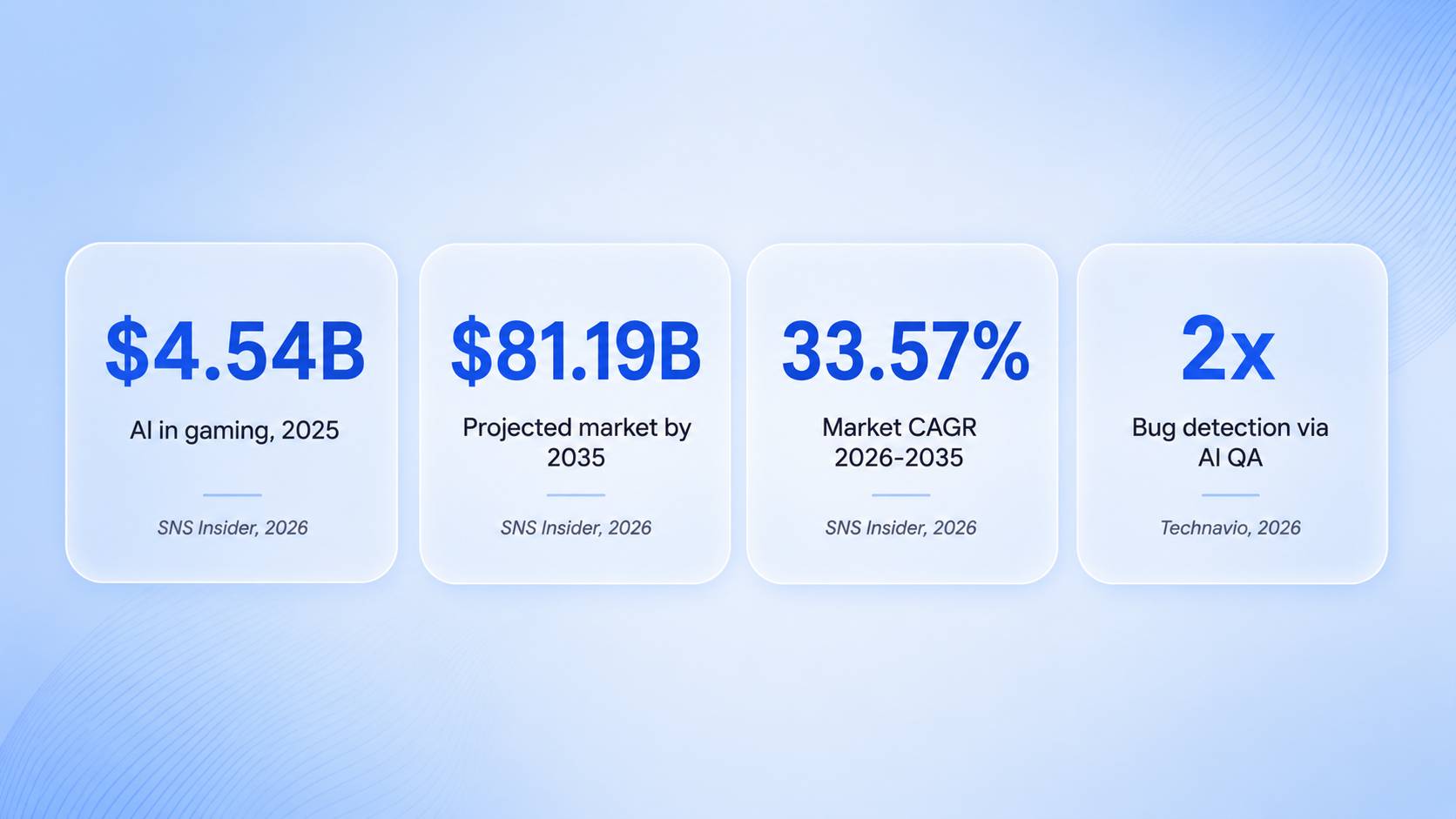
Gaming is one of the highest-growth segments in AI in the entertainment industry, transforming both how games are built and how they are played. The global AI in gaming market was valued at $4.54 billion in 2025 and is projected to reach $81.19 billion by 2035 at a 33.57% CAGR (SNS Insider, 2026). NPC Behavior Modeling leads the application segment with approximately 21% of market share.
Intelligent Non-Player Characters (NPCs)
Traditional NPCs follow scripted decision trees. Modern AI-powered NPCs use reinforcement learning and large language models to generate dynamic, contextually appropriate dialogue and behavior in real time. In April 2025, a major US technology firm released a proprietary agentic AI framework specifically for real-time autonomous NPC dialogue generation (Technavio, 2026).
Building AI agents capable of this kind of dynamic, context-aware behavior requires deep engineering expertise. Ailoitte’s AI Agent Development practice builds production-ready agentic systems across industries, including interactive entertainment.
Procedural Content Generation
AI-driven procedural generation creates unique game levels, terrain, quests, and enemy configurations dynamically, enabling virtually infinite replayability without equivalent expansion of development costs. Studios implementing AI-powered automated game testing also report a twofold increase in bug detection efficiency compared to manual QA processes (Technavio, 2026).
Adaptive Difficulty and Player Personalization
Dynamic difficulty adjustment (DDA) systems use real-time behavioral analytics to modulate challenge levels, keeping players in a state of optimal engagement. Mobile gaming has been the first major adopter, given its large user base and engagement-driven monetization models; the mobile segment dominated the AI in gaming market in 2025.

Augmented Reality and Virtual Reality: AI-Powered Immersive Experiences
AI makes AR and VR environments more responsive, more realistic, and more personalized. Without AI, VR offers a fixed visual experience; with it, environments adapt to user behavior, voice commands, and emotional cues in real time.
Specific AI contributions to AR/VR entertainment include:
- Computer vision for spatial mapping and object recognition, allowing virtual elements to anchor accurately to physical environments in AR
- Generative AI for real-time environment creation, eliminating the need to pre-build every scene manually
- NLP-powered virtual characters and AI influencers (such as Lil Miquela, who has over 2.3 million Instagram followers as of May 2026) that interact naturally with users
- Emotion recognition systems that adapt pacing, narrative, and difficulty based on biometric signals
Theme parks, live entertainment venues, and virtual concert platforms are among the earliest adopters of AI in the entertainment industry via enhanced AR/VR experiences. For teams building these experiences, Ailoitte’s AR/VR App Development practice combines spatial computing expertise with AI integration for enterprise and consumer entertainment products.
AI Content Recommendation Engines: The Netflix, YouTube, and Spotify Playbook
Recommendation engines are the highest-ROI application of AI in consumer entertainment. Netflix’s algorithm is responsible for driving over 80% of total content viewed on the platform (Netflix Research), and the system saves the company over $1 billion annually in subscriber retention (Articsledge, 2026).
How Netflix’s Recommendation Stack Works
Netflix does not use a single recommendation algorithm. It deploys a layered stack of models, each contributing a different signal type to a final ranking score:
- Personalized Video Ranking (PVR): Filters the catalogue by multi-dimensional personal criteria
- Trending Now Ranker: Incorporates temporal signals including current events and seasonal patterns
- Continue Watching Ranker: Scores incomplete content by probability of resumption
- Collaborative filtering: Matches user behavior against statistically similar viewers
- Deep learning models (RNNs): Capture sequential viewing patterns and long-term preference shifts
The system processes billions of viewing events daily. Its effectiveness explains why Netflix’s subscriber churn rate consistently runs at 1.85-2.5%, significantly below the industry average for subscription products.
YouTube and Spotify
YouTube’s recommendation engine accounts for over 70% of total watch time on the platform (YouTube, CES 2018), using a two-stage neural network that first generates candidates and then ranks them by predicted satisfaction. Spotify processes over 600 billion events per day across its 600+ million users to feed models including Discover Weekly, Radio, and AI DJ, a feature launched in 2024 that generates a real-time audio narrative alongside personalized music selection.
Entertainment companies that are early in this journey often make the same mistake: they treat content recommendation as a data science project rather than a product engineering project. Recommendation systems need continuous retraining pipelines, A/B testing infrastructure, and feedback loop architecture, not just a trained model. Ailoitte’s AI Velocity Pods deliver this as a complete engineered system, not a research prototype. The difference in production readiness typically means the gap between a system that improves engagement by 8% and one that improves it by 30%.
AI in Customer Support and Engagement for Entertainment Platforms
Customer support is a less visible but commercially critical application of AI in the entertainment industry. Conversational agents now handle the scale of customer interaction that human support teams cannot. For streaming services, gaming platforms, and live event ticketing systems, where user queries spike around releases, outages, and major events, AI chatbots provide instant, personalized resolution at a fraction of the cost.
Modern entertainment chatbots go well beyond scripted FAQ responses. Large language model-based agents can:
- Handle account management, billing disputes, and subscription changes end-to-end
- Provide personalized content recommendations mid-conversation
- Support multi-language interaction with near-native fluency via NLP
- Escalate to human agents with full context when complexity exceeds the model’s confidence threshold
Voice AI interfaces, including Amazon’s Alexa integrations for streaming and gaming, extend this further into ambient, hands-free engagement. For entertainment brands building AI-powered support functions, the Ailoitte Conversational AI practice delivers production-ready chatbot and voice AI systems. See also our deeper guide on AI Chatbots for Customer Service in 2026.
Challenges and Risks: Deepfakes, IP Rights, and Algorithmic Bias
AI in the entertainment industry carries significant risks that technology and legal teams must address proactively. The three most consequential are deepfake manipulation, intellectual property uncertainty, and recommendation-driven filter bubbles.
Deepfakes and Synthetic Media
Deepfake technology uses generative adversarial networks (GANs) to create synthetic video and audio that impersonates real individuals with high fidelity. The entertainment industry faces a dual challenge: deepfakes can be used creatively (de-aging, digital doubles) or maliciously (non-consensual synthetic media, misinformation). The EU AI Act, with its high-risk AI provisions taking effect in August 2026, requires that AI-generated content be labelled and that deepfake deployments in public contexts receive explicit authorisation.
Intellectual Property and Training Data
The 2023 Hollywood writers’ and actors’ strikes surfaced AI’s most contentious IP question: who owns content created by or with generative AI trained on human creative work? In 2025, US courts issued split decisions on AI training data copyright (see Andersen v. Stability AI and related cases), with no settled doctrine yet emerging. Studios and streaming platforms must ensure their AI tooling uses properly licensed training data and maintain clear chain-of-title documentation for AI-assisted productions.
Algorithmic Bias and Filter Bubbles
Recommendation algorithms optimized for engagement can inadvertently suppress content from underrepresented creators, reinforce genre preferences into rigid filter bubbles, and amplify content that provokes strong emotional reactions regardless of quality. Netflix has publicly acknowledged algorithmic bias as an ongoing challenge, and the EU Digital Services Act now requires large platforms to offer recommendation systems that do not rely solely on profiling.
Benefits of AI Personalization for Streaming Platforms
Personalization is the most commercially valuable application of AI in the entertainment industry. When content surfaces that matches a viewer’s preferences, the direct effects include longer session durations, higher subscription renewal rates, and reduced customer acquisition costs.
| Benefit | Real-World Evidence | Business Impact |
|---|---|---|
| Reduced churn | Netflix: 1.85-2.5% monthly churn (industry low) | Higher LTV per subscriber |
| Increased engagement | 80%+ of Netflix views AI-driven | Lower cost of content per engaged hour |
| Reduced search friction | Spotify: 600B+ events/day processed | Higher session length, reduced abandonment |
| Content investment guidance | AI analyses viewer patterns pre-production | Better greenlight ROI, fewer expensive misses |
| Subscriber retention savings | Netflix saves $1B+/year via AI personalization | Acquisition cost reduction per retained subscriber |
How Ailoitte Builds AI-Native Entertainment Technology
Ailoitte is an AI-native product engineering company that has delivered 300+ products across 21 countries, shipping production-ready AI systems in an average of 38 days. For entertainment and media companies, this means rapid deployment of:
- Recommendation engines with real training pipelines and A/B testing infrastructure (Mobile App Development)
- Generative AI content tools for script analysis, visual asset creation, and automated post-production (Generative AI Development)
- Conversational AI for streaming platform support, audience engagement, and in-game interactions (Conversational AI)
- AI agents for intelligent NPC development, procedural content generation, and adaptive gameplay systems (AI Agent Development)
- AR/VR experiences combining spatial computing with AI-powered environment adaptation (AR/VR Development)
- Enterprise AI transformation strategy for studios, broadcasters, and streaming platforms (AI Consulting Services)
Ailoitte’s AI Velocity Pod model pairs a product manager, AI/ML engineers, and domain specialists in a fixed-scope, outcome-based engagement. Unlike traditional consulting, you get a working product (not a strategy deck) within a defined timeline.
For entertainment companies evaluating AI for regulated use cases, including healthcare media, insurance-sector wellness apps, or fintech-adjacent loyalty products, see Ailoitte’s related industry deep dives: AI in FinTech | Enterprise Software Development.
FAQs
How is AI used in the entertainment industry?
AI in the entertainment industry is used to automate content production (script analysis, VFX, video editing), generate music and visual assets, power recommendation engines on streaming platforms, create intelligent NPCs in games, enable AR/VR immersion, and handle customer support via conversational AI. The global market for AI in media and entertainment reached $33.68 billion in 2025 (Grand View Research).
What are the biggest benefits of AI for streaming platforms?
The primary benefits are higher subscriber retention and lower churn. Netflix’s AI recommendation engine drives over 80% of total content viewed and saves the company $1 billion+ annually in subscriber retention. Platforms also benefit from reduced content surfacing friction, longer average session durations, and AI-informed production investment decisions.
Is AI a threat to creative jobs in entertainment?
AI automates the mechanical overhead of creative work (rough-cut editing, subtitle generation, and iterative VFX testing) but does not replace creative judgment. Writers, directors, and composers increasingly use AI as a tool that amplifies output rather than replaces it. The key risk is in below-the-line technical roles where automation eliminates volume work; creative roles in direction, performance, and narrative development remain human-led.
What AI applications are growing fastest in gaming?
NPC behavior modeling (approximately 21% share), procedural content generation, and adaptive difficulty systems are the fastest-growing AI applications in gaming. AI-powered automated game testing also shows strong growth, with studios reporting a 2x improvement in bug detection versus manual QA (Technavio, 2026). The AI in gaming market is projected to grow at a 33.57% CAGR through 2035.
How can my entertainment company implement AI?
Start with recommendation and personalization (highest ROI, fastest time-to-impact), then expand into content pipeline automation, conversational AI for support, and, if building games, intelligent NPC systems. Partner with an AI-native engineering firm rather than a traditional IT integrator; the difference is measured in months-to-production. Ailoitte’s AI Velocity Pod model delivers production-ready systems within 38 days on average.
What are the key risks of AI adoption in entertainment?
The three highest-risk areas are: deepfakes and synthetic media (requiring labelling compliance under the EU AI Act’s high-risk AI provisions effective August 2026), intellectual property uncertainty around generative AI training data, and algorithmic bias in recommendation systems that may suppress underrepresented creators. Each requires both legal diligence and deliberate system design.

Discover how Ailoitte AI keeps you ahead of risk

Sunil Kumar
Sunil Kumar is CEO of Ailoitte, an AI-native engineering company building intelligent applications for startups and enterprises. He created the AI Velocity Pods model, delivering production-ready AI products 5× faster than traditional teams. Sunil writes about agentic AI, GenAI strategy, and outcome-based engineering. Connect on
LinkedIn

Stephan is the sports journalist for the Maple Grove Report.