
Picture this: your best account executive is on their fourth hour of cold calls. They have reached 4 people. Three asked to be emailed. One was mildly interested but unqualified. Meanwhile, your inbound form fills from this morning are sitting unread, slowly going cold. This is not a motivation problem. It is a structural one, and it is haemorrhaging pipeline every single day.
AI voice agents fix this at the root. Not by making your SDRs work harder, but by removing the bottleneck entirely. In 2026, the businesses adding the most pipeline are not the ones hiring more reps. They are the ones whose AI agents are running 500+ calls a day while their human closers work exclusively on deals that are already warm.
This guide covers everything a business needs to know about developing, deploying, and scaling an AI voice agent: from how the technology works to what it costs, how long it takes, and what separates deployments that compound from those that plateau.
What is an AI voice agent?
An AI voice agent is an autonomous, phone-based conversational system capable of initiating and receiving real calls, understanding natural speech, handling objections, applying qualification logic, and routing or booking outcomes, without a human on the line.
Unlike a traditional IVR (interactive voice response) system, which routes callers through pre-recorded menus, an AI voice agent understands intent and adapts in real time. And unlike a text-based AI chatbot, it works entirely over the phone: the channel where B2B buyers still convert at 3× the rate of chat or email.
Inbound vs outbound AI voice agents
There are two distinct agent types, each with different design requirements:
- Outbound calling agents initiate calls from a prospect list, navigate gatekeepers, deliver a personalised pitch, handle the most common objections, drop personalised voicemails, and warm-transfer live, engaged prospects to human closers.
- Inbound qualification agents respond to form fills, demo requests, and incoming calls within seconds. They apply BANT or MEDDIC criteria conversationally, auto-book meetings into AE calendars, and push scored, transcript-backed records to your CRM in real time.
Ailoitte’s AI voice agent platform packages both as distinct deployable engines (the Calling Engine for outbound, the Qual Engine for inbound) sharing a common telephony and CRM integration layer.
Why businesses need AI voice agents in 2026: the market case
The global AI voice agent market is growing at 34.8% compound annual growth rate, from $2.4 billion in 2024 to a projected $47.5 billion by 2034. Gartner forecasts conversational AI will cut contact centre labour costs by $80 billion in 2026 alone. 80% of businesses plan to integrate AI voice technology into customer service this year. The window for competitive differentiation through early adoption is closing.
The pipeline leak most teams cannot see
82% of B2B buyers never receive a timely follow-up after expressing interest. The cause is not effort; it is a structural mismatch between human capacity and the volume and speed that modern lead behaviour demands.
- Missing the 5-minute response window drops lead conversion by 80%.
- The average SDR spends 64% of their time on activity that does not generate revenue.
- Every unqualified call a senior closer takes is a qualified call they did not make.
The economics are compelling at every company size

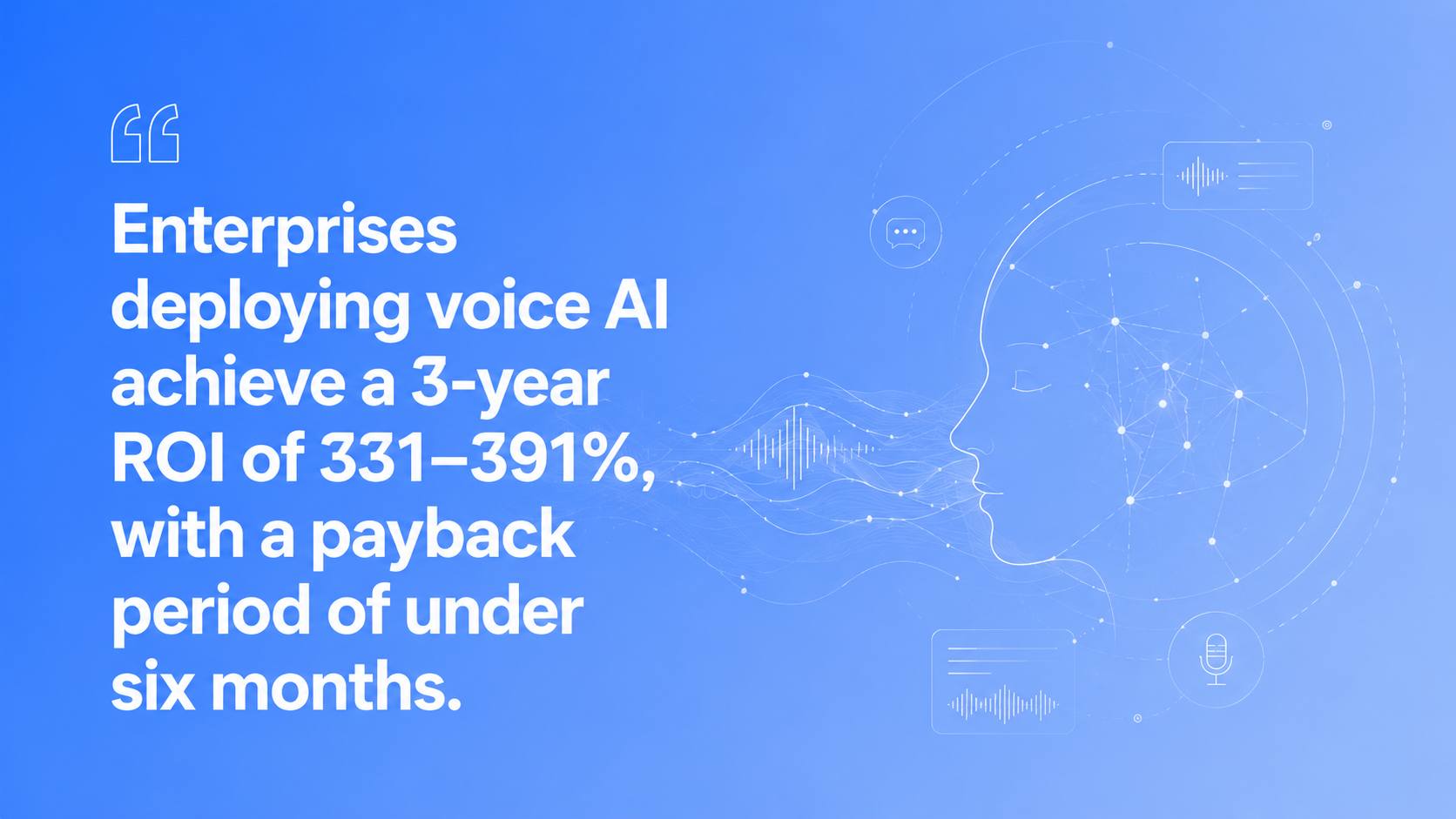
A Forrester Consulting study found that enterprises deploying voice AI achieve a 3-year ROI of 331–391%, with a payback period of under six months. One composite organisation in the study recovered $10.3 million in labour costs over three years. For a 10-person SDR team, Ailoitte’s ROI model estimates over $330,000 in recoverable annual value, before accounting for pipeline acceleration from faster qualification.
Key use cases: where AI voice agents deliver the highest ROI
The most direct ROI case. An AI outbound calling agent runs 500+ parallel calls per day, compared to 52 for a peak-performing human SDR. It handles gatekeeper navigation, delivers personalised opening lines using ICP data, manages the most common objections, drops personalised voicemails with 3× higher callback rates, and warm-transfers live prospects to closers with a 20-second brief before handoff. No hold music. No voicemail inbox to manage. No end-of-day fatigue.
Inbound lead qualification
Form fills are the highest-intent signals in your funnel, and the ones most commonly fumbled. Ailoitte’s Qual Engine responds to every submission within 5 minutes, day or night. It applies BANT or MEDDIC criteria conversationally, offers available AE calendar slots in real time, books the meeting, and pushes a fully scored, transcript-backed record to CRM. Ailoitte’s Qual Engine achieves 91% BANT accuracy on the first call and qualifies 8× more leads per day than a human SDR team at equivalent list volume.
Recruiting and candidate screening
For high-volume hiring, recruiting teams spend 3+ weeks manually screening 200+ candidates per role. An AI calling agent reaches every applicant within hours of application, runs a structured 8-minute screening interview, scores against your criteria, and delivers a ranked shortlist within 48 hours. HR teams recover weeks of calendar time and refocus energy on offer negotiation and culture assessment, the decisions that genuinely require human judgment.
Appointment scheduling across regulated industries
Healthcare, real estate, and financial services each have high-frequency, compliance-sensitive scheduling workflows that are well-suited to AI voice agents. In healthcare, agents handle patient callbacks, appointment reminders, and prescription follow-ups, freeing clinical staff for patient-facing work. For a detailed look at how AI is transforming healthcare operations, see our guide to AI in healthcare apps. In real estate, agents respond instantly to property enquiries and book viewings. In financial services, they handle loan pre-qualification and advisory consultations within regulatory disclosure constraints.
Customer re-engagement and renewals
Proactive outbound for churn prevention is an underused high-ROI application. AI agents can call every customer who has not engaged in 90 days, run a structured check-in, identify expansion or churn signals, and route warm upsell opportunities to account executives: converting what was a passive renewals motion into a systematic one.
Industry use-case mapping:
|
Industry |
Primary use case | Key outcome | Agent type |
|
Sales / RevOps |
Outbound cold calling | 500+ calls/day, 3× connect rate | Calling Engine |
| Recruiting / HR |
Candidate screening |
200 applicants in 48 hrs |
Calling Engine |
| Real estate | Inbound lead qualification | Sub-5-min response, demo booked | Qual Engine |
| Healthcare | Appointment scheduling | 24/7 booking, zero wait time | Qual Engine |
| Fintech / BFSI | Loan pre-qualification | 20–30% cost reduction per call | Qual Engine |
| SaaS / Tech | Expansion & upsell outreach | Pipeline from existing accounts | Calling Engine |
Already know which use case fits your business? See how Ailoitte deploys it in 4 weeks
What’s inside an AI voice agent: the 6-component stack behind every call
Non-technical readers: this section explains what each component does and (more importantly) why each one matters to your outcomes. You do not need to build any of this to understand where deployments succeed or fail.
Speech-to-text (STT): the ears
STT converts the caller’s spoken audio to text in real time, handling accents, background noise, interruptions, and filler words. Production-grade systems target under 300ms transcription delay. Deepgram and OpenAI Whisper lead enterprise deployments in 2026.
Why it matters for your business:
Transcription accuracy directly determines how well the agent qualifies. A 5% error rate in STT produces roughly the same error rate in BANT scores. Poor STT also introduces the unnatural pauses that make callers feel they are speaking with a robot. This is the single biggest trust-killer in AI voice deployments.
Natural language understanding (NLU): the intelligence
NLU understands intent, not just words. It recognises that “we’re still evaluating options” is a buying signal requiring a timeline question, not a disqualification. It also handles context across multiple conversation turns, so the agent never asks the same question twice.
Why it matters for your business:
NLU quality is the difference between an agent that qualifies accurately and one that either misclassifies good leads as cold or lets unqualified prospects through to your AEs.
LLM reasoning engine (the brain)
The LLM) GPT-4o Realtime in Ailoitte’s AI voice agent stack: generates contextually appropriate responses, applies scoring logic in real time, handles objections with scripted and generative fallbacks, and decides when to warm-transfer versus continue qualifying. Fine-tuned models can incorporate your specific product knowledge, compliance disclosures, and brand vocabulary.
Why it matters for your business:
The LLM determines how the agent handles anything outside the script. A generic model produces generic responses. A well-configured model handles your specific objections, your product positioning, and your qualification criteria without human oversight.
4. Text-to-speech (TTS): the voice
Neural TTS (ElevenLabs in Ailoitte’s implementation) converts the agent’s responses back into human-quality speech. The target for a natural-feeling AI conversation is under 500ms total round-trip latency from the moment the caller stops speaking. At this speed, callers do not notice the pause, which is the most common tell that reveals an AI on the line.
Why it matters for your business:
Voice quality is your brand on every call. A stilted or robotic voice undermines the conversation before the agent has asked a single qualification question. Invest in voice selection and pacing configuration as carefully as you invest in your human reps’ pitch training.
5. Telephony infrastructure: the pipes
Twilio and RingCentral are the standard enterprise choices for SIP trunking, PSTN routing, parallel dialling across hundreds of simultaneous lines, call recording, and warm transfer protocols. TCPA-compliant configurations restrict calling hours and manage DNC list scrubbing at the infrastructure level.
Why it matters for your business:
Telephony reliability is your uptime. A 99.9% SLA means under 9 hours of downtime per year. Anything lower on a high-volume outbound deployment means missed campaign windows and unqualified inbound leads with no callback.
6. CRM integration: where the value lands
Every call produces a CRM record: contact creation or update, full call transcript, BANT/MEDDIC score, disposition code, and next-action recommendation, pushed in real time. Native integrations cover HubSpot, Salesforce, Pipedrive, Zoho, Greenhouse, and Lever. Custom webhooks handle the rest.
Why it matters for your business:
Without CRM integration, your voice agent is a standalone tool. With it, every qualified call automatically advances a deal, triggers a follow-up sequence, and updates forecast data. This is where the operational leverage multiplies.
How to develop an AI voice agent (a 7-step guide for 2026)
Step 1) Define your use case, ICP, and success metrics
Before writing a single line of script, answer three questions precisely: Who is the agent calling? What does a qualified outcome look like in specific, binary terms? What does a successful deployment look like in 90 days?
Vague briefs produce underperforming agents. A qualification criterion like “is interested” is not scoreable. “Has a budget above $50,000, a decision in Q3, and a team of 10+ SDRs” is.
- Document your ICP in structured fields: industry, company size, tech stack signals, seniority of target contact.
- Define your qualification framework explicitly (BANT, MEDDIC, or a custom scoring matrix) with specific thresholds for each variable.
- Set KPI baselines before launch: target connect rate, qualified lead rate, meetings booked per 100 calls, and cost per qualified lead.
Step 2. Design the conversation flow
Conversation design is the highest-leverage step and the one most teams underinvest in. A well-designed flow handles the 15 most common objections explicitly, branches naturally for different ICP profiles, includes warm transfer triggers, and degrades gracefully when the agent reaches its confidence boundary.
- Map the call arc: opening → qualification sequence → objection handling → warm transfer or disposition.
- Write explicit objection branches for: “send me an email”, “not the right person”, “not interested right now”, “already working with someone”, “call me back next quarter”. Agents without these branches lose callers at the first pushback.
- Define the warm transfer script: what the agent says to the live rep in the 20-second brief immediately before handoff.
Step 3. Choose your build path
Three paths exist: build in-house, use a no-code platform such as Vapi, Bland, or Retell, or engage an outcome-based development partner. See Section 6 for a full comparison. For businesses without a dedicated voice AI engineering team, the fastest route to a production-grade, CRM-integrated, compliance-ready deployment is working with specialists like Ailoitte’s AI voice agent team, who deliver under a fixed-price model in 4–6 weeks.
Step 4. Configure the voice persona
The voice persona is your brand in audio form. Core decisions: the name the agent introduces itself with, the neural voice profile (ElevenLabs offers hundreds of options, so match it to your brand register), speaking pace, and tone calibration across call scenarios (warmer for early discovery, more direct for qualification).
- Choose a name that sounds professional but does not impersonate a specific named person, which is a regulatory best practice in most jurisdictions.
- Run persona test calls with your actual sales team. Collect structured feedback on naturalness, pacing, and register before going live.
- Configure jurisdiction-aware disclosure language: many markets now require the agent to identify itself as AI on direct request.
Step 5. Integrate telephony and CRM
This step has three parallel workstreams that should run simultaneously, not sequentially, to avoid timeline compression in later weeks.
- Telephony provisioning: secure dedicated phone numbers, configure SIP trunk with Twilio or RingCentral, set up parallel dialling capacity and DNC scrubbing, configure call recording storage.
- Webhook and event setup: map every call event (call started, qualification complete, warm transfer triggered, voicemail dropped) to a real-time webhook that fires to your CRM.
- CRM field mapping: this step requires the most business input. Decide exactly which call dispositions map to which pipeline stages, which BANT fields update which CRM properties, and which qualification outcomes trigger which automated follow-up sequences.
Allow 3–5 working days per workstream with an experienced implementation team. Rushing CRM mapping is the most common source of post-launch data quality problems.
Step 6. Test with shadow calls and accuracy benchmarking
Before touching real prospects, run 50–100 shadow calls: live calls made to internal team members playing the role of different prospect personas. Measure four things: BANT scoring accuracy, round-trip latency, fallback rate, and disposition accuracy.
A well-configured agent should achieve 85%+ BANT accuracy and under 8% fallback rate in shadow testing before going live. If either metric is below threshold, the issue is almost always in conversation design (Step 2) rather than the technology stack. Fix at the script level before adjusting the model.
Step 7. Deploy, monitor, and iterate
Go-live is not the finish line. It is the start of a compounding improvement cycle. Deployments that improve continuously share three operating habits: weekly call review sessions (listen to 10–15 calls per week, score objection handling and qualification accuracy), monthly scoring drift checks (BANT accuracy can degrade as prospect language evolves), and quarterly script A/B tests on opening hooks and key qualification questions. Ailoitte’s AI voice agent service includes supervised live deployment and a structured 6-week iteration programme as standard.
Want Ailoitte to run these 7 steps for you? The Velocity Pod model covers the full deployment.
Build vs buy vs partner: the honest comparison
This decision sets your timeline, your compliance posture, and your total cost of ownership. Here is an unvarnished breakdown of each path.

Build in-house
Building from scratch makes sense when you have a dedicated voice AI engineering team (typically 3–5 senior engineers), highly proprietary conversation requirements (regulated financial scripting, custom LLM fine-tuning on internal data), and 12+ months to invest. For most mid-market businesses, none of these conditions hold. In-house builds typically take 6–12 months, cost $500K–$2M in engineering time, and require a permanent maintenance team.
No-code platforms (Vapi, Bland, Retell)
These platforms are the right choice for fast proof-of-concept work, simple use cases with standard CRM integrations, and teams with some technical resources to manage configuration. They become a ceiling when you need complex multi-branch qualification logic, deep enterprise compliance requirements, or custom LLM fine-tuning. You also absorb platform risk: if the vendor changes pricing or deprecates a feature, your deployment depends on it.
Outcome-based development partner
The lowest-risk path for businesses that need a production-ready, enterprise-grade agent without building a permanent internal team. Ailoitte operates on a fixed-price model: you pay for a working, compliant, CRM-integrated agent, not for billable hours or the uncertainty of “it depends on scope.” Recognised consistently among the top AI-native engineering companies in India, Ailoitte deploys using senior architects, governed AI workflows, and agentic QA automation, with SOC2 Type II and ISO 27001 compliance built into every deployment from day one, not added later.
The key differentiator is risk elimination. Timeline slippage, compliance gaps, and CRM integration failures are the three most common failure modes in voice AI deployments. The Velocity Pod model is specifically engineered to prevent all three. See the Voice agent deployment framework.
| Criteria | Build in-house | No-code platform | Ailoitte Velocity Pod ✓ |
| Time to deploy | 6–12 months | 2–8 weeks | 4–6 weeks |
| Cost model | $500K–$2M+ | $500–$5K/mo | Fixed price |
| Customisation | Full: if you build it | Limited ceiling | Enterprise-grade |
| Compliance | DIY liability | Varies by vendor | SOC2 + ISO built-in |
| CRM integration | Custom build required | Native connectors | Native + custom webhooks |
| Ongoing support | Internal team burden | Vendor SLA only | Dedicated Velocity Pod |
| Go-live risk | High (timeline slips | Medium | Low) fixed-scope guarantee |
Five deployment mistakes that kill AI voice agent performance
These are the most common failure modes across deployments, and every one of them is preventable with the right preparation.
| Mistake | What to do instead |
| Vague ICP definition | Define your ICP in structured fields before writing a single script line. Tight criteria produce 85%+ BANT accuracy on call one. |
| Skipping objection design | Map the 15 most common objections explicitly. Agents that reach their confidence boundary without a branch lose callers instantly. |
| Going live without shadow testing | Run 50–100 shadow calls with internal team members before touching real prospects. Fix scoring gaps before they cost pipeline. |
| Ignoring CRM field mapping | Decide which call dispositions map to which CRM stages before integration. Post-launch remapping breaks reporting and forecast accuracy. |
| Treating go-live as the finish line | Weekly call reviews and quarterly script A/B tests are what separate compounding deployments from static ones that plateau. |
Compliance, ethics, and data privacy for AI voice agents
TCPA compliance (United States)
The Telephone Consumer Protection Act governs all automated calling in the US. Key requirements: prior express written consent for calls to mobile numbers, automated DNC list scrubbing before every campaign run, calling hour restrictions (8am–9pm local time in the recipient’s timezone), and caller ID transparency. Violations carry statutory damages of $500–$1,500 per call: making compliance a financial risk that scales with call volume.
Ailoitte’s deployments include automated consent management, real-time DNC scrubbing, and full audit trails for every call interaction as standard.
GDPR and data privacy (EU)
For campaigns touching EU residents, GDPR governs call recording consent, data residency requirements, right-to-erasure obligations for transcripts, and the legal basis for processing. Zero-data-retention architectures: where transcript data is processed and discarded without long-term storage: are the cleanest compliance posture for most B2B use cases. All Ailoitte deployments default to zero-retention processing.
AI disclosure requirements
Multiple jurisdictions now require or are moving toward requiring disclosure when a caller is speaking with an AI. Best practice (regardless of jurisdiction) is to configure the agent to identify itself as AI on direct request, and in some markets, to proactively disclose at the call opening. Ailoitte’s voice persona templates include jurisdiction-aware disclosure logic.
Security standards
Production voice agent deployments should meet SOC2 Type II and ISO 27001, with OWASP alignment for all API-connected components. Ailoitte holds both certifications across the full stack: telephony, LLM processing, CRM integration, and data storage. Every deployment is covered by a dedicated security audit pre-launch.
Measuring success. KPIs for AI voice agent performance
Outbound performance KPIs
- Connect rate: Live conversations ÷ total dials. Benchmark: 8–12% cold outbound; 20–35% warm or intent-triggered.
- Qualified lead rate: Connected calls meeting ICP and qualification criteria. Target: 15–25% depending on list quality.
- Meetings booked per 100 calls: End-to-end effectiveness metric. High-performing deployments target 3–6.
- Voicemail callback rate: Personalised drops resulting in a return call. Benchmark: 8–12%.
Qualification accuracy KPIs
- BANT score accuracy: AI-qualified leads validated as correct by a human reviewer. Target: 85%+ pre-scale; Ailoitte’s Qual Engine reaches 91% on first call.
- CRM data completeness: Call records with all required fields populated. Target: 95%+.
- False positive rate: AI-qualified leads subsequently rejected by AEs. Target: under 10%.
Technical KPIs
- Round-trip latency: Caller stops speaking → agent first word. Target: under 500ms.
- Fallback rate: Turns where the agent reverts to a scripted fallback. Target: under 8%.
- Platform uptime: 99.9% SLA minimum for any production deployment.
Business KPIs
- Cost per qualified lead (CPQL): Monthly deployment cost ÷ qualified leads delivered. Compare directly to your human SDR CPQL.
- SDR time recovered: Hours per week your human team reclaims for high-value conversations. Benchmark: 20–25 hours per SDR per week.
- 3-year ROI: Forrester benchmarks 331–391% with a payback period under 6 months.
The future of AI voice agents: Trends shaping 2026 and beyond
Emotional AI and real-time sentiment detection
Emotional AI systems now recognise frustration, hesitation, urgency, and enthusiasm in real-time speech, and adjust the agent’s tone and pacing accordingly. A prospect who sounds rushed gets a more direct qualification sequence. One who sounds uncertain gets a more consultative approach. The emotional AI market has grown from $19.5 billion in 2020 to $37.1 billion in 2026, reducing escalation rates by 25% in early production deployments.
Agentic AI: the call is just the beginning
Today’s AI voice agents handle the call. Tomorrow’s will handle everything surrounding it: researching the prospect before dialling using LinkedIn and intent data, personalising the opening in real time, booking the follow-up, drafting the post-call email, and updating the CRM record: all without human input. Gartner predicts 40% of enterprise applications will integrate task-specific AI agents by the end of 2026. Ailoitte’s clients are being built for this capability curve now, not retrofitted later. Learn how Ailoitte approaches agentic AI voice development.
Multilingual AI voice agents
Production-grade deployments in 2026 support 40+ languages with regional accent adaptation and mid-call language switching. For B2B businesses selling across South-East Asia, LATAM, or Europe, this is not a future roadmap item: it is a current deployment option that represents a step-change in total addressable market.
Voice biometrics
Passive voice biometric authentication verifies caller identity from the natural pattern of speech in the first 10–15 seconds: without challenge-response friction. For fintech and healthcare deployments, this eliminates security verification steps while improving fraud detection.
91% BANT accuracy on the first call, benchmarked across Ailoitte production deployments
About Ailoitte
Ailoitte is an AI-native engineering partner that deploys secure, enterprise-grade AI products 5× faster than traditional development firms, on fixed-price, outcome-based contracts. Ailoitte has delivered AI voice agents for lead qualification, outbound sales, and candidate screening; AI chatbots for customer service and support automation; and end-to-end workflow automation for clients across B2B SaaS, healthcare, fintech, real estate, and enterprise software. Consistently named among the top AI-native engineering companies in India, Ailoitte holds SOC2 Type II and ISO 27001 certifications and operates a zero-billable-hour, outcome-first commercial model.
FAQs
What is AI voice agent development?
AI voice agent development is the process of designing, building, integrating, and deploying an autonomous phone-based system that conducts natural two-way conversations with prospects, customers, or candidates: qualifying, booking, or routing them without human involvement. It covers speech-to-text, LLM configuration, text-to-speech, telephony provisioning, and CRM integration.
How much does it cost to build an AI voice agent?
Costs depend significantly on the development path. No-code platforms typically run $500–$5,000 per month in licensing fees. Custom in-house builds start at $500,000 and require 6–12 months of engineering time. Ailoitte’s Velocity Pod model delivers a fully integrated, compliance-ready agent at a fixed project price: see ailoitte.com/ai-voice-agent for a tailored proposal.
How long does AI voice agent deployment take?
With an experienced development partner and pre-built infrastructure, 4–6 weeks is the production timeline. Week 1–2: ICP definition, conversation design, integration scoping. Week 3–4: build, configuration, shadow call testing. Week 5–6: supervised live deployment and first iteration cycle.
Can AI voice agents handle objections naturally?
Yes. Modern agents built on GPT-4o Realtime with well-designed conversation flows handle the 10–15 most common sales objections with scripted-plus-generative responses that adapt to context. They also detect tone mid-call and adjust their approach accordingly. The quality of objection handling is determined primarily by conversation design, not the underlying model.
Is AI cold calling legal and TCPA compliant?
Yes, with correct configuration. TCPA compliance requires prior express written consent for mobile calls, automated DNC scrubbing before each campaign, calling hour restrictions, and transparent caller ID. Ailoitte’s deployments include all of these as standard, along with full call audit trails for regulatory review. EU deployments additionally comply with GDPR data processing requirements.
Which CRMs do AI voice agents integrate with?
Ailoitte’s platform offers native integrations with HubSpot, Salesforce, Pipedrive, Zoho, Greenhouse, and Lever. Real-time webhook support covers any CRM with an open API. Call transcripts, BANT scores, dispositions, and next-action recommendations sync automatically at call completion.
How do I calculate the ROI of an AI voice agent?
The core formula: (annual SDR salary × headcount × % time on non-revenue activity) × 0.8 = recoverable value. A 10-person team at $65,000 average salary spending 64% of time on non-revenue work recovers approximately $333,000 per year. Pipeline acceleration from faster qualification typically adds another 20–40% to that figure in year one.
What is the difference between an AI voice agent and an IVR?
An IVR routes callers through pre-recorded menus based on keypad input or simple voice commands. It cannot hold a conversation, handle objections, or respond to anything outside its predefined logic. An AI voice agent conducts free-form, two-way conversations, understands intent and nuance, applies dynamic qualification logic, and responds naturally to anything the caller says: including questions the designer never anticipated.

Discover how Ailoitte AI keeps you ahead of risk

Ravi Ranjan
Ravi Ranjan is a seasoned Mobile Lead specializing in Flutter, iOS, and Android development. With 8+ years of experience, he has built and scaled high-performance mobile apps used by global audiences.

Stephan is the sports journalist for the Maple Grove Report.