
Picture this: You have raised your seed round. You have a clear vision, a target market, and a shortlist of agencies. Six months later, your runway is half-gone, your competitors have shipped two iterations, and your product is still not live.
This is not a cautionary tale. It is the default experience for the majority of early-stage startups today.
According to CB Insights research, 35% of startups fail because there is no market need for their product, a problem that fast MVP validation is specifically designed to prevent. Yet most teams still spend six months or more getting to their first user.
Slow MVP development does not just cost money. It costs market position, investor confidence, and the irreplaceable window in which early movers build durable advantages.
The real issue is that the 6-month MVP is not a timeline problem. It is a methodology problem. The traditional model of hiring an agency, writing a lengthy specification, and watching developers bill hourly was designed for an era before AI fundamentally changed what is possible in software delivery.
A new class of AI-native development has emerged. At Ailoitte, we call the operational unit behind it the AI Velocity Pod. It makes a 4-week MVP not a bold promise, but a repeatable, documented outcome.
If you are a founder, CTO, or product lead deciding how to build your first product version, this guide covers everything you need to make that decision clearly.
The 6-Month MVP Problem Is More Common Than You Think
Ask any experienced founder how long their first MVP took. Honest answers are rarely flattering. Most will tell you it took twice as long as planned and cost twice as much. And the frustrating part is that most of that time was not spent building.
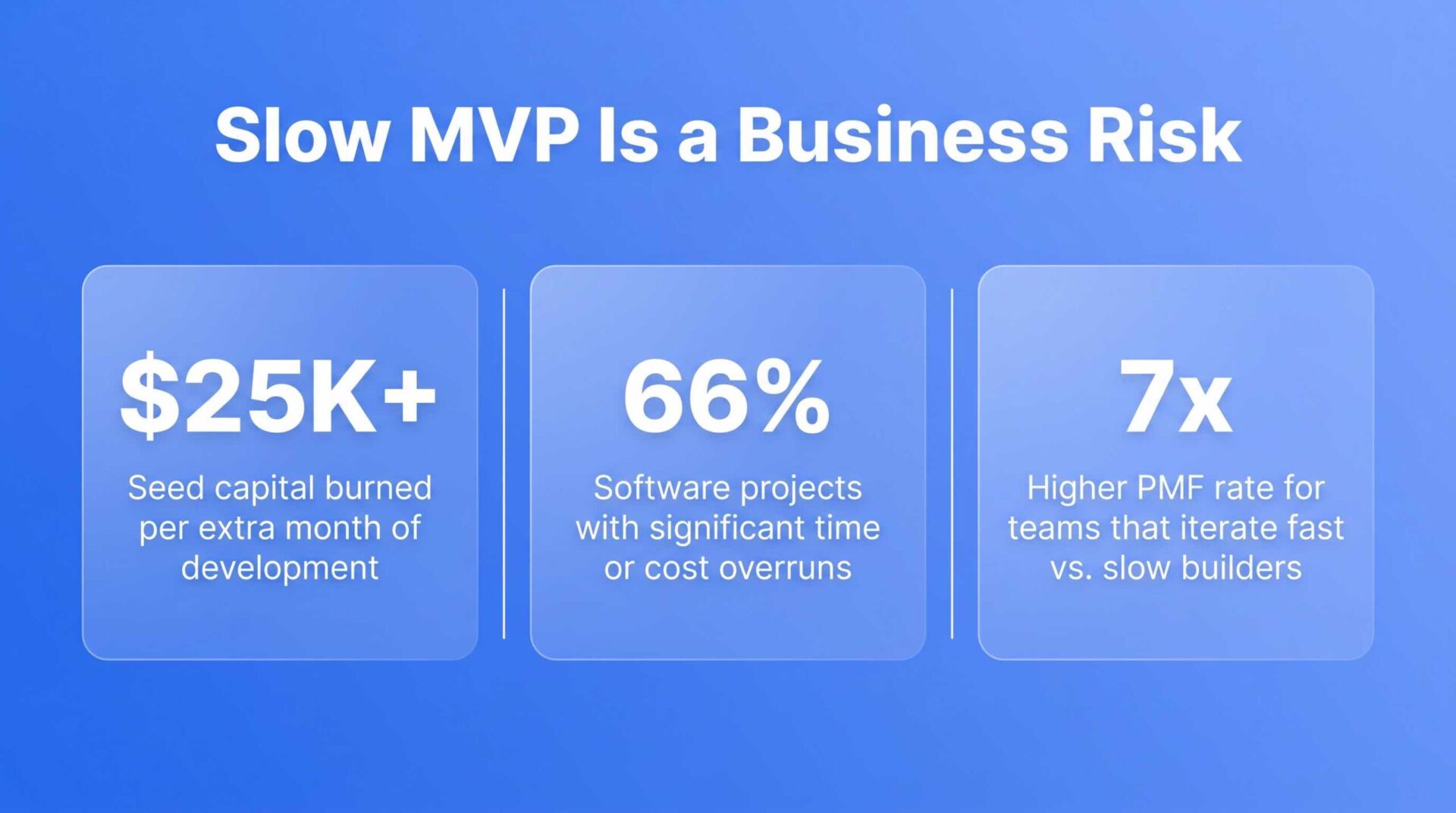
The Standish Group CHAOS Report found that 66% of software projects experience significant overruns in time or cost. For startups with limited runway, that statistic is not an academic footnote. It is an existential risk.
Here is how the typical 6-month breakdown actually looks:
- Weeks 1 to 2: Planning paralysis. Alignment meetings multiply. Scope documents go through multiple revisions. Nobody wants to commit to constraints.
- Weeks 3 to 6: Vendor selection or hiring delays. Finding the right agency takes longer than expected. NDAs, contracts, onboarding rituals.
- Weeks 7 to 16: Build cycles with constant scope creep. Every week surfaces a new essential feature. Priorities shift without a documented change process.
- Weeks 17 to 24: Manual QA cycles, revisions, and the perpetual one more feature. Launch keeps getting pushed by weeks, then months.
The uncomfortable insight is that the majority of time is lost before a single line of code is written. Planning, alignment, and vendor evaluation are not development activities, but they consume development timelines without anyone noticing.
Why a Slow MVP Is a Business Risk, Not an Inconvenience
Founders often treat a delayed MVP as frustrating but manageable. It should be framed as a business risk, because that is what it is.

The runway math is brutal
Consider a mid-range development setup: three developers billing at $10,000 per month each. A 6-month engagement burns $180,000 before a single user validates your core assumption. At that rate, each additional month of delay is not just time. It is 10 to 15 percent of a typical seed round evaporating with no market signal in return.
Markets move faster than development cycles
The venture landscape moves in weeks, not quarters. A competitor who ships in month two is collecting user feedback and iterating while you are still in planning meetings. The Startup Genome Report found that startups which iterate quickly are seven times more likely to achieve strong product-market fit. By the time a 6-month build launches, the market has moved and you are launching yesterday’s solution.
The sunk cost trap
There is a less-discussed risk that compounds the financial one. The longer you build, the harder it becomes to kill features, change direction, or admit the original assumption was wrong. Extended development cycles create emotional and financial sunk costs. Founders become attached to a product they have waited months to see. Pivoting becomes psychologically painful at exactly the moment when pivoting would save the company.
Investor confidence has a shelf life
Early-stage interest, warm introductions, and follow-up conversations do not pause while you build. A product that ships in four weeks can generate traction signals, user testimonials, and early revenue that accelerates fundraising conversations. A product still in development six months later arrives without that leverage.
What Most Teams Get Wrong About MVPs
Before understanding how to build faster, it helps to identify why so many MVPs take so long. Most of the delay is self-inflicted, driven by common misconceptions about what a minimum viable product actually is.
Misconception 1: MVP means full product with fewer features
This is the most destructive misconception in product development. An MVP built with a full product minus some features mindset still carries the architecture, QA surface, and design complexity of a complete product. It just has fewer screens. The result is a trimmed-down version of something overbuilt: still slow, still expensive, still months away.
Misconception 2: You need a full in-house team
Many founders believe that a proper build requires a project manager, designer, frontend developer, backend developer, QA engineer, and DevOps specialist all running simultaneously. In a traditional model, that might be accurate. In an AI-native model, a smaller, specialized team with the right toolchain outperforms that entire structure.
Misconception 3: More planning reduces rework
There is a version of this that holds true: good architecture matters. But extensive pre-build planning often becomes an excuse to delay commitment. The best planning happens alongside building, not instead of it. As Eric Ries documented in The Lean Startup, two-week sprints surface real constraints faster than two-month planning phases.
Misconception 4: The MVP must be polished before launch
Polish is the enemy of speed at the MVP stage. Users do not abandon products because an onboarding animation is imperfect. They abandon products because the core value proposition does not work. Launch with rough edges, learn what matters, then polish only the things users care about.
Misconception 5: Building in-house is faster than using a partner
Founders sometimes assume that hiring developers directly eliminates agency overhead. In practice, hiring takes 6 to 10 weeks, onboarding takes additional weeks, and in-house teams without AI-native tooling operate at the same speed as traditional agencies, but with more direct management overhead.
The 4-Week MVP Framework
Four weeks is not an arbitrary number. It is the window that is focused enough to prevent scope creep, long enough to build something real, and short enough to maintain the urgency that keeps teams honest.
This is the framework Ailoitte uses across its Startup MVP Velocity programme, covering SaaS platforms, D2C applications, healthcare tools, and AI-native products.

WEEK 1: Define and Architect
- Identify the single core problem being solved, in one sentence
- Senior architect maps the full system design on Day 1
- AI scaffolding generates 80% of the core database schema by Day 3
- Lock the scope document. Everything non-critical moves to the post-launch backlog
- Agree in writing on what the MVP does not include
WEEK 2: Build with AI Velocity Pods
- Specialized AI development agents generate clean API routes and frontend components
- Development stays focused exclusively on the primary user journey
- Daily check-ins catch scope additions the moment they appear
- Tech stack selected for speed and future scalability: MERN or Flutter
WEEK 3: Agentic QA
- Automated regression testing validates business logic, not just syntax
- AI agents run thousands of parallel tests without manual intervention
- Self-healing selectors adapt to UI changes automatically
- Automated OWASP security scanning integrated into every pull request
WEEK 4: Launch and Handoff
- Full CI/CD handoff: founders own the code, the keys, and the market
- Soft launch or beta release to the first 10 to 50 target users
- Complete documentation package: Swagger docs, architecture maps, deployment scripts
- 100% IP transferred with no vendor lock-in or recurring licensing fees
Meet the Engine Behind It: Ailoitte’s AI Velocity Pods
Understanding the 4-week framework is one thing. Understanding what makes it consistently possible across different product types, industries, and technical requirements is another.
What is an AI Velocity Pod?
An AI Velocity Pod is Ailoitte’s delivery unit: a structured combination of senior software architects, governed AI development workflows, and Agentic QA automation, operating as a single outcome-focused system. Unlike traditional staff augmentation, which adds hourly capacity by role, a Velocity Pod delivers against defined goals at a fixed monthly cost. The pod profits from efficiency, not from your delays.
Why a Velocity Pod is different from a traditional agency?
Traditional staff augmentation adds people by role and bills by the hour. An AI Velocity Pod is outcome-focused. Fixed-cost pods mean the team’s incentive is to ship faster, not to find reasons to extend the engagement. This is a structural difference, not a cultural one.
According to McKinsey research on large-scale IT delivery, the single biggest driver of project overruns is poorly defined scope and misaligned incentives between client and vendor. The Velocity Pod model is designed to eliminate both.

The AI-native tooling that changes the math
- Cursor IDE: Context-aware coding that eliminates boilerplate and speeds up logic implementation by 40%, allowing developers to focus entirely on business logic.
- Claude by Anthropic: Advanced architectural reasoning, complex decision analysis, and automated documentation generation at a speed no manual process can match.
- Agentic QA: AI agents that write and run end-to-end tests based on pull request descriptions, ensuring zero breakage without a manual QA cycle holding up delivery.
- VPC deployment: Secure, isolated environments for all pod activity from day one. Enterprise-grade IP protection is not an add-on. It is the default.
Why AI-Native Testing Is the Secret Weapon
Most MVPs do not fail in development. They fail in QA. Manual testing is slow, inconsistent, and easily overwhelmed by fast-moving codebases. In traditional development, a QA phase planned for one week regularly expands to four. That single bottleneck is often the difference between a 4-week MVP and a 4-month one.
What is AI native QA?
An Agentic QA Pipeline is an AI-driven quality assurance system that automatically generates test suites, maintains self-healing test selectors, runs parallel regression cycles, and integrates OWASP security scanning into every pull request. It replaces fragile, manually maintained test scripts with adaptive agents that validate business requirements continuously, not just at the end of a sprint.
What Agentic QA delivers in practice
Ailoitte’s Agentic QA Pipeline replaces four specific manual bottlenecks that inflate every traditional MVP timeline:
- Generative test authoring: AI writes comprehensive test suites from user stories or Figma designs. What previously took a QA engineer a week to script is generated in hours.
- Self-healing selectors: Selectors adapt automatically to UI changes, eliminating 99% of maintenance overhead. The fragile, break-every-sprint test suites of traditional QA are gone.
- Visual regression AI: Pixel-perfect diffing powered by computer vision catches layout shifts and rendering errors that manual testers miss even in thorough reviews.
- Security as code: Automated OWASP security scanning integrated into every pull request. Security is not a phase at the end. It is a gate at every commit.
The Result
90% faster regression cycles. Zero flaky maintenance overhead. Full edge-case coverage. These are not incremental improvements. They represent a qualitative shift in what is achievable within a 4-week delivery window.
Traditional Agency vs. Ailoitte Velocity Pod: A Direct Comparison
Numbers tell the story more clearly than claims. Here is how the two models compare across the metrics that matter to a decision maker with limited runway.
| Metric | Traditional agency | Ailoitte Velocity Pod |
| Average timeline | 6 to 9 months | 4 weeks |
| Fixed price | $120,000+ (variable) | From $24,900 |
| IP ownership | Often restricted | 100% yours, day one |
| Client mgmt load | 15+ hrs per week | 2 hrs per week |
| QA approach | Manual, fragmented | Agentic, automated |
| Billing model | Hourly billables | Fixed-price outcomes |
| Time to first commit | Weeks | 5 days |
What You Receive at the End of 4 Weeks
To be specific about what done looks like: at the end of a 4-week Velocity Pod engagement, you do not receive a prototype or a staging environment. You receive a production-ready product.
100% IP ownership, immediately
Every line of code is yours from day one. No vendor lock-in. No recurring licensing fees. No ongoing dependency on Ailoitte to make changes. This is described in detail on the Startup MVP Velocity page, including the handoff documentation that comes with every engagement.
Automated documentation ready for handoff
At the end of the engagement you receive Swagger API documentation, architecture maps, and deployment scripts. Not as an afterthought but as a contractual deliverable. Any engineer joining your team post-launch can be productive within days.
A scalable stack built for growth
Tech choices in a Velocity Pod engagement are made with the next 18 months in mind. MERN and Flutter are industry-standard stacks that developer surveys consistently rank as among the most widely used in production. Your future hires will know them. The MVP is the foundation, not the ceiling.
A product ready for what matters next
After 4 weeks you have a product ready for investor demos, user feedback sessions, early revenue conversations, and iteration sprints. Not a slide deck. Not a clickable prototype. A live product in front of real users generating real signal.
What Happens After the 4 Weeks
The MVP is the starting line, not the finish line. What you do in the weeks immediately after launch determines whether the product gains traction or stalls.
Weeks 5 and 6: gather signal, not opinions
Run structured interviews with your first 10 users. You are looking for patterns in behavior, not a wishlist of features. What are users doing that you did not expect? Where are they dropping off? What is the one thing they wish worked differently?
Weeks 7 and 8: one thing better, not ten things new
Resist the urge to build a second version of everything. Identify the single change that would most improve the core experience and ship only that. Fast teams that shipped an MVP in 4 weeks can turn a round of feedback into a new release in under two weeks.
The fundraising advantage
Teams with a live product, real users, and two or three months of iteration data walk into investor conversations with an entirely different kind of credibility than teams still describing what they plan to build. The 4-week MVP is not just a product decision. It is a fundraising strategy.
Continuing with Ailoitte after launch
Post-launch teams can continue with Ailoitte through the AI Velocity Pod subscription model, which provides sustained delivery capacity on a fixed monthly cost. This is designed for teams that need to keep shipping without rebuilding their delivery setup from scratch after each sprint.
Final Thoughts
Return to that founder from the opening. Six months in. Runway half-spent. Competitors ahead. Product still not live.
Now consider a different version of that story. Same idea. Same founder. But instead of a 6-month agency engagement, they engaged an Ailoitte Velocity Pod. Four weeks later, the product is live. Week five, they are running user interviews on a real product. Week eight, they have their first paying customer. Week twelve, they are in investor conversations with traction data in hand.
The difference is not luck. It is not cutting corners. It is methodology, tooling, and a team whose incentive is to deliver outcomes rather than accumulate billable hours.
FAQs
Can you really build a production-ready MVP in 4 weeks?
Yes, for the right scope. A 4-week MVP is realistic when the product focuses on one core user journey rather than trying to replicate a full-feature product. Ailoitte has delivered focused MVPs in this window for SaaS, healthcare, D2C, and AI-native applications. Scope, available decision makers, and integration complexity are the variables that determine the final timeline. A fixed-price estimate is available within 48 hours of a scoping session.
What does an AI Velocity Pod actually include?
A Velocity Pod includes a senior software architect, AI-augmented engineering workflows using Cursor and Claude, automated Agentic QA coverage, and DevOps infrastructure automation. It operates on a fixed monthly cost with defined delivery goals, not hourly billing. The pod manages itself and requires approximately two hours of client input per week.
What is an Agentic QA Pipeline and why does it matter for speed?
An Agentic QA Pipeline is an AI-driven testing system that automatically writes test suites, runs them in parallel, and adapts to UI changes without manual maintenance. It replaces the manual QA cycles that traditionally extend MVP timelines by weeks. By integrating QA at every commit rather than at the end of a sprint, it eliminates the bottleneck that causes most 4-week plans to become 4-month realities.
Who owns the code and IP after the engagement?
100% of the code, architecture, and documentation belongs to the client from day one. There is no vendor lock-in, no recurring licensing requirement, and no restriction on moving development in-house or to another partner after handoff. Full IP transfer is a contractual condition of every Ailoitte MVP engagement.
How much does a 4-week MVP cost with Ailoitte?
Ailoitte uses fixed-price, outcome-based delivery. A focused MVP with 4 to 6 core features starts from $24,900. Complex MVPs with custom AI features or regulated compliance requirements range from $40,000 to $90,000. A detailed proposal is available within 48 hours of a one-hour scoping session.
What types of MVPs does Ailoitte build?
Ailoitte has delivered MVPs across SaaS platforms, healthcare and HIPAA-compliant tools, D2C and marketplace applications, fintech platforms, and agentic AI applications using LangChain and vector database integrations. Pre-built accelerators for telemedicine, D2C commerce, and AI tooling reduce scope and timeline further for these verticals.

Discover how Ailoitte AI keeps you ahead of risk

Sunil Kumar
Sunil Kumar is CEO of Ailoitte, an AI-native engineering company building intelligent applications for startups and enterprises. He created the AI Velocity Pods model, delivering production-ready AI products 5× faster than traditional teams. Sunil writes about agentic AI, GenAI strategy, and outcome-based engineering. Connect on
LinkedIn

Stephan is the sports journalist for the Maple Grove Report.