As Minnesota looks to ban prediction markets, regulatory gray areas arise


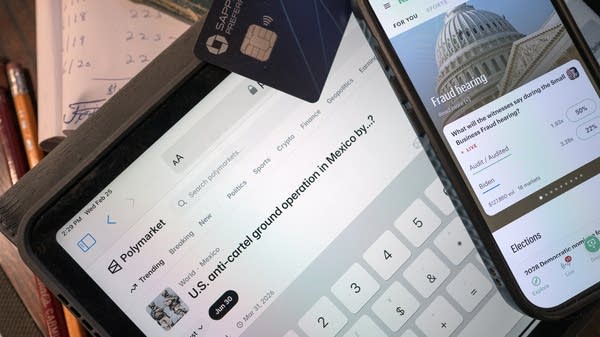
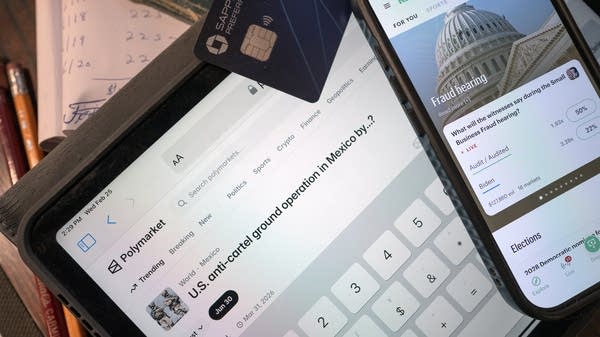
Kalshi and Polymarket on a user's browsers

A state Democratic lawmaker running for Congress apologized for placing a wager on himself that he'd win his party primary.

State Sen. Matt Klein of Mendota Heights said he wagered $50 in an online prediction market last October. The platform Kalshi flagged it as a political insider trading, penalized Klein $540 and banned him from the platform for five years.

This situation is one of the many ethical conversations around prediction markets. At the State Capitol there's a bill looking to ban them. Minnesota Alcohol and Gambling Enforcement director Jon Anglin's job is to regulate this market.

He spoke to Minnesota Now host Nina Moini to talk about the challenges around regulating prediction markets.

The following was edited for length and clarity. Use the audio player above to listen to the full conversation.

What is a prediction market?

A prediction market is basically the stock market for real world events, anything from sports to weather. I could choose how many times I'm going to say ‘um’ through this interview. So if I say ‘um,’ 12 or more times, I could put that on a prediction market. Let's say 70 percent of the population said yes, I'm going to say ‘um’ over 12 times, you're going to pay 70 cents on the dollar. And if I do under 12, they're going to pay 30 cents on the dollar.

Traditional sports wagering is only on sports, where the house picks the odds.

Prediction markets went from $9 billion in 2024 to over $60 billion global volume in 2025, which is just explosive. It's easy to use.

What makes it hard to regulate?

A lot of these prediction markets have registered with the Commodities Futures Trade Commission. They're the ones that say, “OK, prediction markets are securities, and so therefore they cannot be regulated by state gambling laws.

Because of that, that's where the big fight is coming in between the federal government and the states like Nevada, Massachusetts and Tennessee. And they've all been already in court trying to say the states have been saying we need to regulate the gambling.

What would a responsible prediction market look like?

It's really hard, because no one has regulated it as of yet, and we're still finding things out as we go through this. And I think it would be easier to answer that question once we have all the facts on what it is, and how it all works, and what it can do to the public. Because how do you handle insider trade information?

And I think that that's going to take some work, and that's not something easily we can figure out how we would handle if it was regulated. A ban on it is easier than regulating.

Source link

Leave a Reply

Subscribe to Our Newsletter

Get our latest articles delivered straight to your inbox. No spam, we promise.

Recent Reviews


A Republican lawmaker charged in an alcohol-related driving offense won’t have to appear in court again until after the Legislature adjourns for the year.

A June 10 arraignment hearing is set for Rep. Elliott Engen, a Lino Lakes Republican who faces three misdemeanor charges following an arrest early Friday. He was stopped for speeding and other infractions in White Bear Lake; officers detected alcohol and he later tested well above the legal limit for driving, according to a citation.

Engen has apologized for a lapse in judgment; he promised to learn from his actions and “do better.” Aside from being a second-term legislator, he is also a candidate for state auditor.

A second lawmaker, GOP Rep. Walter Hudson, was in Engen’s truck at the time of the stop and an open bottle of alcohol was found in a rear seat. Hudson, a second-term legislator from Albertville, was in possession of a permitted handgun, which could cause him legal problems if he is determined to have been intoxicated.

Police officers wrote in their report that Hudson disclosed he had the gun as the truck was being searched. The report said police took the firearm for safekeeping and said he could pick it up at a later time, which Hudson agreed to.

“I regret the poor decisions that were made during this incident, and commend the White Bear Police Department for their professional response,” Hudson said in a written statement. “I’m grateful that no harm was done to ourselves and others.”

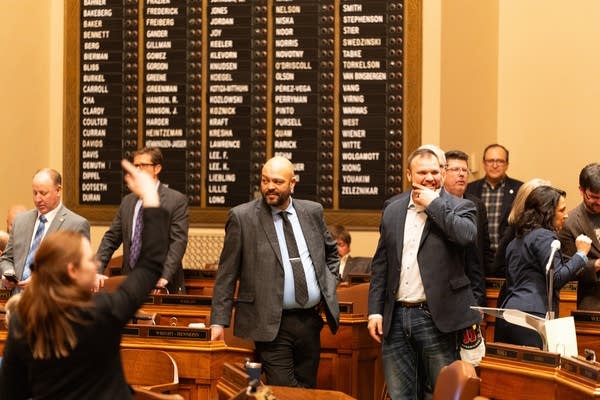
Two lawmakers stand and look around
Rep. Walter Hudson, R-Albertville, (center) and Rep. Bidal Duran, R-Bemidji, (right) join other Republican lawmakers gather in the House chambers Jan. 27, 2025.
Tim Evans for MPR News file

A third, unidentified passenger was in the truck as well, according to police. Hudson and that person were transferred to the police department until they could arrange rides.

The Minnesota lawmakers had been at the Capitol late into the evening Thursday as the House debated procedural motions on gun, immigration and social media legislation. The motions failed on 67-67 votes.

There is no indication yet that either Hudson nor Engen had been drinking on Capitol grounds, which would be a violation of a House rule against consumption of alcohol or drugs in spaces under that chamber’s control.

According to a White Bear Lake Police report, Engen initially said he had not been drinking when asked by the police officer who pulled him over — “nothing at all,” he is quoted as saying. He performed a field sobriety test, which the report says showed signs of impairment.

Engen gave a preliminary breath sample there, the report says, which estimated a 0.142 blood alcohol level. After he was taken by squad car to the police department “Engen spontaneously stated, ‘Sir, I had a drink three hours ago,’” the report says.

He told the Minnesota Star Tribune in an interview Monday that he had also consumed alcohol in the afternoon on Thursday as well.

Engen is charged with two impaired driving offenses and speeding. White Bear Lake police also said he was driving a vehicle with expired registration and an inoperable headlight.

Engen has not returned calls from MPR News. A court docket lists a “notice of appearance” on Tuesday.

He is being represented in the criminal case by Chris Madel, an Excelsior attorney who waged a brief Republican campaign for governor.


Source link