Astronauts return home. What’s next?


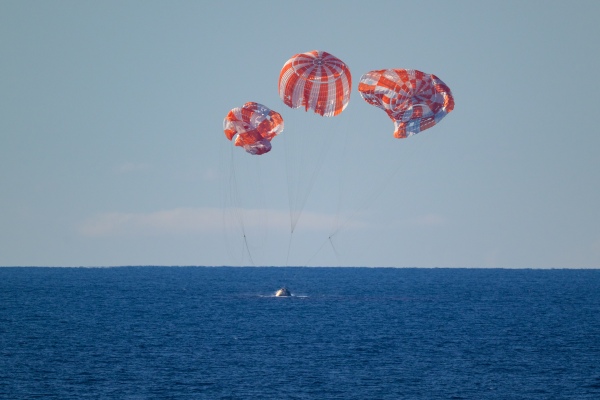
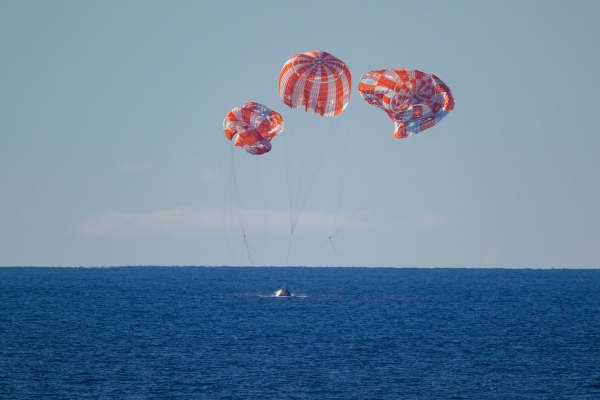
The Artemis II crew — NASA astronauts Reid Wiseman, Victor Glover, and Christina Koch as well as Canadian Space Agency astronaut Jeremy Hansen — splashed down in an Orion space capsule Friday after a 9-day mission to the moon and back.
Bill Ingalls | NASA

The crew of NASA's Artemis II mission are safely back on Earth after a nine-day mission took them on a trip around the moon and back, sending humans deeper into space than ever before.

To come home safely, the crew — NASA's Reid Wiseman, Victor Glover, Christina Koch, and Canadian Space Agency astronaut Jeremy Hansen — and its capsule had to endure near-record-breaking entry speeds and temperatures up to 5,000 degrees Fahrenheit.

The Orion spacecraft spent 13 and a half minutes falling through the atmosphere, hitting a top speed of more than 30 times the speed of sound.

Orion performed as designed. The capsule's heat shield protected the crew, and a series of parachutes helped the capsule gently splash down in the Pacific Ocean off the coast of San Diego.

With that landing, the mission came to a close, clocking more than 700,237 statute miles, said Artemis II entry flight director Rick Henfling.

Four members of the U.S. Navy Dive team pulled the crew from the capsule. Helicopters plucked them from a raft outside their spacecraft — called the porch — and within 24 hours of splashdown, they'll arrive at the Johnson Space Center in Houston.

"We did it. We sent four amazing people to the moon and safely returned them to Earth for the first time in more than 50 years," said NASA's Lori Glaze, who leads the Artemis programs. "To the generation that now knows what we're capable of: Welcome to our moonshot."

The crew's flight path took them around the far side of the moon at around 4,000 miles above the surface.

The crew made a number of geological observations and took thousands of photos to help scientists better understand what the moon is made of – and where it might have come from.

But perhaps the most profound vantage point came from looking back at home.

"Trust me, you are special, in all of this emptiness," said Glover, "This is a whole bunch of nothing, this thing we call The Universe. You have this oasis, this beautiful place that we get to exist together."

The Artemis II mission was a critical test flight for the Orion spacecraft, which will carry future Artemis astronauts, including those that will venture to the lunar surface.

The crew tested key systems of the spacecraft — its life support system, maneuverability, its heat shield, the toilet. What NASA learns from this flight will set future lunar missions up for success.

"Part of our ethos as a crew, and our values from the very beginning were that this is a relay race," said Koch "In fact, we have batons that we bought to symbolize physically, that we plan to hand them to the next crew, and every single thing that we do is with them in mind."

That next crew will come soon. NASA administrator Jared Isaacman accelerated the Artemis program, charging the agency with launching an Artemis mission each year.

Even before the Artemis II crew splashed down, work had begun at the Kennedy Space Center in Florida to prepare for the next mission.

NASA engineering operations manager John Giles oversees the Crawler-Transporter, the massive vehicle that moves the mobile launch pad, and the SLS rocket that launches Orion, from the Vehicle Assembly Building to the launch site. His team is preparing to move the launch platform for Artemis II back into the Vehicle Assembly Building next week to begin putting together the rocket for Artemis III.

"We really haven't had too much time to relax and reflect on Artemis II, other than thinking what a perfect accomplishment it was," said Giles. "Moving right into Artemis III. No rest for the weary. It's moving on."

A key part of the Artemis III SLS rocket — the core stage fuel tank — is heading to Kennedy Space Center later this month. Parts of the solid rocket motors are already there.

Artemis III aims to launch next year. It'll stay in Earth orbit while testing spacecraft that are designed to land humans on the moon. The following mission, Artemis IV, could bring humans to the lunar surface, for the first time since 1972.

Copyright 2026, NPR


Source link

Leave a Reply

Subscribe to Our Newsletter

Get our latest articles delivered straight to your inbox. No spam, we promise.

Recent Reviews


A Republican lawmaker charged in an alcohol-related driving offense won’t have to appear in court again until after the Legislature adjourns for the year.

A June 10 arraignment hearing is set for Rep. Elliott Engen, a Lino Lakes Republican who faces three misdemeanor charges following an arrest early Friday. He was stopped for speeding and other infractions in White Bear Lake; officers detected alcohol and he later tested well above the legal limit for driving, according to a citation.

Engen has apologized for a lapse in judgment; he promised to learn from his actions and “do better.” Aside from being a second-term legislator, he is also a candidate for state auditor.

A second lawmaker, GOP Rep. Walter Hudson, was in Engen’s truck at the time of the stop and an open bottle of alcohol was found in a rear seat. Hudson, a second-term legislator from Albertville, was in possession of a permitted handgun, which could cause him legal problems if he is determined to have been intoxicated.

Police officers wrote in their report that Hudson disclosed he had the gun as the truck was being searched. The report said police took the firearm for safekeeping and said he could pick it up at a later time, which Hudson agreed to.

“I regret the poor decisions that were made during this incident, and commend the White Bear Police Department for their professional response,” Hudson said in a written statement. “I’m grateful that no harm was done to ourselves and others.”

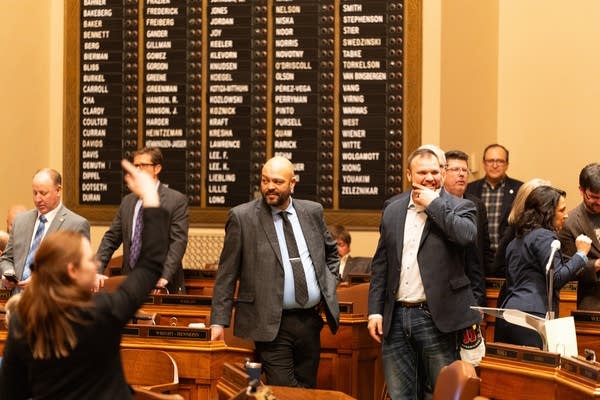
Two lawmakers stand and look around
Rep. Walter Hudson, R-Albertville, (center) and Rep. Bidal Duran, R-Bemidji, (right) join other Republican lawmakers gather in the House chambers Jan. 27, 2025.
Tim Evans for MPR News file

A third, unidentified passenger was in the truck as well, according to police. Hudson and that person were transferred to the police department until they could arrange rides.

The Minnesota lawmakers had been at the Capitol late into the evening Thursday as the House debated procedural motions on gun, immigration and social media legislation. The motions failed on 67-67 votes.

There is no indication yet that either Hudson nor Engen had been drinking on Capitol grounds, which would be a violation of a House rule against consumption of alcohol or drugs in spaces under that chamber’s control.

According to a White Bear Lake Police report, Engen initially said he had not been drinking when asked by the police officer who pulled him over — “nothing at all,” he is quoted as saying. He performed a field sobriety test, which the report says showed signs of impairment.

Engen gave a preliminary breath sample there, the report says, which estimated a 0.142 blood alcohol level. After he was taken by squad car to the police department “Engen spontaneously stated, ‘Sir, I had a drink three hours ago,’” the report says.

He told the Minnesota Star Tribune in an interview Monday that he had also consumed alcohol in the afternoon on Thursday as well.

Engen is charged with two impaired driving offenses and speeding. White Bear Lake police also said he was driving a vehicle with expired registration and an inoperable headlight.

Engen has not returned calls from MPR News. A court docket lists a “notice of appearance” on Tuesday.

He is being represented in the criminal case by Chris Madel, an Excelsior attorney who waged a brief Republican campaign for governor.


Source link