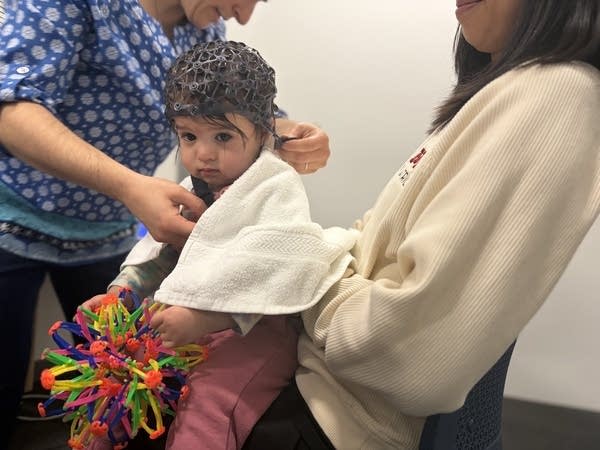
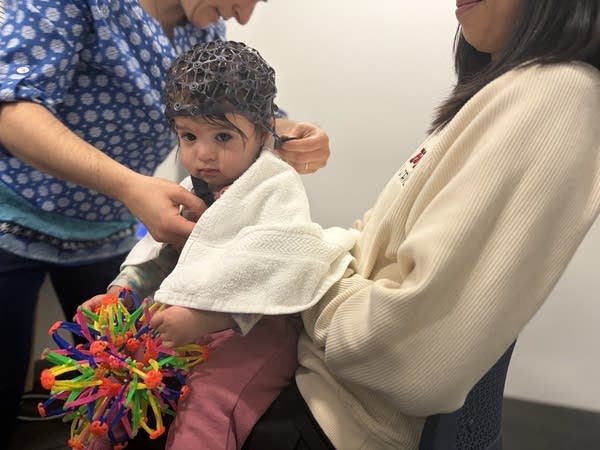
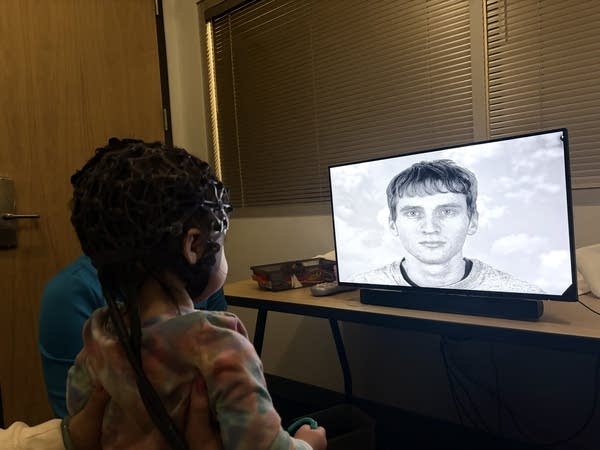
Sophie Sandin isn’t wearing a white coat, but she’s getting ready for a day in the lab. The 18-month-old, in her tie-dye shirt and pink leggings sits calmly in her moms lap while researchers fit her with an EEG cap to monitor her brain waves.
“You get to wear the special hat!” Emmy Higgs Matzner, manager of the University of Minnesota Child Brain and Perception Lab, tells Sophie, who celebrates by holding up the toy in her hand.
In this experiment, baby Sophie is shown a series of photos of men, women and made up objects. A narrator asks prompts like, “Where is the mommy?” and “Show me the daddy.” There are breaks in between so Sophie doesn’t get bored.
The researchers will look at how Sophie's brain responds to the prompts and pictures. It’s a follow up to a previous study from the lab to see how infants process language and begin to categorize people by race and gender.
Sophie’s participating in one of many studies across the University of Minnesota’s catalog of childhood research. The Institute of Child Development has 20 research labs, all studying the ways children and families and their environments relate to each other.
“We’re interested in whether at any age, and then specifically, what age do infants seem to generalize the words ‘mommy’ and ‘daddy’ to people that are not their caretakers, but also may map onto kind of the gendered, kind of stereotypical gendered category of maleness and femaleness,” said lab director Charisse Pickron.
Pickron said the research they do with child participants is slow but it gives parents an opportunity to really see what their child can do. She said society doesn’t really give babies enough credit.
“There is that sentiment that infants are these sponges,” Pickron said. “They’re just absorbing all this information, which is true, but they’re not passive. They’re not just sitting there. And so much of what infants learn and perceive and attend to, they have agency in changing what their environment does around them.”
Pickron said her students often joke that babies are smarter than adults.
“I mean, did you learn a brand new language and learn a new way to move your body in the past three months?” Pickron laughed.
93 faces, and that’s it
Another example of baby prowess from Pickron’s research: Before six months, babies can differentiate all faces, regardless of race. But by nine months and into adulthood that perception of faces narrows.
“So adults and 9-month-olds perform kind of similarly, not being able to differentiate faces of a race they're not as experienced with, and that can have kind of cascading implications for other areas of which we use faces we think about like face recognition,” she said. “I think about it in the justice system of being able to tell, did I see this person or this person in this moment?”
Exploring these implications can be helpful long-term, but these studies have a more immediate impact for caregivers, Pickron added.
“I think the research really informs the foundation of how we build our curriculum and how we imagine our relationship with children and families,” said Marie Lister, who teaches preschool children at the U’s Child Development Laboratory School.
“We really rely on our teachers to have a really deep understanding of child development, how children learn.”
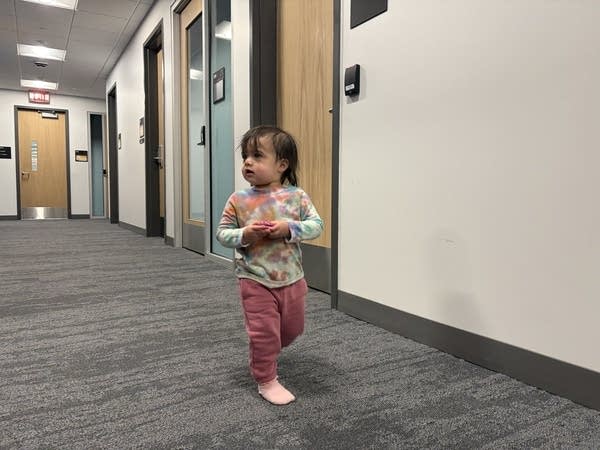
Lister said the program prides itself on using an emergent curriculum that changes as more research comes out on how children grow and perceive the world around them.
Back at the lab, the researchers only run the experiment as long as the child is willing. Sophie indicates she’s done after looking at 93 faces.
This study started a few months ago, so Sophie is one of what researchers call “pilot babies.” Sophie’s mother, Gianna Rea-Sandin, is a professor of pediatrics at the U. She’s signed up all three of her children for research studies.
“I just know the importance of participating in research,” Rea-Sandin said. “It furthers our understanding of child development — and it gets them out of the house. So it's something for us to do to have them learn and get exposed to other stuff, too. So kind of a win-win.”
Research with infants is a slow process, so it’ll be at least a year until Rea-Sandin gets to see any conclusions from today’s experiment, but she said she’s happy to lay a good foundation for her children — to appreciate science and be a part of it.