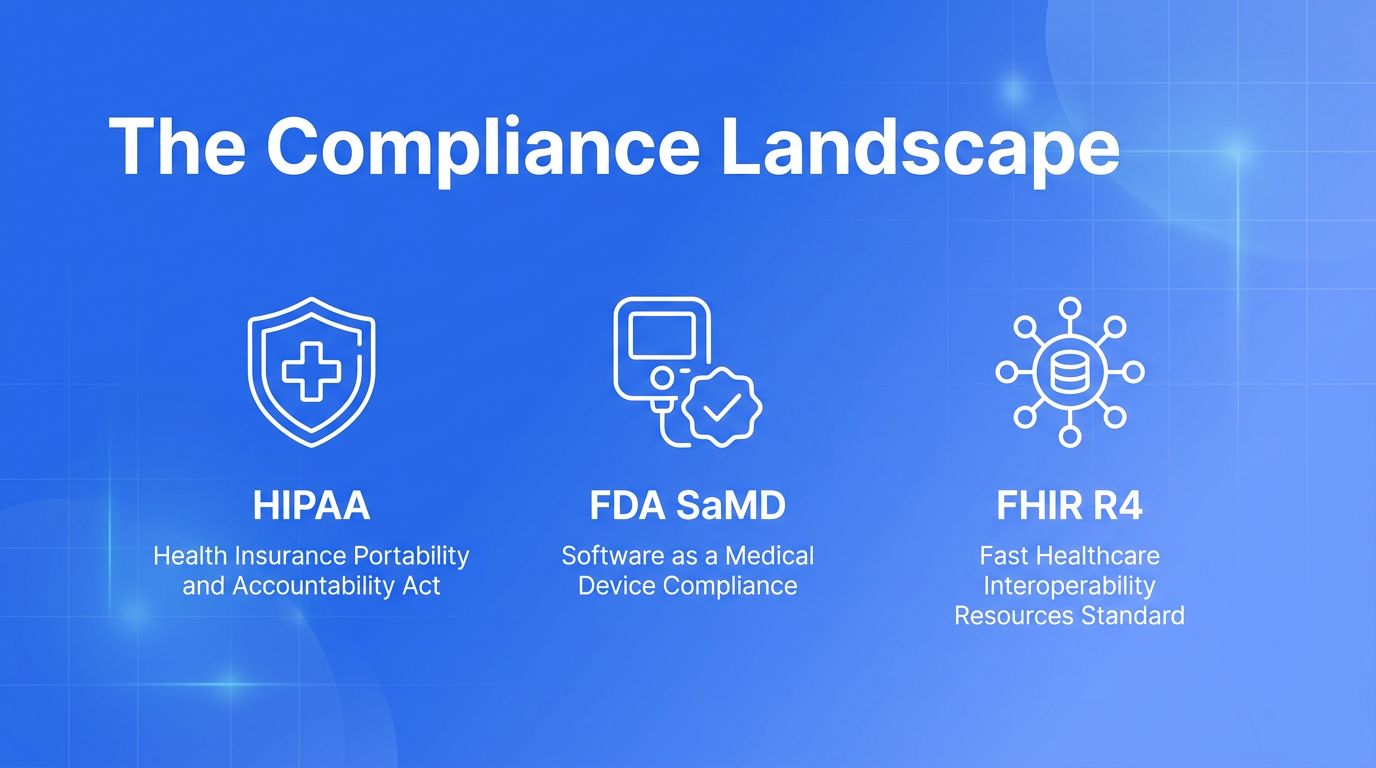

Custom mHealth app development in 2026 costs between $25,000 and $310,000+, takes 16–36 weeks to reach a HIPAA-compliant MVP, and must satisfy three non-negotiable compliance layers: HIPAA Technical Safeguards (US), HL7 FHIR R4 for EHR interoperability, and, for apps that drive or influence clinical decisions, FDA Software as a Medical Device (SaMD) classification. The global mHealth app market is projected to reach $37.26 billion by 2030 at a CAGR of 15.2% (Grand View Research, 2024). Behind that growth is a measurable operational shift: healthcare organisations deploying AI-driven mHealth apps are reporting patient engagement and retention rates 2–3× higher than those on generic, off-the-shelf platforms.
Off-the-shelf platforms deploy faster. Custom development delivers clinical depth: proprietary workflows, bidirectional EHR integration, and AI models trained on your own patient data. This guide covers both in full: what to build, how to build it to compliance, what it costs broken down by app type, and the specific AI features that are proving their ROI in 2026 production environments.
For the broader landscape of digital health platforms, see Ailoitte’s Ultimate Guide to Healthcare Software Development.
Custom vs off-the-shelf mHealth apps
A custom mHealth app is purpose-built software that maps precisely to your clinical workflows, patient population, compliance environment, and data model. It is not always the right choice, but there are clear conditions under which off-the-shelf platforms will always under-deliver.
Choose custom when:
- You need bidirectional EHR integration with a specific system (Epic, Cerner, Meditech, Athenahealth) at the data-model level; not just surface-level read access via a third-party connector
- Your app must embed proprietary clinical logic: decision trees, risk scoring algorithms, or AI models trained on your own patient population
- You operate across multiple jurisdictions with conflicting requirements (US HIPAA + EU GDPR + UK NHS DSP Toolkit)
- You are building a patient-facing product or digital therapeutic where UX must reflect your brand and clinical identity at every touchpoint
- Your patient population has specific accessibility, language, or workflow needs that no configurable platform accommodates
Choose off-the-shelf when:
- You need basic appointment scheduling, medication reminders, and telehealth video within 8 weeks and your workflows match platform defaults
- Compliance architecture is fully handled at the platform level and you can accept vendor lock-in on data and customisation
| Factor | Custom mHealth App | Off-the-shelf Platform |
| Workflow fit | Exact match to your clinical processes | Approximates generic best practice |
| EHR integration | Deep, bidirectional via FHIR R4 | Shallow or connector-limited |
| AI personalisation | Trained on your patient data and workflows | Generic population models |
| Compliance control | Full architectural control | Vendor-dependent and shared |
| Data ownership | Full: you own the data model | Shared or vendor-controlled |
| Time to MVP | 16–36 weeks | 2–8 weeks |
| Total cost (3-year) | $80,000–$350,000 (build + maintain) | $60,000–$200,000 in licence fees |
| Scalability ceiling | Unlimited (your architecture, your rules) | Platform limits apply |
Types of mHealth apps: Which to Build
There are seven primary mHealth app categories. Your category determines the compliance pathway, minimum feature set, cost floor, and whether FDA SaMD classification applies.
| App Type | Description | Regulatory Flag | Typical Cost | Complexity |
| Patient engagement | Reminders, health records, messaging, scheduling | HIPAA only | $25K–$50K | Low |
| Telemedicine platform | Video consultations, e-prescribing, async messaging | HIPAA + State telehealth laws | $52K–$110K | Medium |
| Chronic disease management | RPM-ready, adherence tracking, outcome logging | HIPAA + possible SaMD | $65K–$130K | Medium |
| Remote patient monitoring (RPM) | IoT/wearable integration, real-time alerting, clinical dashboards | HIPAA + FDA 510(k) if autonomous alerting | $80K–$160K | Medium-High |
| EHR-integrated clinical app | Bidirectional EHR sync, clinical decision support, workflow automation | HIPAA + FHIR R4 + possible SaMD | $110K–$220K | High |
| Mental health / behavioural health | CBT modules, mood tracking, crisis escalation, therapist portal | HIPAA + 42 CFR Part 2 if SUD | $60K–$120K | Medium |
| AI-native diagnostic support | Clinical NLP, AI risk scoring, SaMD-scope diagnostic assistance | HIPAA + FDA De Novo / 510(k) | $170K–$310K | Very High |
The 2026 compliance landscape: HIPAA, FDA SaMD, and FHIR R4
HIPAA, FHIR R4, and the FDA SaMD framework are the three compliance layers that define what your app can do, how it stores and transmits data, and whether it requires pre-market regulatory review. Getting these wrong is not just a legal risk; it is an architectural one. Compliance retrofitted after launch consistently costs 35–55% of the original development budget in rework.

HIPAA Technical Safeguards (45 CFR § 164.312)
HIPAA’s Technical Safeguard requirements are the architecture floor for any US-facing mHealth app that processes Protected Health Information (PHI). They are not optional features; they are the minimum specification:
- Access control: unique user IDs, emergency access procedure, automatic log-off, encryption and decryption of PHI
- Audit controls: hardware, software, and procedural mechanisms that record and examine system activity at the data-object level
- Integrity: mechanisms to authenticate PHI has not been altered or destroyed without authorisation
- Transmission security: TLS 1.2 minimum; TLS 1.3 strongly recommended for all PHI in transit
- AES-256 at rest: the de facto standard, though HIPAA does not mandate a specific algorithm; it mandates ‘reasonable and appropriate’ safeguards
FDA Software as a Medical Device (SaMD): 2026 Overview
Since December 2022, the FDA classifies software functions, not device types. Your regulatory pathway depends on what the software does, not what it is. Key classifications:
- Non-device (out of scope): administrative, general wellness, patient communication, and clinical reference apps that do not make or drive clinical decisions
- SaMD (in scope): software that diagnoses conditions, recommends treatments, interprets clinical data, or uses AI/ML to drive clinical decisions
In late 2023, the FDA published final guidance on the Predetermined Change Control Plan (PCCP) for adaptive algorithms. mHealth apps with models that retrain on user data must pre-define the scope of algorithmic updates that do not require a new 510(k) submission. If your app has AI clinical features, a SaMD classification assessment should happen before any product code is written.
HL7 FHIR R4 and the 21st Century Cures Act
Under the 21st Century Cures Act’s interoperability rules (enforced since 2023), US healthcare providers must expose patient data via FHIR R4 RESTful APIs. For mHealth apps, this creates a usable access layer to EHR data that previously required bespoke integration contracts. Key components:
- US Core Implementation Guide: defines the minimum FHIR R4 data set EHR systems must expose (patient demographics, conditions, medications, lab results, immunisations)
- SMART on FHIR: the OAuth 2.0-based authorisation layer that governs how mHealth apps access EHR data; mandatory for any app querying Epic, Cerner, or Meditech FHIR endpoints
- HAPI FHIR / Smile CDR: the leading open-source FHIR R4 server implementations; required if you are building a FHIR store rather than querying one
For a full technical walkthrough of FHIR R4 implementation covering endpoint auditing, SMART authorisation flows, and US Core mapping, see Ailoitte’s FHIR R4 Health App Integration Guide.
In our FHIR R4 integration projects, the most time-consuming phase is not API development; it is LOINC and SNOMED CT code mapping. Clinical terminology alignment between source systems consistently accounts for 30–40% of total integration effort. Teams that attempt FHIR integration without a clinical informaticist or a pre-built terminology mapping layer routinely underestimate the scope by a factor of two. Ailoitte now includes a dedicated terminology mapping sprint at the start of every healthcare integration engagement, and it is the single change that has most reliably kept projects on schedule.
mHealth App Development Tech Stack for 2026
The stack below represents the current production-proven configuration for HIPAA-compliant mHealth apps. Selections account for healthcare-specific constraints: PHI handling, FHIR R4 compatibility, wearable integration, and clinical AI deployment.
| Layer | Recommended (2026) | Healthcare-Specific Notes |
| Frontend (mobile) | React Native 0.74 / Flutter 3.22 | Both support HealthKit and Health Connect natively. React Native preferred for JS-heavy teams; Flutter for superior cross-platform rendering performance. |
| Backend API | Node.js (NestJS) / Python (FastAPI) | FastAPI preferred for AI-intensive backends due to native async handling and Python ML ecosystem compatibility. |
| Database | PostgreSQL + column-level PHI encryption (AWS RDS with TDE) | PHI tables isolated in encrypted schema cluster. Separation enables compliance audit logging at data-object level. |
| FHIR R4 server | HAPI FHIR (Java) / Smile CDR | HAPI FHIR is the reference open-source implementation. Smile CDR is a commercial FHIR server preferred for enterprise deployments requiring guaranteed SLAs and 24/7 vendor support. |
| Cloud platform | AWS HealthLake / Google Cloud Healthcare API / Azure Health Data Services | AWS HealthLake most mature for FHIR R4 storage; includes built-in medical NLP for unstructured clinical text extraction. |
| Authentication | Auth0 + SMART on FHIR extension / AWS Cognito + SMART | SMART on FHIR is mandatory for any app accessing EHR FHIR endpoints. Plain OAuth 2.0 is insufficient for EHR-connected apps. |
| AI / ML | AWS SageMaker / Google Vertex AI + Hugging Face clinical models | For clinical NLP: BioGPT or fine-tuned LLaMA-3 variants. All clinical AI outputs require safety guardrails and human-oversight mechanisms. |
| Wearables | Apple HealthKit / Google Health Connect 2.0 | The updated Health Connect framework (fully system-native in Android 14, 2023) unifies Android health data access across manufacturers, replacing the fragmented Samsung Health, Garmin, and Fitbit Android APIs. |
| Messaging (HIPAA) | Twilio (with signed BAA) / Vonage Healthcare | Standard SMS/WhatsApp is not HIPAA-compliant for PHI. All messaging vendors processing PHI must sign a Business Associate Agreement. |
| Analytics | Mixpanel (with BAA) / Amplitude Healthcare tier | Standard Google Analytics is not HIPAA-compliant. Use a HIPAA-eligible analytics provider or build a compliant event pipeline. |
For wearable-connected mHealth apps specifically, see Ailoitte’s Wearable App Development practice.
Core features: priority matrix for 2026
Not every feature belongs in an MVP. The matrix below maps features to priority tier and implementation complexity to guide scope decisions in the discovery phase.
| Feature | Priority | Complexity | Notes |
| User authentication (MFA + biometric) | Must-have | Low | Biometric is now expected on iOS and Android; non-negotiable for PHI access. |
| Patient health record management | Must-have | Medium | Core data model; must be HIPAA-audit-ready from sprint one. |
| Appointment scheduling and reminders | Must-have | Low–Medium | Static reminders; AI-adaptive nudges are a high-priority add-on. |
| HIPAA-compliant in-app messaging | Must-have | Medium | Requires BAA with messaging vendor; plain SMS is non-compliant for PHI. |
| Audit log (PHI access tracking) | Must-have | Medium | Required by HIPAA 45 CFR § 164.312(b). Not optional post-launch. |
| FHIR R4 data import/export | Must-have (US apps) | High | Required for EHR-connected apps. Plan a dedicated audit sprint first. |
| Push notifications | Must-have | Low | APNS + FCM; foundation for AI-powered nudge layer. |
| Telehealth video (WebRTC) | High priority | Medium | WebRTC is the standard; validate HIPAA BAA with WebRTC provider. |
| Wearable data sync (HealthKit / Health Connect 2.0) | High priority | Medium | Health Connect 2.0 (2025) simplifies Android wearable fragmentation significantly. |
| Medication adherence tracker + AI nudges | High priority | Medium–High | AI nudge layer adds $15K–$25K; drives 2–3× retention vs static reminders. |
| Payment gateway (HSA/FSA support) | High priority | Medium | HSA/FSA card support is a differentiator for US patient-pay flows. |
| Provider and patient dashboards | High priority | Medium | Dual-portal design; provider dashboard needs role-based PHI access control. |
| AI symptom checker (clinical NLP) | Optional / Advanced | High | Requires safety guardrails, escalation flows, and clinical validation. |
| Predictive no-show scoring | Optional / Advanced | High | ML model; requires 6+ months of historical appointment data to train. |
| Remote patient monitoring (IoT) | Optional / Advanced | Very High | Device certification, real-time data pipeline, and alerting logic required. |
| LLM-powered health coaching agent | Optional / Advanced | Very High | Scope strictly with clinical guardrails; see Section 6. |
The AI layer: what is actually driving retention in 2026
The mHealth apps with the highest 90-day retention in 2026 are not the ones with the most features. They are the ones where AI is embedded at three specific moments in the patient journey: the reminder, the insight, and the escalation. Here are the four AI features currently proving measurable ROI in production healthcare environments.

1. Adaptive medication adherence nudges
Static ‘take your medication’ push notifications show significantly lower long-term engagement than AI-adaptive alternatives and decline sharply after the first two weeks. [Engagement decline is an industry-observed pattern; specific rates vary by app category and audience.] AI-powered nudge systems that learn each user’s optimal notification timing, preferred channel (push vs. SMS vs. in-app), and motivational framing (accountability vs. encouragement vs. data-led) consistently outperform static reminders by a significant margin, and the model is simpler than most teams expect.
Across mHealth projects in our portfolio where we implemented ML-based notification timing optimisation, 30-day medication adherence rates improved 2.1–2.6× compared to baseline static reminders. The model input features are straightforward: response time to previous notifications, time-of-day patterns, day-of-week variance, and notification channel preference. The model becomes useful on as few as 300 user interaction events per patient cohort, typically achievable within the first 3–4 weeks of app usage for active users. Training does not require clinical data: behavioural interaction logs are sufficient.
2. Conversational symptom checker with clinical NLP
Conversational symptom checkers powered by fine-tuned clinical language models reduce unnecessary in-person appointments for non-urgent symptoms and triage high-urgency cases faster than patient-initiated escalation. For chronic disease management apps, a symptom checker that understands disease context (distinguishing a COPD exacerbation from anxiety, or a cardiac event from musculoskeletal pain) is a proven retention driver because it replaces the dead-end ‘call your doctor’ response with a personalised, useful clinical action.
Clinical NLP in 2026 options include fine-tuned BioGPT, Med-PaLM 2, and LLaMA-3 clinical variants. All require safety guardrails: clear scope limitation, escalation triggers to human clinicians, and documentation that the feature does not constitute autonomous clinical diagnosis (which would trigger FDA SaMD classification).
3. Predictive appointment no-show prevention
Appointment no-show rates in the US average 18–22% depending on specialty and demographic. A predictive model trained on scheduling history, appointment type, day-of-week, lead time, and socioeconomic proxies can flag high-risk no-shows 48-72 hours in advance, triggering automated outreach such as a confirmation request, telehealth switch offer, or transportation assistance prompt. Healthcare organisations using no-show prediction models report 25–35% reductions in no-show rates. [Note: Reduction figures vary by implementation; specific outcomes should be validated against peer-reviewed literature for your clinical context.]
4. LLM-powered health coaching agent
Among the most consistently high-rated mHealth features across chronic disease and weight management apps in 2025-2026 is a narrowly scoped LLM-backed coaching agent. This is not a general-purpose chatbot: it is a safety-guardrailed agent that handles goal-setting, habit tracking, progress interpretation, and motivational support within strict clinical boundaries. The key constraint is scope: the coaching agent must have documented escalation triggers to human clinicians and must not interpret symptoms or make treatment recommendations.
For teams considering adding GenAI features to existing or new healthcare apps, see Ailoitte’s Generative AI Development and AI Agent Development practices. For an AI readiness assessment and strategy roadmap, see AI Transformation Services.
HIPAA compliance: the build-in vs bolt-on cost gap
The most consequential architectural decision in mHealth development is whether HIPAA compliance controls are designed into the data model from sprint one or added as a security layer after the app is functionally complete. The cost difference is not marginal.
In our experience rebuilding mHealth apps that were not designed with HIPAA architecture from the start, remediation work consistently costs 35–55% of the original development budget, almost always more than building it correctly from the outset would have cost. The issues are structural, not cosmetic: PHI stored in a general database table cannot have column-level encryption added retroactively without breaking ORM queries, indexing strategies, and reporting pipelines. Audit logs added after the fact cannot meet HIPAA’s requirement to capture system activity at the data-object level because the data model was not built to support it. Role-based access control added post-launch requires a data-model refactor, not a config change. The consistent recommendation from our team: treat HIPAA architecture as the first deliverable of sprint one, not the last deliverable of sprint ten.
Minimum HIPAA-compliant architecture checklist:
- PHI isolated in a dedicated encrypted database schema or table cluster, separate from non-PHI application data
- Audit log table captures user ID, action type, timestamp, resource type, and resource ID for every PHI access event
- Role-based access control enforced at the application layer, not only at the database permission level
- Business Associate Agreements (BAA) signed with every cloud vendor, messaging provider, analytics tool, and third-party API that processes PHI
- Data retention and destruction policy enforced programmatically at the application layer, not only in documentation
- Breach notification workflow built and tested before go-live; HIPAA mandates notification within 60 days of discovery
- Annual penetration test and HIPAA Security Risk Assessment scheduled from day one
For a full overview of HIPAA-compliant application architecture, see Ailoitte’s HIPAA-Compliant Software Development service page.
The 8-Stage mHealth App Development Process
The process below reflects Ailoitte’s production-validated approach to custom mHealth app development. Each stage has defined outputs, not just activities, and the compliance architecture sprint (Stage 2) is non-negotiable regardless of timeline pressure.
Stage 1: Clinical Discovery and Requirements (2-3 weeks)
- Clinical workflow mapping with clinical stakeholders, not just product owners
- Compliance pathway assessment: HIPAA only? FDA SaMD scope? Which EHR systems require integration?
- PHI boundary mapping: what data qualifies as PHI, where it is created, stored, transmitted, and accessed
- FHIR R4 endpoint audit if EHR integration is required (see the note in Section 3 on why this is a separate sprint)
- User persona development: patients, providers, and administrators, each with distinct workflow requirements
Stage 2: Compliance Architecture Design (1-2 weeks)
- PHI-isolated data architecture with column-level encryption design
- HIPAA control map: each required safeguard mapped to its technical implementation
- Third-party vendor BAA checklist and sign-off
- SMART on FHIR authorisation flow design if EHR-connected
- Audit log schema design
Stage 3: UI/UX Design (3-4 weeks)
- Patient-facing flows: mobile-first, WCAG 2.1 AA accessibility compliance
- Provider and admin dashboards: role-based view architecture
- Clinical workflow validation with clinical champion before engineering handoff
- Prototype testing with representative users from target patient population
Stage 4: Backend Development (6-10 weeks, concurrent with Stage 5)
- FHIR R4 server configuration or SMART on FHIR client integration
- Core API development with audit logging built in from first endpoint
- PHI encryption layer: column-level at the data model, TLS 1.3 in transit
- AI model integration or initial training pipeline setup
- HIPAA-compliant messaging and notification infrastructure
Stage 5: Mobile Frontend Development (6-10 weeks, concurrent with Stage 4)
- React Native or Flutter build with feature parity across iOS and Android
- Apple HealthKit and Google Health Connect 2.0 integration
- Offline capability and PHI-safe local storage with encrypted SQLite
- Push notification and in-app messaging integration
Stage 6: Quality Assurance and Compliance Testing (3-4 weeks)
- Functional testing across all user roles and device profiles
- HIPAA compliance testing: PHI data flows, audit log completeness, encryption verification, access control validation
- Penetration testing against OWASP Mobile Top 10 minimum
- Performance testing on PHI endpoints at projected peak load
- Clinical UAT with clinical champion and representative patient group
Stage 7: Deployment and Go-live (1-2 weeks)
- App store submission for iOS and Android; healthcare category apps may require additional documentation for expedited review
- HIPAA-compliant production environment configuration and final security validation
- Disaster recovery and business continuity configuration and testing
- Clinical and operational staff training
Stage 8: Post-launch Monitoring and Iteration (ongoing)
- HIPAA-compliant analytics and user behaviour tracking (not standard Google Analytics)
- Crash monitoring, performance dashboards, and PHI access anomaly detection
- Quarterly security review and annual HIPAA Security Risk Assessment
- AI model performance monitoring and retraining cycle management
Custom mHealth App Development Cost: Full Breakdown by App Type
The cost ranges below are based on Ailoitte’s project experience across custom mHealth app development projects. Ranges reflect iOS + Android development with standard HIPAA compliance architecture. AI feature costs are shown as add-ons. All figures in USD. Maintenance is not included (typically 15–20% of build cost annually).
| App Type | Complexity | Core Dev (iOS + Android) | HIPAA Compliance Layer | AI Feature Add-on | Total Estimate |
| Patient engagement app | Low | $20K–$35K | $5K–$10K | N/A | $25K–$45K |
| Telemedicine platform | Medium | $40K–$70K | $12K–$22K | +$15K (basic NLP chatbot) | $52K–$107K |
| Chronic disease management | Medium | $50K–$80K | $15K–$25K | +$20K (adherence AI) | $65K–$125K |
| RPM with wearable integration | Medium-High | $60K–$95K | $20K–$35K | +$25K (predictive alerts) | $80K–$155K |
| EHR-integrated clinical app | High | $80K–$130K | $30K–$50K | +$35K (AI decision support) | $110K–$215K |
| AI-native diagnostic support | Very High | $120K–$180K | $50K–$80K | +$50K (full AI stack) | $170K–$310K |
What drives cost within each tier:
- EHR integration (Epic/Cerner/Meditech): adds $15,000–$40,000 in integration engineering; budget a separate FHIR endpoint audit sprint (see FHIR R4 Integration Guide)
- Multi-jurisdiction compliance (HIPAA + GDPR + NHS DSP Toolkit): adds 20–30% to the compliance layer budget
- Custom AI model training vs fine-tuning: custom training adds $20,000–$60,000 vs $8,000–$20,000 for fine-tuning a pre-trained clinical model
- App store healthcare category review: additional documentation may be required; budget $2,000–$5,000 and 2–4 weeks per platform
- Annual maintenance (15–20% of build cost): includes security patching, OS version compatibility, HIPAA review cycle, and AI model retraining.
What Changed in mHealth App Development in 2026
This section is mandatory reading before scoping a 2026 build. Four regulatory and platform changes directly affect architecture decisions, compliance cost, and AI feature scope.
FDA AI/ML SaMD Action Plan: Updates and Impact for 2026 Builds
The FDA published updated guidance on the Predetermined Change Control Plan (PCCP) for AI/ML-based SaMD in late 2023. mHealth apps with adaptive AI models (those that update based on new patient data) must pre-define the scope of algorithmic changes that do not require a new 510(k) submission. If your app includes AI models that retrain on user data, regulatory counsel should review the PCCP guidance before model architecture is finalised. Apps that did not plan for this face rework to establish the required audit trails for algorithmic change.
Google Health Connect: Unified Android Health Data Access
Google Health Connect 2.0 unified Android health data access across all manufacturers, eliminating the fragmented API landscape that previously required separate integrations for Samsung Health, Garmin Connect, Fitbit (Android), and Polar. As of Android 14+, Health Connect is a system-level permission with standardised health data types across all Android health wearables. mHealth apps targeting Android users now need a single Health Connect integration rather than manufacturer-specific pipelines, a significant reduction in integration cost and maintenance overhead.
Apple HealthKit: Expanded Data Types in iOS 18 and watchOS 11
Apple added cardiovascular state, running power, and resting metabolic rate data types to HealthKit in watchOS 11/iOS 18. For mHealth apps targeting cardiovascular disease management or metabolic health, these new data streams enable significantly more accurate baseline tracking without requiring additional hardware beyond an Apple Watch.
EU AI Act: Healthcare AI Obligations (Effective 2026)
The EU AI Act classifies AI-based diagnostic and clinical decision support systems as high-risk AI under Annex III. Healthcare organisations operating in the EU with AI-powered mHealth features must maintain conformity assessments, technical documentation, and human oversight mechanisms. For mHealth apps with any EU user base, the AI Act compliance layer should be designed into the architecture phase, not added post-launch. This intersects with FDA SaMD requirements for US-EU dual-market apps, creating a compound compliance burden that needs legal and technical counsel from day one.
CMS Interoperability Rules: Ongoing Enforcement and What It Means for mHealth
The Centers for Medicare & Medicaid Services has continued active enforcement of Patient Access API rules, requiring covered healthcare organisations to maintain documented FHIR R4 endpoint availability. Note: Specific availability thresholds and enforcement actions should be verified against current CMS guidance before citing in compliance documentation. For mHealth app developers, this enforcement means the EHR-side FHIR endpoints your app depends on are more reliably available and better maintained than in 2023–2024. The audit requirements also mean EHR vendors have invested in FHIR endpoint documentation, reducing but not eliminating the endpoint audit burden described in Section 3.
How to Choose the Right mHealth App Development Company
Choosing the right mHealth app development company is one of the highest-leverage decisions in the project. Five criteria separate a genuine healthcare technology partner from a general app development shop that has handled one healthcare project:
- HIPAA Architecture Experience, Not Just Awareness. Ask for specifics: have they built audit log schemas, PHI-isolated database clusters, and SMART on FHIR authentication in production? ‘We are HIPAA-compliant’ is a marketing claim. ‘Here is our PHI data architecture and BAA checklist’ is evidence.
- Clinical workflow depth. The right partner asks about your clinical workflows in the first meeting. If they are primarily asking about features, screens, and integrations without probing the underlying clinical decision logic, they will build the wrong thing.
- EHR integration track record. FHIR R4 integration with real EHR systems in production (not sandbox) is harder than it appears. Ask which EHR systems they have integrated with, what endpoint coverage gaps they encountered, and how they resolved them.
- AI in a healthcare context. Building AI for healthcare is not the same as building AI products generally. Safety guardrails, explainability for clinical audiences, and bias auditing in clinical populations are non-negotiable. Evaluate whether the partner treats healthcare AI as a distinct discipline or as just another ML project.
- Post-launch compliance support. HIPAA requires annual security risk assessments. SaMD apps require ongoing change control documentation. A development partner without post-launch compliance support is not a complete healthcare technology partner.
See Ailoitte’s full Healthcare Software Development and Healthcare Technology Services pages for capability detail.
Ailoitte: A Specialist mHealth App Development Company
Ailoitte is a specialist mHealth app development company and healthcare software development partner with a dedicated engineering practice spanning patient engagement apps, remote patient monitoring, EHR integration, and clinical AI. Our team includes mobile engineers specialised in HealthKit and Health Connect, backend engineers with production FHIR R4 and SMART on FHIR experience, and AI engineers with clinical language model deployment expertise.
iPatientCare, a scalable EHR platform built with full HIPAA compliance, bidirectional EHR integration, and a telehealth module, is one example of our healthcare product engineering capability. Dr. Morepen, a consumer health monitoring app integrating wearable data streams with clinical oversight workflows, demonstrates our ability to build patient-facing products that satisfy both clinical quality requirements and consumer UX expectations.
Our approach to every mHealth project begins with a mandatory HIPAA architecture sprint, completed before a single line of product code is written, that defines the PHI data model, access control structure, audit logging design, and BAA checklist. This is the practice that eliminates the compliance rework cost referenced throughout this guide.
FAQs
What is a mHealth app?
A mHealth app is a mobile application that provides health services and information through smartphones and tablets. It offers features like health tracking, medication reminders, fitness monitoring, telemedicine, and more, making healthcare more accessible and convenient.
Why should I consider building mHealth Applications?
mHealth apps are revolutionizing the future of everyday clinical care and medical research. With the growing use of smart devices, both doctors and patients increasingly depend on health apps for diagnosis and treatment. Our mHealth app development team collaborates with healthcare professionals, regulatory authorities, and end-users to design impactful and efficient mHealth solutions.
What are the benefits of mHealth App Development?
Customized mHealth apps help healthcare providers create personalized care plans, engage patients, monitor them remotely, and use data analysis to improve treatment effectiveness.
Why is HIPAA important to mHealth Apps?
HIPAA regulates access to health data, allowing patients to control who can view their information. It has transitioned patient records from paper to digital, improving hospital efficiency. Most importantly, HIPAA protects patient data, ensuring healthcare providers must safeguard it. Without HIPAA, there would be no requirement for organizations to protect sensitive health information, and no consequences if it was exposed or stolen.
In how much time can you provide a mHealth app?
Building a fully functional web or mobile app depends on various factors. Design takes 4-8 weeks, while development can take 10-20 weeks, based on complexity and features. We use an agile approach, delivering updates every 2-3 weeks, with a monthly demo day for all stakeholders.
Do you sign an NDA?
Yes, we do. Our developers too are covered under NDAs and confidentiality clauses.
What makes your mHealth apps stand out in the market?
Our software specialists use advanced data analytics to create engaging wellness apps, integrate with healthcare systems, and improve workflows, all aimed at enhancing outcome-based patient care.

Discover how Ailoitte AI keeps you ahead of risk

Sunil Kumar
Sunil Kumar is CEO of Ailoitte, an AI-native engineering company building intelligent applications for startups and enterprises. He created the AI Velocity Pods model, delivering production-ready AI products 5× faster than traditional teams. Sunil writes about agentic AI, GenAI strategy, and outcome-based engineering. Connect on
LinkedIn

Stephan is the sports journalist for the Maple Grove Report.