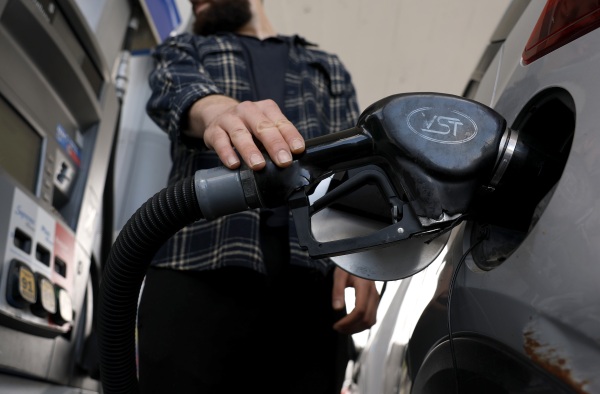
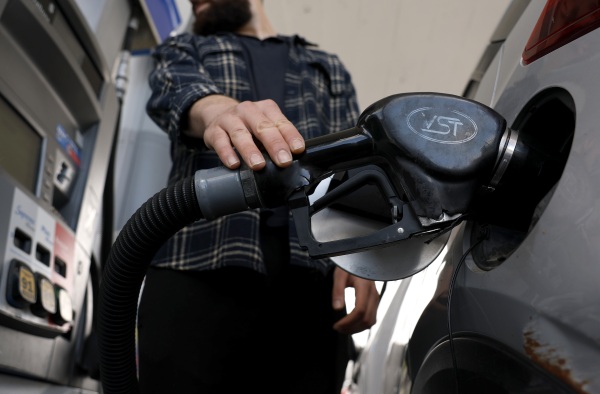
The national average for a gallon of gasoline is $4.55, according to AAA; that's a four-year high, unwelcome news for drivers as the U.S. heads into one of the busiest travel weekends of the year.
AAA estimates a record 45 million Americans will travel this weekend, despite high prices for gasoline, diesel and jet fuel.
Gasoline prices have been elevated since the start of the war in Iran, and there's no sign of relief on the horizon. High prices are angering voters and straining household budgets.
In California, which has the highest gasoline prices in the nation, Gov. Gavin Newsom is openly feuding with the oil giant Chevron, discouraging Californians from filling up at its stations.
Chevron and the state have been in a tense relationship for years; Chevron moved its headquarters out of California in 2024 after complaining about state and local regulations, and is currently buying oil shipped through an offshore pipeline that California has attempted to keep shut down. In the latest salvos, Chevron has posted placards at California gas stations blaming state policies for the high prices, while Newsom's office is telling Californians they can get cheaper gas at unbranded stations.
But where does all this leave drivers? Despite high prices, most Americans are unwilling, or unable, to give up on driving. Americans have been logging more miles since the war with Iran started, according to the analytics company Arity, which tracks driving habits.
What can you do to cut costs? We asked the experts for ideas.
Drive smoothly. Pay less
The key to getting the most miles out of each gallon is driving efficiently. That means smooth acceleration, soft braking and slowing down.
Underinflated tires, heavy boxes in the back seat and an unused ski or luggage rack on the top of the vehicle can also make it less fuel efficient.
Some high-performance vehicles require premium gasoline. But if it's only recommended, you can skip it without damaging the car, according to Consumer Reports' deputy auto editor, Jonathan Linkov. "All cars, except the most esoteric supercars or older cars, can run fine on regular," said Linkov.
Are you considering going electric?
Data suggests that higher gasoline prices have many drivers at least thinking about giving up gas-powered cars altogether.
But the data on sales isn't so clear-cut. New-EV sales are still depressed following the abrupt end of a $7,500 federal consumer tax credit last fall. It's also tax refund season, which can push up car sales of all types, compared with the previous month. CarGurus reports that used-EV sales did seem to accelerate in the month of March, and Cox Automotive reports strong prices for used EVs at wholesale auction, noting that rising gas prices "may have positively influenced demand." On the other hand, data from the sites iSeeCars.com showed no appreciable shift in used-EV sales.
It's not surprising to see a rise in shoppers' interest before a rise in actual sales, especially for a purchase as significant as a vehicle. "What consumers are viewing on the site tends to be an earlier indicator than sales," says Kevin Roberts, the director of economic and market intelligence with CarGurus.
But analysts note that high gasoline prices do motivate shoppers to select for more fuel-efficient or entirely electric vehicles — if prices stay elevated for a long time.
An average driver can save $1,800 a year
The more you drive, the more you stand to save from switching to a battery-powered car, says Janelle London, the co-executive director of a nonprofit called Coltura, which advocates against gasoline. "Across the entire U.S., an average driver doing, say, 15,000 miles a year already is going to save $1,800 a year by switching to an electric car," London says. "But if you're talking about a big driver, somebody who does maybe 25,000 miles a year, they're going to be saving on average $3,000 a year by making the switch."
And as the cost of gas keeps rising, she says, "we're seeing the savings just skyrocket up."
Coltura has an online tool that car shoppers can use to estimate potential savings from going electric.
Those savings vary based not just on how much you drive but also on where you live, thanks to differences in the local prices of gasoline and electricity. Yale Climate Connections recently published a map comparing the price of charging with the price of gasoline, by looking at the cost of enough electricity to take you as far as 1 gallon goes in a similar gas car: In North Dakota, driving an EV is like paying less than a dollar a gallon, but in California it's more like $2.70 a gallon.
Or you can crunch your personal numbers more precisely by comparing the cost per mile using your own electricity rates, local gasoline prices and the efficiency of the gas and electric vehicles you're comparing. (The extremely lazy route? Multiply your home's cost per kilowatt-hour for electricity by 10. That's very roughly comparable to how many dollars per gallon you'd pay to fuel your car. The national average cost for home electricity is $0.17 right now, so, ballpark, that's like paying $1.70 for gasoline.)
Consider factors beyond gasoline
If you're thinking of switching to an EV to save money, there are other factors to weigh as well. Maintenance savings can also be substantial — electric vehicles need new tires and not much else. On the other hand, insurance can be pricey. You might also weigh nonfinancial factors, like how much you value the environmental benefits of an EV or the merits of a quiet ride.
Charging is also crucial. Can you charge at home, which is far more convenient and affordable than charging at stations? If so, will you need to install a dedicated, higher-speed charger, which comes with an installation cost, or can you get by with a standard outlet?
The more you drive and the larger your vehicle is, the more likely it is you'll need to add a charger. The Environmental Protection Agency has a calculator that can help with that decision.
Could you get by without driving at all?
Another option, of course, is to pursue alternatives to driving.
But data compiled by the app Transit shows that ridership was steady for most of March and actually dropped slightly in the week ending April 4.
That's no surprise, says Stephen Miller, the policy lead at Transit; the Easter holiday may have pulled ridership down, and gas prices have been elevated only for a few weeks. "Historically, people only make larger changes that show up as a significant shift from driving to public transit if the price of gas goes up — and stays up," he says. Year over year, transit ridership continues to increase overall, although it has yet to fully recover from the collapse in public transit use at the start of the COVID-19 pandemic.
Jerick White, who lives in Houston, bought his first e-bike in March. There were several reasons explaining why he switched from a car to two wheels, but saving on gasoline was one of them. Between the cost of the car, maintenance and gas, he says, "it just became too unbearable, unmanageable and expensive."
He hasn't calculated exactly how much money he's saving, but, he says, it's "a lot of money for sure." One important factor in his decision: White works from home now and lives close to a grocery store and other places where he needs to run errands. Biking around "is very, very reliable if you stay in a neighborhood and you work close by," he says.
If getting an EV makes the most sense for people with the longest commutes, trading out of a car entirely is for the other end of the spectrum: people who don't drive much or take a lot of short trips. Veo, the bike and scooter app, reports that its average trip length is 1.9 miles.
If it works for your lifestyle, White says, biking has benefits in addition to savings on gas. "I feel like a kid again when I'm riding it," he says. "It's very enjoyable." And: "Oh, my goodness, I can avoid the traffic."
Spend more on fuel by cutting more elsewhere
Finally, some folks are willing to spend more at the pump — but cut back elsewhere. High fuel prices were not enough to stop Julie and Vince Rossi from taking their first cross-country road trip in their new recreational vehicle. They sold their house to live in a 22,000-pound RV full time and went on their longest road trip yet, driving from Arizona to Virginia.
Diesel costs even more than gasoline — and its price has gone up faster since the war started — so to afford their now-doubled fuel budget, they're skipping the museums and amusement parks for free attractions. "If we want to continue on this lifestyle, we either look for the lowest prices or we need to cut spending somewhere else," Julie Rossi says.
A previous version of this story ran on April 7, 2026.
Copyright 2026, NPR