The Trump Administration announced a massive reorganization of the U.S. Forest Service this week that will result in the closure of two research facilities in northeast Minnesota, including an office in Grand Rapids that leads internationally recognized projects on the impact of climate change on peatlands and northern forests.
The Grand Rapids office is one of 57 research facilities that will be shuttered across the country, more than 20 of which are part of the Northern Research Station, which spans from upper Midwest states, including Minnesota and Wisconsin into New England.
The agency’s five regional research stations will now be consolidated under a single Forest Service research organization based in Fort Collins, Colo. But other details on the closures and how it will affect ongoing research projects are scarce.
“These changes are designed to unify research priorities, accelerate the application of science to management decisions, and reduce administrative duplication,” the Forest Service said in a statement announcing the moves this week.

The restructuring is expected to take place over the next one to two years. No staff in Grand Rapids will be fired. But it’s not known how many staffers will be relocated, and where they will be reassigned.
In response to several questions requesting more details on the announced closures in Minnesota, a USDA spokesperson said “The transition will occur in phases. Employees will receive clear information about relocation timelines, available options, and resources to support their decisions.”
The announcement did not come as a big surprise to Brian Palik, a research forest ecologist who worked at the Northern Research Station in Grand Rapids for 30 years before retiring about a year ago. He said staff was told last year the agency would be reorganized to make it more streamlined.
“Having said that, it still comes as a shock, because that facility has been there for 65 years. It’s kind of a fixture in the community,” said Palik.
Palik estimates eight to 10 Forest Service scientists work there. The office also houses researchers from the University of Minnesota and the U.S. Geological Survey.

For decades researchers there have conducted long-term and large-scale experiments on wetlands and forests. Much of the research has been conducted at experimental forests within the nearby Chippewa National Forest, including the Marcell Experimental Forest, a 2,800-acre site established in 1960 to study peatland hydrology and ecology.
Having scientists physically close to the experimental forest to conduct research has been key to the facility’s success, Palik said. “It's just something that's hard to do in the same way when you're three hours away at the University of Minnesota in St. Paul,” Palik said.
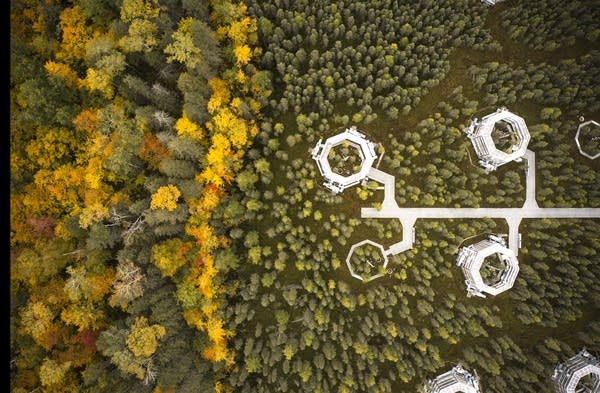
One of the best-known projects is called SPRUCE, short for Spruce and Peatland Responses Under Changing Environment.
Scientists have built 10 huge chambers in the woods near Grand Rapids where they artificially vary the climatic conditions to simulate possible future temperatures due to global warming.
Then, every day, they measure how the ecosystem is responding to warmer conditions. It’s one of the largest ecosystem-level experiments in the world.

“That project is globally recognized for the work that it's doing about how climate change may affect our forested peatland and lowland conifer ecosystems in the state,” said Eric Schenck, executive director of the Minnesota Forest Resources Council, a state organization that represents a variety of interests, from the forest products industry to environmental groups, and provides policy recommendations to state officials.
“I don't see how we can afford to lose this ongoing research,” Schenck added. “And in the absence of having Forest Service leadership, I think we're going to be hard pressed to figure out how to maintain it through our existing means and institutions.”
Palik led projects that studied what species of trees could replace Minnesota’s one billion black ash trees, which are expected to soon be wiped out by the invasive emerald ash borer.
He’s also launched a project examining how the state’s red pine forests can survive climate change, and what other species may be able to best survive in northern Minnesota in warmer conditions. It’s one of the largest studies of its kind in the world.
“And it's run out of the Grand Rapids lab,” Palik said. “It’s hard to imagine. The impact is international of the research that has and does come out of there.”

The U.S. Forest Service did not specify which research facility in Ely would be closed. The Kawishiwi Research Station there has not housed Forest Service employees for several years.
It’s currently being leased by the Northern Bedrock Historic Preservation Corps, which uses the site for hands-on training in historic preservation trades. The group says it has not been told about any potential changes at the site.
Other possibilities include a water lab that collects baseline water data on area lakes and rivers and has studied the impacts of copper-nickel mining, and a site that monitors air quality, including mercury pollution.
“The research is long-term, ongoing research on things that are important to us in northern Minnesota,” said Aaron Kania, retired former district ranger for the Kawishiwi Ranger District in Ely who’s now running for a seat in the state legislature.
“So if we were to lose that research, that baseline monitoring, it would have some pretty major implications for all the work that's happening in northern Minnesota,” Kania said.
On a national level, the U.S. Forest Service restructuring will move the agency’s headquarters from Washington, D.C. to Salt Lake City, Utah. Regional offices will also be replaced by a state-based organizational model, with the closest center to Minnesota in Madison, Wis.
The announcement indicates a research facility in St. Paul will be retained. There aren’t any expected changes for district offices or their staffing at the Superior or Chippewa National Forests in northern Minnesota.
“The Superior and Chippewa National Forests are committed to ensuring that all operations — including wildfire readiness and response — continue without interruption,” a USDA spokesperson said.