Group homes drive growth and problems in Brooklyn Park


The explosive growth of the group home industry in the northwestern suburbs of the Twin Cities is being driven largely by a relatively new licensing system overseen by the Minnesota Department of Health. And in Brooklyn Park, which has more group homes than any other city in Minnesota, those Health Department-licensed facilities appear to be responsible for an outsize number of the police calls that the city says are overwhelming its first responders.

Historically in Minnesota, group homes have been overseen by the Department of Human Services. But since 2009, there’s been a moratorium in place prohibiting the department from licensing any new group homes.

Despite the moratorium, the industry continued to grow. Providers were able to seek exemptions from the Department of Human Services or enter the industry under the auspices of the Department of Health. Today, those Health Department licenses are technically classified as “assisted living” facilities, and they have been expanding rapidly in the northwestern metro area.

About two-thirds of the group homes in Brooklyn Park are licensed by the Health Department, but even so, their impact on the city’s first responders appears to be disproportionate. The Brooklyn Park Police Department maintains a list of the group homes it responds to most often. Of the top ten facilities on the list, nine are licensed by the Health Department.

Group homes concentrated in the northwest suburbs of Minneapolis
Most parts of the Twin Cities haven’t seen the rapid growth in group homes that Brooklyn Park and other nearby suburbs have experienced.
NOTES: APM Reports and MPR News standardized MDH and DHS licensing data at the address level to determine the number of group homes with licenses that were active in 2025. Group homes with matching addresses and overlapping agencies were counted as one facility. Census data was used to estimate the number of households in Minnesota cities. Data was excluded when the margins of error exceeded 12 percent or when there were fewer than 10 group homes in a city.
DATA and MAP: Jennifer Lu

An analysis of state maltreatment investigations and police reports found that all 12 Brooklyn Park group home residents who died in the past few years were living in group homes licensed by the Health Department. In three of those cases, the state found neglect by the group home contributed to the resident’s death.

In a statement to MPR News and APM Reports, a Minnesota Department of Health spokesperson said the division’s "goal is always that Minnesota have zero deaths from maltreatment or neglect”.

“We are always open to improving relationships with our local partners,” The Minnesota Department of Human Services said in a statement.

Even the lobby groups for group home providers agree that the current system is overly complicated.

“It seems weird to have these populations served in two disparately regulated settings,” said Matthew Bergeron, a lawyer for the Residential Providers Association of Minnesota, the trade group that represents group homes licensed by the health department.

Sue Schettle, CEO of the Association of Residential Resources in Minnesota, the trade group that represents facilities licensed by the Department of Human Services, said she expects the state will eventually need to t streamline the system.

“The system right now, where there are differences in how these organizations are regulated, is puzzling to me,” Schettle said. “I would imagine at some point in time that that will be rectified and it will be tightened up.”


Source link

Leave a Reply

Subscribe to Our Newsletter

Get our latest articles delivered straight to your inbox. No spam, we promise.

Recent Reviews


A Republican lawmaker charged in an alcohol-related driving offense won’t have to appear in court again until after the Legislature adjourns for the year.

A June 10 arraignment hearing is set for Rep. Elliott Engen, a Lino Lakes Republican who faces three misdemeanor charges following an arrest early Friday. He was stopped for speeding and other infractions in White Bear Lake; officers detected alcohol and he later tested well above the legal limit for driving, according to a citation.

Engen has apologized for a lapse in judgment; he promised to learn from his actions and “do better.” Aside from being a second-term legislator, he is also a candidate for state auditor.

A second lawmaker, GOP Rep. Walter Hudson, was in Engen’s truck at the time of the stop and an open bottle of alcohol was found in a rear seat. Hudson, a second-term legislator from Albertville, was in possession of a permitted handgun, which could cause him legal problems if he is determined to have been intoxicated.

Police officers wrote in their report that Hudson disclosed he had the gun as the truck was being searched. The report said police took the firearm for safekeeping and said he could pick it up at a later time, which Hudson agreed to.

“I regret the poor decisions that were made during this incident, and commend the White Bear Police Department for their professional response,” Hudson said in a written statement. “I’m grateful that no harm was done to ourselves and others.”

Two lawmakers stand and look around
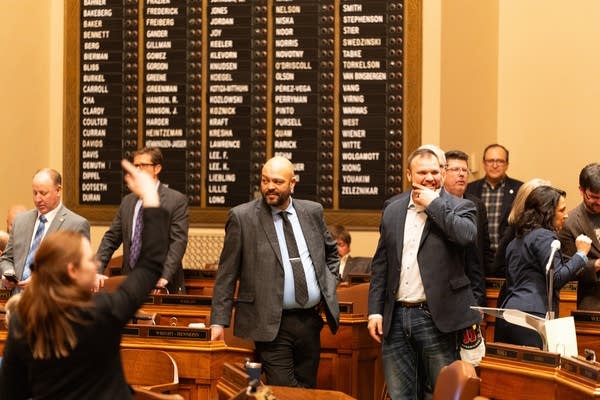
Rep. Walter Hudson, R-Albertville, (center) and Rep. Bidal Duran, R-Bemidji, (right) join other Republican lawmakers gather in the House chambers Jan. 27, 2025.
Tim Evans for MPR News file

A third, unidentified passenger was in the truck as well, according to police. Hudson and that person were transferred to the police department until they could arrange rides.

The Minnesota lawmakers had been at the Capitol late into the evening Thursday as the House debated procedural motions on gun, immigration and social media legislation. The motions failed on 67-67 votes.

There is no indication yet that either Hudson nor Engen had been drinking on Capitol grounds, which would be a violation of a House rule against consumption of alcohol or drugs in spaces under that chamber’s control.

According to a White Bear Lake Police report, Engen initially said he had not been drinking when asked by the police officer who pulled him over — “nothing at all,” he is quoted as saying. He performed a field sobriety test, which the report says showed signs of impairment.

Engen gave a preliminary breath sample there, the report says, which estimated a 0.142 blood alcohol level. After he was taken by squad car to the police department “Engen spontaneously stated, ‘Sir, I had a drink three hours ago,’” the report says.

He told the Minnesota Star Tribune in an interview Monday that he had also consumed alcohol in the afternoon on Thursday as well.

Engen is charged with two impaired driving offenses and speeding. White Bear Lake police also said he was driving a vehicle with expired registration and an inoperable headlight.

Engen has not returned calls from MPR News. A court docket lists a “notice of appearance” on Tuesday.

He is being represented in the criminal case by Chris Madel, an Excelsior attorney who waged a brief Republican campaign for governor.


Source link